
The jeep cj engine hurricane story is fundamentally a story about a single engineering decision: keep the block, change the head. That sounds modest, and in some ways it was, but the F-head Hurricane four that replaced the flathead Go-Devil in the mid-1950s solved a real problem for Willys engineers, and it did so with a design philosophy worth examining closely rather than taking on faith.
Car Features
7 min read
The Hurricane F-Head: Breathing New Life Into the Four
The F-head Hurricane four raised Jeep CJ horsepower from 60 to roughly 75 without a full redesign, a pragmatic engineering compromise worth examining honestly.
The problem the Hurricane was built to solve
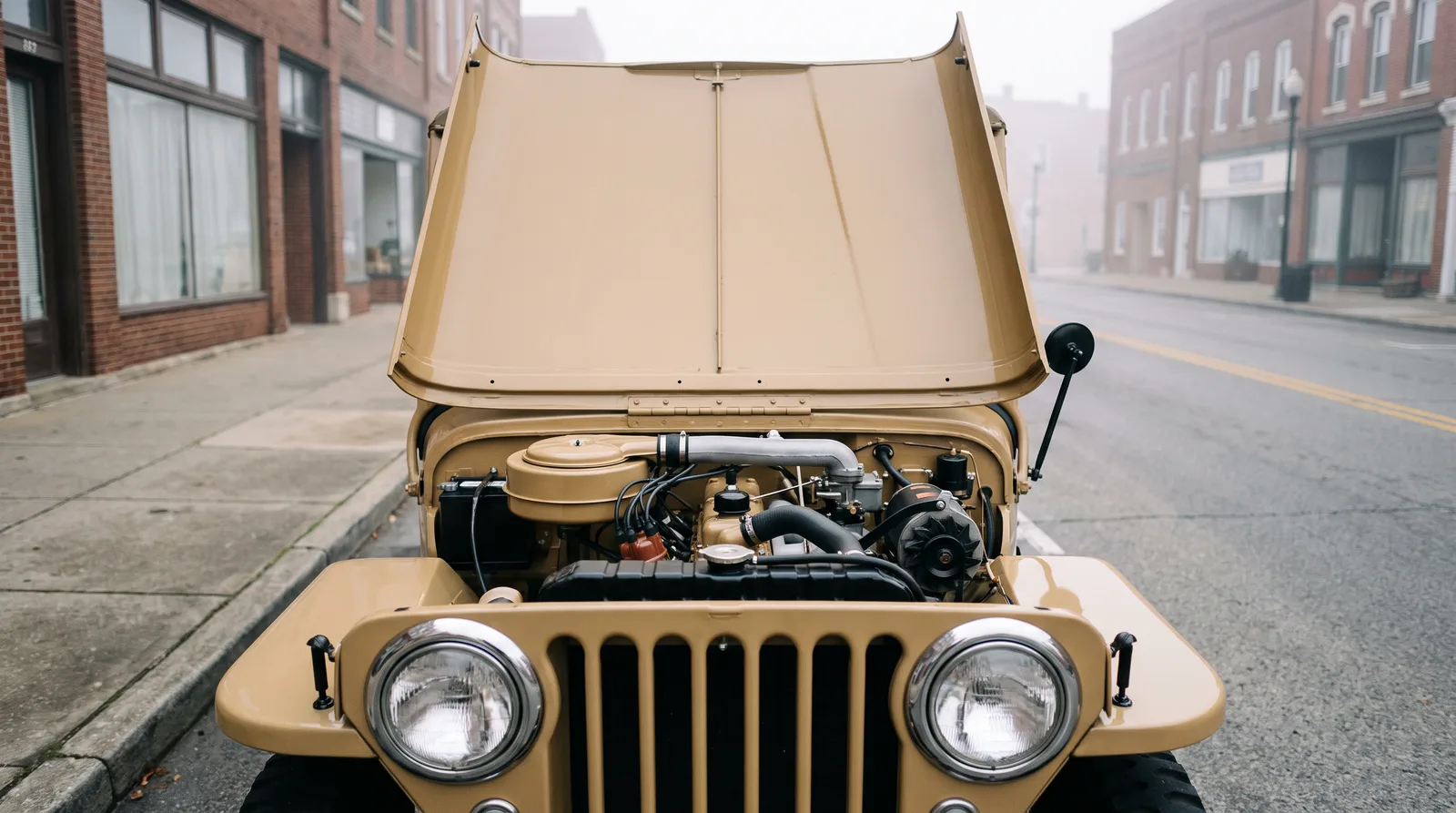
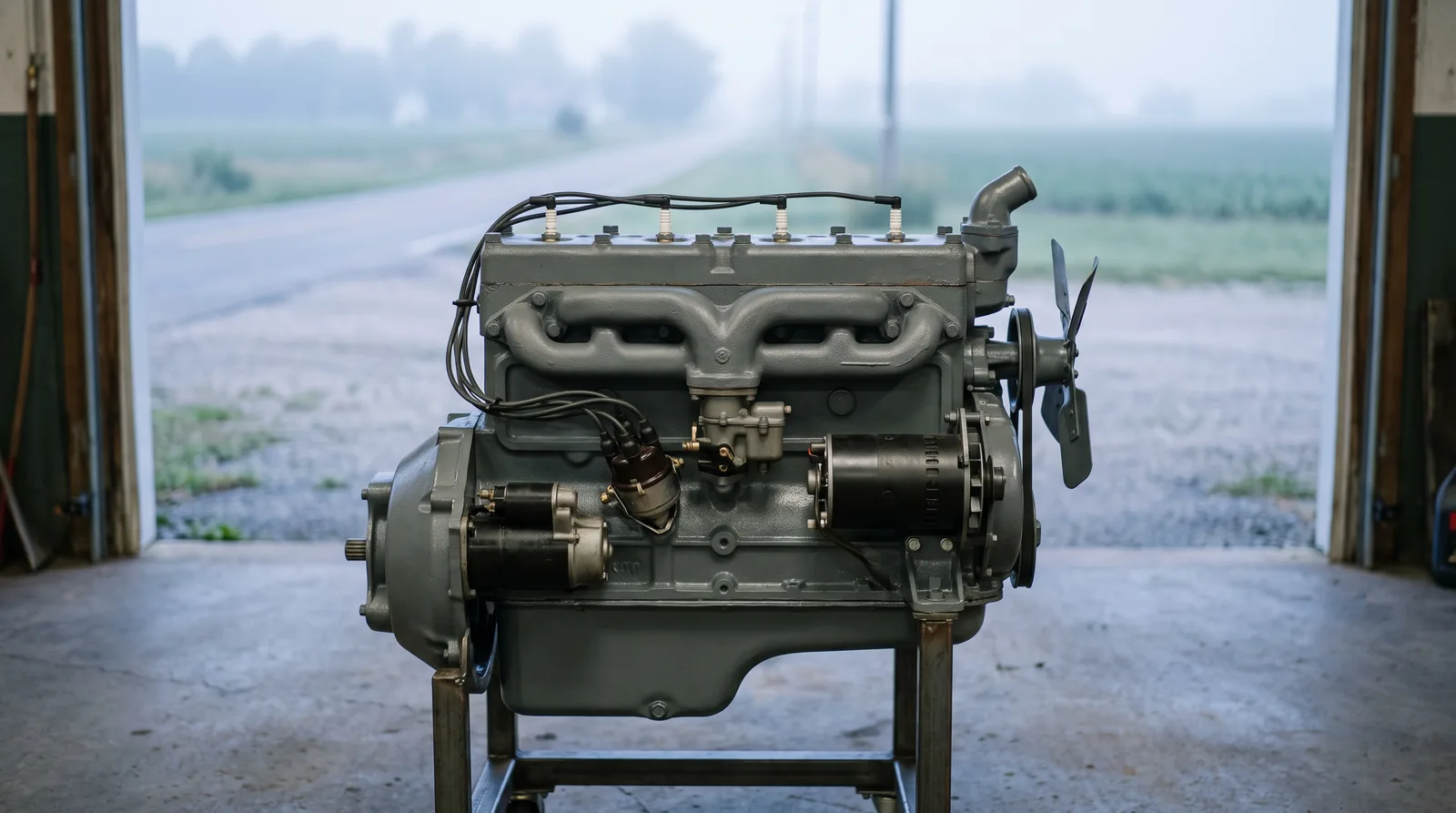
By the early 1950s, the L-head Go-Devil four that had powered the CJ line since its earliest civilian versions was showing its age. Its side-valve configuration limited breathing efficiency in a way that was well understood by engineers of the period, and postwar advances in engine design made it clear there was more performance available from the same basic displacement if the valve arrangement changed. Willys did not want to abandon the proven bottom end of the Go-Devil, which had a strong reliability track record. The engineering answer was an F-head layout: intake valves moved into the cylinder head while the exhaust valves stayed in the block, a hybrid arrangement that let engineers improve breathing without a full redesign.
This is a genuinely interesting compromise from an engineering standpoint. It is not the cleanest solution on paper, an overhead-valve or overhead-cam design would breathe better still, but it let Willys retain most of the existing tooling and manufacturing investment in the lower end while meaningfully improving output. Given the cost pressures facing Willys in that period, this was a smart, pragmatic call rather than an ideal one, and it is worth being honest about that tradeoff rather than treating the Hurricane as some kind of unqualified engineering triumph.
What the F-head layout actually delivered
The Hurricane four displaced the same basic 134 cubic inches as its Go-Devil predecessor but produced meaningfully more power, largely thanks to improved intake breathing from the relocated valves. Output climbed to roughly 75 horsepower, a real gain over the Go-Devil's approximately 60, achieved without a bore or stroke change. That is the kind of result that validates the engineering approach even if the layout itself was a compromise: a genuine, measurable improvement extracted from an existing architecture rather than a wholesale replacement.
Torque delivery also improved, giving CJ-3B and later CJ-5 models noticeably better real-world drivability, particularly at the low engine speeds where these trucks spent most of their working lives. For a vehicle whose buyers cared more about pulling a stuck implement out of mud than about acceleration off the line, that low-end improvement mattered more than the peak horsepower number suggests on its own.
An honest look at the Hurricane's limitations
It would be easy to write the Hurricane up as a straightforward win, but a fair engineering assessment has to acknowledge its downsides too. The hybrid F-head arrangement is mechanically more complex than a simple L-head, with two different valve actuation systems working in the same engine. That complexity showed up in maintenance requirements that were somewhat more involved than the dead-simple Go-Devil, a real cost for buyers who valued the earlier engine's field-serviceable simplicity above all else.
The Hurricane also remained, fundamentally, a modest four-cylinder engine competing in a market that was slowly moving toward six-cylinder power for buyers who wanted more capability. It was a genuine improvement over its predecessor, not a leap into a different performance category. Understanding that distinction matters for anyone evaluating a Hurricane-powered CJ today against later inline-six options.
| Spec | Go-Devil (predecessor) | Hurricane F-head |
|---|---|---|
| Displacement | 134 cubic inches | 134 cubic inches |
| Valve configuration | L-head (side valve) | F-head (intake overhead, exhaust in block) |
| Horsepower (rated) | Approximately 60 hp | Approximately 75 hp |
| Primary application | CJ-2A, early CJ-3A | CJ-3B, early CJ-5 |
Why this matters for the CJ story overall
The Hurricane's real significance is in what it represents within the broader arc of CJ engine development. It shows Willys engineers making a deliberate, resource-conscious decision to extract more performance from proven hardware rather than chase a clean-sheet design they could not have afforded at the time. That same pragmatic instinct shows up repeatedly across the CJ engine lineage, right through to the AMC-sourced engines that eventually powered the CJ-7. For the complete lineage connecting this engine to everything that came before and after it, our complete history traces the full sequence.
"The F-head is not an elegant solution if you're grading it against a textbook. It is an honest one. Willys engineers took what they had and made it meaningfully better without pretending to reinvent it."
- Emily Chen
Finding a Hurricane-powered CJ today
Original Hurricane engines are reasonably well documented today, and parts support has held up better than some enthusiasts expect for an engine this old, largely thanks to the CJ platform's long popularity keeping demand alive. Buyers should still expect to do real diligence on any specific engine's condition and originality before assuming a listing's claims are accurate.
Anyone shopping specifically for a CJ-3B or early CJ-5 with a documented original Hurricane four should take the time to find a classic CJ and compare available examples rather than committing to the first listing that comes up.
Identifying a genuine Hurricane in the field
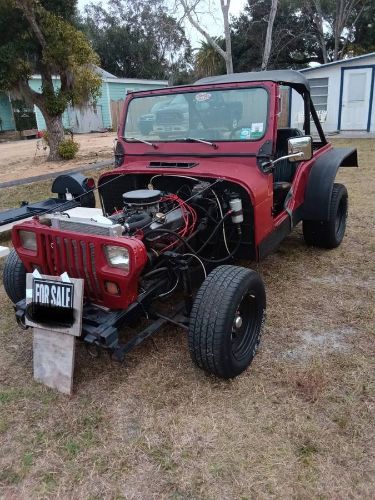
For anyone evaluating a CJ-3B or early CJ-5 today, correctly identifying whether the original Hurricane engine is still in place matters for both authenticity and value. The raised hood profile that the F-head layout required is one visible clue, but engine swaps across the CJ family were common enough over the decades that hood shape alone is not conclusive. Checking casting numbers on the block against known Hurricane specifications remains the most reliable verification method, something any serious buyer should do before assuming a listing's description is accurate.
Reliability numbers worth acknowledging
One thing an honest engineering assessment has to credit the Hurricane with is that its added complexity did not come at a meaningful cost to long-term reliability. Despite running two different valve actuation systems, well-maintained Hurricane fours have a solid reputation for durability that holds up against the simpler Go-Devil it replaced. That is not a given with hybrid designs generally, where added complexity often does translate into added failure points. Willys engineering deserves credit for avoiding that outcome here, whether through careful design or simply conservative tolerances that left margin for error.
Surviving Hurricane-powered CJs on the road today, many of them approaching seventy years old, are a reasonable data point in the engine's favor. An engine that was fundamentally fragile would not have this many working survivors still turning over on a regular basis.
A pragmatic engine for a pragmatic era
The Hurricane never gets the same attention as the six-cylinder engines that followed it, and that is understandable given how much more capable those later options were. But as an engineering case study in getting more from less, it holds up well, and it deserves credit for bridging the gap between the CJ line's flathead origins and the more powerful engines that eventually carried the platform through the 1960s and beyond.
Sources and notes
Related Reading
Have a
Jeep CJ
for Sale?
Reach thousands of serious classic car collectors across the US.
Sell It Here →
Selling a classic? Here's how: the best sites to sell a classic car
Are You a Classic Car Dealer?
List your full inventory and connect with targeted classic car buyers.
Join as a Dealer →

About the author
Emily Chen
Bay Area engineer with a deep focus on vintage Japanese and European performance cars. Approaches classic car research and restoration with an analytical eye.
Related Listings - Jeep CJ

Comments
Be the first to comment on this article.