
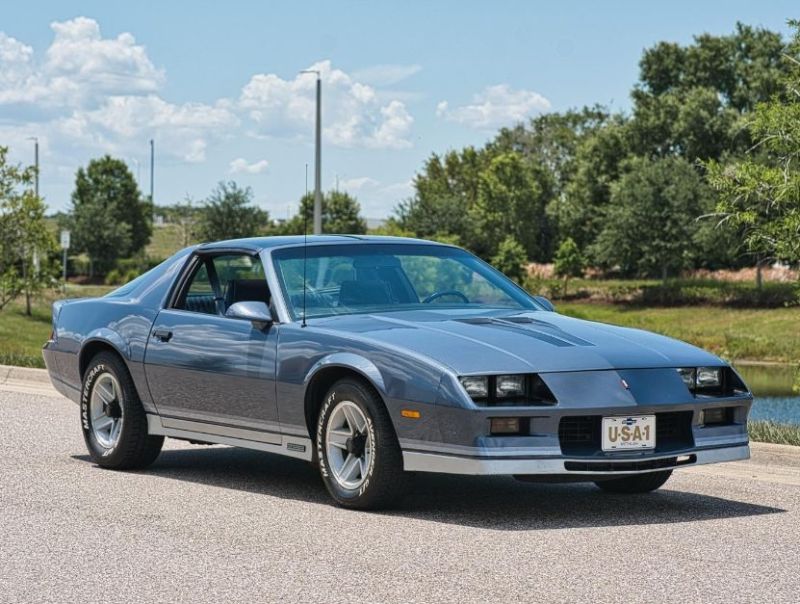
The third gen Camaro RS was the cheap seat, and Chevrolet sold a lot of cheap seats. For 1989 the Rally Sport name went back on the entry-level coupe, the car got the ground effects and the spoiler, and buyers who could not stretch to an IROC-Z drove home in something that looked close enough from across a parking lot. Most got a V6. Some got a 305. Very few got pampered. That last part is why a clean one is harder to find than the production numbers suggest.
Car Features
7 min read
The 1989 to 1992 Camaro RS
The 1989 to 1992 Camaro RS was the entry coupe in IROC-Z clothes. Engines, the short 1990 year, the 1991 facelift and what to check before buying.
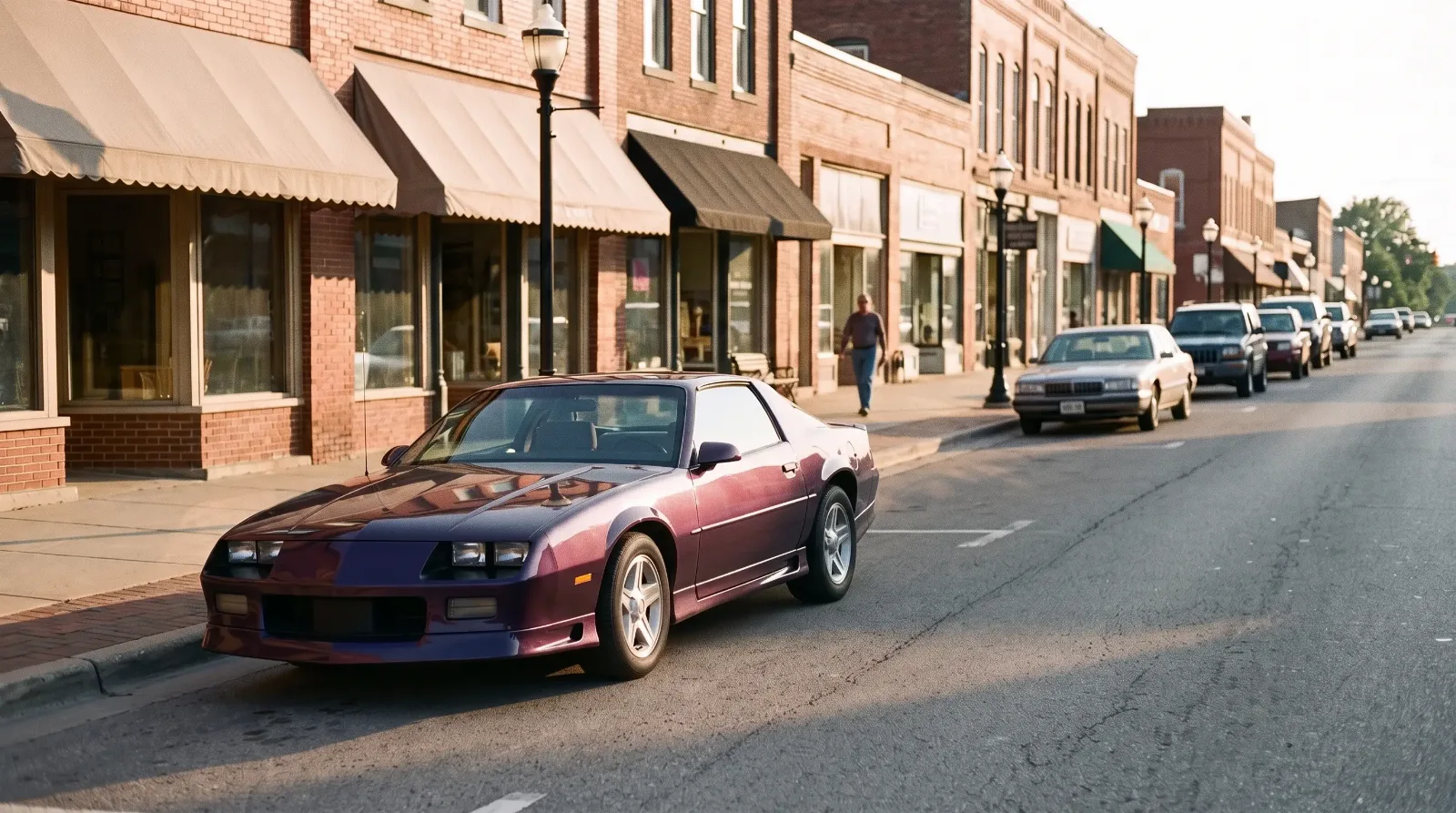
If you want the bigger picture of the platform these cars sat on, start with the downsized Camaro era. This piece stays on the RS: what it was, what it had under the hood, how it changed from 1989 to 1992, and what to look at before you hand anyone money for one.
Why the RS name came back for 1989
Rally Sport had been gone for most of the decade. Chevrolet dropped the RS for 1981, the last full year of the second generation, and the name sat on the shelf while the downsized car arrived and the IROC-Z became the hero. Then, in 1987, Chevrolet tried it out quietly. The RS name was tested in California only, on V6 cars dressed with IROC-Z appearance items.
For 1989 it went national. The RS replaced the Sport Coupe as the entry Camaro, and with the Z28 name already retired after 1987, the lineup that year was simple: RS at the bottom, IROC-Z at the top. Every one of them came out of Van Nuys, California, because Norwood had stopped building Camaros after 1987.
The recipe was paint and plastic. The RS got ground effects, a rear spoiler and blacked-out tail lamps. Nothing on that list makes a car faster. All of it makes a car look like it might be. That was the point, and honestly, it worked.
What was under the hood
Here is where the poster on the bedroom wall and the car in the driveway part ways. For 1989 the standard engine was the LB8 2.8 liter V6 at 135 hp. The option was the LO3, a 5.0 liter 305 with throttle-body injection, rated at 170 hp. The RS convertible used the LO3, so the drop-top RS was always a V8 car.
For 1990 the V6 grew. The LH0 3.1 liter V6 replaced the 2.8 and was rated at 140 hp and 180 lb-ft. That carried through 1992. Five more horsepower is not a story anyone tells at a car show, but the torque helps in traffic, which is where these cars spent their lives.
Put that next to the Z28 that came back for 1991. Its tuned port 305 made 205 hp with the automatic or 230 hp with the five-speed, and the 350 made 245 hp, automatic only. So the gap between a V8 RS and a Z28 was real. The RS was a commuter in a sport jacket, and anyone selling one as a sleeper should be asked what was done to it, by whom, and where the receipts are.
| Model year | Standard RS engine | All Camaros built | RS coupes | RS convertibles |
|---|---|---|---|---|
| 1989 | LB8 2.8 V6, 135 hp | 110,739 | 83,487 | 3,245 |
| 1990 | LH0 3.1 V6, 140 hp | 34,986 | 28,750 | 729 |
| 1991 | LH0 3.1 V6, 140 hp | 100,838 | 79,854 | 5,329 |
| 1992 | LH0 3.1 V6, 140 hp | 70,007 | 60,994 | 2,562 |
Read those columns together and the RS stops looking like a trim level and starts looking like the whole business. Add them up and roughly four of every five Camaros built in this stretch were RS coupes. That matters for buyers in one simple way: these were not rare when new, and the ones left are not rare because of the badge. They are rare because people used them up.
The 1990 short year and the 1991 facelift
The 1990 model year was short. Production ran from roughly August to December 1989, which is why the total sits near 35,000 while the years on either side cleared 100,000 and 70,000. That short run also brought the 3.1 V6 and a driver airbag.
The 1991 cars started coming down the line early in calendar 1990, and they looked different. Every Camaro got new ground effects that year. The lower valances and the rear bumper were restyled, and the middle tail lamp went back inside the hatch glass. So when someone tells you a 1991 RS has "the wrong bumper cover," check the year before you argue. The part might be exactly right.
T-tops stayed on the RS order sheet in 1991 and 1992. They are nice on a dry day and a test of your patience on a wet one, but that is true of every third gen with glass panels, not just the RS.
The strangest RS of all is one most buyers will never see. From 1991, Chevrolet built a Special Service package for police, government and military fleets. It was badged RS but sat on Z28 and 1LE hardware: heavy-duty suspension, bigger brakes, a baffled fuel tank. In 1991 the 5.0 liter version cost $3,135 over an RS and the 5.7 liter version $3,950. That car has its own story, and you can read about the B4C police car separately. For this article the point is simple: an RS badge on a third gen does not, by itself, tell you what is underneath.
For 1992 any Camaro could take the 25th Anniversary Heritage package, RPO Z03, for $175. The RS could also be painted Polo Green II Metallic that year.
Buying a third gen Camaro RS today
Start with the money, because that is where the trouble usually starts. In 1992 an RS coupe had a base price of $12,075. A Z28 coupe was $16,055. That is nearly $4,000 of difference when new, and the market has not forgotten it. A 1991 Z28 with the tuned port 305 and an automatic sold for $12,038 with no reserve on Hagerty Marketplace, as of September 1, 2026. Use that as a yardstick. An RS asking Z28 money needs a very good reason, and "only 60,000 miles" is not one.
"Nobody restored an RS in 1998. They put tires on it, drove it to work, and sold it to their nephew. Buy the one that somebody kept dry and kept the paperwork on, and ignore the one with the loudest exhaust."
Mike Sullivan
Then get under it. These were daily drivers, and daily drivers collect shortcuts. Look for the shortcuts first.
An honest RS is a pleasant car. It has the long hood and the big glass hatch, it is cheap to keep running, and it will not embarrass you at a cruise night as long as you do not pretend it is something else. The 1991 and 1992 cars have the cleaner styling. The 1989 cars have the 2.8 V6 and the older look. The 1990 cars are the scarce year, though scarcity in a car this common is a modest selling point.
If you want one, the hunt is mostly patience. Skip the modified cars unless the work is documented, favor convertibles only if you need the open roof, and keep an eye on Rally Sport Camaros for sale until the dry, original, boring one turns up. The boring one is the good one.
Sources and notes
- Camarotech: third-generation Camaro year-by-year description and production
- GM EFI: guide to the third-gen Chevrolet Camaro
- Wikipedia: Chevrolet Camaro (third generation)
- Camarotech: 1990 Camaro VIN codes
- RM Sotheby's: 1991 Camaro RS convertible, Auburn Spring 2018
- Hagerty Marketplace: 1991 Camaro Z28 auction
Related Reading
Have a
Chevrolet Camaro
for Sale?
Reach thousands of serious classic car collectors across the US.
Sell It Here →
Selling a classic? Here's how: compare the places to sell classic cars
Are You a Classic Car Dealer?
List your full inventory and connect with targeted classic car buyers.
Join as a Dealer →

About the author
Mike Sullivan
Detroit-area muscle car enthusiast and restoration specialist with three decades of hands-on experience working on American iron.
Related Listings - Chevrolet Camaro
Comments
Be the first to comment on this article.