
In 1922 a girl of sixteen read a newspaper advertisement and answered it. The ad came from a man who called himself Captain Walter Wanderwell, and it promised travel, adventure and a place on an expedition that meant to drive around the world. The girl was Idris Welsh, born in Winnipeg on October 13, 1906. Within a few years the world would know her by the name the expedition gave her: Aloha Wanderwell. Her car was a Ford Model T.
Car Features
7 min read
Aloha Wanderwell: Around the World in a Model T
At sixteen Aloha Wanderwell answered an ad and set off in a Ford Model T, becoming the first woman on record to drive around the world.
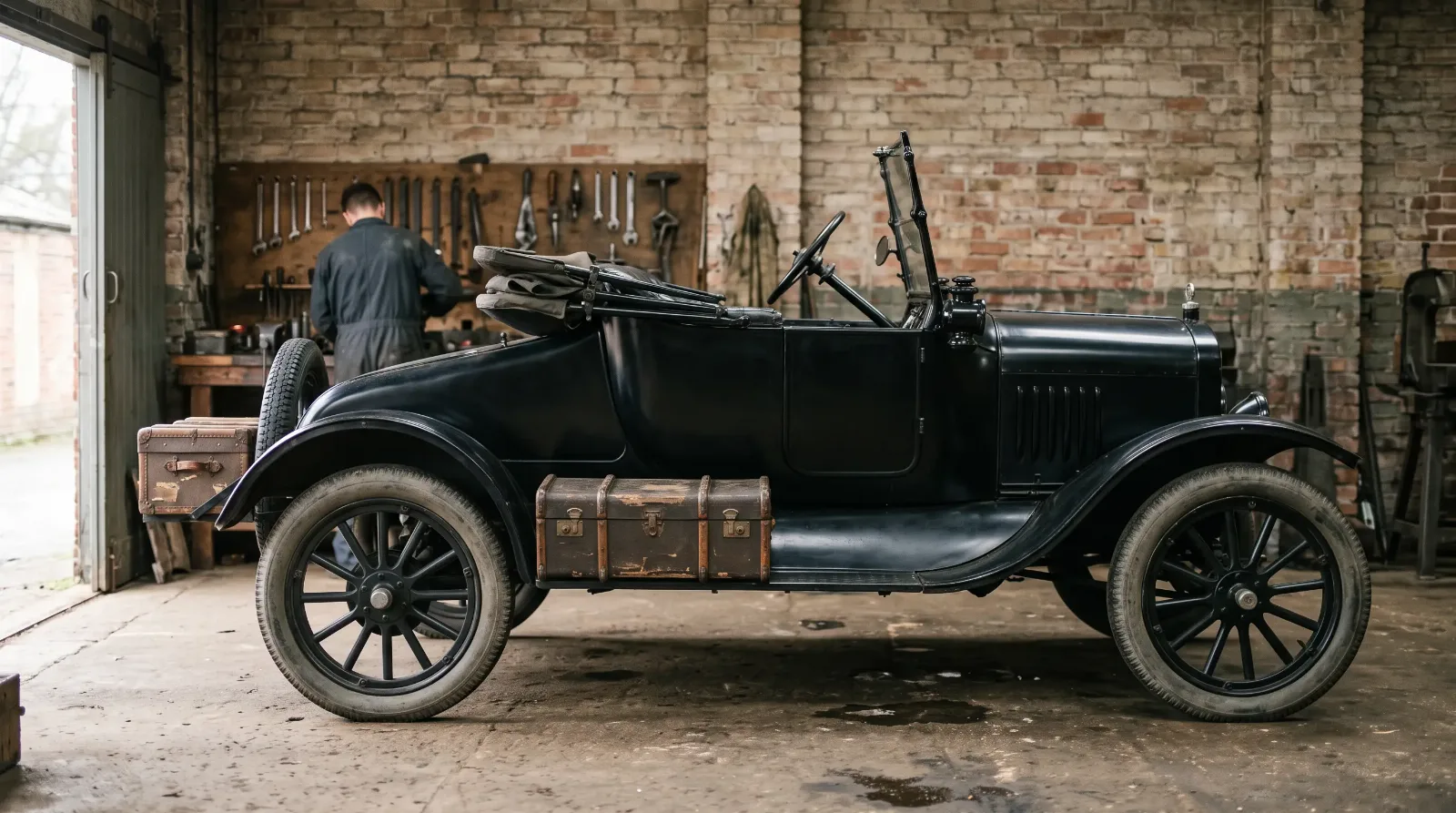
She would become the first woman on record to drive around the world, and she did it in the same plain, cheap car that farmers used to haul milk cans. That pairing is the whole charm of the story. It belongs with the other legends gathered around the nickname and its legend, but it is stranger than most of them, and better documented than some.
The advertisement and the captain
Walter Wanderwell was not his real name either. He was born Valerian Johannes Pieczynski, and by the early 1920s he was running a traveling expedition that drove Model Ts from country to country, paid its way with film, and recruited young people to come along. Idris joined in 1922. She was taken on as a driver, a translator and a filmmaker, three jobs that would each matter more than anyone expected.
The driving was the obvious part. A Model T in 1922 was a car you learned with your feet and your nerves, three pedals and a hand lever, and roads outside the cities were often no roads at all. The translating kept the expedition moving through borders and markets. The filming paid for everything. The Wanderwells sold the romance of the trip back to audiences who would never leave home, and the camera was the cash register.
The new name came with the job. Idris Welsh from Winnipeg became Aloha Wanderwell, a name built for a poster, and the face behind the wheel of a dusty Ford became part of what the expedition sold.
Nice to Nice: the drive Guinness counts
The record has a clear frame. The journey that Guinness recognizes began in Nice, on the French Riviera, on December 29, 1922, and ended back in Nice in January 1927. Four years, more or less, in Model Ts. That is the claim that holds, and it is the one worth repeating.
Everything beyond that frame gets slippery. Read three accounts of Aloha Wanderwell and you will find three sets of numbers. Wikipedia gives about 500,000 miles and more than 80 countries. Her estate's own site gives 75 countries, and elsewhere says she filmed in 80, with 580,000 miles covered between 1922 and 1950. The Academy of Motion Picture Arts and Sciences, which holds much of her film, says the Wanderwell caravan of Model Ts passed through 43 countries.
These are not really contradictions. They measure different things. The smaller figures look like a single expedition. The larger ones look like a lifetime of travel, stretched out to 1950. No single surviving log settles it, and a legend left alone tends to round up. So the honest version is the one with edges: Nice to Nice, late 1922 to early 1927, around the world, by Model T.
"I keep coming back to the age. Sixteen, answering an ad. The record is impressive, but what stays with me is a teenager deciding that the world was something you could drive to."
Nora Beckett
Little Lizzie and the cars that made the trip
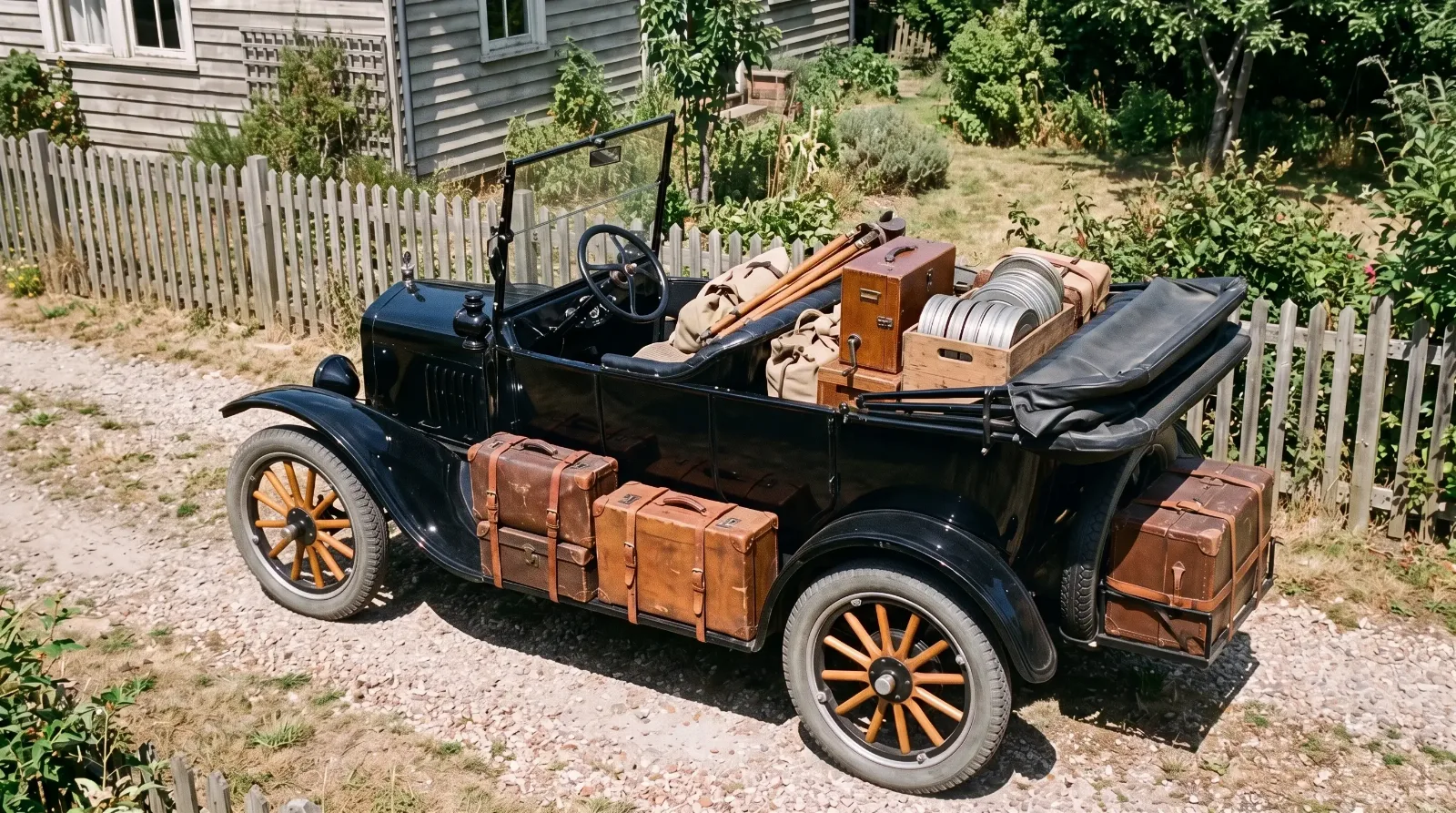
Why a Model T? Because it was everywhere. A car that could be fixed with simple tools, by someone who had never seen it before, in a town that had never seen a mechanic, was the only sensible choice for a trip like this. Parts were common. The engine was simple. The high ground clearance and light weight let a few strong people lift it out of a ditch.
One of the expedition cars carried a nickname that fits this series nicely: "Little Lizzie." In 1929 that car was donated to Henry Ford, which is a tidy ending for a machine that had been a traveling advertisement for his product for years. Her estate's site and Wikipedia both call the round-the-world car a 1918 Model T, while at least one account speaks of a pair of 1917 cars, and the expedition certainly ran more than one Ford over the years. Captain Wanderwell reworked the body with a speedster-style tail. The ending is less tidy than it sounds: in 1942 Ford decided that Little Lizzie and some 50 other cars in its collection would be scrapped for the war effort.
It is easy to forget how small the car was against what it was asked to do. The Model T was built for the farm lane and the county road. It was not a rally car, though the speedsters built on the same chassis showed how far it could be pushed. Aloha's Fords were not stripped for speed. They were loaded with people, cameras, film and gear, and they kept going.
A camera, a marriage and a death at sea
Aloha married Walter Wanderwell on April 7, 1925, in Riverside, California. The expedition went on, and so did the filming. The footage she shot and appeared in was not just publicity. It became a record of places and people in the 1920s, seen from the seat of an American car.
The story turned dark in 1932. On December 5 of that year Walter Wanderwell was shot and killed aboard the yacht Carma at Long Beach, California. A man named William James Guy was tried and acquitted. The killing has never been solved in the eyes of the law, and it closed the first chapter of Aloha's life with a mystery that the newspapers enjoyed far more than she could have.
She kept traveling and filming. She lived until June 4, 1996, and died in Newport Beach, California, at 89. By then the girl from the newspaper ad had become a footnote, then a curiosity, then, slowly, a figure that historians of film and travel wanted to look at again.
Why Aloha Wanderwell still matters
In 2020 the 1929 film "With Car and Camera Around the World" was added to the US National Film Registry. That is a quiet kind of honor. It says the footage matters as a document, not just as a stunt. It also brings the car back into focus. Without the Model T there was no trip, and without the trip there was no film.
For Model T people the lesson is simpler. This car went around the world with a teenager at the wheel. It did so on bad roads, with the tools of the day, and a crew that learned to fix what broke. Owners today fuss over correct bolts and original paint. Aloha's Fords were held together with what was at hand.
Her story fits a long run of writers and filmmakers who found the Model T irresistible, and it has its own place in that tradition. If you want the wider frame of the car in books and on the page, there is the full story. But hers is the one with the passport stamps.
The record will always come with a caveat about miles and countries. That is fine. The fixed points are enough: a sixteen-year-old, a newspaper ad, a Ford, Nice in December 1922 and Nice again in January 1927. The rest is road.
Sources and notes
Related Reading
Have a
Ford Model T
for Sale?
Reach thousands of serious classic car collectors across the US.
Sell It Here →
Selling a classic? Here's how: compare the places to sell classic cars
Are You a Classic Car Dealer?
List your full inventory and connect with targeted classic car buyers.
Join as a Dealer →

About the author
Nora Beckett
Automotive features writer and photographer who tells the human stories behind the cars, from show fields to cross-country road trips.
Related Listings - Ford Model T
Comments
Be the first to comment on this article.