
Jeep CJ engines have a reputation for being tough. Half of that reputation is earned and half of it is nostalgia doing the heavy lifting. Across forty-one model years the CJ used a flathead four, an F-head four, a Buick V6, three AMC sixes, an AMC V8, a Pontiac-designed four, and finally an AMC four of its own. Only one of them made more than 150 horsepower. One of them made 60. The interesting part is not the peak numbers. It is what those numbers were asked to do, and how little they changed for how long.
Car Features
10 min read
Jeep CJ Engines: Go-Devil, Hurricane, Dauntless and the AMC Years
Forty-one years, eight engines, and only two of them made more than 150 horsepower. A blunt look at what Jeep CJ engines actually delivered and which ones are worth buying now.
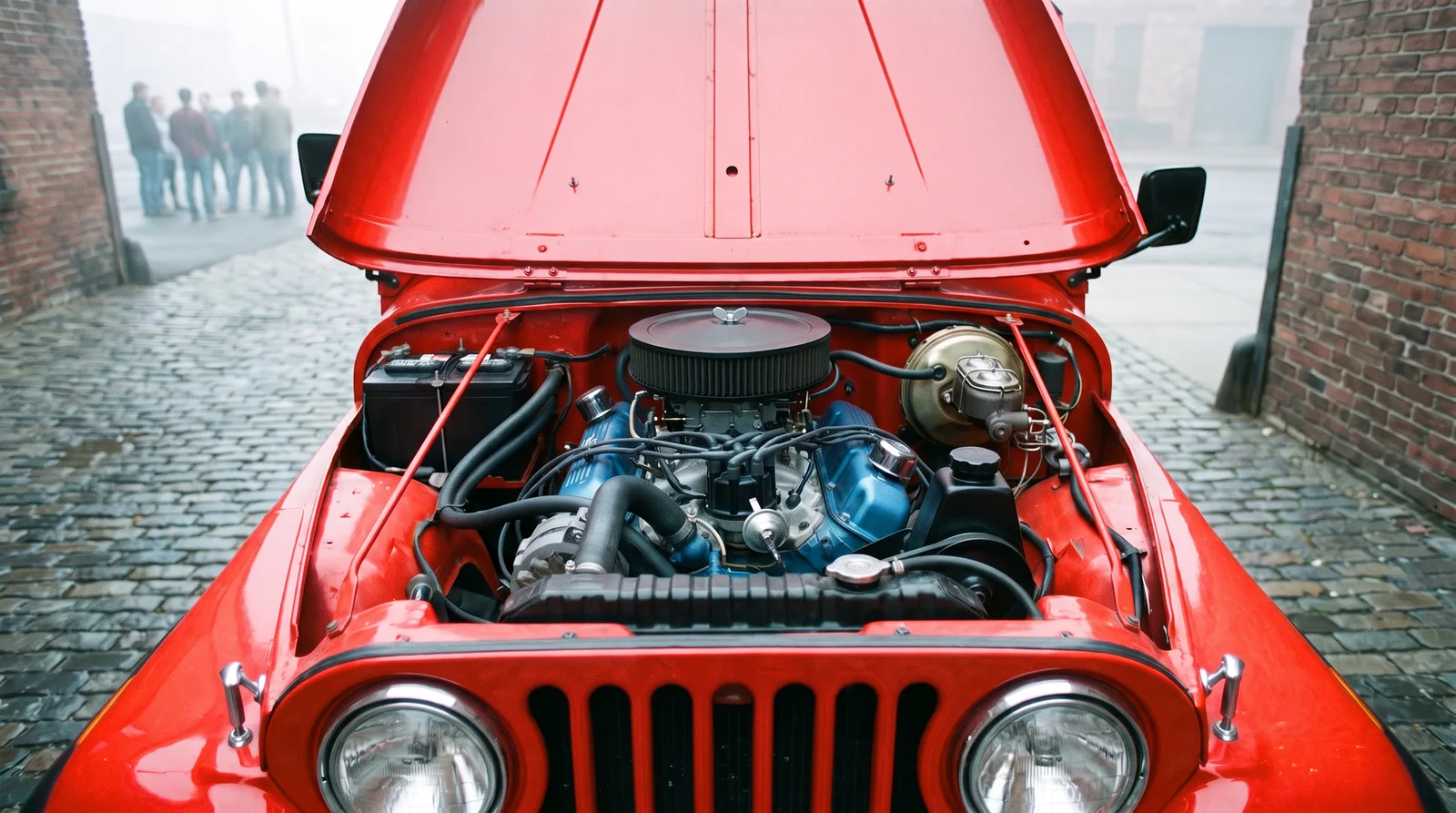
The Go-Devil made 60 horsepower and that was enough
The L-134 Go-Devil is a 134.2 cubic inch flathead four. It made 60 horsepower at 4,000 rpm and 105 lb-ft at 2,000 rpm. Those are gross figures from an era when nobody argued about test methods. It powered the wartime MB and GPW, then carried straight into the civilian CJ-2A in 1945 and the CJ-3A in 1949.
Sixty horsepower sounds like a joke now. It was not. The CJ-2A weighed about 2,100 pounds and ran a 5.38 rear axle ratio with a two speed transfer case behind a three speed gearbox. Multiply the crawl ratio out and the flathead never needed to make power, it needed to make torque at 1,500 rpm and survive being lugged there all day. It did. The Go-Devil's real specification is not the horsepower figure, it is the fact that farms ran them as stationary power units off the rear power take-off for years at a time.
Top speed was roughly 60 mph and the engine was working hard to hold it. Anyone who tells you an early CJ was a good highway vehicle has not driven one on a highway. The Go-Devil also set the tone for everything that followed. Cast iron, undersquare, low revving, and built with more margin than the output figure justifies. Willys did not design it for the CJ. It arrived in 1938 for passenger cars, went to war, and came home to a farm implement. Almost nothing about the CJ engine story is a clean-sheet design, and that is the point. The full arc of how the vehicle developed around these engines is covered in the jeep cj story, and the engines only make sense next to the gearing.
The Hurricane F-head was the same block with a better idea
In 1953 Willys introduced the F-134 Hurricane. Same 134.2 cubic inches. Same bore and stroke. Different head. The intake valve moved overhead while the exhaust valve stayed in the block, which is what "F-head" means. Result: 75 horsepower at 4,000 rpm and 114 lb-ft, up 25 percent on power for no change in displacement and very little change in cost.
The F-134 forced a body change. The taller engine did not fit under the flat CJ-3A hood, so Willys raised it and created the CJ-3B, the high-hood Jeep with the awkward proportions that ran in one form or another until 1968 in Toledo and far longer under license overseas. The Hurricane then went into the CJ-5 at launch in 1955 and stayed the standard engine until 1971. Sixteen years on one four cylinder is a long run by any standard.
The Dauntless V6 was the first CJ engine with real power
1966. Kaiser drops the Buick 225 cubic inch V6 into the CJ-5 and CJ-6 and calls it the Dauntless. 160 horsepower at 4,200 rpm. 235 lb-ft at 2,400 rpm. That is more than double the Hurricane's output in a vehicle that gained maybe 200 pounds.
The transformation was violent by CJ standards. An 81 inch wheelbase, leaf springs at both ends, drum brakes all around, and 160 horsepower is a combination that taught a generation of drivers about weight transfer. The V6 CJ-5 is quick off a line and genuinely unnerving above 50 mph. It is also the engine that made the CJ desirable rather than merely useful, and the reason 1966 to 1971 V6 cars carry a premium today.
Kaiser bought the tooling outright from General Motors in 1967 and built the engine in Toledo. GM bought it back in 1974, having decided that a small V6 was suddenly worth owning again after the fuel crisis. The odd-fire firing interval that made the Dauntless shake at idle was a Buick design characteristic, not a Jeep problem, and owners learned to live with it.
| Engine | Years in CJ | Displacement | Configuration | Rated output |
|---|---|---|---|---|
| L-134 Go-Devil | 1945 to 1953 | 134.2 cu in | Flathead four | 60 hp, 105 lb-ft (gross) |
| F-134 Hurricane | 1953 to 1971 | 134.2 cu in | F-head four | 75 hp, 114 lb-ft (gross) |
| Dauntless V6 | 1966 to 1971 | 225 cu in | Buick 90-degree V6 | 160 hp, 235 lb-ft (gross) |
| AMC 232 | 1972 to 1978 | 232 cu in | Inline six | approx. 90 to 100 hp net (rating fell late in the run) |
| AMC 258 | 1972 to 1986 | 258 cu in (4.2 L) | Inline six | 110 hp, approx. 210 lb-ft (net) |
| AMC 304 | 1972 to 1981 | 304 cu in | V8 | 150 hp, approx. 245 lb-ft (net) |
| GM 151 "Iron Duke" | 1980 to 1983 | 151 cu in (2.5 L) | Inline four | approx. 82 hp |
| AMC 150 | 1984 to 1986 | 150 cu in (2.5 L) | Inline four | approx. 105 hp |
AMC took over and the CJ grew three inches to fit the sixes
American Motors bought Jeep in 1970 and had no intention of paying Buick for engines. For 1972 the CJ-5 wheelbase went from 81 inches to 83.5 and the front sheet metal grew about three inches. That change was not styling. It was clearance for the AMC 232 and 258 inline sixes and the 304 V8.
The 258 is the engine most people mean when they say a CJ has a six. It is a 4.2 litre cast iron inline six with seven main bearings, and it is slow, heavy, and close to unkillable. Net output settled at 110 horsepower with roughly 210 lb-ft, and those net figures are not directly comparable to the gross numbers quoted for the Dauntless. A 258 CJ-7 is not faster than a V6 CJ-5. It is smoother, torquier down low, and far easier to live with.
The 304 V8 ran from 1972 to 1981 at 150 net horsepower. Buyers expected more from a V8 and did not get it, because by the mid-1970s emissions equipment had taken a bite out of everything. The 304 does sound right and it does pull, but the honest comparison is that a good 258 with correct gearing gets most of the same job done and does not push the front axle weight up.
The 232 is the forgotten one. It is the same basic AMC six with a shorter stroke, it was the base six in early AMC-era CJs, and it was gone by the end of the 1970s because buyers who wanted a six wanted the bigger one. Very few people go looking for a 232 CJ today, and the ones that survive are usually base-spec cars that nobody bothered to modify. That makes them interesting for a different reason. Unmolested plain CJs from the 1970s are getting harder to find than the loaded ones, because the loaded ones were always treated as worth keeping.
The carburetion is where the emissions-era reputation comes from. The Carter BBD two barrel on later 258s arrived with a vacuum system complicated enough to fill a full page of the service manual. Blame the regulations and the budget, not the engine. The underlying architecture kept getting more capable every time somebody was allowed to redesign the top end, which is the whole history of this engine family in one sentence.
"Every CJ engine argument comes down to the same thing. The V6 has the numbers, the 258 has the survival rate. Pick which one you want to explain at the fuel stop."
- Dan Reeves
The four cylinder years at the end
1980 brought the 151 cubic inch four, the GM-built unit everyone calls the Iron Duke, as base equipment in the CJ-5 and CJ-7. About 82 horsepower. It exists because of fuel economy rules and a second fuel crisis, and it is the reason a lot of late CJs feel underpowered in a way no 1950s Jeep does. The 1950s cars were geared for their engines. A 151 CJ-7 with a four speed and 2,900 pounds to move is a different problem.
For 1984 AMC replaced it with its own 150 cubic inch four, still 2.5 litres, worth roughly 105 horsepower. That engine is the one that mattered long term. It carried into the Wrangler YJ and the Cherokee and stayed in production for over a decade after the CJ ended. In CJ terms it is the best of the four cylinders by a clear margin, and it is still not the engine you want if you plan to drive the thing on an interstate.
Which CJ engine is worth buying now
Values follow the engines closely, so this is not an academic question. Dauntless V6 cars from 1966 to 1971 sit at the top of the CJ-5 market when they are original and documented. Flathead and F-head cars sell on originality and condition rather than drivetrain, because nobody buys a CJ-2A to drive to work. AMC 258 cars are the volume of the market and the most usable, and a well sorted 258 CJ-7 remains the sensible entry point. 304 V8 cars carry a small premium over 258s. Four cylinder cars are the discount tier and always will be.
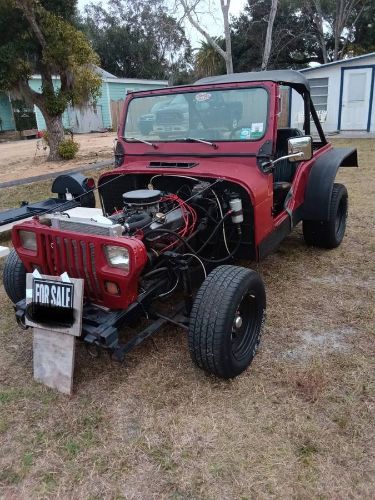
Two warnings. First, engine swaps are everywhere in this market, and a small block Chevrolet in a CJ-5 does not make it more valuable, it makes it a modified car judged on build quality. Second, matching-numbers thinking barely applies here. Jeep did not stamp CJ engines the way Detroit stamped muscle car blocks, so provenance leans on build sheets, tags, and casting dates rather than a single decoded number. If you want to see how the drivetrain choices track against real asking prices, look at classic CJs on the market and sort by year and engine before you decide what you are shopping for.
The engines are only half the story of why these vehicles kept selling for four decades. What buyers actually chose in the showroom, and the trim packages and culture that grew around them, is the next chapter. The mechanical arc is simpler than most: one small four cylinder architecture for twenty-six years, one borrowed V6 for six, and one AMC inline six that outlived the vehicle it was bought for.
Sources and notes
Related Reading

About the author
Dan Reeves
Performance engine builder from North Carolina's motorsports corridor, focused on swaps, forced induction and making real, repeatable power.
Related Listings - Jeep CJ





Comments (1)
G
GrumpyOldGasser
5 days ago
Dauntless V6 or the 258 for a trail rig? Pick one. Harrumph.
The 258. The Dauntless makes more power on paper, 160 gross, and it's lighter up front. But the 258's net rating undersells its low-rpm torque, parts are everywhere, and it doesn't shake at idle. On a trail you live around 1,500 rpm. That's where the six wins.