
There is a guy at our monthly club breakfast, has been coming for twenty years, who still will not park his Land Cruiser next to my CJ-5 without making some comment about it. Good natured, mostly. But it goes back further than either of us, and honestly further than most club members realize. The Jeep CJ-5 vs Toyota Land Cruiser FJ40 argument, what most folks shorthand to CJ5 vs FJ40 these days, is not a modern internet debate. It is one of the oldest rivalries in off-road culture, and it started because two very different countries decided to build the same kind of truck around the same time, for very different reasons.
Car Features
7 min read
Jeep CJ-5 vs Toyota Land Cruiser FJ40: The Global 4x4 Rivalry
The CJ-5 vs FJ40 rivalry was never settled in a showroom. It was built over decades of trail runs by owners who traded jabs and traded tools in equal measure.
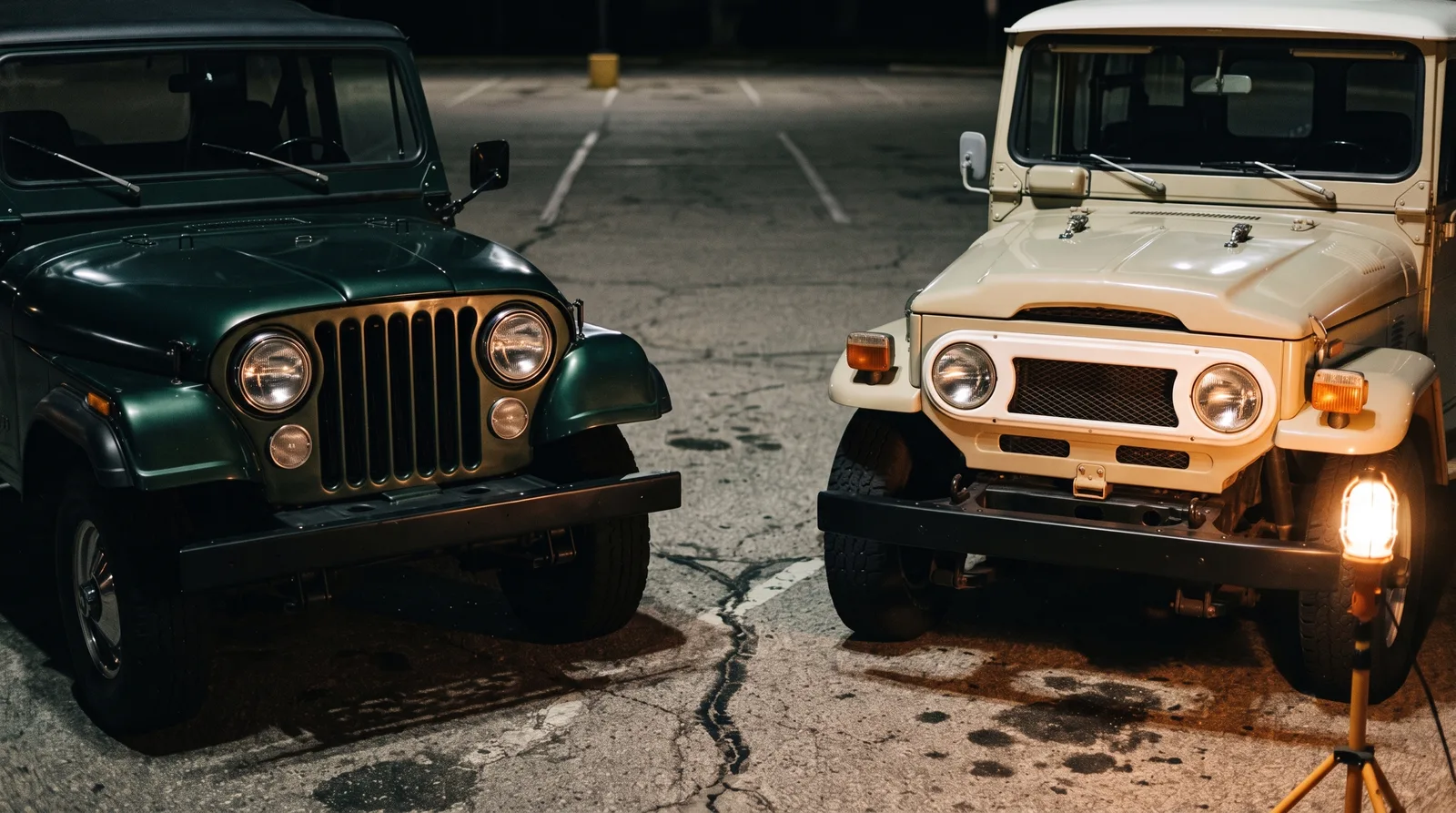
CJ5 vs FJ40: two very different postwar stories
The CJ5 vs FJ40 comparison really starts with two separate national moments. The CJ-5 arrived in 1955, a refinement of the wartime Jeep formula that Willys had been building since 1945, compact, simple, and cheap to run. The FJ40 followed in 1960, the second generation of a Land Cruiser line that began with Toyota's 1951 BJ, built for a Japanese National Police Reserve requirement, and it was developed with heavy attention to durability and long-haul reliability rather than outright compactness. Toyota was a company rebuilding its reputation after the war, and it needed the Land Cruiser to prove Japanese engineering could match American toughness on American terms. That chip on the shoulder shows up in how over-built the early FJ40 feels compared to a CJ-5 of the same era. Toyota was not just building a truck. It was making an argument.
What separated them on the trail
The CJ-5 had the edge in tight terrain, thanks to a shorter wheelbase and lighter overall weight that let it thread between rocks and trees a longer FJ40 simply could not fit through. That agility became its calling card among American trail clubs, where narrow eastern forest trails and rocky western switchbacks rewarded a nimble truck over a bigger one. The FJ40, heavier and built with a stouter frame, answered with sheer durability, particularly in long-distance and high-heat conditions where Land Cruisers built a reputation running taxi and expedition duty across Africa and the Middle East that the CJ never really competed for. Neither truck was objectively better. They were built to win different arguments.
"I've watched a CJ-5 slip through a gap on the trail that a Land Cruiser had to detour around, and I've watched that same Land Cruiser outlast three CJs on a hundred-degree crossing. Both trucks are right. That's the whole rivalry in one sentence."
- Wayne Coburn
How the rivalry lived in the clubs, not the showrooms
Dealers barely acknowledged each other's existence in period advertising, but club members did, constantly. Regional four-wheel-drive clubs through the sixties and seventies often had a healthy mix of CJ and Land Cruiser owners running the same trails together, and the friendly needling between them became part of the culture rather than a source of real division. Guys would trade stories at the tailgate about whose truck handled a particular obstacle better, and those stories accumulated into a kind of informal folklore that neither manufacturer ever wrote down. Nobody at Willys or Toyota was managing this rivalry. The owners built it themselves, one weekend trail run at a time, and it has outlasted plenty of manufacturer marketing campaigns from the same era.
The parts-swapping truce nobody planned
Here is the part that surprises people outside the hobby. Despite the rivalry, CJ and FJ40 owners have quietly helped each other out with parts knowledge for decades, because both trucks share a similar problem, aging supply chains and increasingly scarce factory-correct components. A club member with a line on hard-to-find CJ trim pieces would often know an FJ40 owner chasing an equally obscure Toyota part, and the two would trade leads even while ribbing each other about whose truck needed the help more. That kind of practical cooperation existed alongside the rivalry rather than in spite of it, which tells you the competition was always more performance than genuine grudge. Nobody was actually rooting for the other guy's truck to break down on the trail. They just liked pretending they were.
That cooperative streak shows up most clearly at swap meets, where CJ and FJ40 parts tables frequently end up next to each other by informal tradition rather than accident. Vendors who deal in both trucks say the crossover customer base is bigger than either camp likes to admit out loud.
Why it still matters at shows today
Walk any large off-road heritage show now and you will still find CJ and FJ40 owners parked near each other, usually by choice, usually still trading the same good-natured jabs their predecessors traded fifty years ago. Values for clean examples of both trucks have climbed steadily, and each camp will tell you their truck holds up better as an investment, which is its own version of the old trail argument transplanted onto a spreadsheet. If you want the fuller context on how the CJ built its identity across those decades of rivalry, read the background on the trim story that runs alongside it.
I have owned three CJs over the years and wrenched on a handful of FJ40s belonging to friends, and the thing that sticks with me most is how differently each truck rewards patience. A CJ tells you almost immediately if something is wrong, light, direct, no mystery in the feedback through the wheel. An FJ40 takes longer to know. It hides small issues under sheer mechanical stubbornness, running rough for months before something finally lets go, which teaches an owner a different kind of attentiveness. Neither habit is wrong. They just come from two different engineering philosophies built forty years apart from two very different manufacturing cultures, and once you have spent real time with both, the old rivalry starts to feel less like competition and more like two honest answers to the same hard question.
My buddy still parks his Land Cruiser a little too close to my CJ at breakfast, and I still tell him mine would have made the last switchback he had to back out of. Neither of us has ever actually settled it, and honestly, I do not think either of us wants to. Settling it would mean one of us finally admits the other truck has a point, and after twenty years of breakfast arguments, that admission is worth more as a running bit at a folding table than it would ever be as an actual settled conclusion between two old friends. If you are curious enough to start your own side of that argument, there is usually a decent classic CJ for sale nearby worth a look before the Land Cruiser guys talk you out of it.
Sources and notes
Related Reading
Have a
Jeep CJ
for Sale?
Reach thousands of serious classic car collectors across the US.
Sell It Here →
Selling a classic? Here's how: the best sites to sell a classic car
Are You a Classic Car Dealer?
List your full inventory and connect with targeted classic car buyers.
Join as a Dealer →

About the author
Wayne Coburn
Longtime Corvette owner, judge and club figure who knows the cars, the records and the people behind them.
Related Listings - Jeep CJ

More in Car Features
Comments
Be the first to comment on this article.