
Ask ten Jeep owners what CJ stands for and you will get at least four confident, completely different answers. Someone will tell you it means Civilian Jeep. Someone else swears it stands for Command Jeep, or Combat Jeep, or that it never stood for anything at all. What does Jeep CJ actually mean turns out to be one of those questions with a real answer that has been quietly overwritten by decades of confident guessing, and untangling it says something about how badge names actually get chosen in Detroit.
Car Features
6 min read
What Does CJ Actually Mean on a Jeep?
Command Jeep, Combat Jeep, or something else entirely: the real answer to what CJ means is simpler than the myths, and it explains the truck's whole identity.
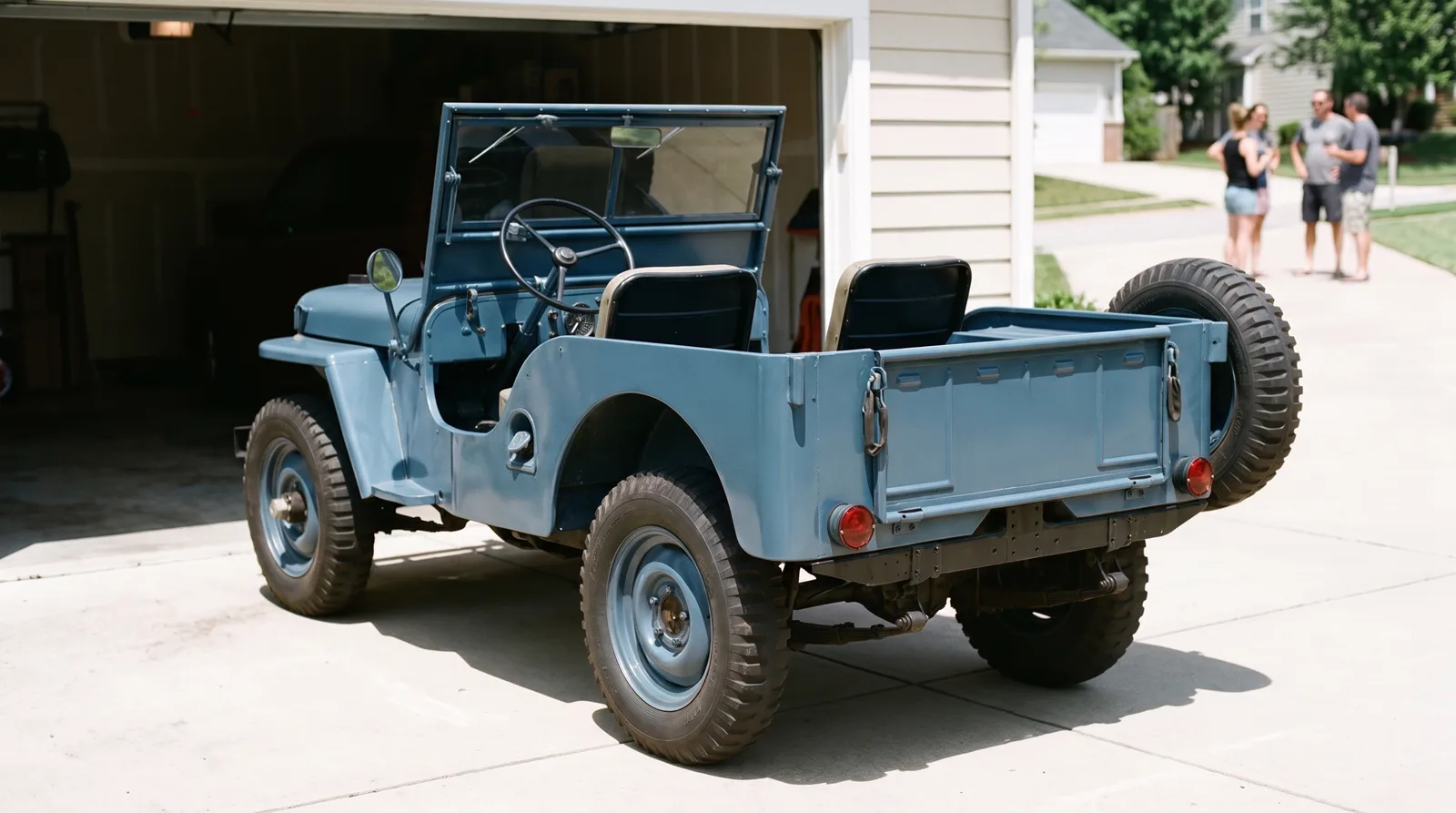
The official answer: Civilian Jeep
The most historically supported explanation is the simplest one. CJ stood for Civilian Jeep, a designation Willys-Overland adopted to distinguish its postwar consumer models from the military MB it had built during the war. This was not a marketing flourish. It was practical shorthand used internally and in dealer literature to signal that the CJ-2A, introduced in 1945, was the version built for farmers, ranchers, and general buyers rather than for the Army. The distinction mattered enormously at the time, because Willys was trying to convince a skeptical public that a vehicle designed for battlefields could also make sense parked next to a barn.
Why the confusion never went away
Part of the reason "Civilian Jeep" never fully stuck in public memory is that Willys itself was inconsistent about explaining it in advertising, which focused more on utility and price than on the badge's meaning. Owners filled that vacuum with their own theories, and some of those theories, particularly "Command Jeep," found their way into enthusiast lore because they sounded plausible for a vehicle with such obvious military roots. Once a wrong answer gets repeated at enough car shows and campfires, it starts to feel more true than the boring, documented one. That is not unique to Jeep, but few vehicles have had their name mythologized quite this thoroughly.
"The real answer is almost disappointingly simple. Willys needed a way to tell dealers and buyers this was not the Army's Jeep anymore. Civilian Jeep did that job, and somehow that plain little abbreviation outlasted every fancier guess people have made since."
- Patrick Walsh
How the letters carried through four decades of change
What is genuinely remarkable is not the origin of the initials but how long they lasted. CJ went on the CJ-2A in 1945 and did not leave the lineup until the badge was retired in 1986, spanning the CJ-3A, CJ-3B, CJ-5, CJ-6, CJ-7, and the Scrambler-branded CJ-8, through ownership changes at Willys, Kaiser, and American Motors. Each generation modernized the mechanicals underneath, but nobody ever felt the need to change what the letters meant or replace them with something newer sounding. That kind of naming consistency across forty-one years and three different corporate parents is rare in the auto industry, where badges get reworked constantly to chase whatever sounds fresh that model year.
What CJ never stood for, despite the guesses
It is worth being direct about the theories that circulate at shows, because most of them fall apart under basic scrutiny. "Command Jeep" implies a military designation, but the CJ line was explicitly the non-military counterpart to the MB, which makes a military-sounding name almost the opposite of the point. "Combat Jeep" has the same problem, plus no documented basis in Willys literature from the period. A few owners have floated "Canadian Jeep," tied to a persistent but unsupported rumor about early export production, which does not hold up against the fact that Civilian Jeep appears consistently in Willys-Overland's own postwar dealer and press materials. None of these alternate theories are malicious. They are just guesses that filled a gap left by advertising that assumed everyone already understood the abbreviation, and once a guess sounds sturdy enough, it tends to travel further than the plain truth ever does.
How other manufacturers handled the same naming problem
Willys was not alone in facing this challenge. Other manufacturers converting military hardware to civilian use after the war dealt with similar naming pressure, needing a designation that reassured buyers a vehicle was not simply surplus equipment repainted for the driveway. Most competitors solved it with entirely new model names rather than a modified abbreviation, which makes the CJ's approach unusual in hindsight. Willys chose to keep the lineage visible in the name itself rather than hide it, betting that the MB's wartime reputation for toughness was an asset worth keeping attached to the civilian version rather than a stigma to erase. That bet paid off. Buyers wanted a vehicle that had proven itself under genuinely brutal conditions, and the CJ name did not let them forget that connection even while making clear this particular one was built for the farm, not the front line.
Why the name still matters to buyers
Understanding what does Jeep CJ actually mean is not just trivia. It shapes how collectors talk about these trucks and how they place a given example in the model's timeline. Someone shopping a CJ-5 today is, whether they realize it or not, shopping a vehicle whose badge was chosen specifically to separate it from military service and mark it as something a regular family could own and use. That civilian framing is baked into the truck's whole identity, from its farm-friendly colors to its accessible price point at launch. It is worth knowing before you go looking at classic CJs on the market, because it explains why these trucks were built to be lived with rather than merely admired.
For a deeper look at how that civilian identity played out through the CJ's various trim packages and eras, the jeep cj renegade story picks up right where this one leaves off. The next time someone at a show confidently tells you CJ stands for Command Jeep, you will know exactly why they are wrong, and exactly why the real answer never needed to be more complicated than it already was.
There is a broader lesson here for anyone researching older vehicles generally, not just Jeeps. Badge meanings, model code origins, and naming conventions from the immediate postwar era were rarely explained to the public with the thoroughness we expect from marketing today. Companies assumed a level of shared context that has simply eroded over eighty years, leaving gaps that enthusiast folklore inevitably fills. The CJ is a useful case study precisely because the correct answer survived in company records even as the popular explanation drifted away from it, which is not always how these stories end. Plenty of vintage vehicle nomenclature has been lost outright, with no documented source left to correct the guesswork. The CJ got lucky. Willys' own paperwork survived well enough that the record could still be set straight, decades after most people had stopped asking the question seriously.
Sources and notes
Related Reading

Have a
Jeep CJ
for Sale?
Reach thousands of serious classic car collectors across the US.
Sell It Here →
Selling a classic? Here's how: where to sell your classic car online
Are You a Classic Car Dealer?
List your full inventory and connect with targeted classic car buyers.
Join as a Dealer →

About the author
Patrick Walsh
Automotive journalist covering classic car shows, events, and the enthusiast community across North America.
Related Listings - Jeep CJ

Comments
Be the first to comment on this article.