
Between 1979 and 1994 Ford reshaped the Mustang twice and revised its face several times in between. This chapter of Mustang design history is easy to flatten into two pictures, the boxy Fox and the rounded SN95, but the records show a steady line of decisions in between: a wind-tunnel shape in 1979, a run of new noses through the 1980s, a near miss with front-wheel drive, and a 1994 car built on the old floor pan under almost entirely new skin. What follows sticks to the dates, the people and the paper trail.
Car Features
6 min read
From Fox to SN95: How Ford Redrew the Mustang, 1979 to 1994
Mustang design history from 1979 to 1994: Telnack's Fox, the SVO and aero noses, the Probe detour and the three SN95 themes.
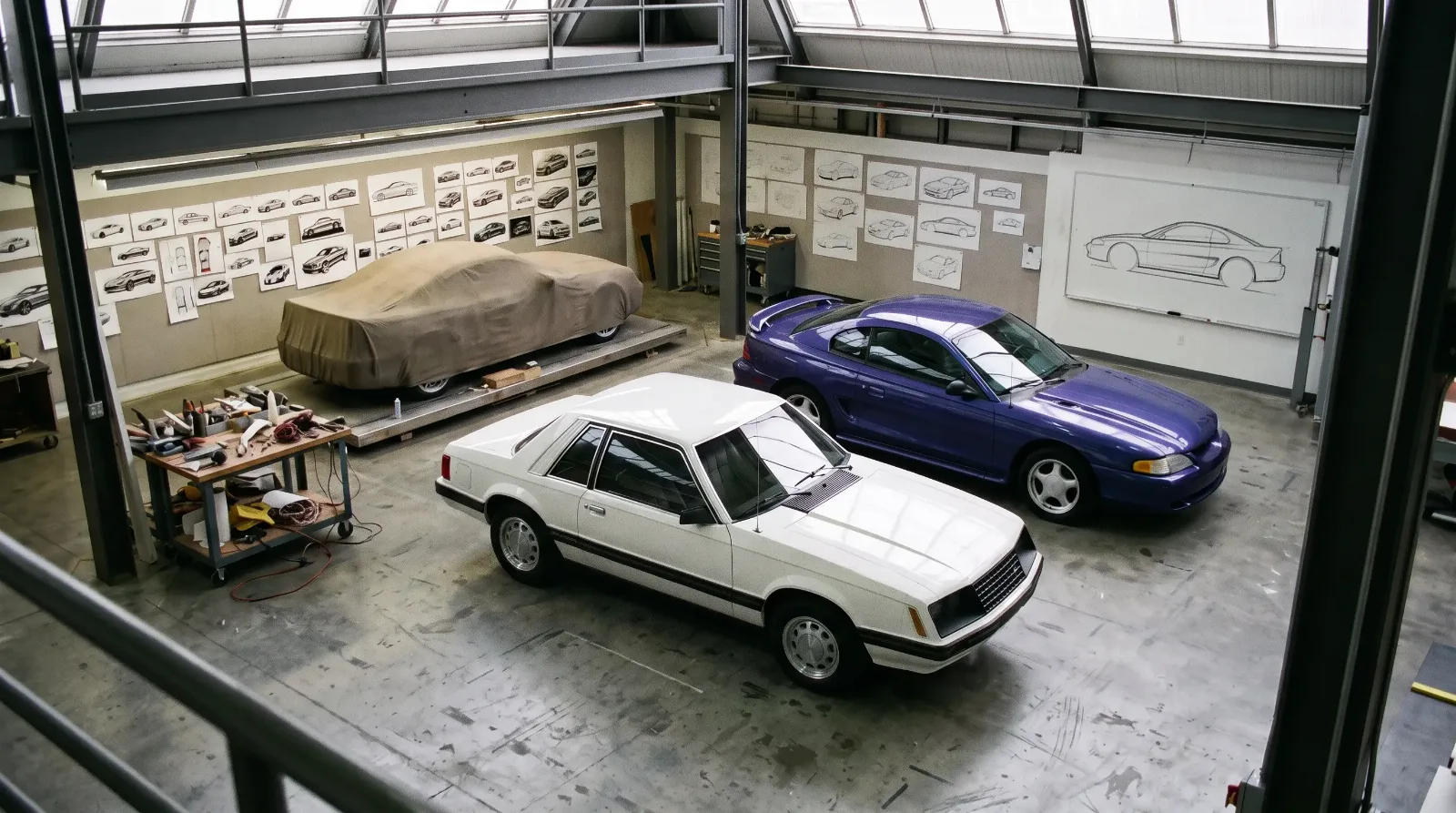
Readers after the individual pieces, the scoops, emblems and taillights, will find the details in the main design guide. This piece covers the sequence.
Mustang design history resets in 1979
Ford confirmed in October 1974 that a Fox-based car would replace the Mustang II. In April 1975 Jack Telnack, who had run design at Ford of Europe, was named executive director of North American Light Car and Truck Design. Styling work began in July 1975, a near-final prototype existed by July 1976, and production approval followed in September 1976. Telnack and his team are credited with the result, the car later known as the Fox Body Mustang.
The shape was a break with the long-hood formula of the 1960s cars, which by then was the shape everyone copied. The Fox was upright, crisp and lighter: MustangSpecs says the new car weighed about 200 lb less than the Mustang II it replaced. MustangSpecs and Jalopnik both quote drag coefficients of 0.44 for the hatchback and 0.46 for the notchback coupe, and Jalopnik calls that the lowest on the road at the time. Neither page cites a test report, but the numbers show where the brief pointed. The front carried four rectangular sealed-beam headlamps, two per side, which is why owners still call the 1979 to 1986 cars "four-eye."
Reworking the Fox face, 1983 to 1987
The Fox did not keep its 1979 face for long. Design leadership changed above it: Gene Bordinat, Ford's vice president of design since 1961, gave way in 1980 to Don Kopka, who held the post until 1987. Under Kopka the car moved through a series of front-end revisions. The 1983 model added the Blue Oval. The 1985 car got a grille-less nose with a horizontal air intake slot.
The real preview came from the SVO. Launched as a 1984½ model, it had a functional hood scoop feeding its intercooler, a biplane rear spoiler and a quoted drag coefficient of 0.38 to 0.39. It began with sealed-beam headlamp capsules and switched to composite aerodynamic lamps for 1985½. That flush-lamp nose was the template for the 1987 facelift, which gave the regular line aero headlamps, a new dash, and on the GT, ground effects and the louvered "cheese grater" taillights.
In June 1987, the same year the aero car reached showrooms, Telnack was elected a Ford vice president and took over the design vice presidency from Kopka. The man who had shaped the 1979 car now ran the studio that would decide what came after it.
| Model year | Design change | Note |
|---|---|---|
| 1979 | New Fox body, four sealed-beam headlamps | Telnack team; quoted Cd 0.44 hatch / 0.46 coupe |
| 1983 | Blue Oval front and rear | First Mustang to wear it outside |
| 1984½ | SVO: functional scoop, biplane spoiler | Cd 0.38 to 0.39 |
| 1985 | Grille-less nose with horizontal slot | SVO gets aero lamps for 1985½ |
| 1987 | Aero nose, new dash, GT "cheese grater" taillights | Fox face until 1993 |
| 1994 | SN95 body, coupe and convertible only | 1,330 of 1,850 parts changed |
The front-drive detour
For a time the next Mustang was not going to look like a Mustang at all. Ford developed a front-drive, Mazda-based car, code ST-16, as the successor. AutoWeek ran it on the cover of its April 13, 1987 issue under the line "Exclusive: The '89 Mustang," and in a June 1987 editorial Mustang Monthly editor Donald Farr urged readers to write to Ford's leadership. Many did. In 1987 Alex Trotman ruled that ST-16 was not a Mustang, and it went on sale as the Ford Probe.
That decision kept the rear-drive Fox in production through 1993, but it did not fund a replacement. A 1989 study put a full redesign at $1 billion, a number that nearly ended the line.
Drawing the SN95: three themes and one winner
The answer was a skunkworks. In August 1989 a nine-member group under Mustang engineering design manager John Coletti began meeting informally on Thursday afternoons. Styling work started in November 1989, when John Aiken, Dennis Reardon and Pat Schiavone began sculpting the first exterior proposal. Three themes followed, nicknamed after public figures: "Bruce Jenner," a trim, athletic car that still looked too much like the Probe; "Rambo," which Ford itself called "the most far out design"; and "Arnold Schwarzenegger," described as Jenner gone to the gym.
Trotman approved the clay model in February 1990, the program received the code name SN95 in May, and the Schwarzenegger theme was approved for production in November 1990. Schiavone's name belongs to that first proposal: MustangSpecs says the final design featured styling by Bud Magaldi, and Wikipedia credits Magaldi with the exterior and Emeline King with the interior. Team Mustang moved into a warehouse in Allen Park, Michigan, in June 1990 under Will Boddie.
"Read the SN95 approvals in order and the brief is plain: make it look like a Mustang before anyone sees the badge. Almost every line on the car answers that one sentence."
Tom Ramirez
Boddie put the goal on the record: "Our goal was to create a vehicle that would be recognizable as a Mustang, even without the badging." The cues came straight from the 1960s. The running horse returned to the grille after a 16-year absence, and the car got C-shaped side scoops, three-element taillights and a dual-cockpit dash. Wheel designs changed too, a subject covered here.
What carried over in 1994
The SN95 is often described as an all-new car. The records say otherwise, in a precise way. Ford's own count is that 1,330 of the car's 1,850 parts changed. The platform, called Fox-4, kept the Fox floor pan and front suspension crossmember. The body line shrank to one fastback-style coupe and a convertible; the notchback and hatchback that had defined the Fox were dropped.
So the period closes where it opened, with a Telnack-era studio reshaping a Fox underbody. The difference is direction. In 1979 Ford looked away from the original car; in 1994 it looked straight back at it. Buyers comparing the two today can browse Fox Body Mustangs for sale and see both halves of that argument in the metal.
Sources and notes
Related Reading
Have a
Ford Mustang
for Sale?
Reach thousands of serious classic car collectors across the US.
Sell It Here →
Selling a classic? Here's how: where to sell your classic car online
Are You a Classic Car Dealer?
List your full inventory and connect with targeted classic car buyers.
Join as a Dealer →
#Ford Mustang
#fox body mustang
#mustang design
#car design history
#SN95 Mustang
#Mustang SVO
#Jack Telnack

About the author
Tom Ramirez
Corvette researcher and historian based in Bowling Green, Kentucky. Two decades documenting Corvette production history from original factory records.
Related Listings - Ford Mustang

More in Car Features


Comments
Be the first to comment on this article.