
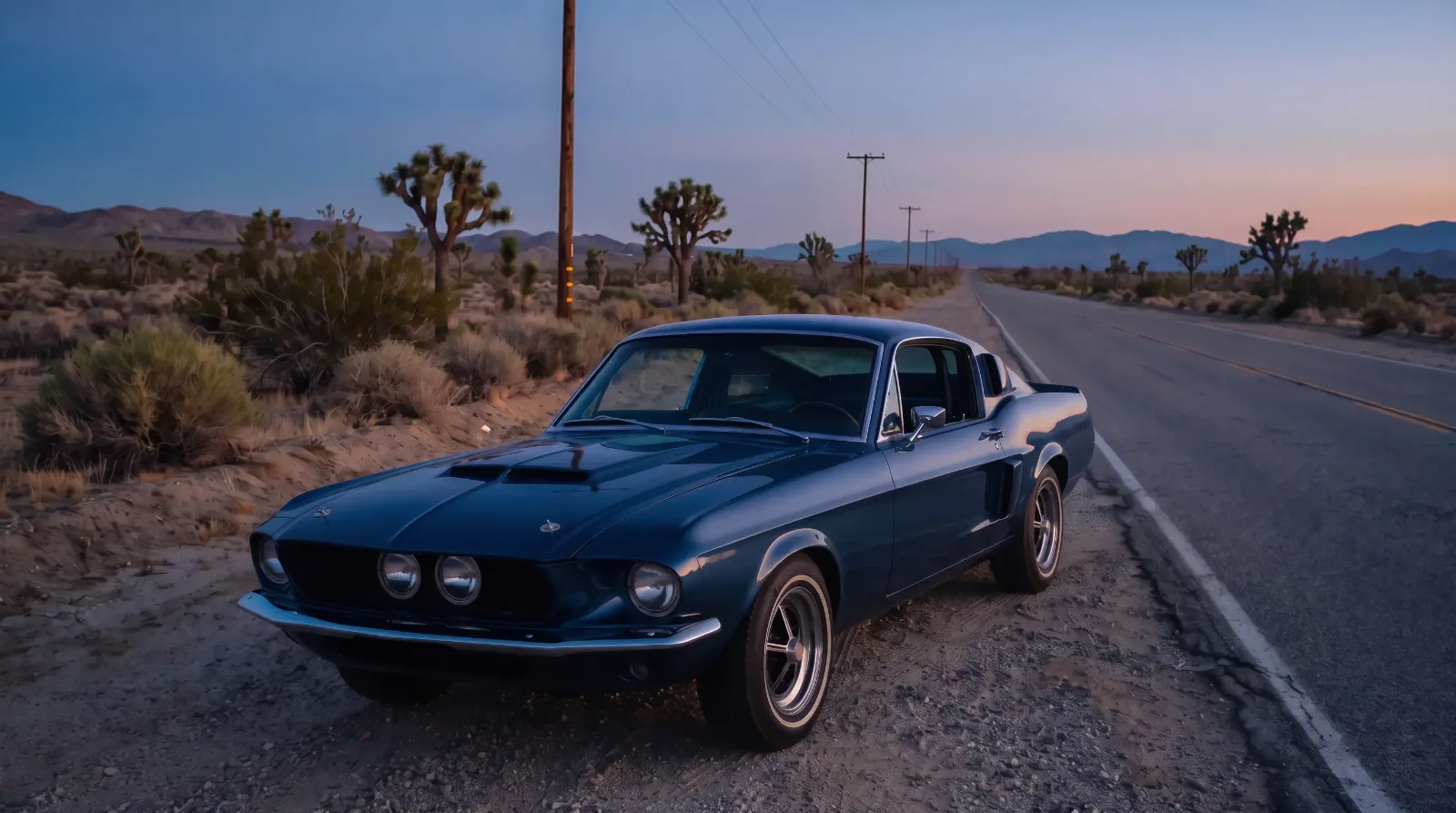
Every big Shelby gathering has one car that is never in the parking lot. Walk the rows long enough and somebody brings it up anyway: the Jim Morrison Shelby GT500, the one he is supposed to have called the Blue Lady, the one nobody can find. It gets told the way old road stories get told, a little differently each time, and almost never with a serial number attached.
Car Features
8 min read
Jim Morrison's "Blue Lady" GT500
What the record supports about the Jim Morrison Shelby GT500 called the Blue Lady, what is only legend, and how a lost Shelby gets found.
That last part is what this article is about. The Mustang has a long life in film, music and television, and there is more on that here. This piece is narrower. It separates what the written record supports about Morrison and his car from what has been repeated so often that it has started to feel like fact.
What the record actually shows
Start with the solid ground, and there is more of it than the legend suggests. The car was real, and it was a 1967 Shelby GT500. The firmest proof is on film. In 1969 Morrison wrote, directed and paid for an experimental picture called HWY: An American Pastoral, shot that spring and summer in the Mojave Desert and in Los Angeles. He plays a hitchhiker who ends up behind the wheel of a stranger's car, and the car on screen is his own 1967 GT500. The finished piece runs 52 minutes and was shown publicly in Vancouver in March 1970.
The second piece of paper is a registration. Street Muscle magazine, which traced the car's history in detail, reports that the last California DMV record for it is dated April 30, 1969, listed to James Douglas Morrison in care of the accounting firm that handled the Doors' business. A card like that carries a VIN. So the car is not a rumor. What is missing is everything after it.
The third item is the documentary. Morrison's filmography lists "Morrison's Mustang: A Vision Quest to Find The Blue Lady" with the year 2011 and the note that it was still in production. The filmmaker behind the long-running search is L. Christian Mixon, a former car dealer turned producer. I could find no sign that the film was ever released. The title still tells you where the story stood: the car had a name, and nobody could say where it was.
The story as it is usually told
The fuller version, as Street Muscle and SlashGear tell it, goes like this. After "Light My Fire" became Elektra Records' first number-one single, label founder Jac Holzman rewarded Morrison. Morrison had admired the Shelby GT350 owned by his hairstylist, Jay Sebring, and Holzman went one better with a new GT500. Some retellings say Morrison bought the car himself, so treat the gift as the likely version rather than a settled one.
The color is usually given as Nightmist Blue, a dark factory blue, with a parchment interior. The nickname did not come from the paint, as is often assumed. According to Street Muscle, Morrison's friend Babe Hill named the car the Blue Lady after a character in a screenplay Morrison was writing.
The ending is where the accounts split. The version told most often puts it in the fall of 1969: Morrison hit a telephone pole on Sunset Boulevard, walked away, and when he came back the car was gone, possibly towed. A second version has him leaving it in long-term parking at Los Angeles International Airport during a tour, where it was towed and sold at auction. A third says it was simply wrecked and crushed. Each version has been repeated by people who knew Morrison or have chased the car for years, and none comes with a document.
There is a quieter risk with legends like this one. Once a story settles on a year and a color, every dark blue 1967 GT500 becomes a candidate. One restorer believes his Nightmist Blue car is the Blue Lady because of old frame damage and repairs. A woman in Arizona once sold what was described as the car's last registration card, without offering the car. Neither claim has been proved in public, and the honest position is still the one the documentary's title takes: the Blue Lady is something to look for, not something anyone has found.
The Jim Morrison Shelby GT500 on paper
Whatever happened to this one car, the 1967 GT500 is well documented. It was the first big-block Shelby Mustang, and it was not a subtle one. Its 428 Police Interceptor V8 wore an aluminum medium-rise intake with two 600-cfm Holley four-barrels and hydraulic lifters, and it was rated at 355 bhp at 5,400 rpm, with 420 lb-ft at 3,200 rpm. Morrison's car is reported to have had the four-speed manual.
The body made the point before the engine did. Charles McHose is credited with the styling, working with Joe Farrer and Carl Nasson: a fiberglass nose and hood, side scoops, a ducktail rear and Mercury Cougar taillamps. Inside, a padded roll bar with inertia-reel shoulder harnesses was among the first fitted to a production car. The list price was $4,195, against $3,995 for the GT350 and $2,698 for a base Mustang fastback. Shelby built 2,048 GT500 fastbacks for 1967. The wider Shelby story, from the first GT350 onward, is a long one, and you can read more here.
How a lost Shelby can still be found
Here is the hopeful part. Shelbys are among the best-documented American performance cars of their era, and a lost one is not lost the way an ordinary used car is. A Shelby carries a Shelby serial number as well as its Ford VIN; the 1967 Super Snake, for example, is serial 67402F4A00544. The Shelby American Automobile Club, founded in 1975 by a handful of owners, built its registry from serial-number and owner records that members gathered over more than 30 years. About three quarters of its Ford VIN records came from sources outside Shelby's own files.
Lost Shelbys do turn up. Little Red, the 1967 GT500 EXP notchback prototype, was located on March 3, 2018, in rural North Texas by Craig Jackson of Barrett-Jackson and Jason Billups, who traced it through its original Ford VIN. Kevin Marti helped confirm it. The search worked because the people doing it started from a number, not a nickname.
Shelbys also went missing in that era for ordinary reasons. In 1968, the GT500KR that Car Life planned to test was stolen first, and the LAPD recovered it in no shape for evaluation. Nothing ties that car to Morrison. It is simply a reminder that big-block Shelbys in Los Angeles drew the wrong kind of attention, and that "missing" can mean a lot of different things.
"I like this story, and most of it holds up better than I expected. The car existed, it was a GT500, and it is on film. What nobody has done is put a surviving car next to that registration and show that the numbers match. Until then I would rather tell you what we know than sell you what we wish."
Patrick Walsh
Why the Blue Lady still matters
Mustang culture runs on stories like this one, and the Blue Lady's place in it says something about how the Shelby was seen in its own time: a car with enough presence that people still connect it to a famous rock singer more than half a century later. Morrison sits on a long list of well-known people tied to Mustangs, and the cars that can be documented get their due in our look at famous owners.
What the Blue Lady needs now is the last piece of paper: a surviving car whose VIN matches the one Morrison registered. The documentary's title called the search a vision quest, and that is a fair description of hunting for a car whose beginning is well recorded and whose end is not. Until that match turns up, the Blue Lady stays what it has always been: the best kind of car-show story and the hardest kind of history, easy to tell and very hard to finish.
Sources and notes
- Wikipedia: HWY: An American Pastoral (filming, length, Morrison's 1967 Shelby GT500 in the film)
- Street Muscle: On the Trail of the Blue Lady, Jim Morrison's Lost 1967 Shelby GT500
- SlashGear: Here's What Happened To Jim Morrison's 1967 Mustang Shelby GT500
- Wikipedia: Jim Morrison (filmography, Morrison's Mustang documentary listing)
- Silodrome: 1967 Shelby GT500 428 (engine, prices, production)
- Old Cars Weekly: 1967 Shelby GT500 EXP prototype Little Red found
Related Reading
Have a
Ford Mustang
for Sale?
Reach thousands of serious classic car collectors across the US.
Sell It Here →
Selling a classic? Here's how: sell my classic car
Are You a Classic Car Dealer?
List your full inventory and connect with targeted classic car buyers.
Join as a Dealer →
#Ford Mustang
#shelby gt500
#Mustang in pop culture
#Jim Morrison
#1967 Shelby GT500
#Blue Lady
#Lost Shelby Mustangs

About the author
Patrick Walsh
Automotive journalist covering classic car shows, events, and the enthusiast community across North America.
Related Listings - Ford Mustang




Comments
Be the first to comment on this article.