
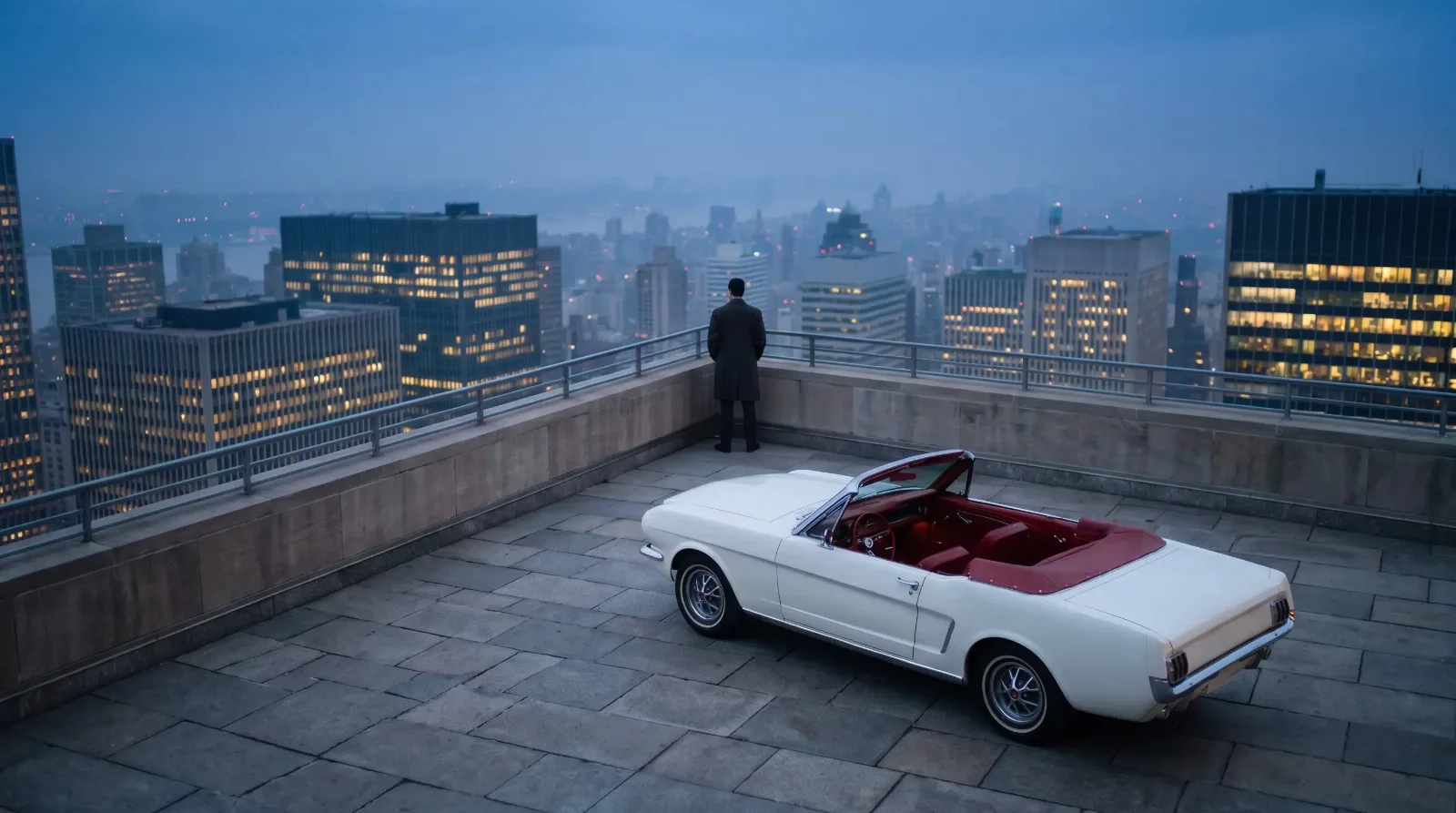
Picture the observation deck of the Empire State Building on an October morning in 1965. A father lifts his daughter so she can see the river. Someone is fighting with the film advance on a camera. A couple from out of town is trying to find their hotel among the rooftops. And there, on the 86th floor, where no car has any business being, sits a brand-new white Mustang convertible with its top down. The Mustang Empire State Building display sounds like one of those stories that grows a little every time it is told. It happened, and Ford did it twice. The way the company pulled it off says a good deal about the car, and about the people who sold it.
Car Features
8 min read
How Ford Put a Mustang on the Empire State Building
Ford cut a new Mustang convertible into sections, took it up the Empire State Building and rebuilt it on the observation deck. Then did it again.
A car that was already news
By the fall of 1965 the Mustang was a year and a half old and already a sales phenomenon. It had been introduced on April 17, 1964, at the New York World's Fair in Flushing Meadows, and it went on sale in showrooms the same day. Counting the early 1964½ cars, the first model year came to almost 681,000 Mustangs. The 1966 model, the one Ford was pushing that autumn, would reach 607,568, the record year for the first generation.
Numbers like that explain why people remember the Mustang. They do not explain why people loved it. A car turns into something more than a product when it starts showing up in places it does not belong: in songs and films, in the background of wedding photographs, in the stories people tell their grandchildren about their first job and their first payment book. The long version of that story, the Mustang in film and music, is told elsewhere. This one is about a single car, a very tall building and a great many wrenches.
New York mattered here. The Mustang had made its public debut in the city, and a return to Manhattan, to the most famous address on its skyline, had a kind of symmetry a marketing man would not miss.
The Mustang Empire State Building stunt of 1965
The idea came from the building, not from Ford. Robert L. Leury, the Empire State Building's general manager, approached the company about it, and Ford's merchandising people put a team on the job. The car was a white convertible from the new 1966 model year, and the brief was simple to say and hard to carry out: put it on the 86th-floor observation deck, where every visitor who came up for the view would walk straight into it. The only way up was the passenger elevators, about seven feet tall inside, and a Mustang convertible is roughly fifteen feet long.
So Ford's people did the obvious, slightly mad thing. They split the car into four main sections, the windshield, the front end, the center body and the rear end, and rehearsed the whole job three times at Ford's facilities in Dearborn first. The real thing started at 10:30 p.m. on October 20, 1965, after the building closed to visitors. Even with all that planning, the front section came up a quarter of an inch too tall for the elevator because of the steering column, and the crew had to work it through the doorway. By 4:30 a.m. the car stood whole on the open-air deck. It was photographed from a helicopter in the morning light, then taken apart once more and rebuilt in the glass-enclosed part of the deck, so that the crowds found it already standing there, as if it had found its own way up the stairs.
I would love to tell you the name of the person who tightened the last bolt. Ford's own account says only that eight crewmen in white overalls did the work, and I would rather leave that space empty than fill it with someone I made up. What the record does give is how long the car stayed: it remained on the 86th floor for five months and came down for the last time on March 16, 1966.
| Detail | The first display | The anniversary display |
|---|---|---|
| When | Night of October 20, 1965 | April 2014 (on show April 16) |
| Car | White 1966 Mustang convertible | 2015 Mustang convertible |
| Where it stood | 86th-floor observation deck | 86th-floor observation deck |
| How it got there | Four main sections in the passenger elevators, rebuilt overnight | Cut into sections and reassembled on the deck overnight |
| Occasion | Promotion of the new 1966 Mustang | The Mustang's 50th anniversary |
| How long it stayed | Five months, until March 16, 1966 | A short anniversary showing |
Why a convertible, and why the sections mattered
Think about what cutting a car into pieces actually means. A first-generation Mustang is a unibody: the floor, the rocker panels and the body shell carry the loads together, and there is no separate frame to bolt everything back onto. Splitting one into sections and making it look whole again on a windy deck is nothing like taking off a fender. It takes careful measuring, a plan for where every cut goes, and people who know exactly how the car went together the first time.
The choice of a convertible makes sense once you stand in that elevator in your imagination. With no fixed roof there are no roof panels or rear pillars to cut through and then hide again, and each section stands lower. That is my reading of it, not anything Ford said on the record, but anyone who has ever helped lift a body shell will recognize the logic. A convertible was also the version that looked best from above, open to the sky, and on an observation deck above is the only angle anyone gets.
"Every car show I have ever covered has one car that stops people in the middle of a sentence. Ford built that moment on purpose, carried it up in pieces, and set it down where the whole city was the backdrop."
Nora Beckett
There is also the plain question of attention. A car on a showroom floor competes with the car parked next to it. A car on the 86th floor competes with the view of Manhattan, and that was the whole point. People who would never have walked into a Ford dealer walked right up to this one, because it was the strangest thing on the deck.
What it meant to the people who saw it
Most of the visitors that winter had not come for a car. They had come for the view, the one their parents had come for, the one people still come for. The Mustang caught them sideways. One account puts the crowd on the first day alone at about 14,000. That is the quiet genius of a stunt like this: it reaches people who are not shopping, which is the audience a car needs most if it is going to become part of ordinary life rather than a line in a sales report.
By the middle of the decade the Mustang was already turning up in other people's stories, not just Ford's. It was in films and in driveways in every kind of neighborhood, and before the sixties were out the extended family had a rock star in it: the story of Jim Morrison's Shelby still comes up whenever enthusiasts talk about where the car sat in that era. The Empire State Building display belongs to the same moment. It is the car as a public object, something a whole city could point at.
For the people who own a 1966 convertible today, the stunt has a particular pull. Their car is the same model that once stood above Midtown. It is a small thing, but small things are what owners carry around with them, along with the paperwork and the stories from the previous owner.
Fifty years later, the same trick
The idea held up well enough that Ford did it again. For the Mustang's 50th anniversary, Ford engineers cut a 2015 Mustang convertible into sections, carried it up in the elevators and reassembled it overnight on the 86th-floor observation deck, where it was on show on April 16, 2014, the same trick half a century on. That is as far as the modern car goes in this story, and it is mostly proof that the first stunt was worth repeating.
In between, the job of putting a Mustang in front of millions of people moved from skyscrapers to the screen. Charlie's Angels premiered on September 22, 1976, and a Cobra II spent the late seventies parked in America's living rooms; more on that here. Television could do in one evening what a promotion on the 86th floor did for one building's visitors. What it could not do was put the car in front of you in person.
That is what stays with me about the 1965 car. Someone had to measure the elevator. Someone had to decide where to cut. Someone worked through the night so that a stranger with a camera could step out into the wind the next morning and laugh at the sight of a convertible parked in the sky. The photographs are what survive. The work behind them is the better story.
Sources and notes
- Ford, From the Road: Mustang on top of the world (1965 display, crew, dates, March 16, 1966 removal)
- Jalopnik: How Ford put a 1966 Mustang atop the world's tallest building
- NBC News: Ford parks Mustang on the Empire State Building... again (April 16, 2014)
- Wikipedia: Ford Mustang (sixth generation), 50th anniversary display
- The Henry Ford: Mustang, the birth of an American icon
- Wikipedia: Ford Mustang (first generation), launch and production figures
Related Reading
Have a
Ford Mustang
for Sale?
Reach thousands of serious classic car collectors across the US.
Sell It Here →
Selling a classic? Here's how: where to sell your classic car online
Are You a Classic Car Dealer?
List your full inventory and connect with targeted classic car buyers.
Join as a Dealer →
#mustang history
#Ford Mustang
#Mustang convertible
#1966 Mustang
#Mustang in pop culture
#Empire State Building

About the author
Nora Beckett
Automotive features writer and photographer who tells the human stories behind the cars, from show fields to cross-country road trips.
Related Listings - Ford Mustang




Comments
Be the first to comment on this article.