
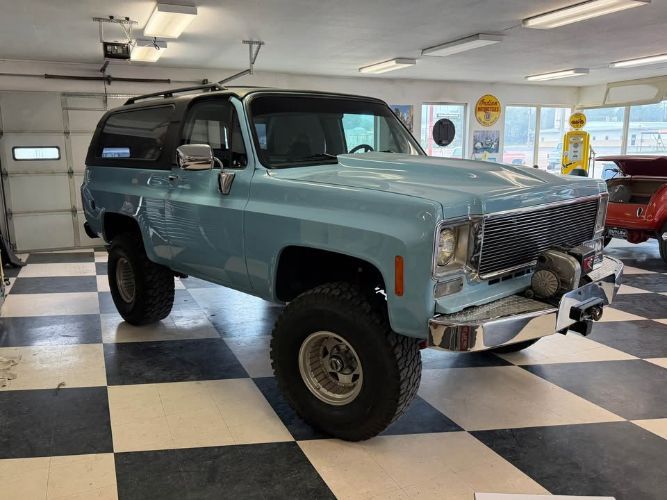
Production records from the 1972 model year show something that surprises people who assume every K5 Blazer left the factory ready for a trail: a meaningful share of them were built as two-wheel-drive trucks, ordered by buyers who wanted the size and the style without the mechanical complexity underneath. That split makes the 1972 K5 Blazer 4x4 worth studying on its own terms, because the four-wheel-drive versions were not simply the same truck with an extra badge. They were built around a different set of engineering decisions, and the reputation they earned in the field came from those decisions, not from marketing copy.
Car Features
7 min read
The 1972 K5 Blazer 4x4 and Its Trail Reputation
How the drivetrain underneath the 1972 K5 Blazer 4x4 was built, and how thousands of unglamorous jobs turned it into a trail legend.
The NP205 and what actually made it capable
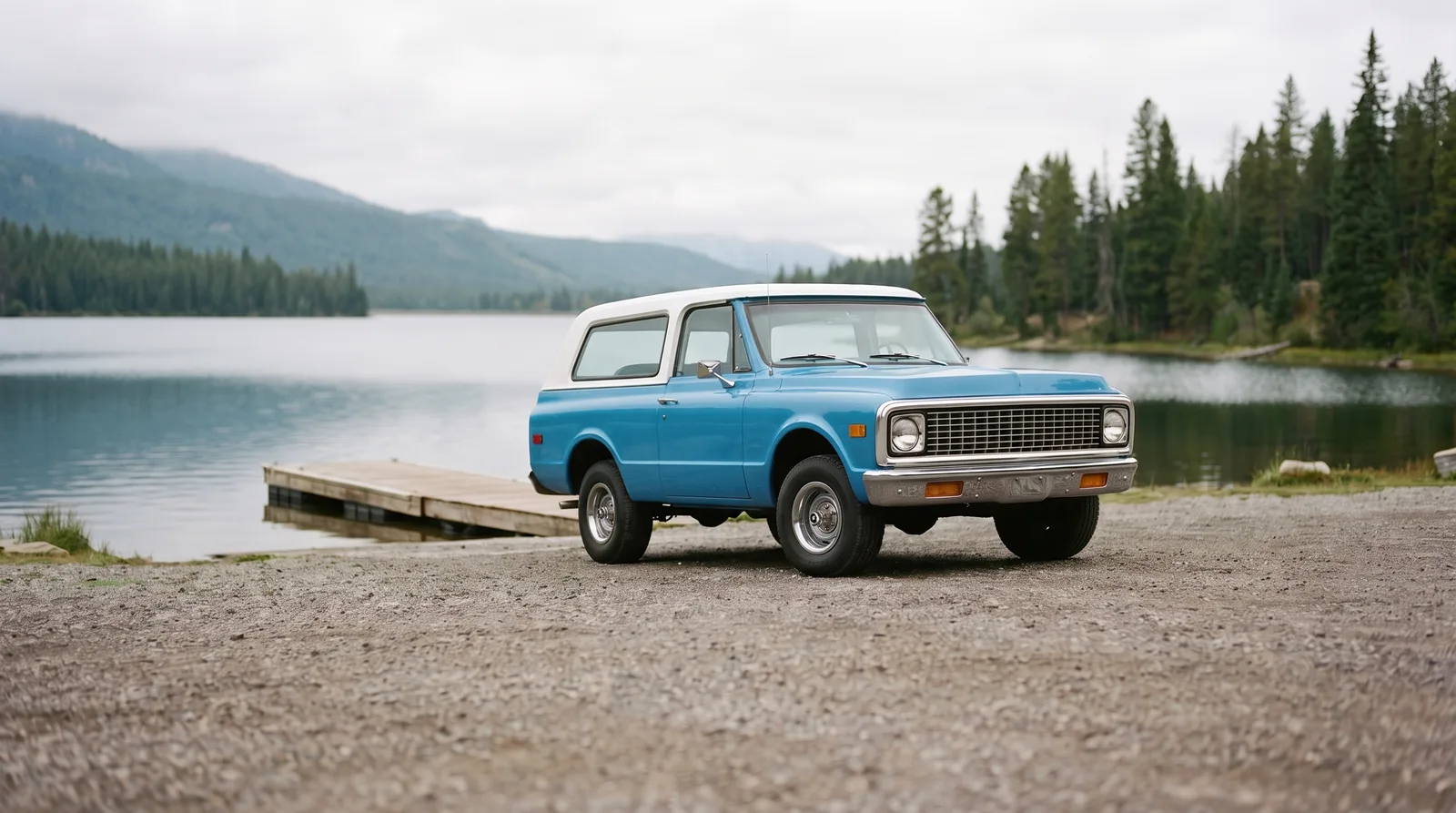
Underneath a 1972 K5 Blazer 4x4 sat a New Process 205 transfer case, a gear-driven unit rather than a chain-driven design, which is part of why so many of these trucks survived decades of ranch, forestry, and utility service without the transfer case itself becoming the weak link. Power routed to a Dana 44 front axle on most trucks of this model year, paired with a Chevrolet 12-bolt or a Dana rear depending on configuration and order date. None of this was exotic hardware. It was proven hardware, most of it shared across GM's truck lineup, which meant parts and service knowledge were never scarce even in rural areas far from a Chevrolet dealer.
The formula worked because it was simple enough for a ranch mechanic to understand and strong enough not to need constant attention. A part-time transfer case, manually engaged, meant the driver made the decision about when four-wheel drive was needed rather than a computer making it automatically, which suited an era and a customer base that trusted their own judgment over a dashboard light.
How the trail reputation actually got built
The 1972 K5 Blazer 4x4's reputation did not come from a single dramatic moment in Chevrolet advertising. It came from thousands of small, undocumented uses, forest service trucks reaching fire roads that regular pickups could not, ranchers crossing creek beds during spring runoff, ski patrols hauling equipment up unplowed access roads. These were not glamorous jobs, and most of them left no paper trail beyond a maintenance log or a purchase order from a government fleet. But that quiet, repeated, unremarkable competence is exactly what built the reputation the truck still carries.
Wheelbase and departure angle helped as much as the drivetrain did. The K5 Blazer's shorter wheelbase compared to the full-size pickup it was based on gave it a tighter turning radius and better approach geometry on tight trails, an advantage that mattered more in the field than any horsepower figure printed in a brochure.
Gearing, clearance, and the maintenance culture that followed
Low range in the New Process 205 gave the 1972 K5 Blazer 4x4 a meaningful mechanical advantage over trucks relying on gearing tricks elsewhere in the drivetrain, since the transfer case itself did the heavy work of multiplying torque rather than depending on an axle ratio to compensate. Combined with the available rear axle ratios, a properly equipped truck could crawl at a genuinely useful pace over rock and loose ground without the driver constantly modulating the throttle to avoid stalling, a trait that owners from the period consistently mention when comparing the K5 Blazer to lighter, less torquey competitors.
Ground clearance benefited from the same solid front axle that gave the truck its durability, since a beam axle sits higher under load than an independent front suspension design would at a comparable ride height. That tradeoff, a firmer and less refined ride in exchange for real clearance and axle strength, was exactly the kind of compromise a working 4x4 buyer in 1972 wanted, even if it would read as a downside on a modern comfort-focused review.
Fleet operators running these trucks developed maintenance routines built around the transfer case and front axle specifically, since those components saw uneven use depending on the season and the job. A ranch truck engaged four-wheel drive constantly through a muddy spring and rarely touched it again until the next wet season, a use pattern that put periodic, heavy stress on seals and u-joints rather than steady, predictable wear. Mechanics who serviced these fleets learned to inspect the front end more closely at the start and end of each wet season rather than on a fixed mileage interval, a practice that shows up repeatedly in period fleet maintenance logs.
What buyers actually chose in 1972
Engine choices for the 4x4 ranged from the standard six-cylinder up through Chevrolet's small-block and big-block V8 options, with the 350 cubic inch V8 proving the most popular middle ground between fuel economy and the torque needed to move a heavy 4x4 truck through mud or snow. Four-wheel-drive trucks made up the clear majority of 1972 K5 Blazer production, with the two-wheel-drive option, introduced for the 1970 model year, remaining the minority choice throughout the run. Buyers who checked the four-wheel-drive box on the order form were, on average, paying for capability they intended to use, whether that meant a working ranch, a construction site, or simply winters in a part of the country where two-wheel drive was not a realistic option.
| Component | 1972 K5 Blazer 4x4 |
|---|---|
| Transfer case | New Process 205, gear-driven, part-time |
| Front axle | Dana 44 |
| Rear axle | Chevrolet 12-bolt or Dana, by configuration |
| Engine options | Inline-six, 350 V8, big-block V8 available |
| Top configuration | Removable steel hardtop |
"Chevrolet did not need to invent a reputation for this truck. Forest services and ranch fleets did that work for them, one unremarkable winter at a time."
- Tom Ramirez
Cold-weather buyers in the northern states and Canada made up another significant slice of 1972 4x4 orders, since a truck that could handle unplowed roads and driveway snowbanks was less a luxury than a basic requirement for months at a time. Dealers in those regions reportedly steered nearly every K5 Blazer buyer toward the four-wheel-drive option by default, since a two-wheel-drive truck sitting on a northern lot risked becoming an unsellable liability the moment the first real snowfall hit.
Reading the 4x4 badge today
For a collector or buyer looking at a surviving 1972 K5 Blazer today, confirming genuine four-wheel-drive configuration matters more than the badge on the tailgate, since trim and running gear were sometimes swapped or altered over five decades of ownership. Checking the transfer case, front axle, and the underbody linkage against factory documentation is the only reliable way to know what you are actually looking at, a step worth taking before assuming a truck's trail-ready reputation applies to the specific example in front of you.
For the wider picture of the 1972 model year, including trim levels, colors, and the two-wheel-drive trucks built alongside the 4x4s, our 1972 k5 blazer retrospective covers the full lineup. If you want to see how the two-wheel-drive version compares, a related story looks at that overlooked side of the same model year. And for anyone ready to go looking for one, K5 Blazers for sale now is a good place to start comparing what has actually survived.
Sources and notes
Related Reading

About the author
Tom Ramirez
Corvette researcher and historian based in Bowling Green, Kentucky. Two decades documenting Corvette production history from original factory records.
Related Listings - Chevrolet Blazer

Comments
Be the first to comment on this article.