
The 1969 vs 1970 Mustang question looks simple until you are standing next to one. Ford changed the face, the tail, the interior and the engine list for 1970, but it kept the basic 1969 body. That means a lot of parts bolt across, and after fifty-plus years of fender benders and parts-counter substitutions, plenty of these cars now wear a little of both years. A 1970 nose on a 1969 car fools people at shows every summer.
Car Features
8 min read
1969 vs 1970 Mustang: The Differences That Matter
Headlamps, grille emblem, quarter scoops, tail panel, 351 Windsor vs Cleveland and the VIN year digit: how to tell a 1969 Mustang from a 1970.
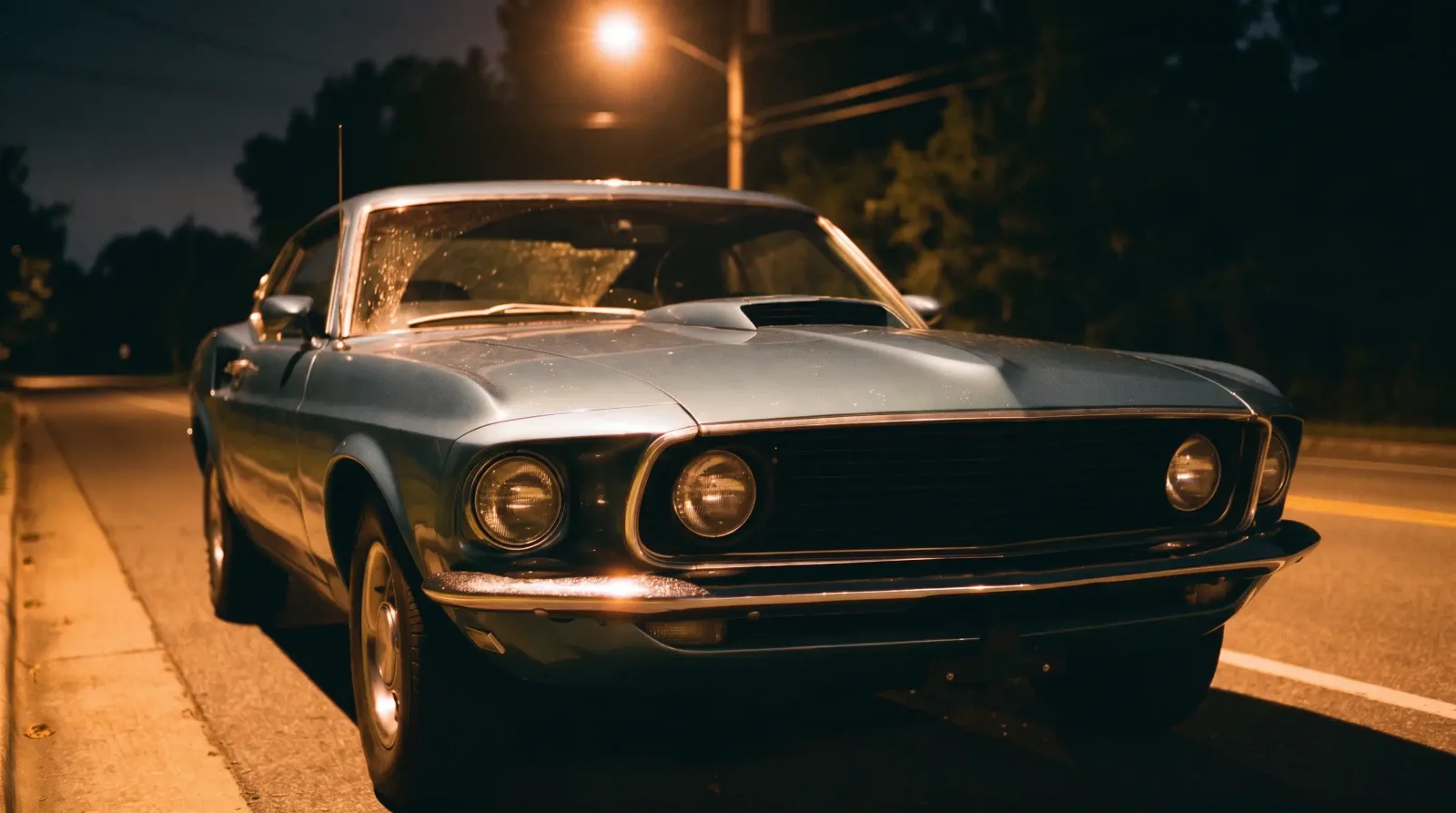
So here is the order I check things in: what you can see from across a parking lot first, and the things that actually prove the year last. If you want the paperwork side in depth, data plate and VIN included, the identification guide tells the full story.
1969 vs 1970 Mustang: count the headlamps first
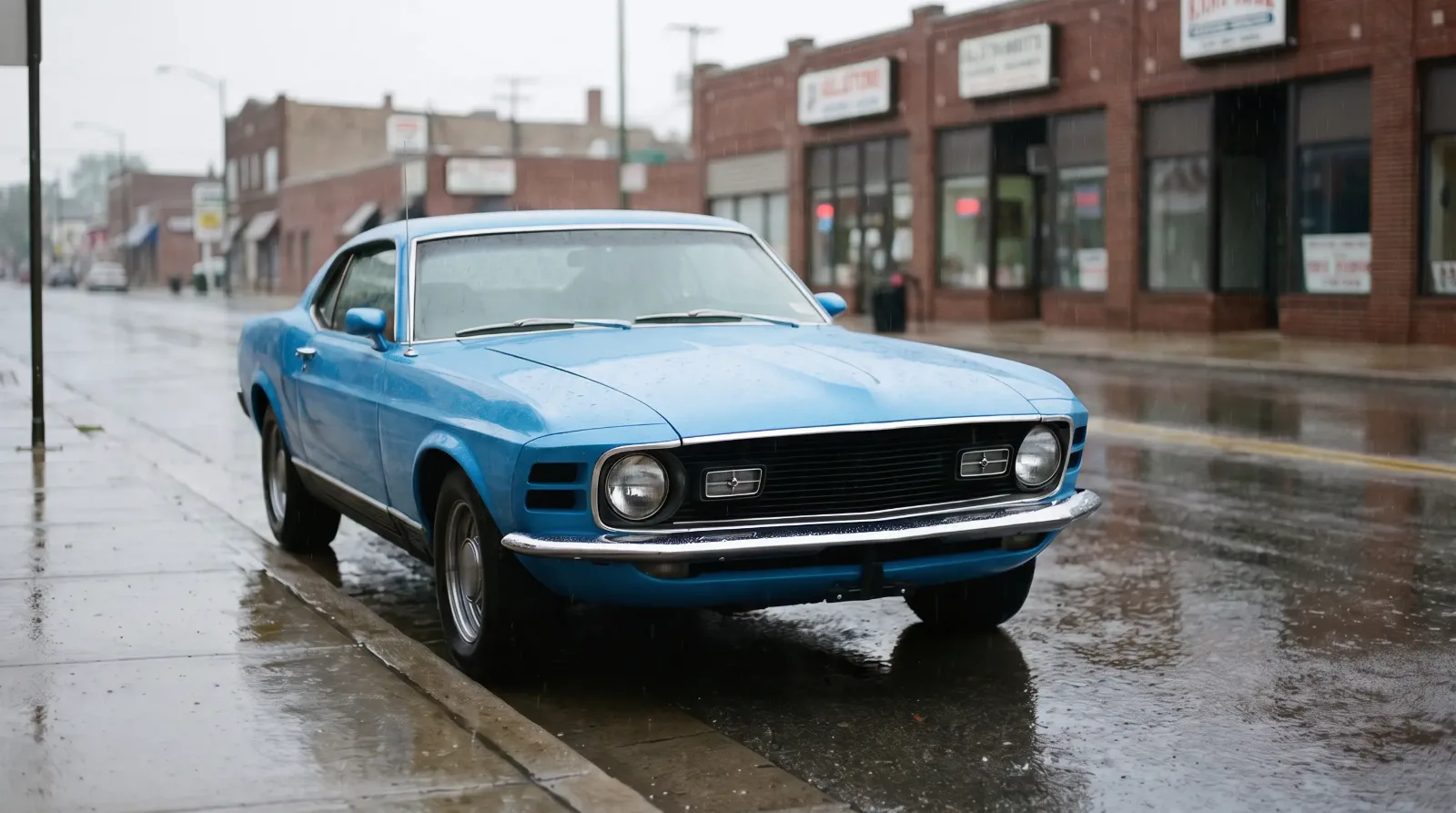
The 1969 is the only first-generation Mustang with four headlamps. Two sit inside the grille opening and two outside it. For 1970 Ford deleted the outer pair and put simulated intakes where they had been, which leaves two headlamps inside the grille. Four lamps, 1969. Two lamps with fake vents beside them, 1970.
Then look at the horse. On a 1969 the pony and tri-bar emblem sits off center, over on the driver's side of the grille. For 1970 it went back to the middle. That is two clues on one panel, and when they agree you are probably looking at a front end that came with the car.
Probably. A front end is sheet metal and bolts. I have seen a 1969 SportsRoof wearing a complete 1970 nose because the original got crunched and the 1970 pieces were what turned up at the salvage yard. When the front changes, the lamps, the grille and the panels around them all have to change together, so check the fit and the paint along the seams. A converted car usually gives itself away there. The Mach 1 has one more tell up front: for 1970 it got its own grille with two driving lamps set into it.
Down the side and across the tail
Walk down the side. The 1969 cars carry a fake scoop on the rear quarter panel. On the SportsRoof, which is what Ford's literature started calling the fastback that year, the scoop sits high on the quarter. On the hardtop and convertible it faces rearward. For 1970 the quarter scoops were deleted. There is one exception that trips people up: when Larry Shinoda styled the 1969 Boss 302, he took the fake scoops off. A genuine 1969 Boss has smooth quarters and four headlamps, and that is correct.
The stripes help on the performance cars. A 1969 Mach 1 wears reflective side striping and a matte-black hood held down with pins. The 1970 Mach 1 moved its identity down low, to an argent lower body panel with MACH 1 lettering, and traded the pins for twist-type hood locks. The Boss 302 changed too: a C-stripe in 1969, the hockey-stick stripe in 1970. Stripes are decals, though, and decals get changed by whoever did the last paint job. Treat them as a hint.
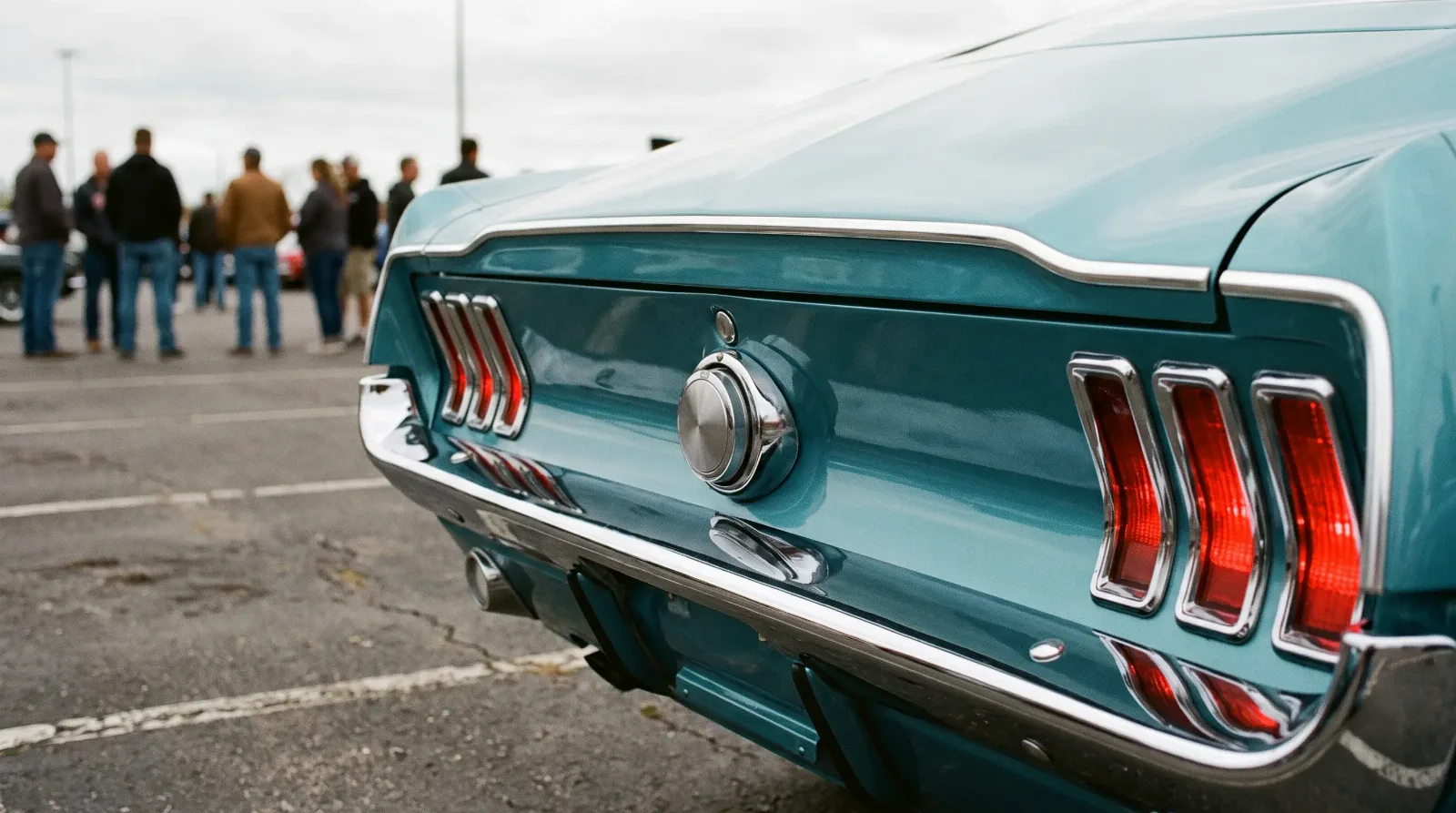
The tail is a better witness, because a taillight panel is welded in, not bolted on. The 1969 keeps the concave panel Ford had used since 1967, with the three-section lamps as separate units. The 1970 panel is flat, and its lamps are recessed into black panels with chrome bezels. A 1970 Mach 1 adds a black honeycomb finish across the panel. If the nose says one year and the tail says another, believe the tail.
"A four-headlamp nose takes a weekend to fit. A flat tail panel takes a welder and a lot of patience. When the two ends of a car argue about what year it is, I go with the end that was harder to change."
Mike Sullivan
Inside the car and under the hood
Open the door. High-back bucket seats became standard for 1970, and the ignition moved to the steering column, where it locked the wheel. Seats swap easily, so the ignition is the more useful of the two clues: a key that goes into the column belongs to a 1970. Grande owners get one more: the 1970 Grande brought houndstooth upholstery and a new option package with a seatback release, a remote mirror and courtesy lights.
The engine list is where the two years really split. For 1969 the 351 was a Windsor: the H-code 2V made 250 hp and the M-code 4V made 290 hp. For 1970 Ford brought in the 351 Cleveland, 250 hp as a 2V and 300 hp as a 4V with about 11.0:1 compression. Some early 1970 cars still left the line with the 351 Windsor 2V, so a 1970 with a Windsor is not automatically wrong. The 390 was dropped for 1970. The base 200 six went from 115 hp to 120 hp. The 428 Cobra Jet kept its 335 hp gross rating in both years, and the Boss 302 kept its 290 hp.
Watch the letters. The fifth character of a first-generation VIN is the engine code, and Ford reused letters, so M means a 351 Windsor 4V on a 1969 and a 351 Cleveland 4V on a 1970. Read the year digit and the engine letter together, never one without the other. There is a full rundown of the engine code letters by year if you need the rest of the list.
The Shaker scoop is less useful than people think. It arrived for 1969 on the 428 Cobra Jet, and the Boss 302 registry lists it across 1969 and 1970 for the 351, the 390, the 428 Cobra Jet and the Boss 302, so a Shaker on its own does not settle the year. The Boss is the exception worth knowing: it only got the Shaker for 1970, so a 1969 Boss 302 wearing one has had help. And the GT package ended with 1969, its last year, when 5,396 were sold. There is no 1970 Mustang GT, no matter what the badges say.
The numbers that separate 1969 and 1970
Here are the differences in one place, cosmetic and mechanical, with production by model year. The 1969 hardtop count depends on which table you read: 127,954 in some, 128,458 in others. The 504-car gap is exactly the gap between the two published 1969 totals, 299,320 and 299,824, so the disagreement sits in the hardtop count.
| Item | 1969 | 1970 |
|---|---|---|
| Headlamps | Four | Two, simulated intakes outboard |
| Grille emblem | Off center, driver's side | Centered |
| Rear quarter scoops | Yes (not on Boss 302) | Deleted |
| Taillight panel | Concave, separate lamp units | Flat, recessed lamps |
| 351 4V (M-code) | Windsor, 290 hp | Cleveland, 300 hp |
| Base 200 six | 115 hp | 120 hp |
| 390 V8 | 320 hp | Dropped |
| GT package | Last year, 5,396 sold | None |
| Total production | 299,824 | 190,727 |
| Hardtop | 128,458 (127,954 in some tables) | 82,569 |
| Grande | 22,182 | 13,581 |
| Mach 1 | 72,458 | 40,970 |
| Convertible | 14,746 | 7,673 |
| Boss 302 | 1,628 | 7,013 |
| Boss 429 | 859 | 499 |
Production fell from 299,824 to 190,727, a drop of more than a third in one model year. The convertible nearly halved. The Mach 1 went from 72,458 to 40,970. The one line that went the other way is the Boss 302, which jumped from 1,628 cars to 7,013. These two years were the last of the original-size cars before the much bigger 1971 Mustang arrived; for how they fit into the first generation as a whole, read more here.
The practical upshot is that the later car is the scarcer one. When you come across 1970 Mustangs at a show or in the classifieds, a 1970 convertible is one of 7,673, against 14,746 the year before. Worth remembering when somebody calls the two years interchangeable.
Proving the year when the parts disagree
Almost everything above unbolts or peels off, apart from the tail panel. To settle it, go to what the factory stamped. A first-generation VIN has 11 characters: the model year digit, the plant letter, a two-digit body code, the engine letter and a six-digit serial. The year digit is 9 on a 1969 and 0 on a 1970. That one character beats every grille, stripe and seat in the car.
Casting date codes add a second layer. Ford marked castings with a year digit, a month letter and a day, so 9B7 is February 7, 1969. Model year 1970 production was already running in the fall of 1969 (the Twister Special Mach 1s were built at Dearborn in October 1969), so an early 1970 can carry castings dated 1969 and be completely honest. A 1969 car carrying castings dated 1970 is wearing replacement parts.
And remember the Shelby exception from the box above. A Shelby titled as a 1970 will look like a 1969 because it is one, chin spoiler and hood stripes aside. For the rest of the first generation, and the cars on either side of this pair, the generation guide tells the longer story.
Sources and notes
- MustangSpecs: 1970 Ford Mustang (headlamps, column ignition, high-back seats, production)
- MustangSpecs: 1969 Mustang production numbers
- Classic Industries: 1964-1973 Mustang VIN decoder (year digit and engine codes)
- Wikipedia: Ford Mustang (first generation)
- Boss 302 Registry: the Shaker option, 1969-1970
- PowerNation: 1969 vs 1970 Mustang, pick your pony
Related Reading
#mustang identification
#Ford Mustang
#first generation Mustang
#1969 mustang
#1970 mustang
#Mach 1
#351 Cleveland

About the author
Mike Sullivan
Detroit-area muscle car enthusiast and restoration specialist with three decades of hands-on experience working on American iron.
Related Listings - Ford Mustang
Comments
Be the first to comment on this article.