
The jeep cj cj7 automatic transmission is the option nobody expected to matter and everybody now argues about. Jeep built the CJ-7 for 1976 with one job it had never done before on a short-wheelbase CJ: hold a slushbox. Before that year, if you wanted a CJ, you learned to work a clutch. The CJ-7's longer wheelbase, nearly ten inches more than the CJ-5's, existed partly to make room for that first automatic, a GM Turbo Hydra-Matic 400 behind a V8, and that single engineering decision changed who could own a Jeep and how the CJ-7 got used for the next decade. That decision sits inside a much longer arc, one that traces back to where this started, when the first civilian Jeep set out to prove a wartime workhorse could also be a daily driver.
Car Features
9 min read
Shiftless in the Wild: The CJ-7 Automatic Story
When Jeep gave the CJ-7 an optional Chrysler TorqueFlite automatic in 1976, it opened the trail to a driver who had never worked a clutch, and reshaped who the CJ-7 was really built for.
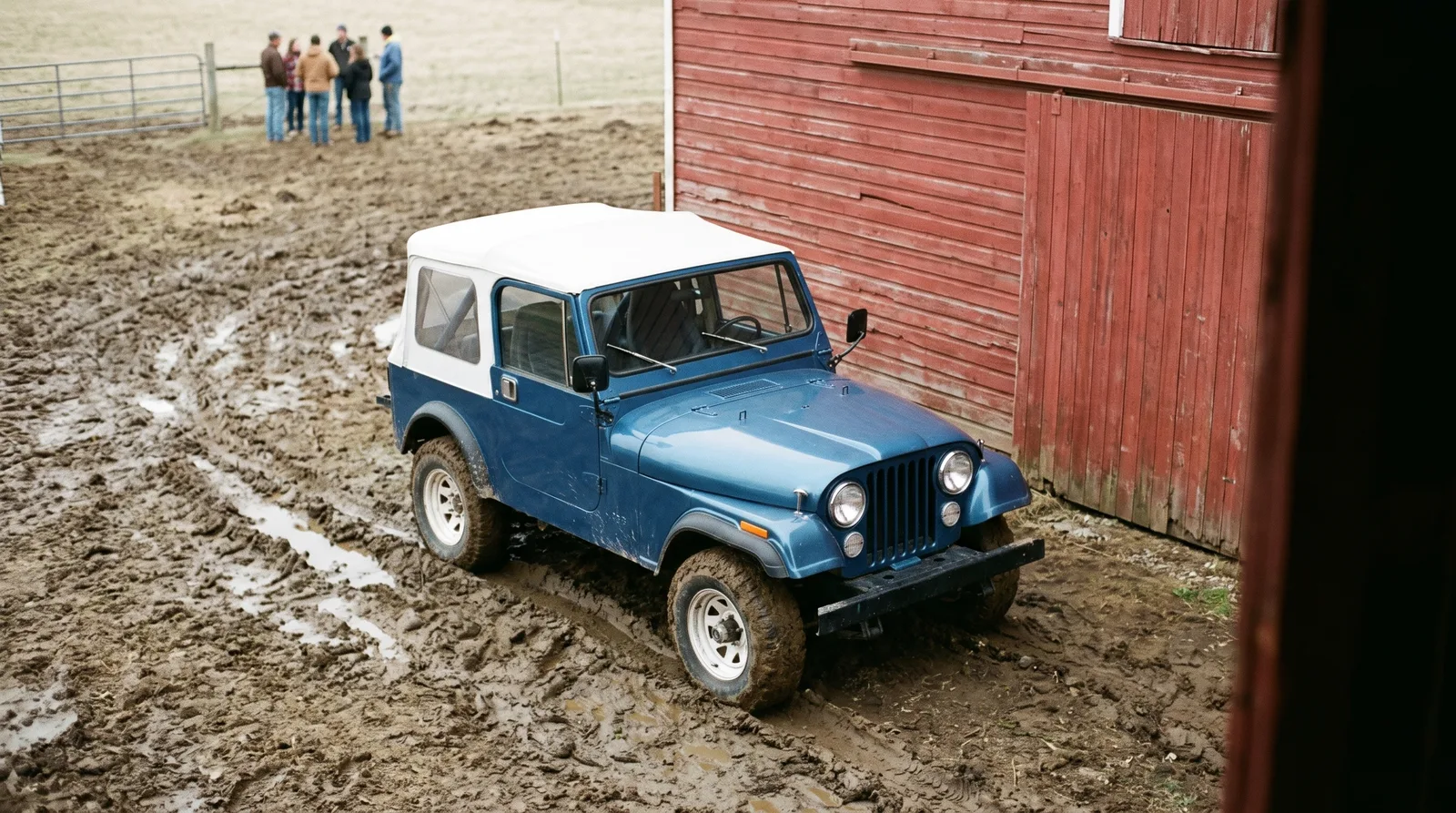
Why the CJ-7 got longer before it got easier
The CJ-5 traced back to an 81-inch wheelbase from the Korean War era M38A1, though by the time the CJ-7 was on the drawing board that wheelbase had already grown to 84 inches, stretched in 1972 so the CJ-5 could accept AMC's inline-six and V8 engines. Even at 84 inches, stuffing a three-speed automatic transmission and its case into that footprint asked for compromises nobody at Jeep wanted to make. So the CJ-7, introduced for the 1976 model year, stretched to 93.5 inches. The extra length gave the driveline room to breathe and gave Jeep's engineers space to run the automatic without redesigning the whole chassis around it.
That stretch also happened to make the CJ-7 friendlier on pavement, which mattered more than Jeep let on. By the mid-1970s the CJ buyer was no longer only a farmer or a National Guard unit. Suburban buyers wanted a Jeep that could double as a second car, and a second car needs to be drivable by someone who has never rowed a gear in their life. The automatic transmission was the concession that let the CJ-7 live that double life.
The gearbox itself: two borrowed hearts in a Jeep body
Jeep did not build its own automatic, and it did not stick with just one supplier either. For 1976 through 1979, the CJ-7's optional slushbox was a GM Turbo Hydra-Matic 400, a holdover relationship dating back to Jeep's Kaiser years, and it arrived bundled with the Quadra-Trac full-time 4WD system, most commonly behind the AMC 304 V8. Starting with the 1980 model year, Jeep switched suppliers and moved to a Chrysler-sourced TorqueFlite three-speed, the 999, part of the same family as the well-known A904/A727 units, this time paired with the Dana 300 transfer case and offered only behind the AMC 258 straight six. Both were proven units already doing duty elsewhere in Chrysler's and GM's own lineups, and that borrowed reliability is a big part of why so many CJ-7 automatics are still running.
What it cost the driver was engagement. A CJ with a stick invites you to manage the terrain, to feather the clutch on a rock ledge, to lug the engine down low and let compression do some of the braking on a descent. An automatic does that thinking for you, which off-road purists of the era treated as heresy and which plenty of trail-riding families treated as a relief. Both were right, depending on who was behind the wheel.
Who actually ordered one, and why the market misjudges them
Automatic CJ-7s were never the majority build. Most enthusiasts who wanted the CJ-7 for serious wheeling stuck with a manual, because the automatic added weight, complexity, and one more thing that could fail far from a parts store. But the automatic sold steadily to buyers who wanted the CJ-7's looks and capability without the learning curve, and by the early 1980s it was a common enough option that nobody blinked at seeing one.
Today the collector market still treats manual CJ-7s as the more desirable variant, and that pushes automatic-equipped trucks toward slightly softer prices. That is a mistake if you actually plan to drive the thing daily or hand it to a spouse or teenager who never learned three pedals. A well-sorted TorqueFlite CJ-7 is arguably the more usable classic, and usable classics tend to get driven, which is the whole point of owning one.
Emily Chen has spent enough time under these trucks to be blunt about the tradeoff. More on the Jeep CJ7 covers the broader model story, but the transmission choice alone tells you a lot about who Jeep was building for by the late 1970s.
"People assume the automatic is the compromised CJ-7. It isn't. It's the honest one. It admits that not everyone wants to work for their off-road capability, and it does the job without drama."
- Emily Chen
Living with a TorqueFlite CJ-7 today
The mechanical case for the automatic CJ-7 holds up well under inspection. Whether a truck carries the earlier TH400 or the later TorqueFlite, both are simple, well-documented three-speeds with straightforward valve bodies and parts availability that has never really dried up, since the same basic units saw duty across huge swaths of the GM, Chrysler, and AMC lineups. Fluid changes are cheap. Rebuilds are well within reach of a competent independent shop. None of that was guaranteed when Jeep picked either supplier, but it is how the story played out.
The compromise shows up in low-range crawling, where a manual's ability to slip the clutch and modulate power at a crawl gives it an edge on technical terrain. Automatic CJ-7s, whether running Quadra-Trac behind the TH400 or the Dana 300 behind the TorqueFlite, still go plenty of places, they just ask for a different driving style, more brake, less clutch-feathering finesse.
How the automatic changed on-road behavior more than off-road behavior
Take a CJ-7 automatic on a highway on-ramp and the difference from a manual truck is immediate. There is no rev-matching, no missed shift under load, just a smooth if unhurried climb through the automatic's three ratios. That predictability mattered enormously to buyers who were using the CJ-7 as genuine daily transportation, commuting on interstates and surface streets where a stalled clutch at a light is an embarrassment, not a character trait.
Off-road, the story is more nuanced than either camp likes to admit. The automatic's torque converter provides a small amount of built-in slip that can actually help in certain low-speed rock crawling situations, smoothing out the power delivery in a way a poorly modulated clutch cannot always match. Where it loses ground is engine braking on steep descents, since a driver cannot lug the automatic down in the same deliberate way a manual allows. Most owners compensate with the transfer case's low range and more deliberate brake use, and the truck gets down the hill just fine.
| Spec | Detail |
|---|---|
| Transmission, 1976-1979 | GM Turbo Hydra-Matic 400, three-speed automatic, with Quadra-Trac |
| Transmission, 1980-1986 | Chrysler TorqueFlite 999, three-speed automatic, with Dana 300 transfer case |
| First offered | 1976 model year, alongside the CJ-7's debut |
| Common engine pairings | AMC 304 V8 (TH400 era), AMC 258 I6 (TorqueFlite 999 era) |
| Wheelbase that enabled it | 93.5 inches (vs. 84 inches on the CJ-5, 81 inches on the original 1955-1971 CJ-5) |
| Typical era in production | 1976 through 1986 |
What to check before buying one
If you are cross-shopping classic CJs on the market and land on an automatic, the inspection priorities shift slightly from a manual-equipped truck. Check the transmission cooler lines for corrosion, since they route low and take road salt directly. Confirm the kickdown linkage is adjusted correctly, a cheap fix if wrong but a source of harsh or delayed shifts if ignored. And ask for maintenance records on fluid and filter changes, because a neglected automatic tells on itself with a burnt smell and delayed engagement long before it fails outright.
None of that makes an automatic CJ-7 a lesser purchase. It makes it a different one, built for a buyer Jeep was courting on purpose in 1976, and still a fair one to court today.
The parts supply question, answered plainly
One reason the automatic CJ-7 has aged into a practical daily classic rather than a curiosity is that neither transmission ever became an orphan platform. The TH400 saw duty across a huge slice of GM's own truck and car lineup, and the later TorqueFlite 999 belongs to the same Chrysler A904/A727 family used across decades of Mopar cars and trucks. Whichever one is under a given CJ-7, the specialty shops that keep old GM or Mopar drivelines running also know that gearbox cold, even if the truck wearing it has a Jeep grille. That cross-pollination of expertise is not something owners of more obscure factory-automatic conversions from other 1970s off-roaders can count on.
It also means used parts are not hard to source in a pinch, since the donor pool includes far more vehicles than just CJ-7s. A seal kit, a valve body rebuild, a torque converter, none of it requires hunting down Jeep-specific stock. That practical reality is worth factoring into any comparison between a manual and automatic CJ-7 beyond the driving experience alone.
The final word
The CJ-7 automatic never asked to be the enthusiast's first choice. It asked to start every morning and go where it was pointed, and by most honest accounts, it did.
Sources and notes
- Jeep-CJ.com Transmissions Wiki
- The Novak Guide to the Chrysler 727 TorqueFlite Automatic Transmission
- Advance Adapters: TorqueFlite 999 (32RH) Specifications
- Hagerty: The Jeep CJ-5 Was Built Forever to Go Wherever
- Automobile Catalog: 1976 Jeep CJ-7 304 V8 Quadra-Trac Automatic Specs
- CarBuzz: Jeep CJ-7 Overview, Design, Specs, and History
Related Reading

About the author
Emily Chen
Bay Area engineer with a deep focus on vintage Japanese and European performance cars. Approaches classic car research and restoration with an analytical eye.
Related Listings - Jeep CJ

Comments
Be the first to comment on this article.