
Park a flared, orange Fox-body hatchback on the grass at a Mustang show and somebody will walk past and call it a kit car. Somebody else will stop, read the badge, and start telling the story of the McLaren Mustang M81, usually with the production number wrong and the wrong Ford department in charge. The car deserves better than that. It was a Ford-sanctioned experiment built with McLaren's American engine shop, it carried a $25,000 sticker, and so few were built that most people who argue about it have never seen one. Then, a few years later, the McLaren name turned up on a second Mustang that had almost nothing in common with the first. This is the record on both cars, and where the paperwork runs thin I will say so.
Car Features
9 min read
The McLaren Mustangs: The M81 and the ASC McLaren
Ten turbo cars built with McLaren's engine shop, then just over 1,800 ASC cars wearing the same name: the record on both McLaren Mustangs.
What the McLaren Mustang M81 actually was
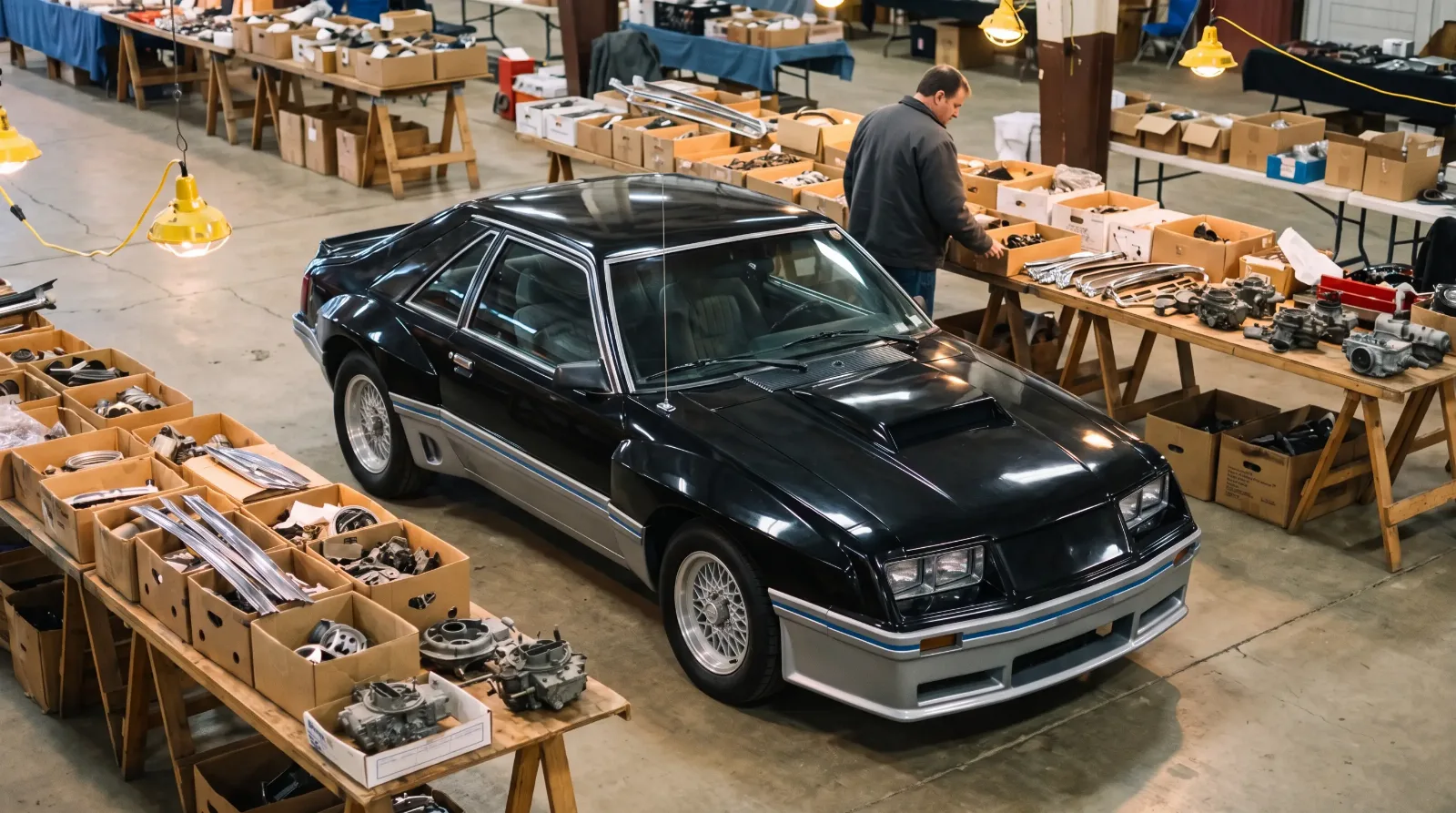
The M81 is often filed under Special Vehicle Operations, the racing division Ford set up under Michael Kranefuss. The better-documented accounts say it came from outside. Ford outlined the idea to Gary Kohs of Marketing Corporation of America, and Kohs built the M81 program around it. Roger Bailey of McLaren Engines, McLaren's engine shop in Livonia, Michigan, took on the turbo four, and Dave Kent of Creative Car Craft did the bodywork. SVO's part in the story, by several accounts, came at the end: the department reportedly resented the outside project and helped get it cancelled. I would file that as likely rather than proven. The base car was the Fox-body three-door hatchback with the turbocharged 2.3-liter four, and the surviving cars I have seen photographed all wear the hatchback roof with louvered rear quarter windows.
The equipment list reads like a road-racing wish list from the period. Steel IMSA-style fender flares covered wider BBS wheels on Firestone HPR tires. Koni dampers went underneath. Inside there were Recaro seats and a roll bar, and the hood was functional rather than decorative. None of it was a paint-and-tape package; the car looked like it had been built for the track because racing people had built it.
Now the dating, because this is where the bench racing usually starts. The name says 1981, and that is how the car is often described. Most records, the auction listings among them, call the road cars 1980 models. Old Cars Weekly's account explains the split: the cars were built on 1980 Mustangs, and the 81 points at the 1981 model year in which Kohs hoped to sell a full run. The McLaren-backed race cars also ran in 1981, starting at Daytona. I would not argue hard with either year, and I would want to see the build paperwork on any individual car before I wrote one on a show card.
Turning up the boost on the 2.3 turbo
To understand what McLaren did to the engine, start with what Ford was selling. The regular 1979 and 1980 Mustang turbo used a draw-through turbocharger with no intercooler, and boost was limited to 5 psi. Output was about 131 to 132 hp, depending on which Ford figure you read. It was also an engine with a reputation. Reliability problems dogged it, and it was dropped during 1981, so the turbo Mustang was on its way out just as the M81 was being sold.
McLaren blueprinted, ported and reassembled each engine by hand and fitted a Garrett T3 turbocharger. Most accounts say the M81 also gave the driver control over boost: a knob in the cabin let you adjust it from 5 psi up to 11 psi. One caution there. A 2024 Old Cars Weekly feature says most M81s it knows of do not have the boost controller, so check before assuming any one car has it. At 10 psi the engine was rated at 175 hp, a big step over the stock turbo car. That is the headline number, and it is the one people quote. What they leave out is the second half: the same engine that struggled with reliability at 5 psi was being asked to run at twice that pressure, and none of the accounts I have read lists an intercooler among McLaren's changes. The stock draw-through layout had none.
Motor Trend tested the car in its December 1980 issue and recorded 0 to 60 mph in 9.76 seconds and the quarter mile in 17.37 seconds at 79.20 mph. MustangSpecs says the testers ran it with the boost set to 7 psi; I have not seen the magazine page to confirm that setting. Those are not fast numbers, even for the time, and if the 7 psi figure is right they are a reminder that the 175 hp rating came at a boost setting the testers did not use. Ford's next try at a fast turbo Mustang, the SVO of 1984, went about the problem differently.
Ten cars and a $25,000 sticker
The plan called for about 250 cars; several accounts give the exact figure as 249. The price was $25,000. The build total was 10. That gap between plan and reality is the whole story of the M81 in three numbers. The accounts I trust name two reasons the run stopped: the price, and politics inside Ford, where the SVO group reportedly did not want an outside program on its turf. A Fox hatchback with flares and a turned-up four-cylinder was a hard sell at that money in 1980. The politics are harder to document, and I would rather call them a well-sourced story than a fact.
| Car | Years | Engine and boost | Rated output | Built |
|---|---|---|---|---|
| Mustang 2.3 turbo | 1979 to early 1981 | 2.3 turbo four, no intercooler, 5 psi limit | 131 to 132 hp | Regular production option |
| McLaren Mustang M81 | 1980 to 1981 | 2.3 turbo four, cabin-adjustable 5 to 11 psi (most accounts) | 175 hp at 10 psi | 10 (planned about 250) |
| Mustang SVO | 1984 to 1986 | 2.3 turbo four, intercooled, about 14 psi | 175 to 205 hp | Regular production model |
| ASC McLaren Mustang | 1987 to 1990 | 5.0 HO V8 | 225 hp (stock 5.0 rating) | Just over 1,800 |
Even the count of 10 has an asterisk, and the colors have a bigger one. Some accounts say 11, counting the original prototype, and give a color split of seven Bittersweet Orange, one black, one white and two cars with the Enduro treatment. Those figures add up to 11, not 10. Another recent history gives the ten as seven orange, two white and one black, and treats the Enduro cars as a separate group of about three continuation cars built on 1982 GTs with the 302 V8. Old Cars Weekly goes further and says all ten, prototype included, left in McLaren orange, and that the black and white cars are repaints. Ten is the number most sources agree on. The color breakdown is not settled. If anyone owns one with original paperwork, that sheet settles more arguments than any website.
"Every club has a member who swears he saw one of the 250 McLarens. Ford planned 250. It built about ten. When the plan and the build sheet disagree, the build sheet wins, and with this car the build sheets are what everybody should be asking about."
Wayne Coburn
The ASC McLaren, 1987 to 1990
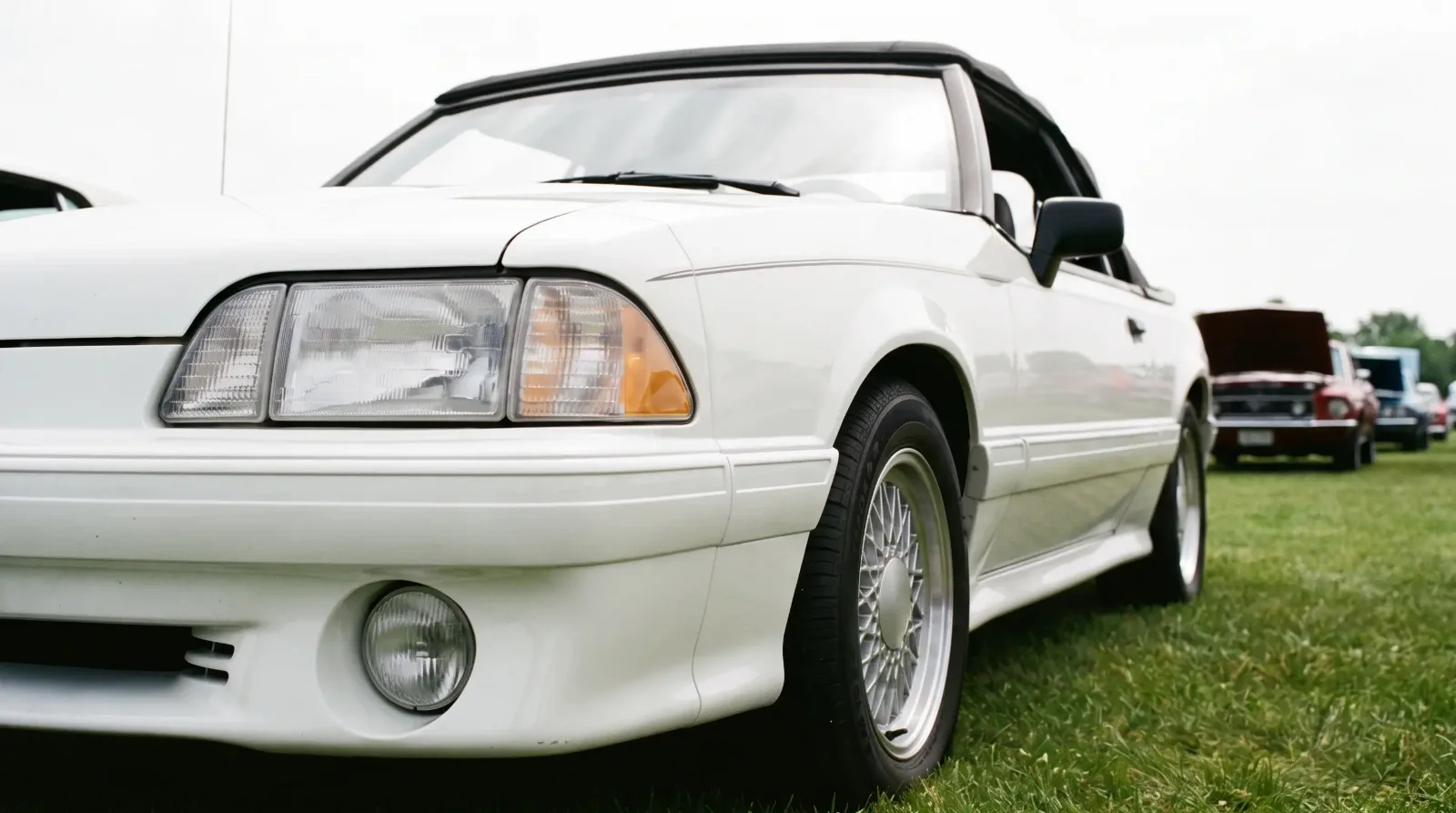
The second McLaren Mustang came from a different company and a different idea. ASC started as the American Sunroof Company, founded in Los Angeles in 1965 by Heinz Prechter. Over the years it grew into a specialty-car builder, and it took on the McLaren name through McLaren Engines, the Michigan racing-engine business Bruce McLaren had founded. Wikipedia says ASC bought that company; another history describes it as a licence of the name. The name went first on a dressed-up Mercury Capri in 1984 and moved to the Mustang for 1987. Is it the same McLaren as the M81? In one sense, yes: the M81's engines came out of that same Michigan engine shop. In the sense that matters to a buyer, no. The ASC cars had no connection to the McLaren Formula One team, and the same recent history says McLaren's Michigan engine people never touched the V8 in the Mustang that carried their name.
The ASC McLaren Mustang ran from 1987 to 1990, and ASC built just over 1,800 of them across coupes and convertibles. The best-known version is the two-seat convertible, with its windshield raked back an extra 20 degrees and a three-window soft top. For the 1989 model year, ASC built 289 of those. Where the M81 was a turbo four built with McLaren's engine shop, the ASC car was a coachbuilt Fox-body car on the standard 5.0 HO V8, styled and trimmed for a buyer who wanted something rarer than a showroom GT. In 1987 the showroom 5.0 itself was rated at 225 hp and 300 lb-ft, and I have not seen a record of ASC raising that figure, so I make no performance claims for the ASC car here.
That is the confusion in a nutshell. Two cars, about seven years apart, share a name and a Fox-body platform. One was a 10-car experiment with a turbo four. The other was a limited coachbuilt V8 car with a production run about 180 times larger. Beyond the platform, the badge is the only thing they have in common.
Where the McLaren cars sit in the tuner story
The M81 matters less for the cars themselves than for what came after. It was not an SVO car, but it was the first serious attempt to sell a high-boost turbo Mustang, and four years later Ford's own SVO division put its name on the 1984 Mustang SVO, a turbo Mustang with an intercooler, four-wheel disc brakes and a regular production line behind it. The lessons look obvious in hindsight. A turbo four needed an intercooler to make that kind of power reliably, and a performance Mustang had to be priced like a Mustang to sell in useful numbers.
The ASC car belongs to the other branch of the family tree, the outside builders who took a stock Mustang and made it into something limited. That branch would grow through the rest of the decade and into the 1990s, and the factory would later field its own Special Vehicle Team and the first Mustang SVT Cobra in 1993. Neither McLaren car sold in big numbers. What they did was mark the two directions every tuner Mustang since has taken: build it with the factory's blessing and a racing partner, or build it outside and put your own name on it. If you see either one at a show, ask to see the paperwork. With cars this rare, the paperwork is the story.
Sources and notes
- MustangSpecs: 1980 SVP M81 McLaren Mustang
- The Autopian: Ford, McLaren and the M81 Mustang (2025)
- Old Cars Weekly: Car of the Week, 1981 McLaren M81 (2024)
- FordMuscle: Blue Oval Icons, the McLaren M-81 Mustang (2018)
- The Drive: one of the world's rarest Ford Mustangs heads to auction (2020)
- Wikipedia: American Specialty Cars
Related Reading
#Ford Mustang
#fox body mustang
#McLaren Mustang
#Ford SVO
#ASC McLaren
#Mustang turbo
#tuner Mustangs

About the author
Wayne Coburn
Longtime Corvette owner, judge and club figure who knows the cars, the records and the people behind them.
Related Listings - Ford Mustang



Comments
Be the first to comment on this article.