
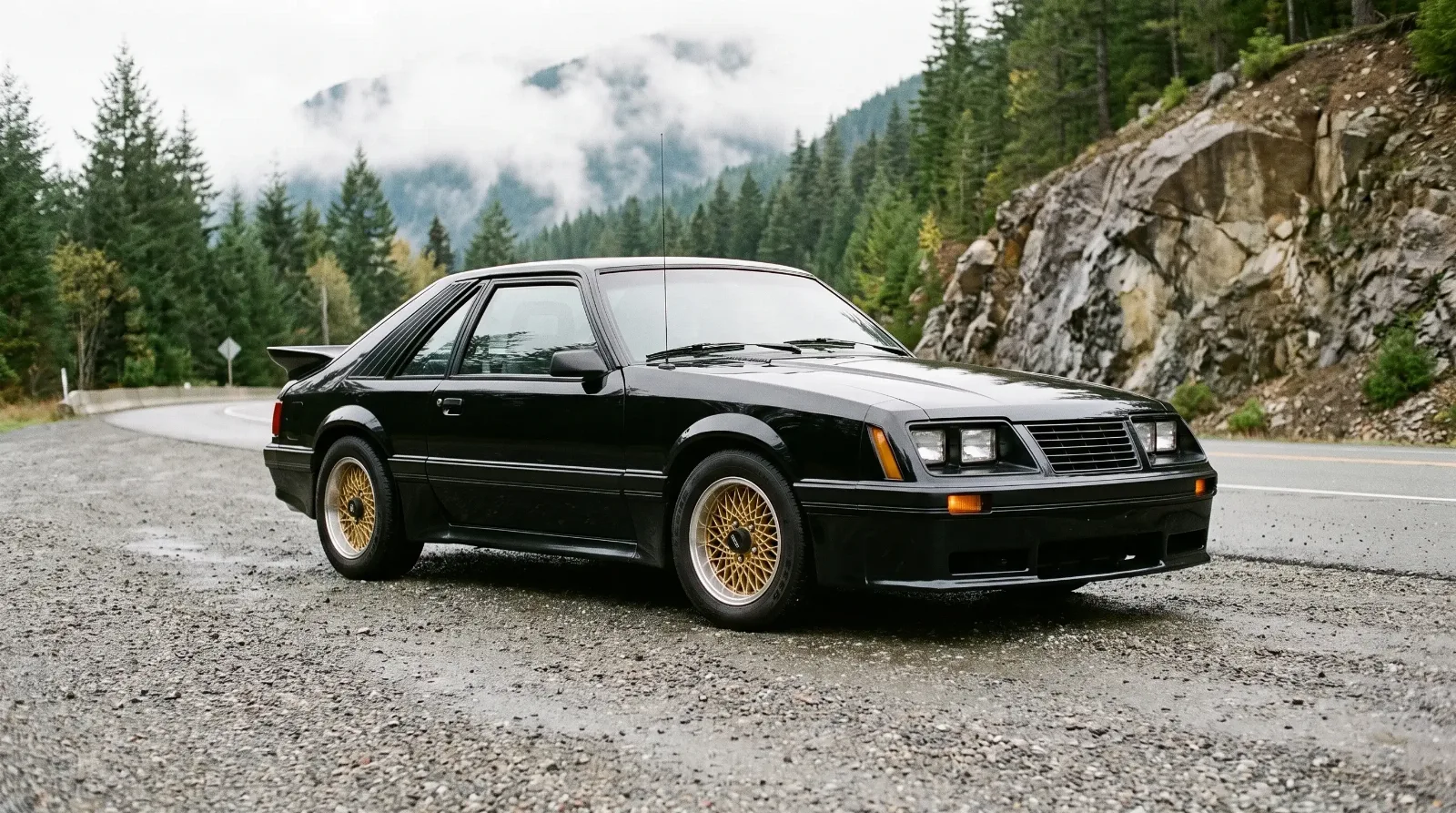
The Mustang SVO was Ford's answer to a question very few buyers were asking in 1984: what if the fast Mustang had four cylinders? It ran a turbocharged 2.3-liter four with an intercooler, four-wheel disc brakes and adjustable Koni dampers, and it cost more than twice as much as a base Mustang. At launch it made 175 hp. So did the V8 GT, for about $6,000 less. That is the whole story in two sentences. The rest is the detail behind it.
Car Features
8 min read
The Mustang SVO: Ford's Turbo-Four Experiment
The 1984 to 1986 Mustang SVO paired an intercooled 2.3 turbo with real brakes and Konis. The numbers, and why the 5.0 GT outsold it.
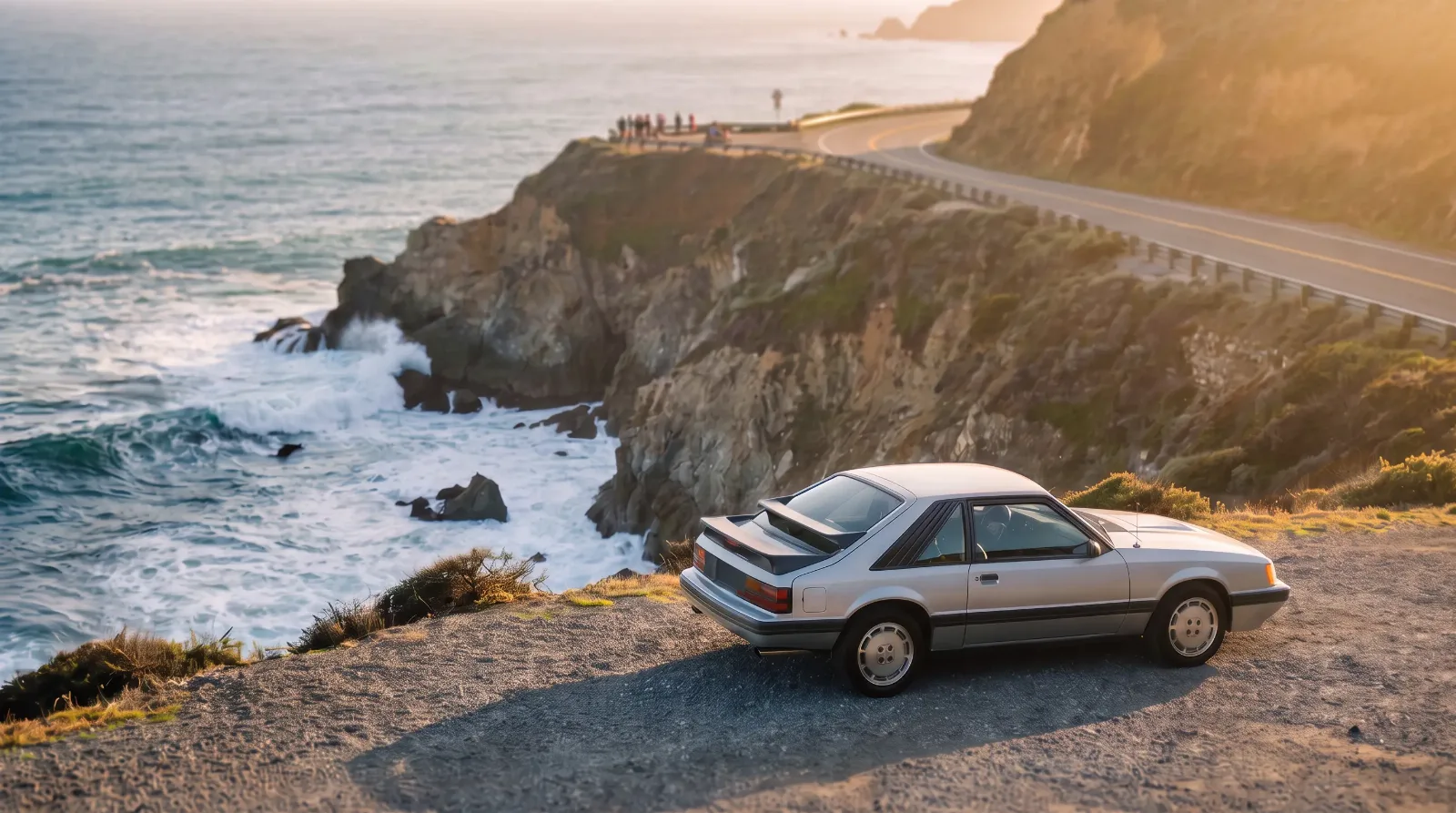
This is the narrow version: the engine, the chassis, the year-by-year numbers and why the car was gone after 1986. The wider picture of Ford's factory specials and the outside tuners who followed them is in the full story. Here the subject is one car and the numbers it put on paper.
Who built the Mustang SVO
SVO stands for Special Vehicle Operations. Ford decided to form the group late in 1979, it was up and running in 1980, and Michael Kranefuss ran it. It started as Ford's racing division. Road cars came second.
Before the production car, SVO worked with McLaren on the M81, a 2.3 turbo Mustang with boost adjustable from the cabin between 5 and 11 psi. At 10 psi it made 175 hp. Remember that figure. It comes back.
The production SVO was previewed for the press in Northern California in 1983 and went on sale in mid-April 1984, which makes it a 1984½ model. Underneath it was a Fox Mustang, the same rear-drive platform Ford had used for every Mustang since 1979. If you want that platform's full timeline, the Fox Body story covers it year by year. The SVO took that chassis and changed almost everything bolted to it.
The pitch was simple. Ford built the 2.3 four in volume. It had a turbo program that had gone badly. It had a racing group that knew how to make small engines pull hard. Put those together with real brakes and real dampers and you get a European-style sports coupe wearing a pony badge. Whether Mustang buyers wanted a European-style sports coupe was a separate question, and the sales figures answered it.
A turbo four that finally worked
Ford had tried a turbo Mustang before, and it did not go well. The 1979 to 1981 turbo 2.3 was a draw-through setup with no intercooler and boost held to 5 psi. It made 131 to 132 hp and had a reputation for reliability trouble. It was offered into 1981 and then quietly dropped. For 1983 the turbo returned in the Turbo GT, now with fuel injection and 145 hp. Ford sold 483 of them. That is not a typo.
The SVO engine started from the same 2.3 Lima four, a single-overhead-cam engine of 140 cubic inches. Then SVO changed what mattered. It fitted a Garrett AiResearch T03 turbocharger, ran it at around 14 psi, and added an air-to-air intercooler fed by a functional scoop in the hood. That is close to three times the boost of the 1979 car.
The intercooler is the reason the boost was usable. Compressing air heats it. Hot air is less dense and more prone to detonation, which forces the tuner to pull timing or pull boost. Cool the charge and you can run more of both. That is where the power came from, not from a decal or a scoop for show.
Launch output was 175 hp and 210 lb-ft. Do the arithmetic per cubic inch. The SVO made about 1.25 hp per cubic inch. The 302 in the 1984 GT, rated at the same 175 hp with its four-barrel, made about 0.58. On efficiency the four won by a mile. Ford also put a fuel-grade switch on the dash so the driver could tell the engine computer whether the tank held premium or regular, and the computer set the spark advance to match. Below 2,500 rpm boost was held to 10 psi; the full 14 came only higher in the rev range on premium. That tells you how close to the edge the calibration ran.
The catch was the delivery. A V8 makes its torque from idle. A turbo four makes its torque once the turbo is spinning. Below that, the SVO drove like a 2.3, and a short test drive could end before the driver ever felt the boost come in.
What $15,585 bought in 1984
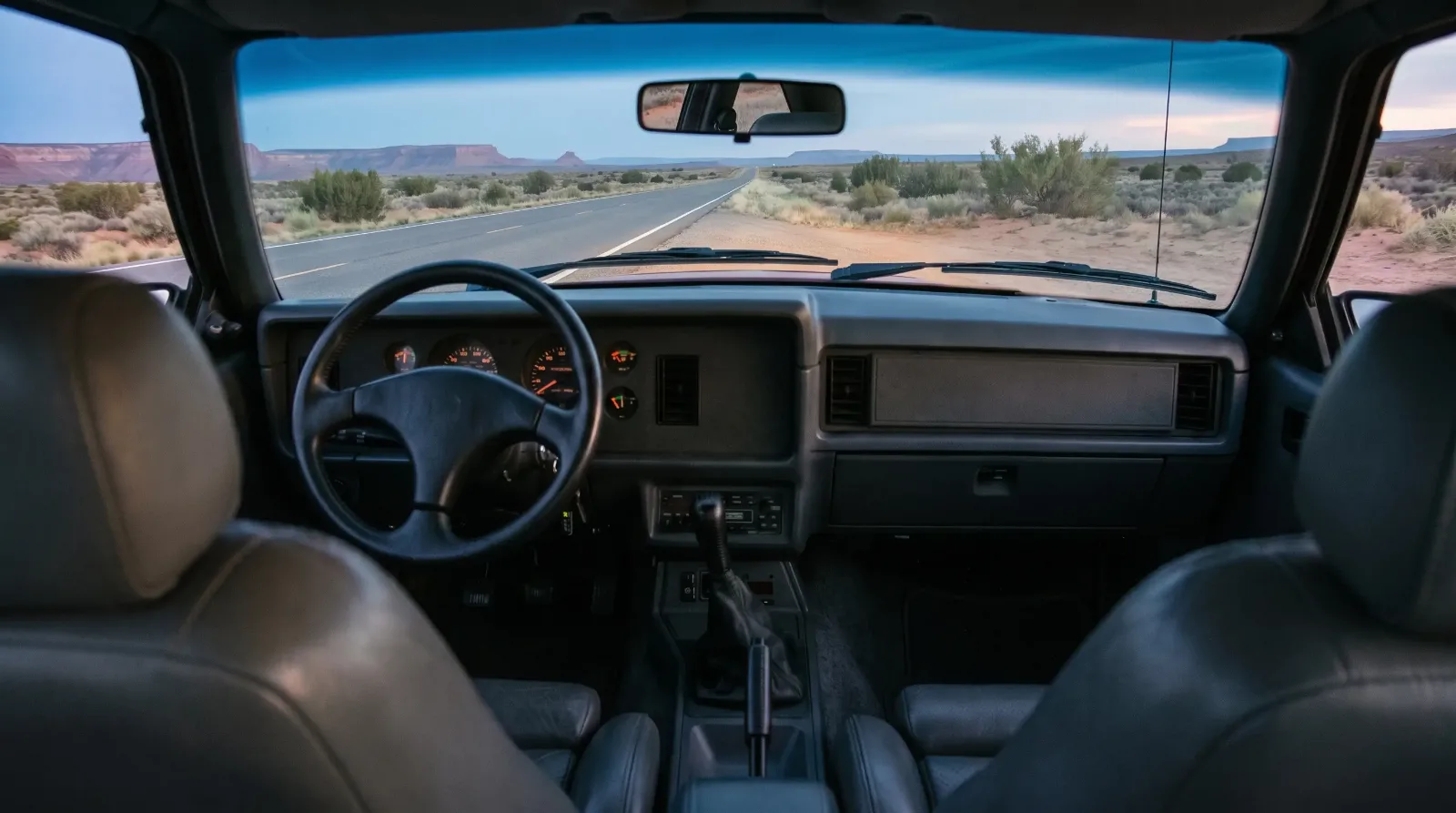
The SVO listed at $15,585 in 1984½. That was more than double the price of a base Mustang and roughly $6,000 over a GT. For the money, Ford put the effort where a racing group would put it.
Brakes were vented discs at all four corners, sourced from the Lincoln Mark VII. Dampers were adjustable Konis. The wheels were 16x7 five-lug pieces on P225/50R16 tires, a serious tire size for the period. The gearbox was the T-5 five-speed with a Hurst shifter. None of that was cosmetic, and all of it showed up on a road course.
The body got its own treatment too. The hood carried the intercooler scoop. The rear wore a biplane spoiler, two stacked wings instead of the usual single lip. The drag coefficient came in at 0.38 to 0.39. The 1984 cars used sealed-beam headlamps. Flush composite lamps arrived with the 1985½ update, and that front end mattered later.
The SVO was not the only Fox Mustang being reworked for handling that year. Elsewhere, a Trans-Am racer named Steve Saleen was building his first three hatchbacks around a suspension, aero and interior package with stock Ford engines. That project became Saleen's first car, and it took the opposite route to the same customer.
Mustang SVO output and production by year
The SVO changed twice in its short life. The 1985½ revision raised output to 205 hp and 248 lb-ft and brought the composite headlamps. For 1986 the rating dipped to 200 hp and 240 lb-ft. Production tells the rest.
| Model year | Output | Built | Notes |
|---|---|---|---|
| 1984½ | 175 hp / 210 lb-ft | 4,508 | Launch year, sealed-beam headlamps, $15,585 list |
| 1985 (early) | 175 hp / 210 lb-ft | 1,515 | Carryover car |
| 1985½ | 205 hp / 248 lb-ft | 439 | Composite flush headlamps |
| 1986 | 200 hp / 240 lb-ft | 3,382 | Final year |
| Total | 9,844 | Includes 123 Competition Prep cars |
The test numbers back the hardware. Popular Mechanics recorded 0 to 60 in 7.5 seconds and a quarter mile of 15.5 seconds at 90 mph. Its January 1984 test ran 15.8 at 90.1. A 1985 car with a 3.73 axle, as reported by Hemmings, ran 15.0 at 94 mph. Quick for a four-cylinder in 1984. Not quick enough to embarrass a 5.0.
Why the Mustang SVO lost to the 5.0
Put the two cars side by side and the problem is obvious. In 1984 the GT made 175 hp with a four-barrel and the SVO made 175 hp with a turbo, and the GT cost about $6,000 less. For 1985 Ford gave manual GTs a roller camshaft, better heads and freer manifolds, and the V8 jumped to 210 hp. The early 1985 SVO was still at 175. The 1985½ car closed the gap at 205. For 1986 the GT went to sequential fuel injection at 200 hp, and the SVO sat at exactly 200. Same number, different sticker.
Ford built 224,410 Mustangs for 1986. The SVO was 3,382 of them, about one and a half percent. Buyers had voted with their checkbooks, and they voted for displacement. The V8 was cheaper to buy, simpler to run, easier to modify and made its torque without waiting for anything to spool. The SVO's better brakes and dampers were real advantages. On a showroom test drive they were invisible.
"Divide the horsepower by the cubic inches and the SVO wins in a walk. Divide the horsepower by the dollars and the GT wins in a walk. In 1984 people paid in dollars."
Dan Reeves
The car still left marks. The flush-headlamp nose from the 1985½ SVO went across the whole Mustang line with the 1987 facelift, announced in August 1986. And the idea of a small in-house team building a sharper Mustang did not die with SVO. Ford's Special Vehicle Team took over production-car tuning later, with a V8 this time. That chapter, and the rest of the history of the Ford Mustang, sits elsewhere.
The SVO ended after 1986 with 9,844 built. It was the right engineering answer to a question the market had not asked. Today it is the Fox Mustang that people who care about brakes and balance tend to seek out, and a fair number still turn up when you browse Fox Body Mustangs. Most of them, as in 1984, are V8 cars.
Sources and notes
- Ford Mustang SVO (Wikipedia): launch, price, fuel-grade switch, production by year
- Ford Mustang, third generation (Wikipedia): 5.0 ratings and Fox production by year
- Ford Pinto engine (Wikipedia): the 2.3 Lima four and its turbo versions
- 1983 Ford Mustang (MustangSpecs): the 145 hp Turbo GT
- 1984 Ford Mustang (MustangSpecs): SVO and GT output and pricing
- 1986 Ford Mustang (MustangSpecs): final-year SVO and the SEFI 5.0
Related Reading
#mustang history
#Ford Mustang
#1980s performance cars
#Fox-body
#Mustang SVO
#2.3 turbo
#Special Vehicle Operations

About the author
Dan Reeves
Performance engine builder from North Carolina's motorsports corridor, focused on swaps, forced induction and making real, repeatable power.
Related Listings - Ford Mustang



Comments
Be the first to comment on this article.