
A moving assembly line is only as fast as its slowest fit. If a worker has to file a bearing cap, shim a bracket or try three pistons before one slides home, the line stops while he does it. That is why the story of Model T interchangeable parts comes before the story of the line itself. Ford could only bolt a car together in minutes because every part arriving at a station was made to fit any car on the line, without hand work. The line gets the headlines. Precision machining did the quiet work underneath it.
Car Features
6 min read
Interchangeable Parts and the Model T
Before the moving line came the tolerance: how a 1/64 inch standard and 15,000 machine tools let Ford build Model Ts without hand fitting.
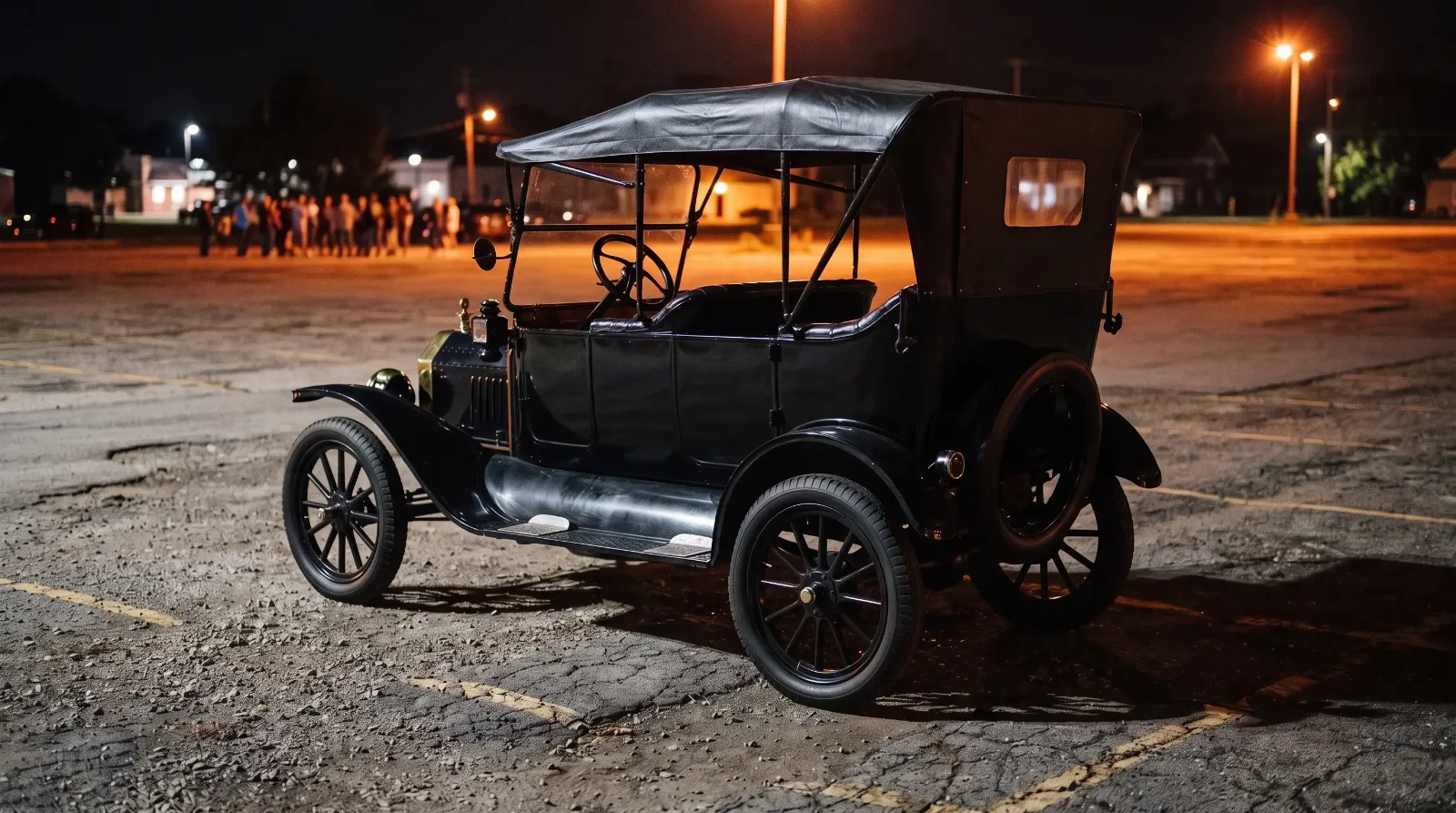
This piece looks at the engineering idea, how Ford applied it to the Model T, and what it meant for owners who needed a spare part decades later. The line itself, with its stations and timings, is covered in our piece on Henry Ford's assembly line.
What "interchangeable" actually means
Two parts are interchangeable when either one can go into the assembly and work correctly, with no fitting by hand. That sounds obvious. In practice it is a statement about tolerances.
No machine cuts a shaft to exactly the size on the drawing. Every real part is a little over or a little under. The engineering trick is to decide how much error each dimension can carry and still mate with its partner, and then to make sure every part falls inside that band. A shaft that must enter a bore needs a shaft that is never too fat and a bore that is never too tight. Get the bands right and any shaft fits any bore. Get them wrong, or let the machines drift, and you are back to a man with a file.
The older method, common in the early car industry, was selective fitting: make parts roughly, then match or adjust them one pair at a time. It works, and it can produce a fine car. It does not scale. Each car becomes a set of parts that belong to each other and to nothing else.
How Ford made Model T interchangeable parts
The typical tolerance cited for Model T parts is 1/64 inch. By modern standards that is generous. It was tight enough for the job, and the important thing is that Ford held it consistently, part after part, across huge volumes.
Consistency came from the machines. By 1914 Highland Park had about 15,000 machine tools. In a mass-production shop the principle is to set a machine up for one operation on one part, with a fixture that holds the work in the same place every time. A single-purpose machine with a good fixture is hard to get wrong. The skill moves out of the operator's hands and into the setup of the machine.
The design helped too. The Model T engine was a four-cylinder of 177 cubic inches, with a 3.75 inch bore and a 4.0 inch stroke. It used a cast-iron monobloc, with all four cylinders cast in one piece, a detachable cast-iron head and three main bearings. Fewer separate castings means fewer joints that need to line up, and a detachable head leaves the cylinders open from above, which makes them easier to machine and inspect. The front axle was drop-forged vanadium steel, a material chosen because it was lighter and stronger than ordinary carbon steel.
The earliest cars were not fully settled. Model Ts from roughly serial 1 to 2,500, built between October 1908 and April 1909, carry many early features, and the car was largely standardized from about number 2,500 onward. Standardizing a design is a precondition for interchangeability: you cannot hold one part to a tolerance band while its partner keeps changing shape.
"People like to say the assembly line made the Model T cheap. The more precise version is that tolerances made the line possible. A conveyor moving a car past a man with a file is just a slow way to file things."
Emily Chen
What precision bought Ford on the factory floor
The payoff showed up in places that are easy to miss.
- No engine test before fitting. Ford did not test engines before they went into a chassis. The reasoning was simple: if the parts were made correctly and put together correctly, the engine would be correct.
- Stock as a buffer. Highland Park kept a parts inventory for 3,000 to 5,000 cars, about 6 to 10 days of production. A pile of parts is only useful as a buffer if any part in the pile fits any car.
- Short, simple jobs. When parts fit without adjustment, an assembly task can be cut into small steps. That is what made the timings on the line possible: chassis assembly fell from about 12.5 hours of stationary work to 93 minutes on the line by early 1914.
| Measure | Figure | Scope |
|---|---|---|
| Design tolerance cited | 1/64 inch | Model T parts |
| Machine tools | About 15,000 | Highland Park, by 1914 |
| Parts inventory | 3,000 to 5,000 cars' worth (6 to 10 days) | Highland Park, 1910s |
| Chassis assembly time | 12.5 hours stationary to 93 minutes on the line | Highland Park, 1913 to 1914 |
| Design largely standardized | From about serial 2,500 | 1909 model year |
Contemporary engineers noticed. In 1915 Horace Lucien Arnold and Fay Leone Faurote published "Ford Methods and the Ford Shops," a detailed study of how Highland Park worked. It remains one of the best period records of the machining and gauging that held the system together.
Interchangeable parts after the sale
Interchangeability did not stop at the factory gate. It shaped how a Model T was owned.
Ford's dealers were required to stock parts and to train at Ford schools. Because a part from the shelf would fit the car in the driveway, a dealer could fix a T without a machinist. Mail-order houses joined in: the Sears catalog offered Model T replacement parts such as axles and tops. A standardized car makes a parts trade possible, and the parts trade in turn made the car easier to keep running.
The effect outlived the car. Model T engines were built until August 4, 1941, and almost 170,000 were made after car production stopped in 1927. That long tail only makes sense if each new engine could drop into a car built years earlier. With more than 15 million Model Ts built in all, the installed base was large enough to justify it. For the year-by-year breakdown of how those cars piled up, see the yearly output figures.
There is a limit worth knowing. Interchangeability ran within the Model T family, not across Ford's history. When the Model A arrived for 1928, its engine was considerably larger and no engine parts interchanged with the T. Same company, same methods, new set of tolerances. That is how the system is meant to work: interchangeable inside one design, and free to start fresh with the next.
Sources and notes
Related Reading

Have a
Ford Model T
for Sale?
Reach thousands of serious classic car collectors across the US.
Sell It Here →
Selling a classic? Here's how: the best sites to sell a classic car
Are You a Classic Car Dealer?
List your full inventory and connect with targeted classic car buyers.
Join as a Dealer →
#mass production
#ford model t
#Highland Park
#Model T engine
#interchangeable parts
#Ford manufacturing

About the author
Emily Chen
Bay Area engineer with a deep focus on vintage Japanese and European performance cars. Approaches classic car research and restoration with an analytical eye.
Related Listings - Ford Model T




Comments
Be the first to comment on this article.