
Build a light, cheap car, then send it down rutted dirt roads for most of two decades. Something has to give, and on most early cars it was the axles, springs and steering parts. The short answer to why the Model T held together is a metal: Model T vanadium steel, an alloy lighter and stronger than the plain carbon steel most of its rivals used. The longer answer involves a mill in Ohio, a metallurgist for hire, and a design that leaned on the alloy in the places where breaking would hurt most.
Car Features
7 min read
Vanadium Steel: The Metal That Made the Model T Tough
How vanadium steel works, how Ford found a mill in Canton, Ohio, and why a light Model T needed a strong alloy in its front axle.
What vanadium does to steel
Plain carbon steel is iron with a small amount of carbon. It is cheap and useful, but it forces a trade. Make it hard and it gets brittle. Make it tough and it bends. For a front axle that takes a pothole at speed, neither failure is acceptable.
Alloying elements change that trade. Vanadium, added in small amounts, does two useful things. It keeps the grain of the steel fine while it is heated and worked, and fine grain resists cracks better than coarse grain. It also combines with carbon to form very hard particles spread through the metal, which add strength without making the whole piece glass-brittle. The catch is heat treatment. An alloy steel is only as good as the furnace work after forging, and a badly treated vanadium part can be worse than a well treated carbon one.
The practical payoff is the one Ford cared about: for the same strength, a part could be lighter. For the same weight, it could take more abuse. That is the whole engineering case in two sentences.
From a race wreck to a mill in Canton
The popular version of the story comes from Ford himself. In his 1922 memoir, My Life and Work, he wrote that a French car was wrecked at a 1905 race in Palm Beach, and that he picked up a small valve stem from it that was very light and very strong. His assistant traced it to a French steel with vanadium in it. It is a good story. Treat it as his account, written 17 years later, not as a lab record.
The documented part is less romantic and more useful. In July 1906 Ford went to the United Steel Company in Canton, Ohio, with J. Kent Smith, a consulting metallurgist. By Ford's account, no American steel maker he tried could make vanadium steel. The alloy needed about 3,000 degrees Fahrenheit, and an ordinary furnace topped out near 2,700. He offered the Canton mill a guarantee against loss if it would run a heat for him. The first heat failed, with very little vanadium left in the steel. The second came through.
Childe Harold Wills, Ford's chief designer and in-house metallurgist, is credited with locating the mill and working out the supply. The alloy first appeared on the 1907 Model N, as a nickel-chrome vanadium steel, and the same supply fed the Model K and later the Model T. By the time the Model T was drawn up, the company had already built cars with it and knew what it could do.
Where Model T vanadium steel was used
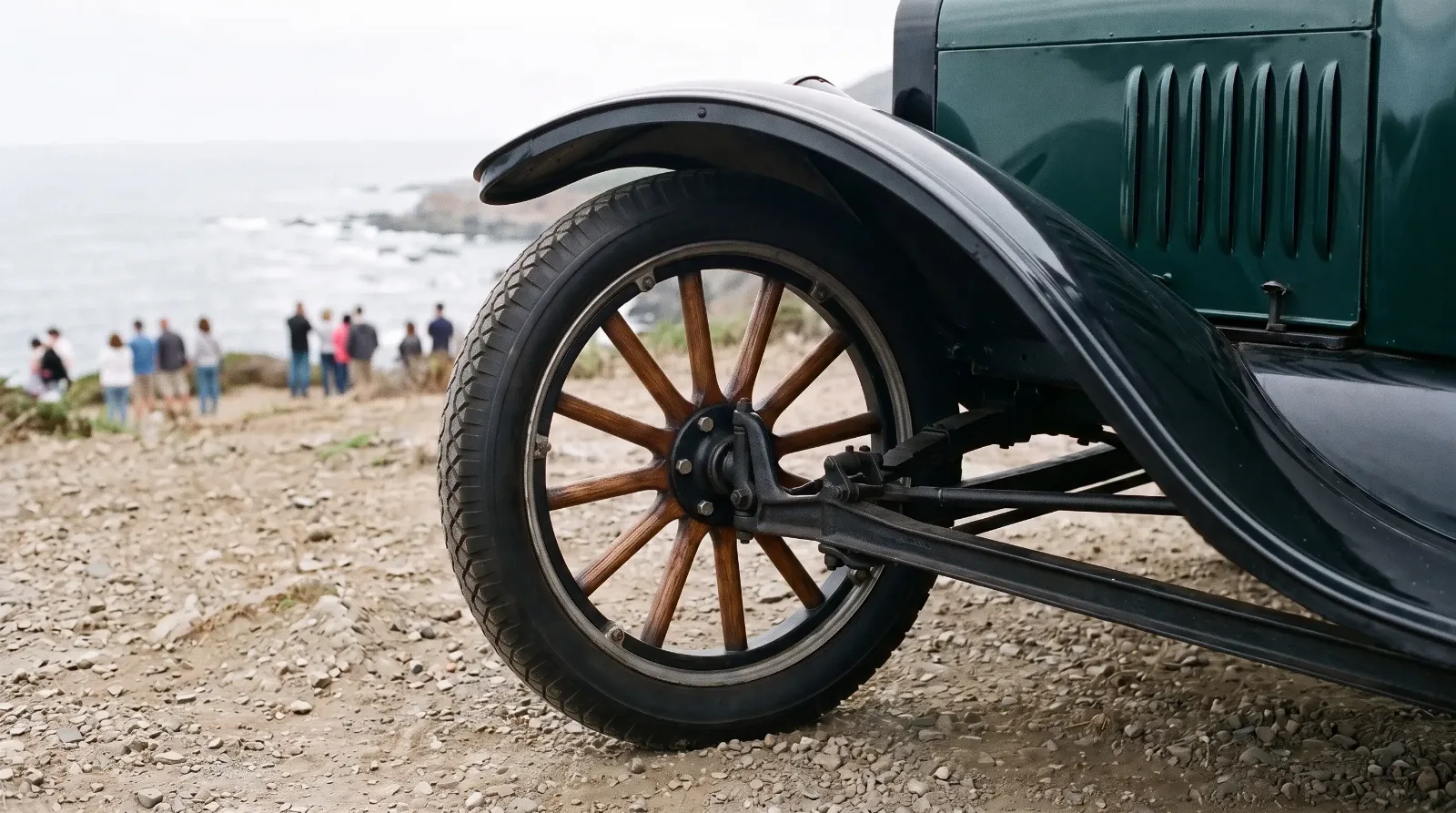
The best record is Ford's own 1908 advance catalog for the Model T, and I would rather give you its short list than a long invented one. It names vanadium steel for the front axle, a one-piece drop forging in I-beam section carrying the front of the car on a transverse semi-elliptic leaf spring. It also names the crankshaft and camshaft, all the transmission gears and the rear axle. Ford later wrote that of the 20 types of steel he chose for the car, about ten were vanadium grades, each mixed for hard wear or for spring.
| Part | Material on record | Confidence |
|---|---|---|
| Front axle | Drop-forged vanadium steel | Documented |
| Crankshaft and camshaft | Drop-forged, heat-treated vanadium steel | Documented (1908 catalog) |
| Transmission gears | Heat-treated vanadium steel | Documented (1908 catalog) |
| Rear axle | "Vanadium steel throughout" | Documented (1908 catalog) |
| Springs | Vanadium steel | Named by later histories, not in the 1908 catalog spec |
| Engine block and head | Cast iron | Documented |
That last row matters. The engine block was cast iron, cylinders cast together with a detachable head, and you can read more here on how it ran. Vanadium was not sprinkled over the whole car. It went where loads were high, sections were thin, and a failure meant the car stopped or crashed.
One more correction. You will see claims that vanadium steel was "three times" as strong as ordinary steel. The root of it is Ford's own memoir: he wrote that his earlier steel ran 60,000 to 70,000 pounds tensile strength and the vanadium steel 170,000. That compares his old steel with his new one, and the result depends entirely on which two steels you pick and how each was heat treated. Lighter and stronger is accurate. A single multiplier is marketing.
Why a light car needed a strong metal
The Model T rode on a 100 inch wheelbase and weighed roughly 1,200 to 1,650 pounds at the curb, depending on body. It was built for roads that were mostly dirt, with high clearance and springs that let the axles move a long way. Every inch of that travel put bending loads into the axle beams and spring leaves.
A heavier car could have carried thicker carbon steel parts. Ford wanted the opposite: a light car that a 20 horsepower engine could pull through mud, sold at a price that kept falling. Strong parts that weighed less were how both goals fit in the same chassis.
"People credit the assembly line for the Model T, and they should. But a cheap car that breaks is just a cheap car. The alloy is why the cheap car kept running long enough to matter."
Emily Chen
The metal also had to suit mass production. A part that comes off the Highland Park line by the hundred thousand has to be forged, treated and machined the same way every time, or the next step fails. Consistent material is the quiet partner of interchangeable parts: a spindle that fits every axle is only useful if every spindle is equally strong.
What this means for a Model T today
A century on, the original forgings are still out there, and plenty are still doing the job. That is the best evidence for the alloy you will find. It is also a reason for caution, because a hundred years of fatigue is a hundred years of fatigue.
You cannot tell vanadium steel from carbon steel by looking at it. A reproduction front axle or spindle is only as good as the steel and heat treatment its maker chose, and the stamp on it tells you who made it, not how. When buying steering and axle parts, ask the supplier what the part is made of and how it was treated. A vague answer is an answer.
Old parts deserve inspection rather than faith. Crack testing on spindles, the front axle and steering arms is cheap compared with what a failure costs on the road. The original engineers picked a strong alloy so the car would survive bad roads, not so it would survive a century of them without anybody looking.
Sources and notes
- The Henry Ford: Henry Ford visiting United Steel Company, Canton, Ohio, July 1906
- The Henry Ford (archived): Model T specifications from the 1908 advance catalog
- Henry Ford, My Life and Work (1922), Project Gutenberg
- Science History Institute: the rocks at the top of the world
- Wikipedia: Childe Harold Wills
- Wikipedia: Ford Model T
Related Reading
Have a
Ford Model T
for Sale?
Reach thousands of serious classic car collectors across the US.
Sell It Here →
Selling a classic? Here's how: where to sell your classic car online
Are You a Classic Car Dealer?
List your full inventory and connect with targeted classic car buyers.
Join as a Dealer →

About the author
Emily Chen
Bay Area engineer with a deep focus on vintage Japanese and European performance cars. Approaches classic car research and restoration with an analytical eye.
Related Listings - Ford Model T




Comments
Be the first to comment on this article.