
Somewhere down a branch line in the 1910s, a section foreman heard an engine coming that did not sound like a locomotive. It was too small, too quick, and it rattled like a coffee can full of bolts. Then it came around the bend: a Ford, riding the rails on steel wheels, with a man at the wheel who never had to steer. The model t railroad car was one of the oddest jobs Henry Ford's little four ever took on, and one of the most sensible.
Car Features
8 min read
Model Ts on Rails: Railroad Inspection Cars
A 56 in tread put the Model T half an inch from rail gauge. How railroads turned Fords into inspection cars and speeders.
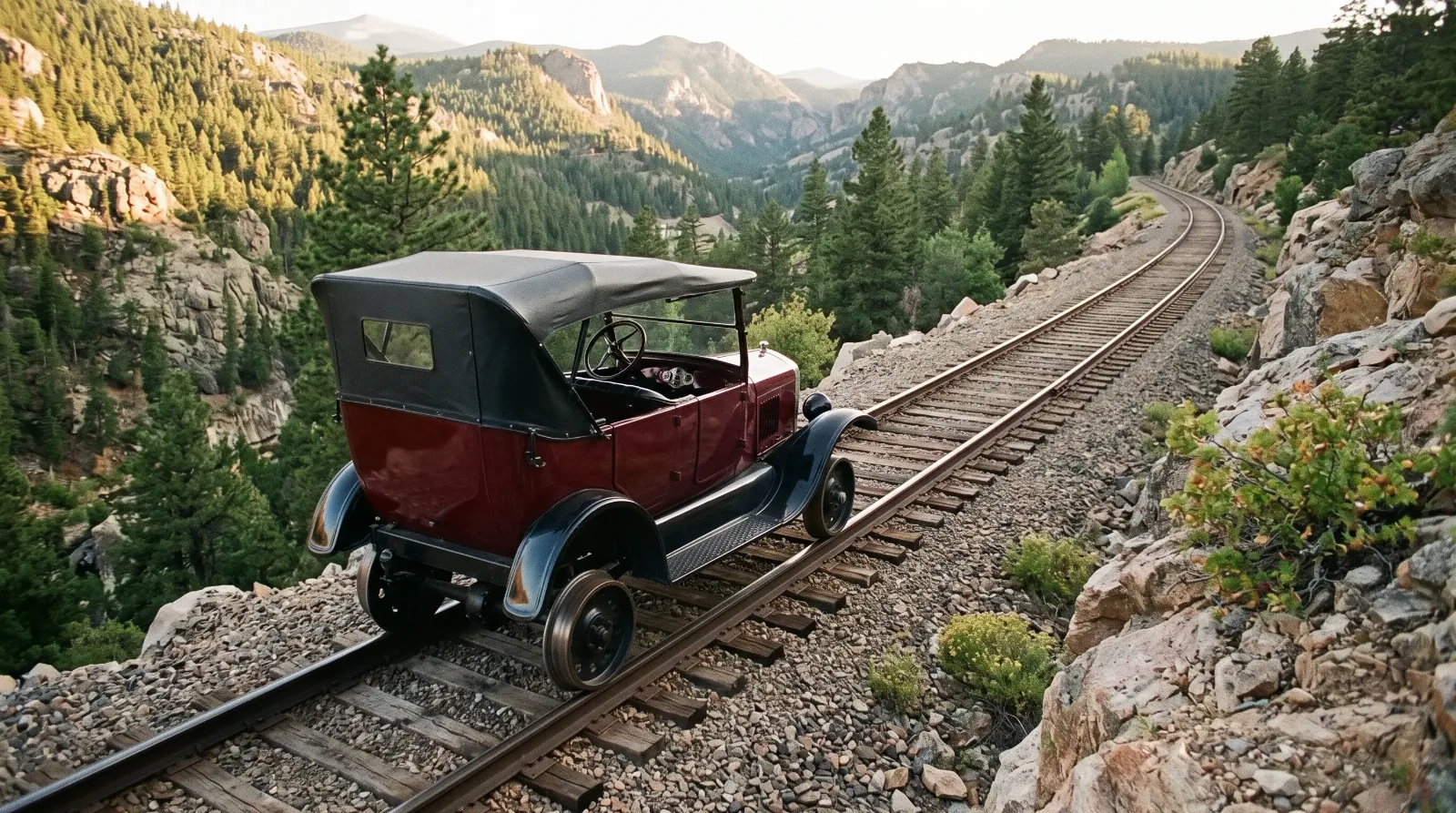
Railroads had miles of track to look over and not much money to do it with. A full steam engine to carry one inspector out to check a bridge was a waste of coal and crew. A Model T was cheap, light, easy to fix with a wrench and a pocketknife, and, as it happened, almost exactly the right width. That last part is where the story starts.
Why a Model T fit the track
The standard Model T rode on a 56 in tread. Standard railroad gauge in the United States and Canada is 4 ft 8 1/2 in, or 56.5 in. Half an inch. You could hardly have planned it closer, and Ford didn't plan it at all. The car was built for wagon ruts, and wagon ruts and rail gauge share an old family tree.
Because the tread sat so close to gauge, owners and railroad shops fitted Ts with flanged wheels and ran them as speeders, the light track cars that crews used to get around. Ford also offered a 60 in tread for Southern roads, where wagon ruts ran wider, but it was the standard car that slipped onto the rails with the least fuss.
The rest of the car helped. The Model T rode on a 100 in wheelbase and weighed roughly 1,200 to 1,650 lb at the curb, depending on the body. Its 177 cu in four was rated at 20 hp. Nobody was going to pull a freight train with that, and nobody tried. The job was moving two or three men, a toolbox and a lantern from one milepost to the next, and the T could do that all day on a few gallons of gas. Like the rest of the working Fords, it earned its keep by being cheap to run and easy to mend.
"The old section men didn't care that it was a Ford. They cared that it started in the cold, fit the rails, and didn't need a fireman. That's the whole sales pitch, and it held up for twenty years."
Gary Nowak
How the conversions worked
The basic idea was simple: take off the rubber, put on steel. The road wheels came off and flanged rail wheels went on, so the track did the steering. The steering wheel stayed in the car, but on the rails it was mostly a place to rest your hands.
Some railroads went a step further and kept two sets of wheels, one for the road and one for the track, so the same car could drive into town on a Saturday and run the line on a Monday. That trick turns up in the best documented example we have, which we will get to in a minute.
The conversion was not limited to standard gauge, either. Model Ts were adapted for track as narrow as 2 ft gauge, the kind used by logging outfits and small industrial lines. Several firms built railcars on the T, and New Zealand's RM class of railcars included some Ford based units: in 1925 New Zealand Railways built two light railcars on the one-ton Model T truck chassis in its Wellington workshops. Exactly which makers sold rail kits for the car in the United States, and what they charged, is a question the record has not answered well, so I won't pretend to name them.
One thing the old hands learned fast: a car on steel wheels on steel rail is loud. Every joint in the track came up through the frame. On the Uintah Railway in western Colorado, one account says the line's Model T coupes got special wheels with wooden spokes so they would make less noise.
Columbus and Greenville No. 1, and other model t railroad car examples
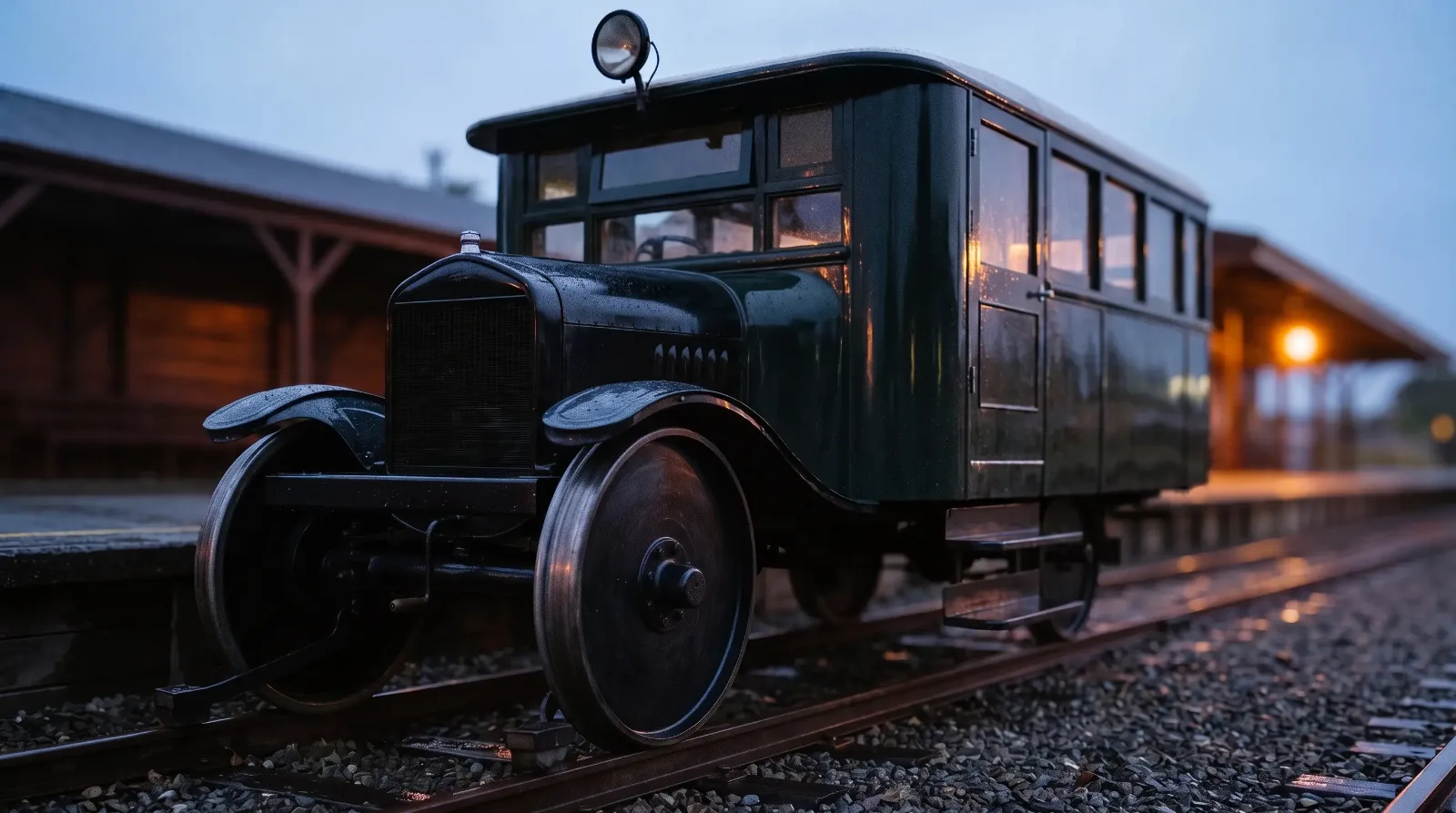
The Columbus and Greenville was a 168 mile line in Mississippi. In late August 1927, just months after Ford had built its last Model Ts at Highland Park, the railroad paid $867.34 for a Model T sedan and the two wheel sets that went with it. The railroad numbered it C&G No. 1.
It was no joke in service. No. 1 worked the line for close to two decades, outlasting the Model T itself on the assembly line by a long stretch. Then it was put away in the railroad's blacksmith shop at Columbus and, later, restored. A railroad fan archive reports that it went to the Smithsonian on September 6, 1984. I have not found the Smithsonian's own catalog entry for it, so treat the museum part as reported rather than nailed down.
Up in the Tennessee mountains, the Little River Railroad had a 1912 Model T converted to rail use for its superintendent, J.P. Murphy. The car survives mainly as a photograph and a caption, reproduced in Floyd Clymer's 1955 book on the Model T, which is about as much paper as most of these machines ever left behind.
And during World War I, Model Ts were pressed into service as rail tractors, pulling small loads on light military track. A photograph dated September 18, 1917 shows three converted Model Ts hauling supplies from Mingoyo on a 2 ft gauge light railway in the East Africa campaign. A car built to haul a farmer to town ended up tugging supplies along a narrow railway.
| Example | Where | What we know |
|---|---|---|
| Columbus and Greenville No. 1 | Mississippi, 168 mile line | Model T sedan bought Aug 28, 1927 for $867.34; road and rail wheel sets; served almost 20 years; reported donated to the Smithsonian Sept 6, 1984 |
| Little River Railroad inspection car | Tennessee | 1912 Model T converted for superintendent J.P. Murphy; known from a period photograph |
| New Zealand RM class | New Zealand | Two light railcars built in 1925 on the one-ton Model T truck chassis |
| Wartime rail tractors | World War I | Model Ts used to pull loads on light track, including 2 ft gauge lines in East Africa, 1917 |
Life on the line
An inspection car had one job: get a man out to look at something. A washout after a storm, a trestle that needed checking, a section gang that needed its boss. Before the motor car, that meant a handcar pumped by sweat or a ride on whatever train happened to be going that way. A Model T on rails changed the arithmetic. One man could cover a lot of track before lunch.
The car brought its road habits with it. It still had the planetary transmission, two forward speeds and reverse, worked with the pedals. It still had the magneto. It still needed oil and water and somebody who knew which end of a wrench to hold. That was the beauty of it. Every town along the line had a man who could fix a Ford, and parts were never far off.
It also brought the T's limits. Twenty horsepower is twenty horsepower, on asphalt or on steel. A loaded car on a grade went slow. And a railroad car with no way to turn around had to back home or find a wye, which made the reverse pedal more important than it ever was in town.
Railroads that wanted something bigger moved on to purpose built motor cars and, later, to trucks and the bodies Ford sold for them. If you are interested in how Ford's commercial line grew beyond the T, the story of the delivery bodies picks up where the speeders leave off.
Seeing one today
Rail converted Model Ts are rare now, and documented ones are rarer. Most were worked until they wore out, then stripped for parts or left behind a section house to rust. The ones that survive tend to sit in museums or with railroad historical groups, and their paperwork is often thin.
If you come across one, ask the plain questions. Which railroad? What number? Where are the rail wheels from, and when were they fitted? A Model T with flanged wheels bolted on in 1990 is a fun toy. A Model T with a road number and a work record is a piece of railroad history. The difference is in the paper, not the paint.
The old guys who ran these cars didn't think of them as anything special. They were tools, like a spike maul or a lantern. That is exactly why they matter now. The Model T got everywhere else in America in those years. It only makes sense that it found its way onto the tracks, too.
Sources and notes
- Columbus and Greenville Railway inspection automobiles (Hawkins Rails)
- Early small petrol powered rail inspection cars (Roger Farnworth)
- Ford Model T (Wikipedia)
- Standard-gauge railway (Wikipedia)
- Model T Ford railcar RM 4, New Zealand Railways (Wikimedia Commons)
- Three converted Model Ts on a 2 ft gauge light railway, 1917 (Wikimedia Commons)
Related Reading
Have a
Ford Model T
for Sale?
Reach thousands of serious classic car collectors across the US.
Sell It Here →
Selling a classic? Here's how: the best sites to sell a classic car
Are You a Classic Car Dealer?
List your full inventory and connect with targeted classic car buyers.
Join as a Dealer →
#ford model t
#Model T conversions
#railroad inspection car
#speeder
#Columbus and Greenville
#railroad history

About the author
Gary Nowak
Lifelong Midwest rodder who has been building and driving traditional pre-war hot rods since the 1970s.
Related Listings - Ford Model T




Comments
Be the first to comment on this article.