
Before Ford sold a single Model T pickup truck, it sold a frame, an engine and a promise. The 1917 Model TT was a bare chassis rated at one ton, and the buyer went to a local body shop for everything behind the seat. Eight years later Ford bolted a steel box to a Runabout and called it a pickup. Then came the Model A, the 1-1/2 ton AA, and closed cabs. This is the working side of the story: what these trucks were, how they differed from the cars, and what it takes to keep one hauling now.
Car Features
11 min read
Model T and Model A Trucks: The TT, the AA and Ford's First Pickups
From the 1917 Model TT chassis to the 1925 Runabout pickup and the 1-1/2 ton Model AA: how Ford's early trucks worked and what they take to own today.
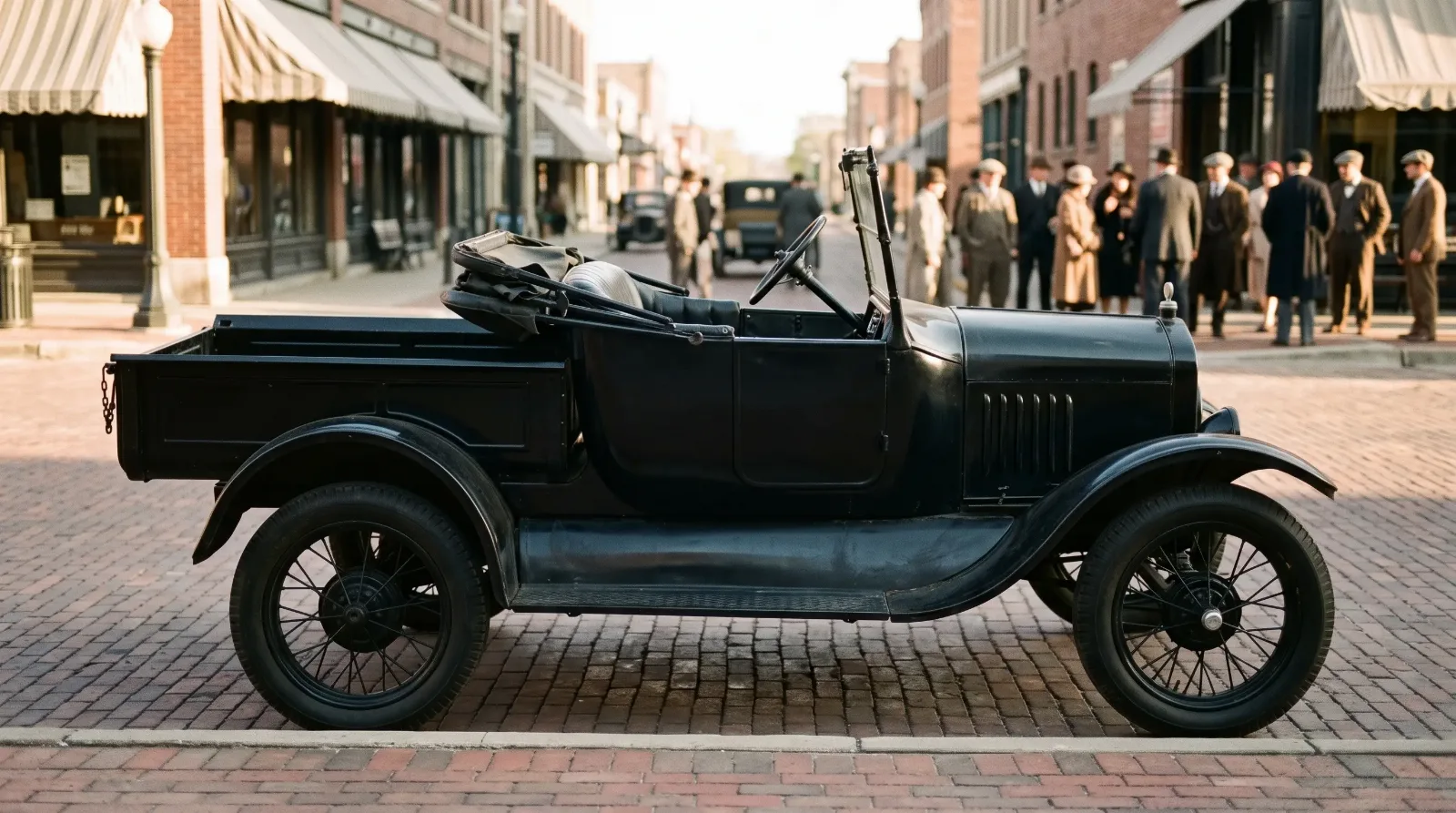
The Model TT: Ford's one-ton chassis, 1917
Ford sold the first one as the "Model T One-Ton Truck," and the name told you most of what you needed to know. It launched in 1917 at $600 as a bare chassis. No cab, no bed, no body of any kind. You bought the running gear from a Ford dealer and had the rest built by whoever in town could work wood and sheet metal. That arrangement held until 1924, when Ford began offering a factory-built body. A closed cab followed in 1925, along with a hand-operated windshield wiper.
The engine and transmission came straight from the car. That meant the same 177 cubic inch four rated at 20 horsepower, and the same two-speed planetary transmission that drivers of the Henry Ford Model T already knew. If you could drive the car, you could drive the truck. What changed was everything between the transmission and the ground.
The first TTs did not go to farmers. About 12,000 of the early trucks reportedly went to the US military during World War I. Civilian demand caught up fast after the war. Production climbed from 41,105 in 1918 to a peak of 306,434 in 1925, and by the time the TT ended in 1927 Ford had built about 1.5 million Model T trucks. A 1923 Ford ad claimed that "more than half of all trucks now in service are Fords." That was Ford talking, not a census, but the production numbers make it hard to argue with.
Worm drive and low gears: how the TT differed from the car
Put a ton on a Model T car and the rear end and the frame will tell you about it quickly. Ford's answer on the TT was a longer, heavier chassis and a different way of turning the rear wheels.
The car used a bevel gear rear axle. The TT used a worm drive, and the gearing was low. Standard final drive was 7.25:1, against 3.63:1 on the car. That ratio is why a loaded TT could pull away from a standstill on a two-speed transmission without cooking the bands. It is also why the truck was slow. Top speed was just under 20 mph, and Ford recommended no more than 15 mph with the standard gears. An optional 5.17:1 special gearing raised the recommended maximum to 22 mph. For comparison, the car would run about 40 to 42 mph.
Wheelbase grew from the car's 100 inches to about 124 to 125 inches, depending on whose measurement you trust. Some references list 131 or 157.5 inches for the TT, but those figures belong to the Model AA and got copied over.
Owners who wanted something between "crawl" and "slightly faster crawl" bought auxiliary gearboxes. The Ruckstell two-speed axle put planetary gearing in the rear axle and gave the driver a choice of direct drive or an underdrive. Jumbo gearboxes did a similar job behind the transmission. Ruckstells turned up mostly on trucks, though car owners bought them too.
| Item | Model TT (1917 to 1927) | Model AA (1928 to 1932) |
|---|---|---|
| Rating | 1 ton | 1-1/2 ton |
| Engine | 177 cu in four, 20 hp | 201 cu in four, 40 hp at 2,200 rpm |
| Transmission | 2-speed planetary (Ruckstell or Jumbo add-ons) | 3-speed early; 4-speed standard during 1929 |
| Final drive | Worm, 7.25:1 standard; 5.17:1 optional | Worm early, then ring and pinion; 6.6:1 standard, 5.14:1 optional |
| Wheelbase | About 124 to 125 in | 131.5 in; 157 in added for 1930 |
| US production | About 1.5 million (1917 to 1927) | More than 480,000 (through 1931) |
April 1925: the first factory Model T pickup truck
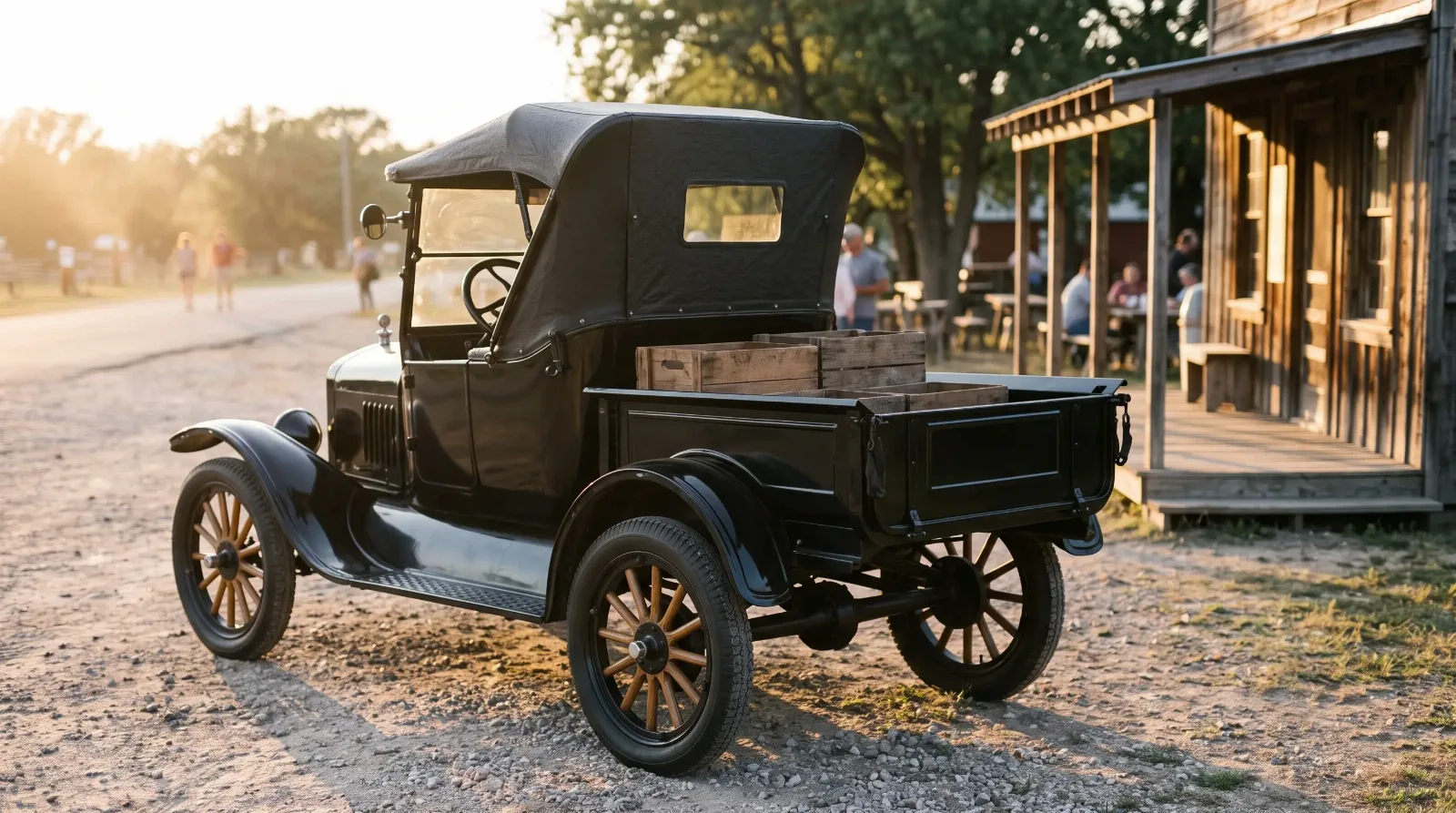
For most of the Model T's life, a pickup was something you made. People cut the rear deck off a Runabout, built a box, and went to work. Ford finally made it official in April 1925 with the "Ford Model T Runabout with Pickup Body," priced at $281 f.o.b. Detroit. It was Ford's first factory pickup.
The recipe was simple. Ford took the standard two-passenger Runabout chassis and mounted a factory steel bed on it, 56 inches long and 40-3/4 inches wide, with an adjustable tailgate and four stake pockets. Light-duty work, car gearing, car speed. This was not a TT with a small body; it was a car that could haul feed sacks and tools.
It sold. The Henry Ford museum puts first-year sales at nearly 33,800. Other counts run lower, and one forum researcher points out that the 33,800 figure is a calendar-year count of pickup bodies, so treat the exact number loosely. For 1926 the pickup came with an electric starter, battery and demountable rims, and balloon tires cost $15 more. One dealer history puts the 1926 price at $366, though Ford's own price lists are harder to pin down, so take that figure as a guide.
Wikipedia goes as far as calling Ford's F-Series "directly descended from the Model T roadster pickup." That is an interpretation, not a factory record, but the line from a Runabout with a box to the pickup in a modern driveway is not hard to draw.
"Nobody at Ford invented the pickup in 1925. Farmers had been cutting the backs off Runabouts for years. Ford just noticed, tooled up a steel box, and started taking the money."
Robert Halloran
The Model AA: a 1-1/2 ton truck on the new A engine
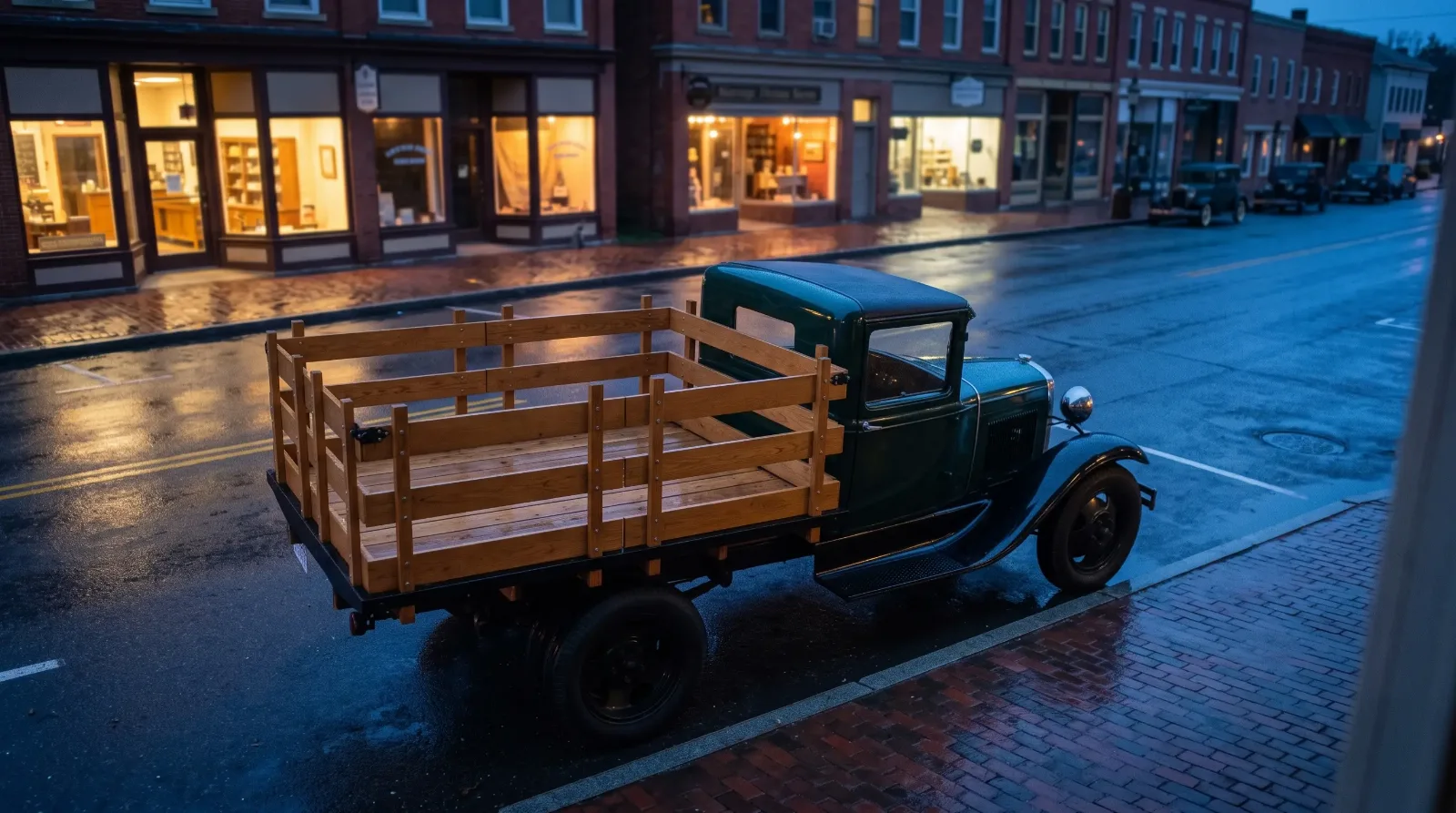
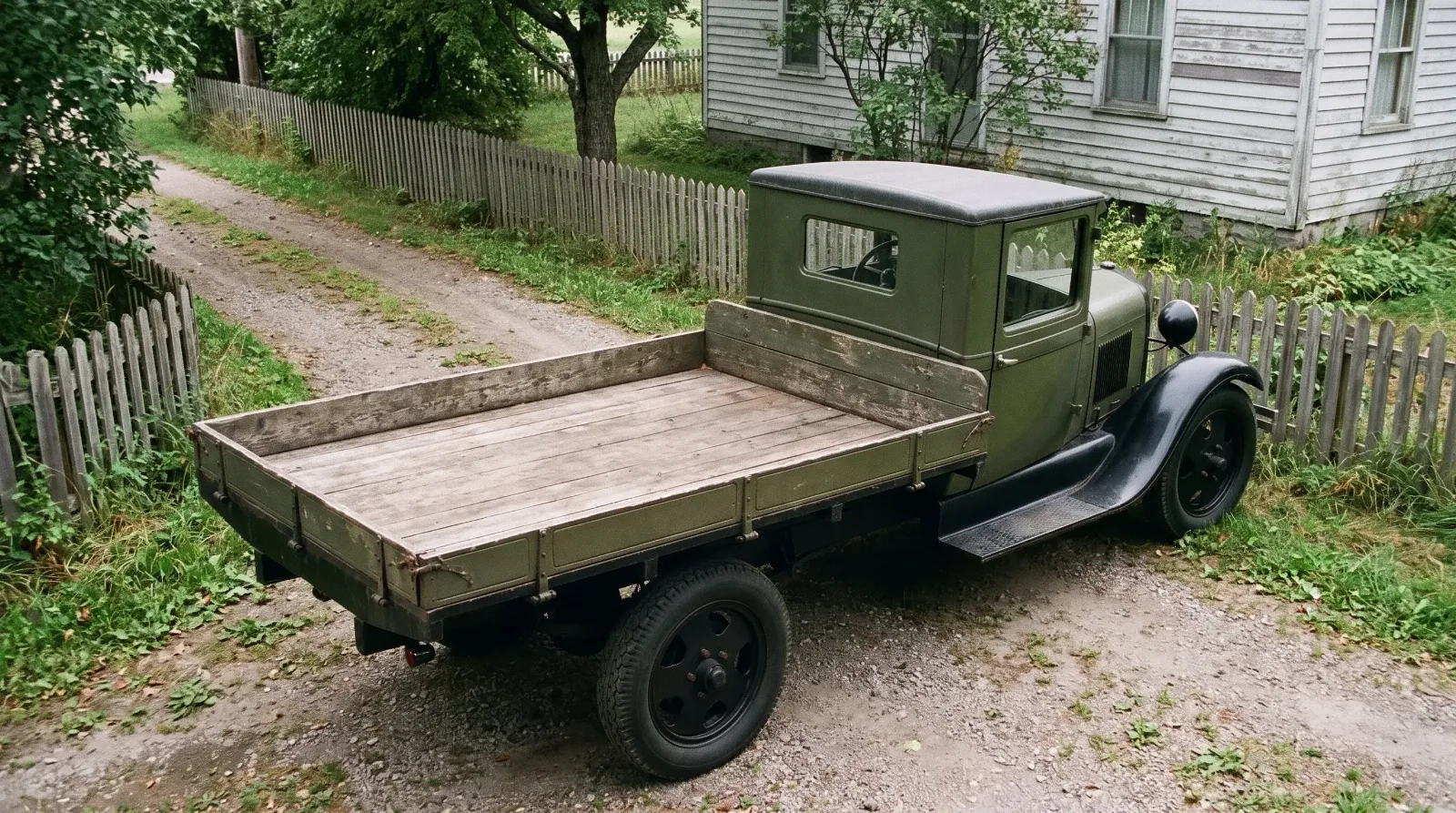
The TT's successor was built from December 1927 to December 1932, a year longer than the Model A car it was paired with. The AA was rated at 1-1/2 tons and used the Model A's 201 cubic inch four (200.5 if you are counting), making 40 hp at 2,200 rpm. That was double the TT's rated power. On the engine side, the only difference from the car was a four-row radiator.
Ford changed the AA steadily through its run, and that matters if you are trying to identify or restore one:
- Transmission. Early trucks had a three-speed. A four-speed with a very low "granny" first gear became standard during the 1929 model year, with a reverse lock-out on the shift knob.
- Rear axle. Early trucks used a worm-gear rear end with a low top speed. Ford replaced it with a ring-and-pinion unit, 6.6:1 standard or an optional 5.14:1 high-speed ratio. Cruising speed was about 35 mph on the standard gear and about 45 on the high-speed set.
- Wheels. Spoked wheels in 1928, 20-inch six-slot Budd discs in 1929, 20-inch five-slot discs in 1930. A later raised-center wheel allowed dual rears.
- Wheelbase. 131.5 inches from launch, with a 157-inch long wheelbase added for 1930.
Brakes were mechanical on four oversize drums. Front suspension was a transverse leaf, rear springs were longitudinal leaves. Nothing fancy, nothing that a farm mechanic could not adjust.
Ford still sold most AAs as a cab and chassis or a bare chassis, and independent suppliers fitted the bodies. Ford outsourced body designs to builders including Briggs and Murray. From late 1930 Ford began selling AA trucks with dump, coal and garbage bodies as complete units. Across the run, AAs wore funeral coach, ambulance, express, panel, mail truck, ice wagon, milk truck and school bus bodies. Duals went under dump, tow, tanker, fire and flatbed stake trucks.
The numbers were real. US Ford truck production ran 110,342 in 1928, 355,453 in 1929, 272,897 in 1930 and 186,394 in 1931. The AA also went abroad. The first vehicle off Ford's new Dagenham line in England in October 1931 was an AA, and the Soviet GAZ-AA, a licensed copy, ran to more than 985,000 units between 1932 and 1950.
Model A pickups, open cab and closed cab
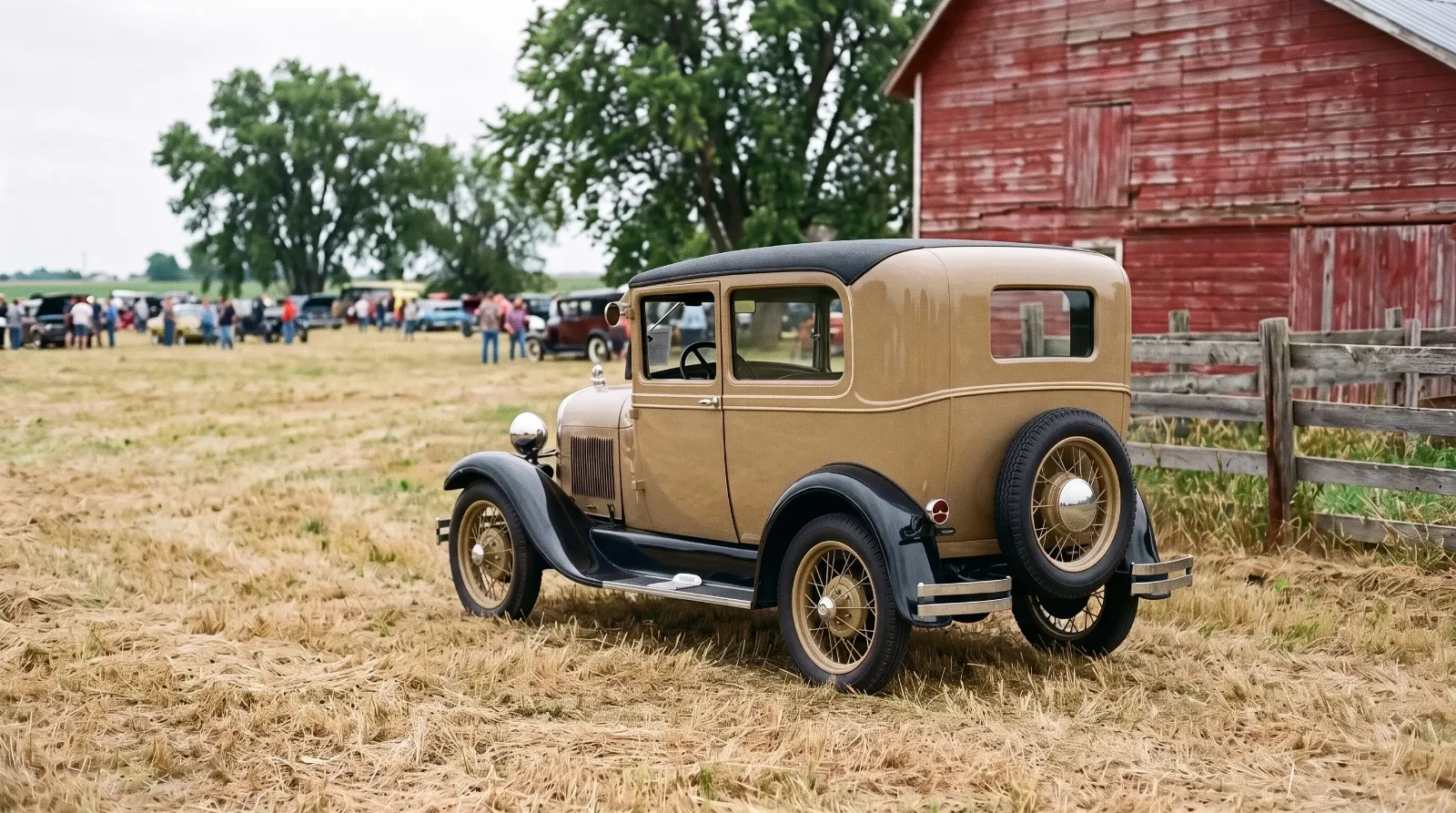
The light-duty pickup carried on with the Model A. At launch it came with an open, roadster-style cab, and the bed carried over from the Model T. The 1928 open-cab pickup started at $395; the closed cab started at $445 once it arrived.
It arrived in August 1928. Until then, every pickup got an open cab, which is why Ford built 23,972 open-cab pickups for 1928, more than any other commercial style that year. Early open cabs had no outside door handles and a fixed top. Hobbyists call these early 1928 trucks "AR," a term taken from parts-book coding rather than anything Ford printed on a brochure.
For 1929 both cab types were offered. For 1930 every Model A truck got a new, less boxy cab that followed the closed-car styling, and the closed cab became standard. The open cab, now with outside door handles for the first time, turned into an extra-cost option. Only 2,730 roadster pickups were built that year. In 1931 Ford built 98,116 Model A pickups, and just 2,637 of them were roadster pickups. Body codes help sort them: 76-A for the open cab from May 1928, 76-B from mid-1930; 82-A for the closed cab from late 1927 to mid-1930 and 82-B after that. The AA shared these cab codes. For 1931 Ford also listed a 66-A DeLuxe Pickup and a 78-B wide-bed pickup box.
What these trucks carried
The body list on these chassis reads like a small-town directory. Pickup, panel, canopy express, box and stake bodies all showed up on the TT, most of them built outside Ford before 1924. School bus bodies went on both the TT and the AA. American LaFrance modified more than 900 Model Ts for firefighting with tanks, hoses, tools and a bell. One 1926 American LaFrance Model T served Milan, Michigan for 12 years before Henry Ford traded the town a new 1938 truck for it.
That variety is the whole point of a chassis truck, and it is also the headache for anyone restoring one today. Two TTs off the same line can carry completely different bodies built by two different shops a county apart.
Buying and restoring a TT, AA or early pickup today
Start with the mechanical side, because that is the easy part. A TT shares its engine and planetary transmission with the Model T car, and an AA shares its 201 four with the Model A. That mechanical overlap with the cars is the reason drivetrain parts are the least of your worries. The truck-only pieces are a different matter: the TT worm-drive rear end, AA worm and ring-and-pinion axles, the four-speed, the 20-inch disc wheels and the long-wheelbase frames. Know which axle and wheels your truck is supposed to have before you buy, because the year-by-year changes above are exactly where mismatched parts hide.
Bodies are the bigger question. Most TT and AA bodies were not Ford-built, so "correct" can mean whatever a local builder did in 1923. Wood rots, and a rotten stake body or depot body is a carpentry job, not a parts order. Price that in before you price the truck.
On the market, open cabs lead. Sports Car Market notes that an open-cab Model A pickup is worth slightly more than a closed cab for 1928 and 1929, and markedly more for 1930 and 1931, which makes sense given how few open cabs were built in those later years. A 1928 open-cab pickup sold for $20,160 at RM Sotheby's Guyton Collection sale, while a 1929 roadster pickup brought $9,350 at Worldwide in Auburn, Indiana on September 2, 2017. Those are individual results, not a price guide, but they show the spread. If you are shopping, compare current Model AA trucks for sale against what the paperwork and the body actually support.
Do not try to learn all of this alone. Truck owners lean on the same technical knowledge as car owners, and the clubs that keep them running are where you find the person who has already rebuilt the axle you are staring at. The Model BB took over from the AA in 1932, but that is another story.
Sources and notes
- Ford Model TT, Wikipedia
- The truck that put American business on wheels: 1917-27 Ford Model TT, Mac's Motor City Garage
- Ford Model T Runabout pickup, The Henry Ford
- Ford Model T Runabout with Pickup Body history, Classic Promenade
- Car of the Week: 1930 Ford Model AA, Old Cars Weekly
- Model A open-cab pickup values, Sports Car Market
Related Reading
Article
Ford Model T and Model A: The Complete Story of Henry Ford's Cars, 1908 to 1931
Article
Ford Model A Body Styles: Tudor, Fordor, Roadster, Victoria and More
Article
Model T and Model A Today: Clubs, Museums and the Hobby

Article
The Ford Model TT: Ford's One-Ton Truck
Article
1925: The Model T Runabout With Pickup Body
Article
The Ford Model AA Truck
External
/ford/model-aa
Have a
Ford Model T
for Sale?
Reach thousands of serious classic car collectors across the US.
Sell It Here →
Selling a classic? Here's how: compare the places to sell classic cars
Are You a Classic Car Dealer?
List your full inventory and connect with targeted classic car buyers.
Join as a Dealer →

About the author
Robert Halloran
Texas-based classic truck enthusiast with decades of experience buying, restoring, and writing about American pickups from the 1940s through the 1980s.
Related Listings - Ford Model T
Comments
Be the first to comment on this article.