
The usual line is that the first Mustang was "just a Falcon with a new body." Like most short answers, it is half right. The Mustang Falcon platform story is really about one decision made under a tight brief: take the unitized floor of the 1964 Falcon, borrow running gear from the Falcon and the Fairlane, and spend the money on the parts a buyer could see. That decision is why Ford could sell a four-seat sporty car for $2,368 in April 1964. It is also why the car carried a few Falcon habits that took a model year to shake off.
Car Features
7 min read
The Falcon Underneath: How Ford Built the Mustang Cheaply
What the first Mustang borrowed from the Falcon and Fairlane, what that saved Ford, and the Falcon habits the car took a year to shed.
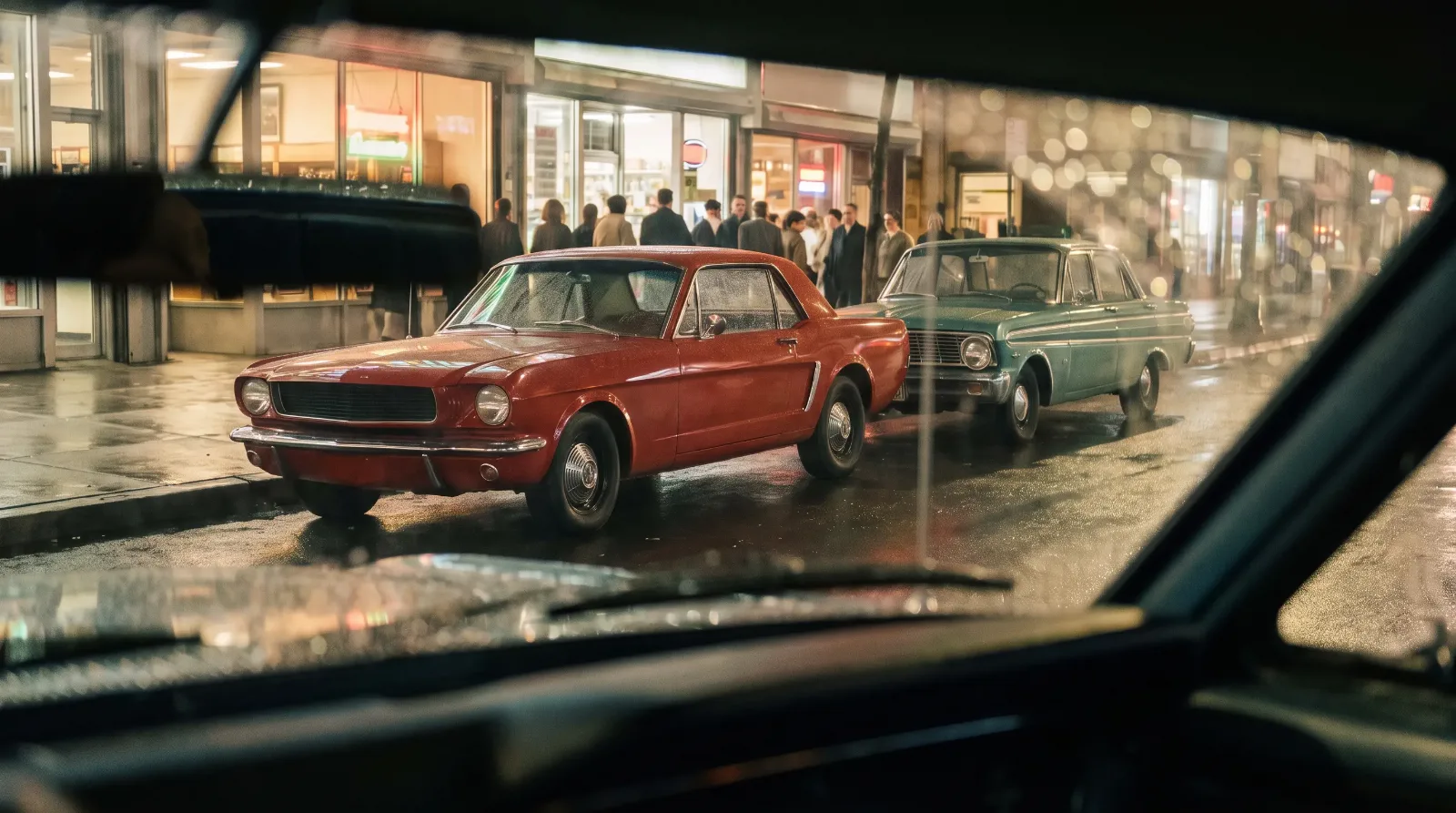
The wider pony car story covers the people, the launch and the rivals. This piece stays underneath the car, with what was borrowed, from where, and what the records say it saved.
Why the Falcon was the obvious donor
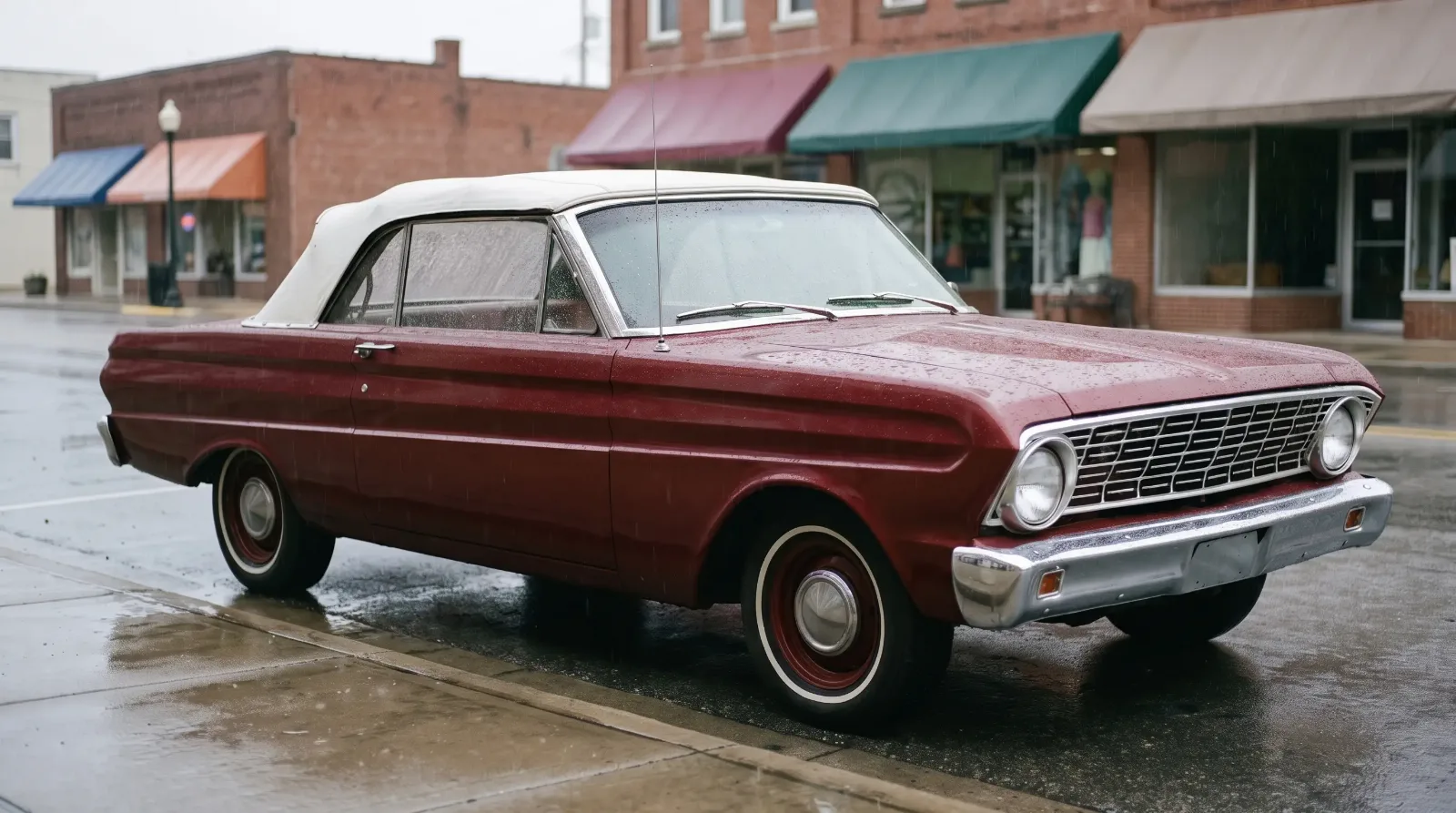
The brief came first, and it was strict. The car had to seat four, carry a usable trunk, weigh under 2,500 lb and start under $2,500. Those last two numbers ruled out a clean-sheet design almost by themselves. A new platform means new tooling, new testing and new suppliers, and none of that is cheap or fast.
The Falcon was sitting right there. It had been Ford's best-selling car in 1960, which meant its parts were already in production in large numbers and its unit body was proven on the road. The Henry Ford puts the cost of creating the Mustang from scratch at $400 million. I treat that as an estimate, because that is what it is, but even a rough figure that size explains the choice.
What Ford actually granted the program is less settled. The museum's account gives $45 million against the $75 million Lee Iacocca asked for, while an insider memoir has the chairman releasing the full $75 million. Both sources are serious and they do not agree. The two versions are set side by side here, and I will not pretend to settle it in this article. What matters for the platform is that either number was small next to the cost of starting from nothing.
The Mustang Falcon platform, part by part
"Falcon underneath" is a fair shorthand, but the parts bin was wider than one car. The unitized platform came from the 1964 Falcon. Chassis, suspension and drivetrain pieces were drawn from both the Falcon and the larger Fairlane. The engines tell the same story: the base six was a Falcon engine, the first V8 was a Fairlane engine, and the 289 family followed.
| Component | Source | Mustang detail |
|---|---|---|
| Unitized platform | 1964 Falcon | 108-in wheelbase, 1964½ to 1970 |
| Base engine | Falcon | U-code 170 six, 101 hp gross (1964½) |
| First V8 | Fairlane | F-code 260, 164 hp gross (1964½ only) |
| 289 V8s | Shared 289 family | C 200 hp, D 210 hp, A 225 hp, K 271 hp (gross) |
| Chassis, suspension, drivetrain | Falcon and Fairlane | Shared pieces, combined for the Mustang |
| Standard instruments | Falcon-type swept cluster | 1965 standard; five-dial cluster standard for 1966 |
| Rally-Pac (tach and clock) | Also on 1964 Falcon and Fairlane | Offered on the 1964½ Mustang |
The six deserves a word, because it was the engine most early buyers actually got. Ford's own name for the engine family was the Thriftpower Six, though plenty of people still call it the Falcon six. The 101 hp rating for the 170 is the museum's figure. You will also see 105 bhp quoted, so do not be surprised when two references disagree on a base 1964½ car.
The Rally-Pac is a small detail that makes the point well. The column-mounted tachometer and clock was introduced in 1963, soon after Ford's showing in that year's Monte Carlo Rally, and the same accessory was offered on the 1964 Falcon, the Fairlane and the 1964½ Mustang. One part, three cars. That is what sharing looked like in practice.
Cutting up a Falcon to make a Mustang
Hal Sperlich, the product planner, is credited with the decision to base the car on the Falcon. One account of his career puts it in plain physical terms: his team cut up a Falcon and added parts. I like that description because it is honest about how cars were really engineered on a deadline. Nobody drew the Mustang on a blank sheet and then went looking for components. The components came first.
The result rode on a 108-in wheelbase, a figure that stayed the same through 1970. Among the conditions Henry Ford II set when he approved the program was an extra inch of rear legroom. Inside a borrowed platform, that inch was not trivial. It is a good example of how the body and seating package were the places the team was allowed to spend.
Speed came with the borrowing. Development ran from September 1962 to April 1964, a record 18 months. The first pre-production cars left the Rouge line on February 10, 1964, and about 180 were built before regular production began on March 9. Eighteen months is not long for a new car. It is about right for a new body on a platform the plant already knew how to build.
What the Falcon underneath cost the car
Borrowing is not free. The brief asked for a car under 2,500 lb, and the base car met it on paper: published base curb weight is 2,445 lb, though The Henry Ford's spec page gives 2,556 lb for the hardtop, so the figure depends on which sheet you trust. Shipping weight with the six was about 2,570 lb. A fully optioned V8 car came in around 3,000 lb. The platform was sized for an economy compact, and every option Ford added to make the Mustang feel special sat on top of it.
The interior showed its roots too. The standard 1965 car used the Falcon-type swept instrument cluster. Buyers who wanted the five round dials had to order the GT Equipment Group or the Interior Decor Group. Ford made the five-dial cluster standard for 1966 and dropped the Falcon-style unit, which tells you how the company judged the borrowed one once the car was a hit.
Shared supply cut both ways later on. For 1966 Ford found itself short of 289 V8s and holding surplus 200 sixes after weak Falcon sales. The Sprint 200 package was partly a way to put those sixes into Mustangs. Sharing an engine with a slower-selling compact meant the Mustang sometimes absorbed the compact's leftovers.
"People hear 'Falcon underneath' and take it as a put-down. The records read the other way. Ford spent its money where the customer would see it and borrowed everything the customer would not, and the production numbers show the customer never minded."
Tom Ramirez
The payoff, and a pattern that lasted
The numbers justify the shortcut. The 1965 model year produced 559,451 Mustangs. Counting the 1964½ cars as well, the first model year came to almost 681,000, and 1966 added another 607,568. Those totals belong to our first-generation Mustang story, but they matter here for a simple reason: with the platform already paid for, that volume did not first have to recover the cost of a new one. Within two years the line had reached the millionth Mustang.
The approach did not end with the Falcon. The 1974 Mustang II was derived from the Pinto platform, though Ford insisted it shared only a limited number of components and gave it its own isolated front subframe. The 1979 car moved to the Fox platform that had debuted under the 1978 Fairmont and Zephyr. The 1994 SN95 rode on an updated version of that Fox platform. Across the classic years, every Mustang generation started from a platform Ford already owned.
That is the real lesson of the Falcon underneath. The Mustang was not cheap because Ford cut corners on what you could see. It was affordable because the expensive, invisible part of the car had already been paid for by a compact sedan.
Sources and notes
- The Henry Ford: Mustang, the birth of an American icon
- Ward's archive: Iacocca scores on his third pitch to Henry Ford II
- Wikipedia: Ford Mustang (first generation)
- Wikipedia: Rally-Pac
- Military.com: Hal Sperlich, engineering pioneer of the Mustang and the minivan
- Fordification: Ford part and casting number codes
Related Reading
Have a
Ford Mustang
for Sale?
Reach thousands of serious classic car collectors across the US.
Sell It Here →
Selling a classic? Here's how: compare the places to sell classic cars
Are You a Classic Car Dealer?
List your full inventory and connect with targeted classic car buyers.
Join as a Dealer →
#1964 mustang
#mustang history
#Ford Mustang
#first generation Mustang
#Ford Falcon
#Ford Fairlane
#Hal Sperlich

About the author
Tom Ramirez
Corvette researcher and historian based in Bowling Green, Kentucky. Two decades documenting Corvette production history from original factory records.
Related Listings - Ford Mustang
Comments
Be the first to comment on this article.