
Open the door of a 1969 Mustang Grande at a car show and the sound changes. The crowd noise behind you goes soft, because the door closes on more padding than a Mustang was ever supposed to carry, and you find yourself looking at a hopsack-and-vinyl bucket seat, Teakwood-grain trim and a small electric clock keeping time for nobody in particular. People who wandered over to see the Mach 1 parked next to it tend to sit a minute longer than they planned. Mustang Grande history is mostly the story of that minute: Ford's attempt, from 1969 to 1973, to make its pony car feel like a quiet and well-appointed place to be.
Car Features
7 min read
The Grandé: Ford's Luxury Mustang, 1969–1973
Ford's luxury Mustang hardtop, 1969 to 1973: Teakwood trim, 55 lb of insulation, houndstooth seats and a share of production that kept growing.
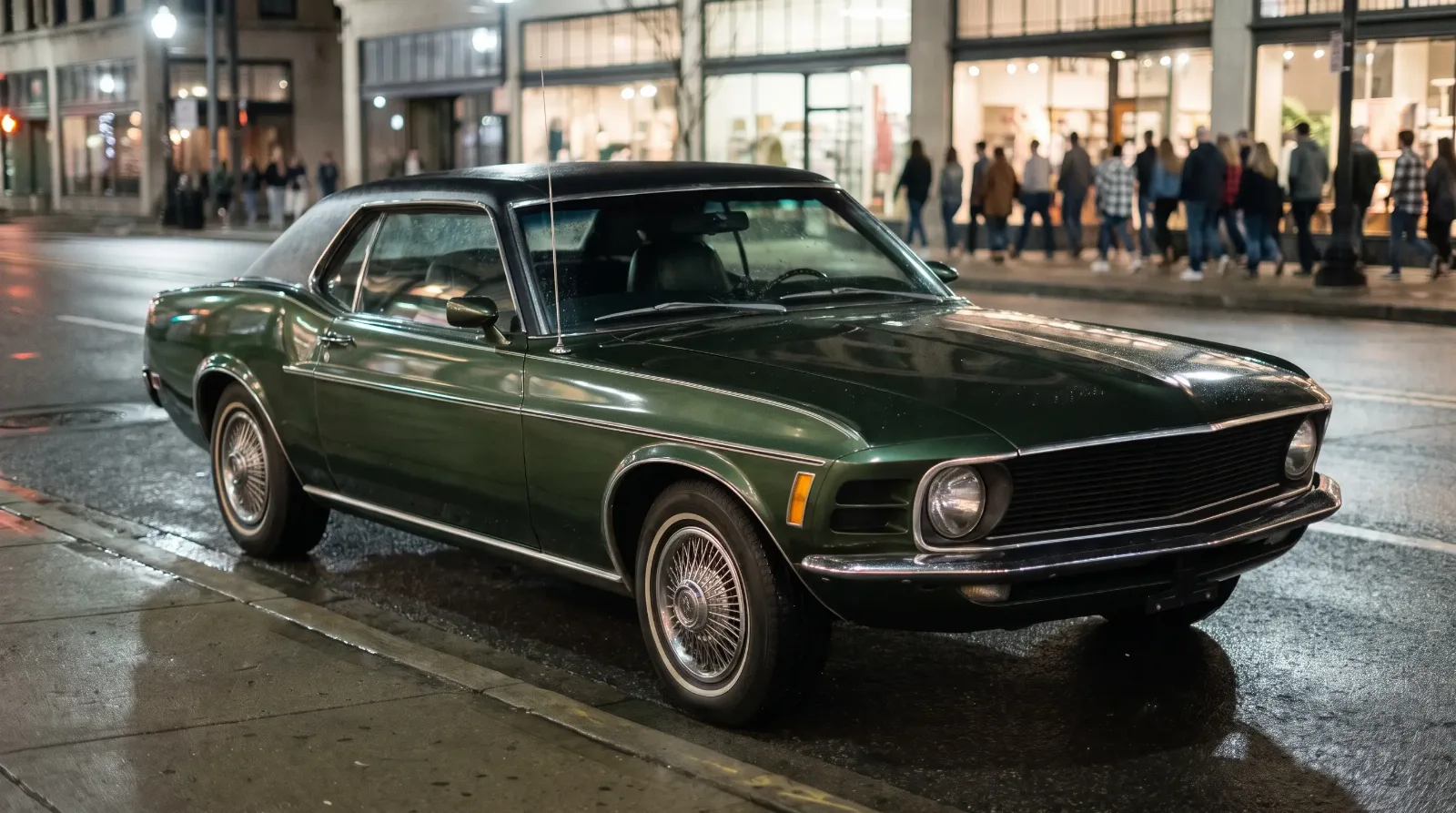
The wider first-generation story, with all its scoops and stripes, lives in the details of our broader history. This one is narrower. It is about a hardtop that never raced and never wore a scoop that worked, and that still outsold some of the most celebrated Mustangs of its day.
A soft Mustang in a loud year
The 1969 model year was the loudest Ford ever gave the Mustang. The restyled car arrived with the Mach 1, the Boss 302 and the Boss 429 all new on the order form, and the advertising leaned hard on speed. In the middle of that, Ford added a fourth new model that went the other way entirely. The Grande was a luxury Mustang, and it came only as a hardtop: there was never a Grande convertible and never a Grande SportsRoof. On the door data plate it carried a body code of its own, 65E, which set it apart from the ordinary coupe at the factory, and from 1970 its VIN carried its own body code too, 04.
I suspect it made more sense in the showroom than it does in hindsight. By 1969 the Mustang was five years old, and the people who had bought the first ones were five years older. Not every one of them wanted a hood scoop. The same season even produced the E model, a SportsRoof built around the 250 six and a 2.33:1 axle for fuel economy. Ford was trying the pony car on in every size that year, and the Grande was the one cut for comfort.
What the Grande package put in the car
The list of standard Grande equipment in 1969 reads like a catalog of small kindnesses. Outside there were wire-style wheel covers, bright moldings, color-keyed racing mirrors and a pair of thin pinstripes along the flanks. Inside were bucket seats in hopsack cloth and vinyl, Teakwood-grain interior trim and that electric clock. A vinyl roof, in black or white, was an option in the first year rather than standard, which surprises people who assume every Grande wears one.
The part you cannot see mattered most. Ford packed about 55 pounds of sound insulation into the car, more than twice the standard amount, and gave it a softer suspension. The goal was a hardtop that hushed the road and rounded off the bumps, a Mustang you could drive across a state and step out of without feeling it in your back.
None of this cost a fortune. With the six, a 1969 Grande started at $2,849, the figure on the Montana Auto Museum's placard, against $2,618 for a six-cylinder hardtop: about $231 for the whole package. It was a modest step up, and it bought a car that felt a class above its sticker.
Under the hood the Grande was as open-minded as any Mustang. Buyers could order anything from the 200 six, rated at 115 horsepower, up to the 428 Cobra Jet, and a handful did exactly that. In 1969, 62 Grandes left the factory with the Cobra Jet, which must have made for some interesting moments at traffic lights: a hushed, pinstriped hardtop with a clock on the dash and one of the strongest engines Ford sold.
"I have always liked the Grande for what it admits. Most Mustangs of that era were dressed for a race nobody was going to run. The Grande was dressed for the drive home, and it was honest about it."
Nora Beckett
1970: houndstooth and a quieter face
For 1970 the whole Mustang line went back to two headlamps, set inside the grille with simulated intakes in the outer positions, and the Grande followed along. Its own changes were inside. Ford dressed the 1970 car in houndstooth upholstery, a pattern that says more about the year than any brochure could, and offered a new option package with a seatback release, a remote-control mirror and courtesy lights. The extra insulation stayed.
It was a hard year for every Mustang. Production across the line fell from 299,824 in 1969 to 190,727, and the Grande fell with it, to 13,581 cars. That makes the 1970 Grande the scarcest of the five years by a wide margin, and the one you are least likely to find at a show. When one does turn up in houndstooth, it is worth a long look.
Mustang Grande history in the big-car years
The 1971 Mustang was the biggest of the first generation, and of all the versions the Grande wore that size most naturally. The new body rode on a 109-inch wheelbase, stretched to 189.5 inches long and 74.1 inches wide, and a hardtop weighed about 3,590 pounds. On a Mach 1 those numbers read like a problem. On a luxury hardtop they read like a promise of a calmer ride.
Ford leaned into it. The vinyl roof became standard, Lambeth cloth replaced the hopsack, and Grande badges on the C-pillar made sure nobody mistook the car for a base hardtop from across a parking lot. Then the market moved the Grande's way. In 1972 Ford switched to SAE net horsepower ratings and every number on the engine list dropped: the 302 two-barrel was now rated at 140 horsepower, the 351 two-barrel at 177. Performance buyers were already being chased off by insurance rates. Buyers who wanted a comfortable two-door had no such worries, and after 1970 the Grande took a steadily larger slice of a shrinking pie.
| Model year | Grande production | All Mustangs | Grande share |
|---|---|---|---|
| 1969 | 22,182 | 299,824 | about 7% |
| 1970 | 13,581 | 190,727 | about 7% |
| 1971 | 17,406 | 149,678 | about 12% |
| 1972 | 18,045 | 125,093 | about 14% |
| 1973 | 25,274 | 134,867 | about 19% |
The 1972 count is the one weak spot. Most references, Hagerty among them, give 18,045 Grandes and 27,675 Mach 1s for that year, but at least two published tables swap the figures and credit the Grande with 27,675. Whichever is right, the direction is plain. By 1973 nearly one Mustang in five left the factory as a Grande, and across its five years Ford built about 96,500 of them on the majority count.
What the Grande left behind
The 1973 car was the last Grande and the last of the first-generation Mustangs. When the smaller Mustang II arrived for 1974, the luxury idea did not go away; it took a new name. The Ghia was a notchback luxury model, and its equipment list reads like a Grande that had spent a summer in Italy: spoke-style wheel covers, a vinyl roof, wood-tone door panel accents, a digital clock and super-soft vinyl or cloth seats. Lee Iacocca's brief for the new car called for an upscale "little jewel," and the Grande had already spent five years proving there were buyers for that kind of Mustang. Ford built 89,477 Ghias in 1974 alone, more than three times the last year of the Grande.
If you are standing beside a Grande today, the factory left you a couple of clues. The door data plate should show body code 65E on a 1969 or 1970 car and 65F on a 1971 to 1973 car, and a 1970 to 1973 VIN should carry 04 in the body-code position (a 1969 Grande shares 01 with the plain hardtop, so on that year the data plate does the work). Badges, wheel covers and a vinyl roof can all be added to a plain hardtop in an afternoon. The codes cannot.
The Grande sits in an odd, gentle corner of how the Mustang evolved, between the stripes of the muscle years and the small, plush Mustang II that came after. It asked very little of its drivers. It just wanted them to arrive rested, with the radio still audible and the clock still keeping time.
Sources and notes
- MustangSpecs: 1969 Ford Mustang Grande
- MustangSpecs: 1970 Ford Mustang Grande
- Car Throttle: That time Ford tried to turn the Mustang into a luxury car
- Daily Kos: Montana Auto Museum Ford Mustangs photo diary (museum placard figures)
- Classic Industries: 1964-1973 Mustang VIN decoder
- Wikipedia: Ford Mustang (first generation)
Related Reading
Have a
Ford Mustang
for Sale?
Reach thousands of serious classic car collectors across the US.
Sell It Here →
Selling a classic? Here's how: where to sell your classic car online
Are You a Classic Car Dealer?
List your full inventory and connect with targeted classic car buyers.
Join as a Dealer →
#Ford Mustang
#first generation Mustang
#1969 mustang
#1970 mustang
#1971 Mustang
#Mustang Grande
#Luxury Mustang

About the author
Nora Beckett
Automotive features writer and photographer who tells the human stories behind the cars, from show fields to cross-country road trips.
Related Listings - Ford Mustang




Comments
Be the first to comment on this article.