
Picture a California freeway in the early 1980s, late at night, and a car going well over the limit in the fast lane. The driver checks the mirror and sees a set of headlights closing fast, low and square. It is not a Camaro and not a big sedan. It is a plain two-door Mustang notchback in highway patrol colors, and it is gaining. That car was the Mustang SSP police package, and for a dozen years it was one of the most recognizable shapes in American law enforcement.
Car Features
7 min read
The SSP: Ford's Police Mustang
The Mustang SSP police car: how a CHP request in 1982 put Fox notchbacks on patrol, what the package added, and why it ended in 1993.
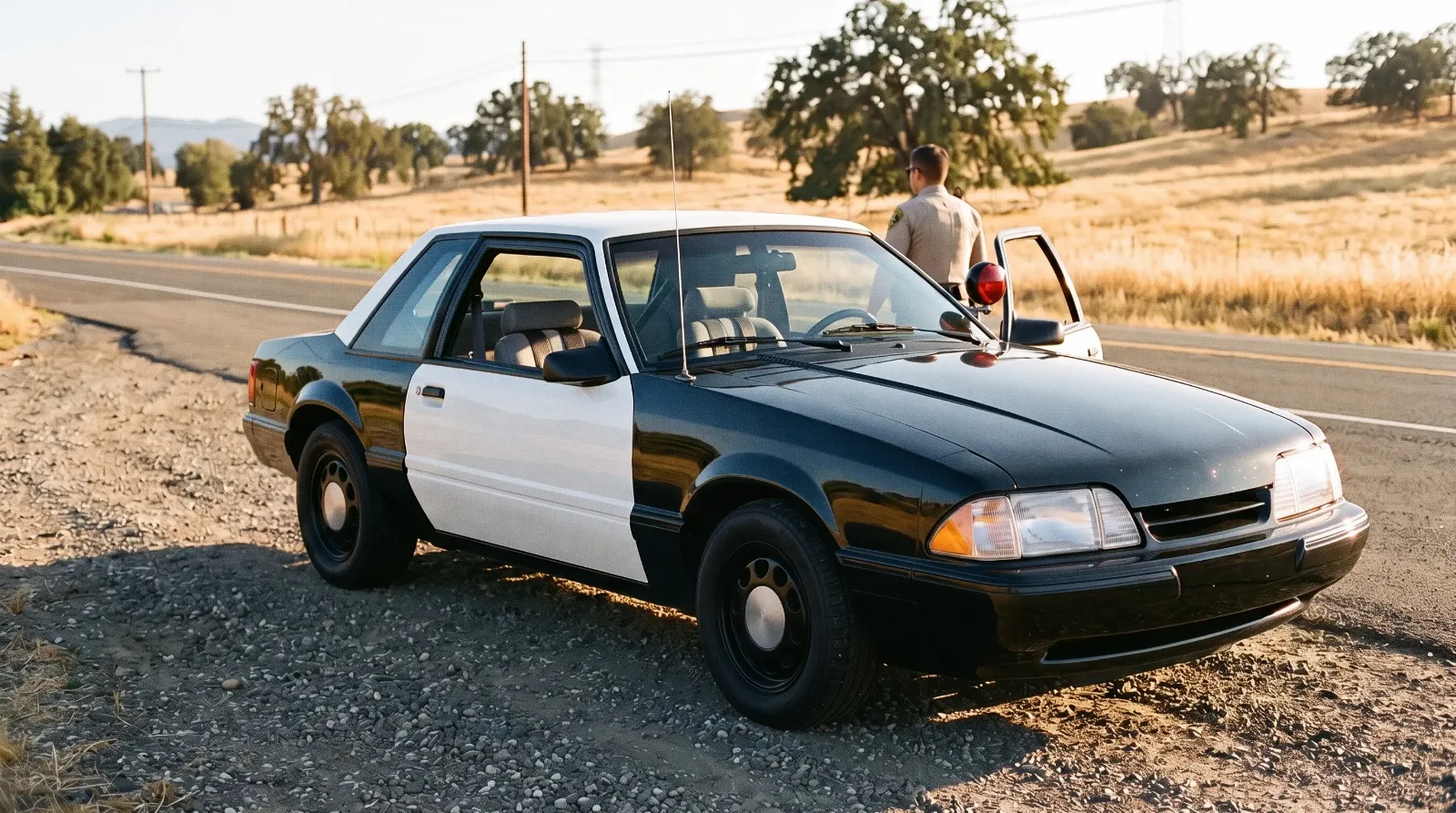
SSP stood for Special Service Package. Ford built it for law enforcement and government fleets, not for the showroom, and it was offered to agencies rather than sold to the public. It was a working car, built for officers who needed to catch people, and the story of how it came about says a lot about where the Fox Mustang stood in the 1980s. For the broader run of the platform, from 1979 to 1993, there is more on the Fox Body cars elsewhere in this series. This piece stays on the police car.
Why the Mustang SSP police car started in California
The California Highway Patrol had a problem at the start of the decade. Its pursuit fleet needed something light and quick, and the cars it had tried were not holding up. The patrol had run into camshaft and engine trouble with Chevrolet Camaros used at pursuit speed. What the patrol wanted was something lighter that would survive the job.
In 1982 the CHP asked Ford for a light pursuit car. Ford answered with the Mustang. The patrol ordered 400 notchbacks, and Ford built 394 of them. That first order was the seed. Over its twelve model years the program grew to nearly 15,000 cars, and more than 60 agencies ended up running them, from state patrols to smaller departments that liked the idea of a cruiser that could actually keep up.
Ford's marketing people saw the angle right away. A 1982 Ford ad for the police package ran under the headline "This Mustang Chases Porsches For A Living." It was a bold line for a car whose base model still came with a four-cylinder engine. It also told the public that the Mustang was fast again, which was the whole point of the 1982 relaunch.
What the Special Service Package actually added
On the outside an SSP looked like the plainest Mustang Ford built. That was deliberate. The notchback was the formal-roof body with a trunk instead of a hatch, and it was the lightest of the three Fox bodies. Published 1987 and 1988 curb weights put the notchback at 2,722 lb against 2,791 lb for the hatchback and 3,044 lb for the convertible. In a pursuit car, every pound the officer didn't carry was a pound that went into acceleration and braking.
Under the skin the package was about survival. Police work is hard on a car: long idles, sudden sprints, heavy electrical loads from radios and lights, and drivers who were not paying for the repairs. The SSP added the parts that kept a hot-rod Mustang alive in that job:
- an engine oil cooler and a transmission cooler, for long runs at high load
- a 130 or 135-amp alternator to feed the radios, lights and siren
- a calibrated speedometer, reading to 140 mph at first and to 160 mph from late 1989, because a speeding ticket has to stand up in court
- reinforced floor pans
- a full-size spare tire in place of a space saver
The package added no power. The engine was the same 5.0 HO the GT and the LX 5.0 used, so the police cars followed the civilian ratings as the 302 changed over the decade. That meant a 157 hp two-barrel in 1982, a four-barrel 175 hp in 1983, and the fuel-injected 225 hp engine from 1987. The table below shows how the 5.0 HO was rated across the SSP years.
| Model year | 5.0 HO rating (SAE net) | Note |
|---|---|---|
| 1982 | 157 hp | Two-barrel carburetor, first year of the program |
| 1983 | 175 hp | Holley four-barrel |
| 1984 | 175 hp (4-bbl) / 165 hp (CFI auto) | Rating depended on transmission |
| 1985 | 210 hp (4-bbl) | Last carbureted V8 year |
| 1986 | 200 hp | Sequential fuel injection arrives |
| 1987 to 1992 | 225 hp | The peak years of the Fox 5.0 |
| 1993 | 205 hp | Rerated, final year of the Fox and the SSP |
Those are the civilian numbers. No source on the sheet gives a separate police rating, and a year-by-year SSP production breakdown has not turned up either, so anyone quoting exact annual counts should be asked where they came from.
Life on patrol, and the culture around the car
What made the SSP stick in people's memories was not its specification. It was the sight of it. For a generation of drivers, especially in California, the black-and-white Mustang in the mirror became shorthand for getting caught.
"The SSP is the rare police car people remember with affection. You didn't want to see one behind you, but you were glad somebody at Ford had built it."
Patrick Walsh
The car also showed up wherever people told stories about the Mustang. Its place in film and television is part of a much longer list of screen appearances, and you can read more here. The patrol car turned the Mustang from something you bought for fun into something the state bought because it worked, and that gave the 5.0 a kind of credibility no advertisement could buy.
The same Fox hardware went in very different directions in those years. In 1990 Ford built 4,103 Emerald Green LX 5.0 convertibles with white tops and white leather for a promotion that fell through, the car now known as the 7-Up car. A showroom curiosity and a working pursuit car came off the same Fox platform, and both ran the 5.0.
Why the SSP ended in 1993
The program ran from 1982 through 1993, and its ending was built into the next Mustang. When the SN95 arrived for 1994, Ford dropped both the notchback and the hatchback and sold only a fastback-style coupe and a convertible. It was the first time since 1964 that a Mustang came without a notchback. The light, formal-roof body that the SSP depended on was gone, and the police Mustang went with it.
That makes 1993 the last year of the SSP as well as the last year of the Fox. Police cars live hard lives, and a car that spent years on patrol rarely reaches retirement in original condition. Survivors with their history intact are the exception.
Finding a real SSP today
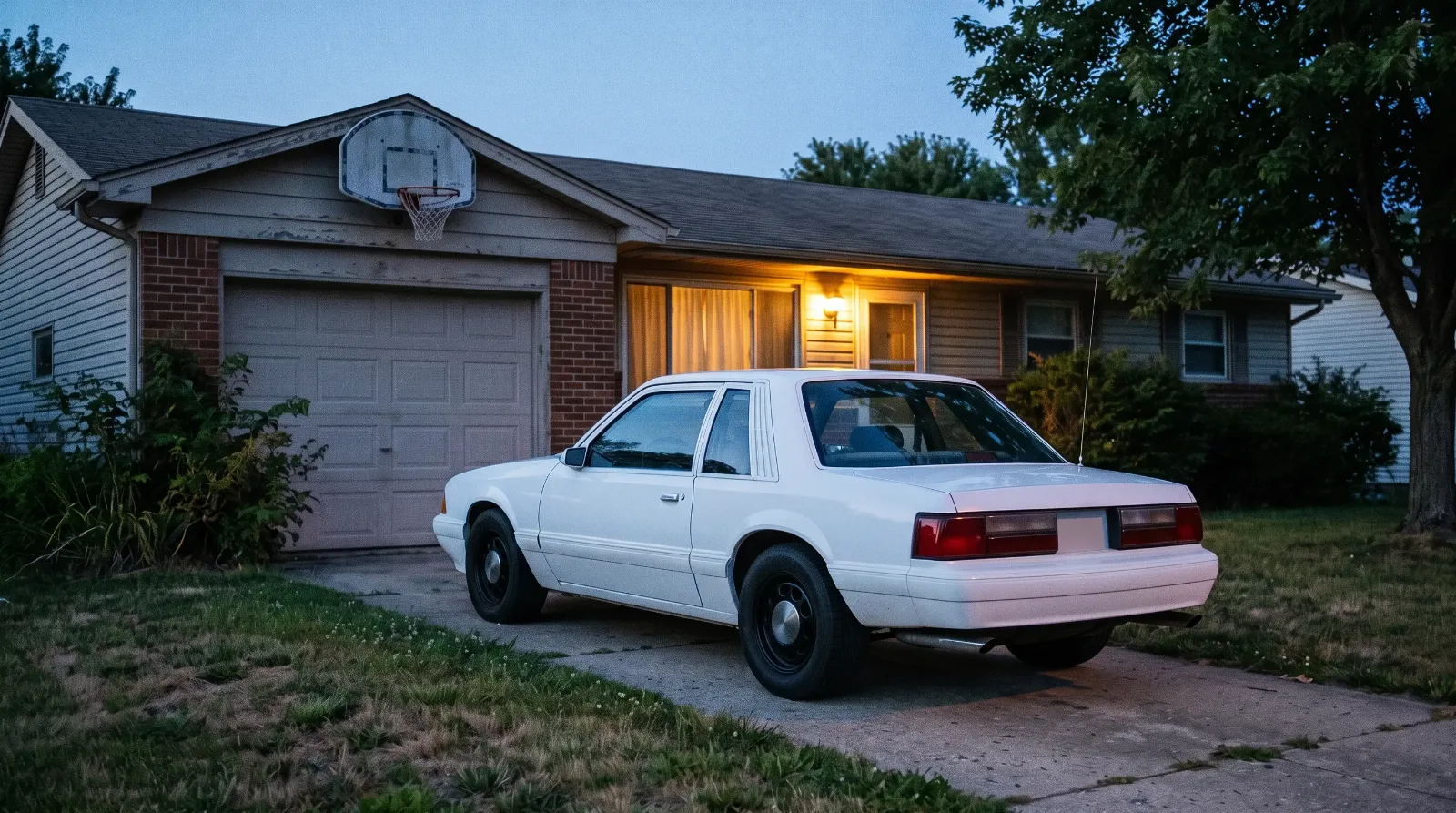
Because the SSP looked so much like a base notchback, it is easy to build a convincing tribute. A set of decals, a light bar and a spotlight will turn any 5.0 coupe into a patrol car for a parade. That is fine as long as it is sold for what it is.
The best survivors still carry their history with them: the paperwork, the worn driver's seat, the holes where the equipment was mounted. They are a reminder that the Fox Mustang was taken seriously in the 1980s, not just by kids at the drag strip but by the people whose job it was to catch them.
Sources and notes
- Ford Mustang SSP (Wikipedia): CHP order, production, agencies, equipment
- Ford Mustang, third generation (Wikipedia): 5.0 HO ratings by year
- FordMuscle: two 1982 SSP Mustangs, the 157 hp two-barrel 5.0 HO and the CHP order
- The Drive: a retired 1992 Florida Highway Patrol SSP and its civilian-spec engine
- MustangSpecs: 1987 Mustang curb weights by body style
- Over-Drive Magazine: 1982 Ford Mustang advertising
Related Reading
Have a
Ford Mustang
for Sale?
Reach thousands of serious classic car collectors across the US.
Sell It Here →
Selling a classic? Here's how: sell my classic car
Are You a Classic Car Dealer?
List your full inventory and connect with targeted classic car buyers.
Join as a Dealer →
#Ford Mustang
#fox body mustang
#police cars
#5.0 HO
#Mustang notchback
#Mustang SSP
#California Highway Patrol

About the author
Patrick Walsh
Automotive journalist covering classic car shows, events, and the enthusiast community across North America.
Related Listings - Ford Mustang




Comments
Be the first to comment on this article.