
Pull up next to a plain two-door Mustang at a light in 1988 and you had no way of knowing what was under the hood. That was the whole trick of the fox body Mustang LX with the 5.0. Same V8 as the GT, none of the skirts or louvers, and a trunk lid where the GT had a hatch. The notchback version got a reputation that the hatchback GT never quite had, and it earned it the cheap way: it was the least expensive, least decorated way Ford would sell you the engine.
Car Features
8 min read
The LX 5.0 Notchback: The Fox Body Sleeper
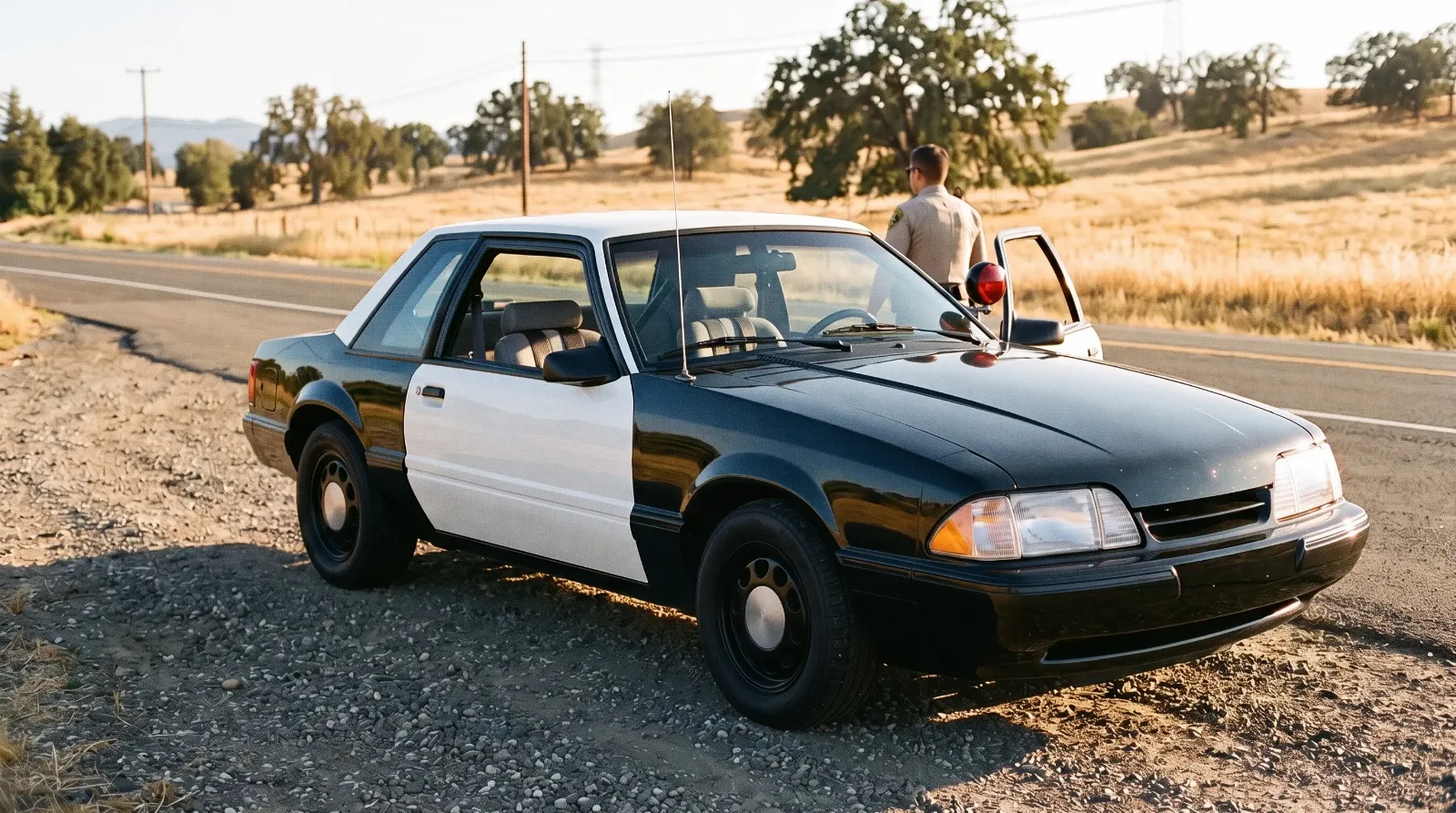
The fox body Mustang LX 5.0 notchback: the GT's V8 in the plainest, cheapest Mustang body, and why it shared a shape with the police SSP.
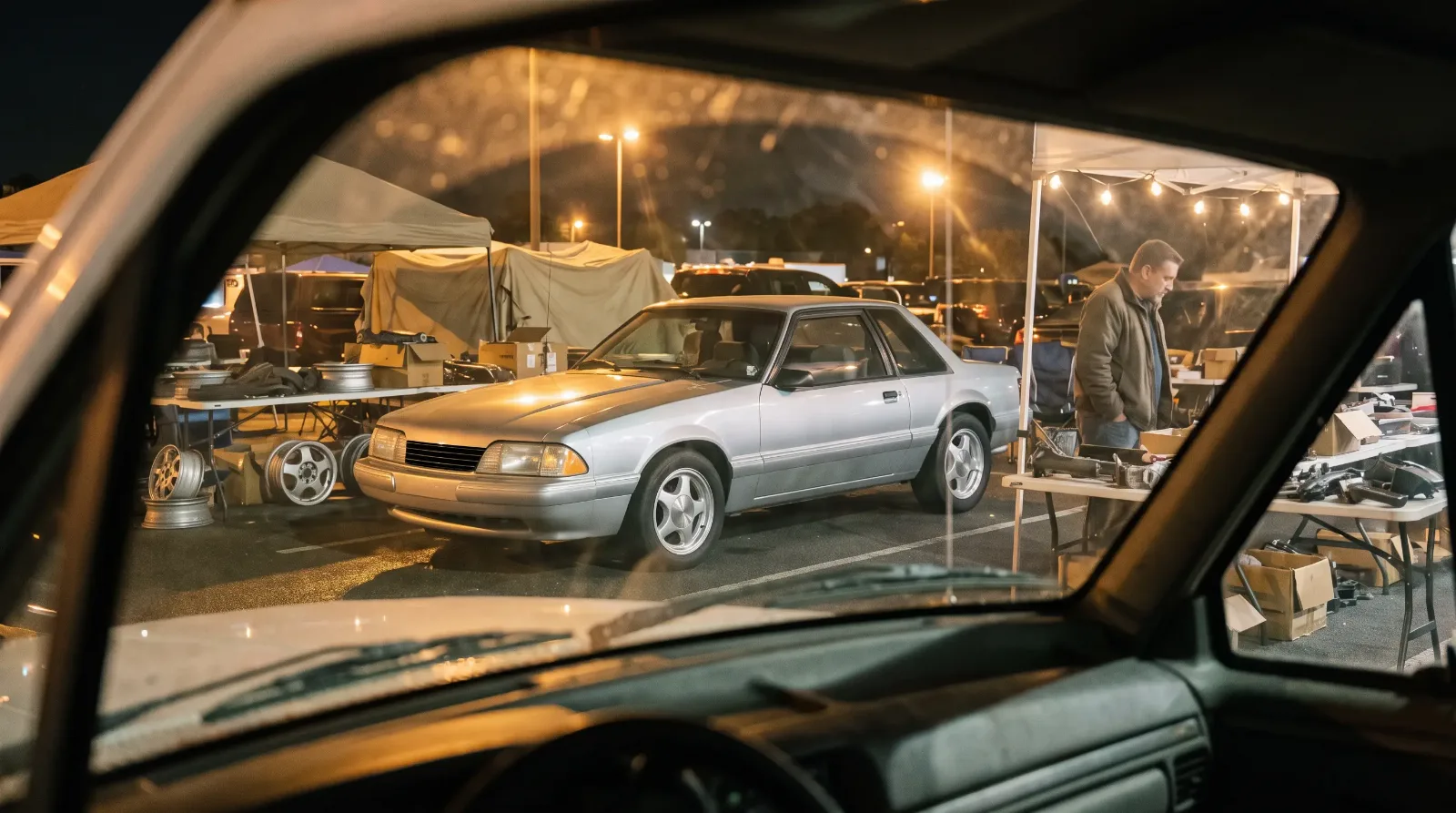
This piece stays on that one car, the LX 5.0 notchback, and why it mattered. The wider Fox run, from the 1979 launch to the last cars of 1993, is covered here.
What the fox body Mustang LX actually was
LX was a trim level, not a model. Ford introduced it for 1984 and dropped the GL and GLX names at the same time. By the end of the run the LX badge sat on all three Fox bodies: the notchback, the hatchback and the convertible. The base engine was the 2.3 four-cylinder. The V8 was something you had to ask for.
When you did ask, the price was hard to argue with. In 1987 a Mustang coupe started at $8,271 and the LX 5.0 package listed at $1,885. Add those up and you had the GT's engine in a car that cost a little over $10,000 before options. For 1988 the package was quoted at about $2,000. I've heard plenty of guys call the LX 5.0 a stripper. It wasn't. It had the same comfortable interior as any LX. What it didn't have was the GT's body kit and the GT's sticker.
The package put the 5.0 HO and the hardware that had to come with it under the plain body. From 1986 every V8 Mustang rode on the 8.8-inch rear axle, and the LX 5.0 was no exception. You could have it with the five-speed manual or an automatic. The manual cars are the ones that built the reputation.
Why the notchback made the best sleeper
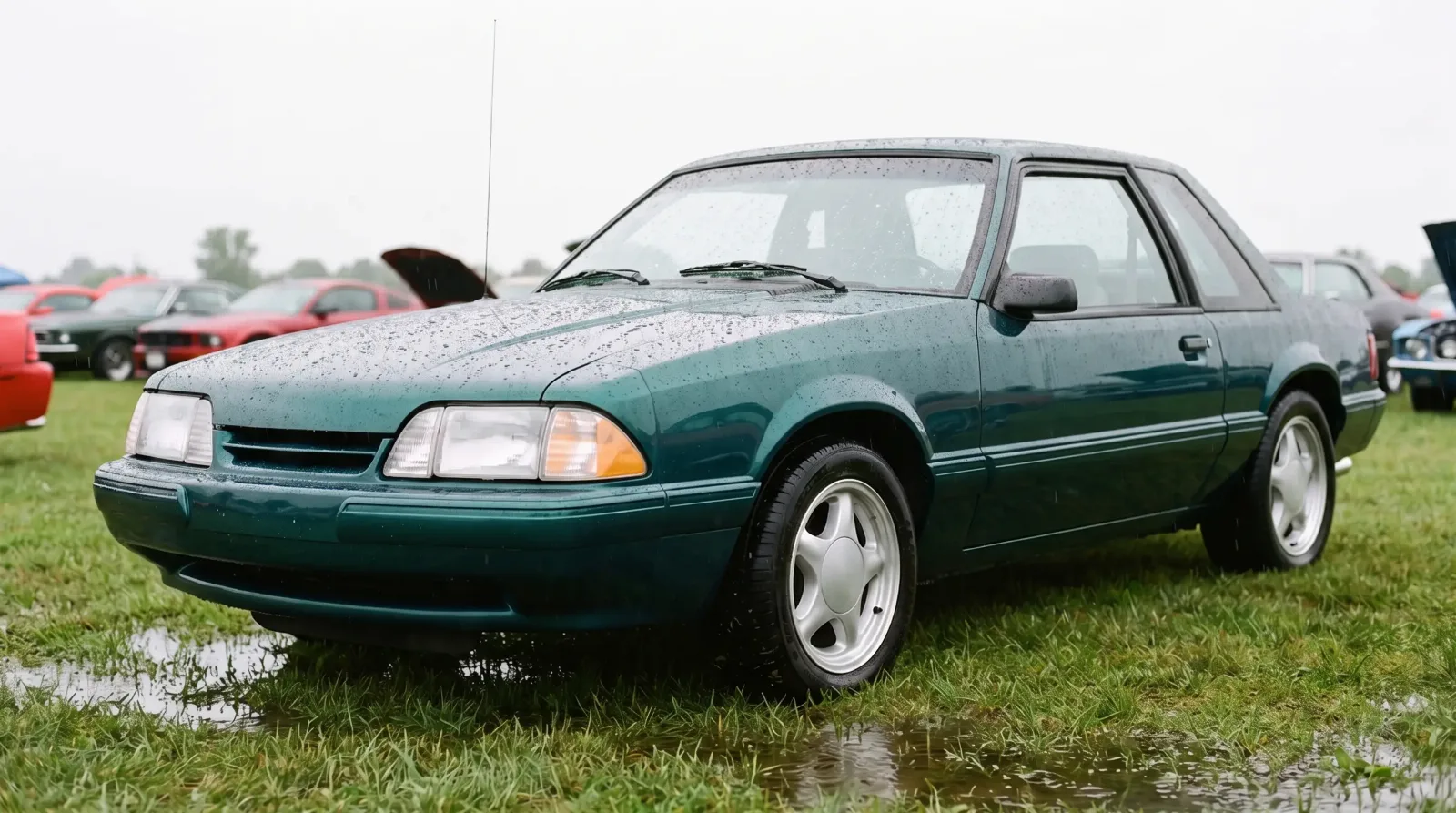
The notchback is the formal-roof Fox: upright rear glass, a separate trunk, a roofline that looks like it belongs on a Fairmont. It was never the slippery one. The 1979 figures put the hatchback at a drag coefficient of 0.44 and the notchback at 0.46. At a quarter-mile, nobody cared.
What people cared about was weight and looks. The GT package added a lot of hardware, and MustangSpecs puts the GT package at about 200 extra pounds over an LX 5.0, though it doesn't show the scale tickets behind that number. The body choice mattered too. Its 1988 table lists the notchback at 2,722 lb, the hatchback at 2,791 lb and the convertible at 3,044 lb, so the notchback was the lightest of the three Fox bodies. Same engine, less car. You don't need a dyno sheet to see where that goes.
Then there's the look, or the lack of one. From 1987 the GT wore ground-effects skirts, louvered taillamps and turbine wheels. The LX 5.0 had flat flanks, ordinary taillamps and a small 5.0 badge on each front fender. Plenty of people who should have known better took one for a four-cylinder commuter car right up until the light turned green.
The money gap made the joke better. In 1989 Saleen's SSC stickered at $36,500. A 5.0 LX went out the door for about $15,000. One of those cars got the magazine covers. The other one got bought by people who just wanted to go fast, and there were a lot more of them.
The police car that wore the same body
Here's the part of the sleeper story that goes past street racing. In 1982 the California Highway Patrol asked Ford for a light pursuit car. Part of the reason was trouble with its Camaros, which had camshaft and engine problems at pursuit speed. The CHP ordered 400 notchbacks and Ford built 394. That was the start of the police SSP, and by the time the Fox ended in 1993 nearly 15,000 had gone to more than 60 agencies.
The SSP was not a civilian LX with a light bar. It had an engine oil cooler, a transmission cooler, a 130 or 135-amp alternator, a calibrated speedometer, reinforced floor pans and a full-size spare. But from the outside it was the same plain, formal-roof Mustang. So for a decade, a white notchback in your mirror could be a kid's LX 5.0 or a state trooper. That is a big part of why people gave the shape a little room on the highway.
The LX 5.0 year by year
The V8 in the LX tracked the GT's engine all the way through. When you read the ratings below, remember they're net figures, and the LX got every one of them in a lighter car. I'm starting at 1984 because that's when the LX name arrived. The car most people mean when they say LX 5.0 is the injected 1987 to 1993 version, and for 1989 Ford's own literature started calling it the LX 5.0L Sport.
| Model year | 5.0 rating (net) | What changed for the LX 5.0 |
|---|---|---|
| 1984 | 175 hp four-barrel; 165 hp CFI automatic | LX trim introduced; GL and GLX dropped |
| 1985 | 210 hp four-barrel; 165 to 180 hp CFI automatic | Roller cam on manual cars; last carbureted V8 |
| 1986 | 200 hp | Sequential multiport injection; 8.8-inch rear axle; VIN engine code M |
| 1987 to 1988 | 225 hp at 4,200 rpm, 300 lb-ft at 3,200 rpm | E7TE heads; aero nose; speed-density; package $1,885 (1987); VIN engine code E |
| 1989 to 1990 | 225 hp | Mass-air-flow injection; driver airbag standard for 1990 |
| 1991 to 1992 | 225 hp | 16-inch five-spoke wheels on V8 cars, LX 5.0 included |
| 1993 | 205 hp, 275 lb-ft | Engine rerated; 24,851 LX hardtops built, all engines |
The line in that table that matters most to an owner is 1989. Speed-density injection works out airflow from a fixed map, and it gets confused the minute you change a cam or an intake. Mass-air measures the air. That switch is a big reason the late LX 5.0 notchback became the starting point for so many street and strip cars, from bolt-on daily drivers to full drag builds.
The 1991 wheels are worth a word too. The five-spoke 16-inch alloys gave the LX 5.0 a little more presence, which some purists will tell you took a bit of the sleeper out of it. I'd say it was still the plainest V8 Mustang you could buy.
How the paperwork settles an LX 5.0 argument
Every Fox gathering has a notchback with a 5.0 badge that started life as a four-cylinder car. Swapping a V8 into a 2.3 notchback is easy work, and a lot of them got swapped. Nothing wrong with that car. It just isn't a factory LX 5.0, and the VIN will tell you so. On a 1987 to 1993 car the eighth character is E for the 5.0 HO, and on a 1986 car it's M. A decoded VIN such as 1FABP41E4KF152360 comes back as a 1989 LX 5.0 built at Dearborn. The body code in positions five through seven separates the bodies: P40 is the LX two-door sedan, which is Ford's name for the notchback, P41 is the LX hatchback and P42 is the GT. So that sample VIN, with its P41, is a hatchback. A factory LX 5.0 notchback from 1987 to 1993 carries P40 there and E in position eight.
Production numbers won't help you as much as you'd like. For 1993, the last year, Ford built 24,851 LX hardtops, and that count lumps the four-cylinder and V8 cars together. I haven't seen a reliable split, so anyone quoting you an exact LX 5.0 notchback total should show you where it came from.
"I've had GT owners tell me the LX 5.0 was a parts-bin car. Then you weigh them both on the same scale and the argument gets real quiet. Ford built the GT for the showroom. The notchback was built for whoever showed up at the strip on Friday night."
Mike Sullivan
The four-eye and aero LX cars split the hobby the same way the GTs do. The 1987 change that divided them, the new nose and the 225 hp rating, is explained here. Most of the LX 5.0 legend lives in the aero years, simply because that's when the full 225 hp and the plain body met.
And then the notchback went away. The 1994 Mustang came only as a fastback-style coupe and a convertible, the first Mustang since 1964 without a notchback. Ford took one more swing at the LX 5.0 idea with the 1995 GTS, a stripped GT at $16,910 against $18,105 for the regular GT. It built 6,370 of them. Good car. Not a sleeper. Once the trunk lid and the formal roof were gone, so was the disguise.
Sources and notes
- MustangSpecs: 1987 Ford Mustang (prices, LX 5.0 package, 225 hp rating)
- MustangSpecs: 1988 Ford Mustang (body-style weights, GT package weight)
- MustangSpecs: 1989 Ford Mustang LX 5.0L Sport
- NHTSA vPIC VIN decoder: 1989 Mustang P40 body code (LX two-door sedan, 5.0, Dearborn)
- Wikipedia: Ford Mustang (third generation)
- Wikipedia: Ford Mustang SSP
Related Reading
Have a
Ford Mustang
for Sale?
Reach thousands of serious classic car collectors across the US.
Sell It Here →
Selling a classic? Here's how: where to sell your classic car online
Are You a Classic Car Dealer?
List your full inventory and connect with targeted classic car buyers.
Join as a Dealer →

About the author
Mike Sullivan
Detroit-area muscle car enthusiast and restoration specialist with three decades of hands-on experience working on American iron.
Related Listings - Ford Mustang




Comments
Be the first to comment on this article.