
The Fox Body Mustang ran fifteen model years, and it started out as the sensible one. A light, clean, economy-minded coupe with a four-cylinder base engine and, for two of its early years, a V8 so weak it barely deserved the badge. It finished as the 5.0 that a whole generation of kids bought, raced, wrecked and rebuilt. Same platform the whole way. Same basic body, too. That is the strange part of the fox body Mustang story: Ford kept improving a car it had already planned to kill, and the car outlived the plan. If you want the background on where the Mustang came from, start there. This is the 1979 to 1993 chapter, start to finish.
Car Features
10 min read
The Fox Body Mustang Story (1979–1993)
The full Fox Body Mustang story, 1979 to 1993: the Fairmont platform, the weak early V8s, the 5.0 HO comeback, the aero cars and the 1993 Cobra.
Where the Fox came from
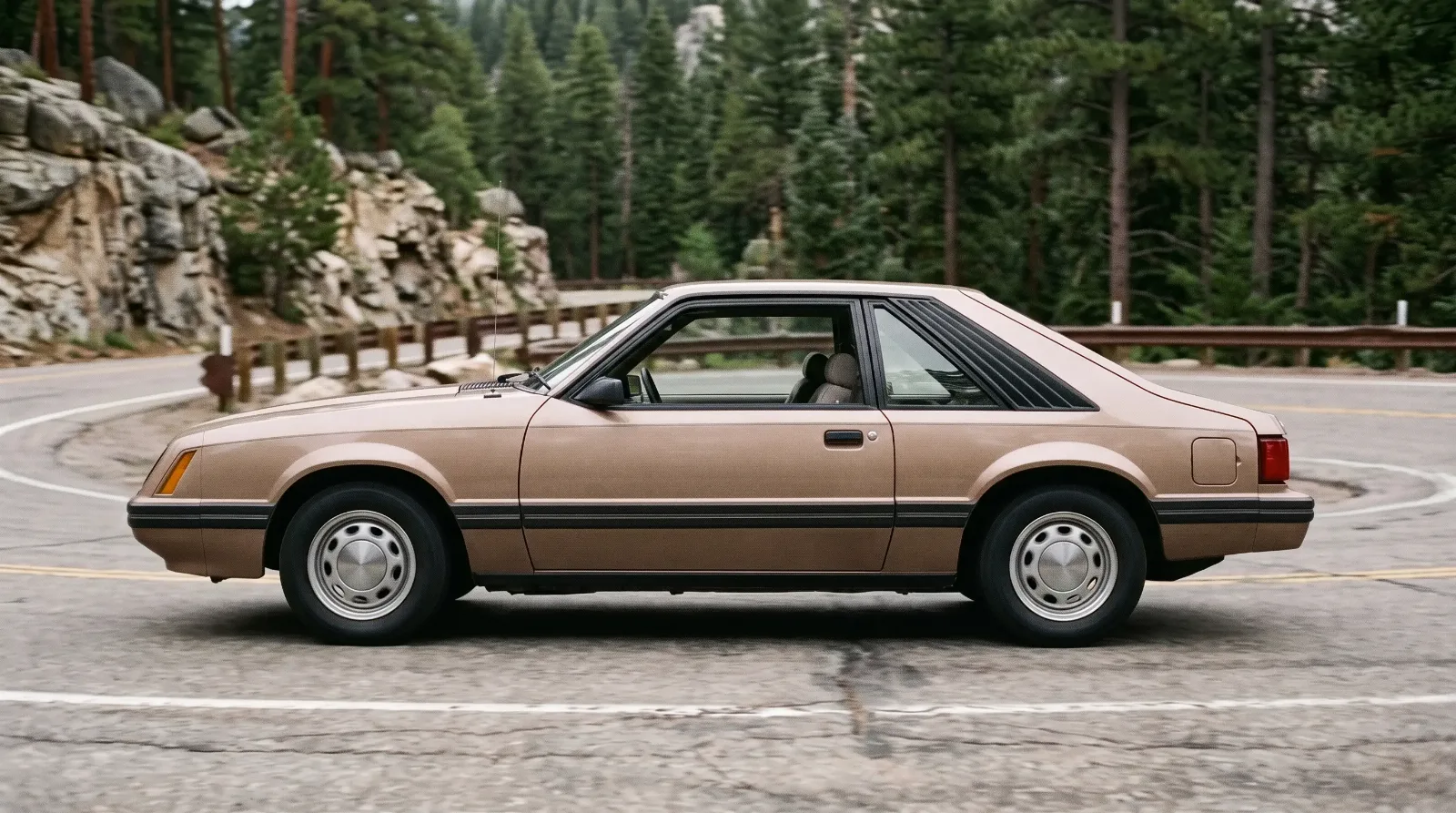
"Fox" was never a model name. It was the code for a rear-drive unibody platform Lee Iacocca approved in December 1973, and the Mustang was not even the first car on it. The 1978 Ford Fairmont and Mercury Zephyr were. Family sedans. That is the hardware the next Mustang would be built from.
Ford confirmed in October 1974 that a Fox-based car would replace the Mustang II, barely a year after the small car had gone on sale. Jack Telnack came back from Ford of Europe in April 1975 to run North American Light Car and Truck Design, and design work on the new Mustang began that July. His group was up against another Dearborn team and Ghia in Italy. Telnack's proposal won. A near-final prototype existed by July 1976, and production approval came in September 1976. Fast work for the time.
1979 to 1981: lighter, cleaner and short on V8
The 1979 car rode a 100.5-inch wheelbase, about four inches longer than the Mustang II, and still came in roughly 200 pounds lighter. Ford got there with urethane bumpers, a soft front fascia, and thinner doors and glass. The hatchback tested at a drag coefficient of 0.44 and the notchback at 0.46, which Ford claimed were the lowest figures on the road at the time. In 1979 that was a real selling point. Most American cars still looked like furniture.
The engine list was a mess. The base 2.3 four made 88 hp. A turbocharged version, draw-through, no intercooler, 5 psi, made 131 to 132 hp. The 302 V8 made about 140 hp. A 109 hp 2.8 V6 got dropped during the year for supply reasons, and a 3.3 inline six at 89 hp joined early on. Five engines in one model year. Base prices were $4,494 for the notchback and $4,828 for the hatchback.
Buyers liked it anyway. Ford built 369,936 Mustangs for 1979, the best year the Fox would ever have. A Mustang paced the Indianapolis 500 that May with Jackie Stewart driving, and Ford sold about 10,500 pace car replicas off the back of it. The Ghia carried over from the Mustang II as the luxury trim, and a $1,200 Cobra package sold 17,579 copies.
Then the V8 went backward. For 1980 the 302 was gone, and the only V8 was a 4.2-liter, the 255, rated at 118 to 120 hp and sold with an automatic only. Lowest-rated V8 Ford ever put in a Mustang. For one model year the turbo four out-rated it, which tells you more about the V8 than the turbo. The turbo had reliability problems of its own, and sources disagree on exactly when it left: one says it stayed on the U.S. order form through calendar 1981, others that it was already gone. Either way it was absent by 1982, and an improved, fuel-injected version came back for 1983. Production fell to 271,322 for 1980 and 182,552 for 1981. The T-top arrived for 1981, and the Ghia and Cobra trims ended with that year.
1982 to 1986: the 5.0 comes back
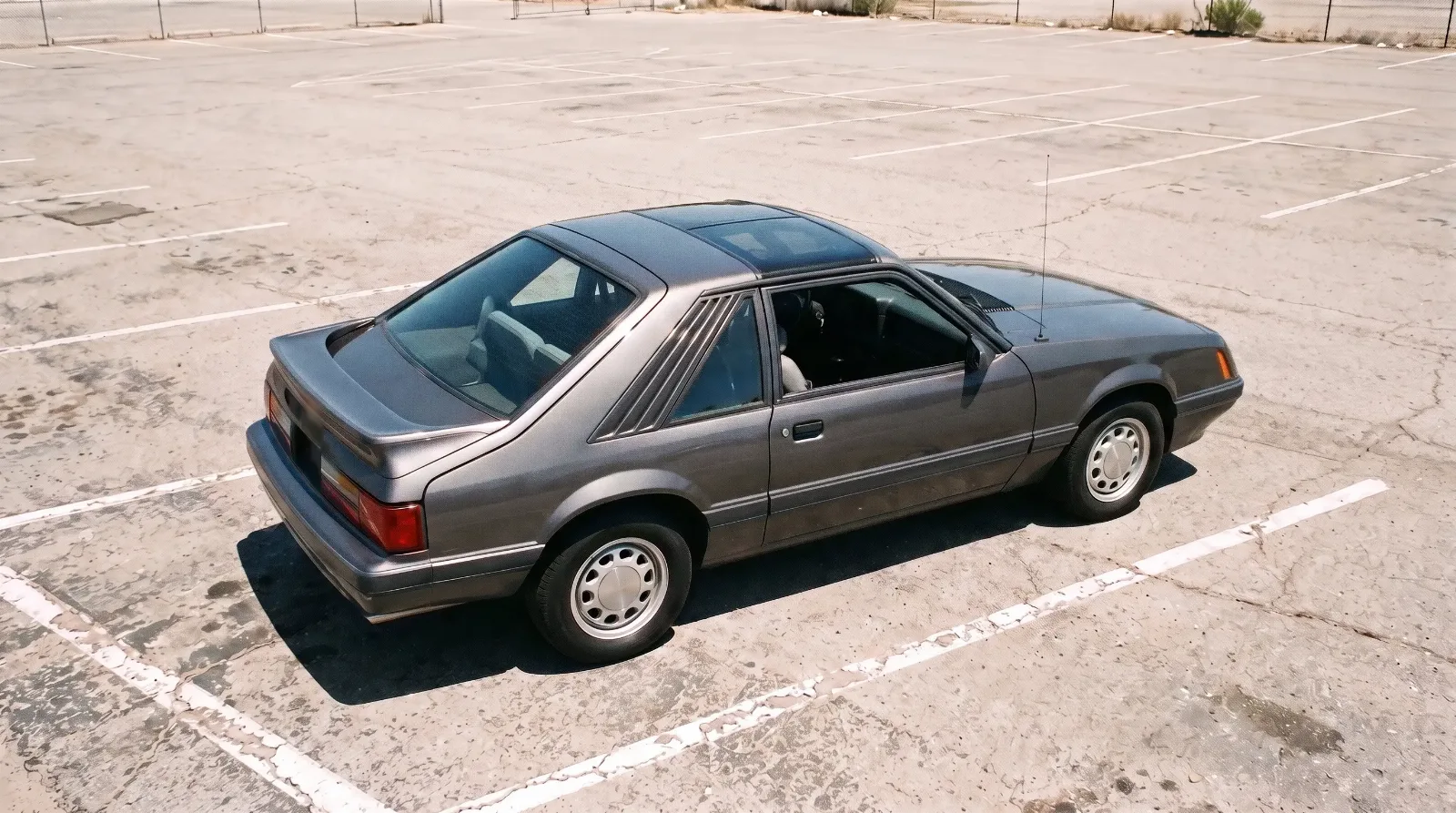
For 1982 Ford revived the GT name, gone since 1969, and put the 5.0 HO in it. A two-barrel 302 rated at 157 hp, behind a four-speed manual. Ford's ads said "The Boss is back." It wasn't, not literally. But after two years of 4.2 automatics, a V8 Mustang with a clutch pedal was back, and that mattered more than the slogan. The same year the California Highway Patrol asked Ford for a light pursuit car and ordered 400 notchbacks, of which Ford built 394. That started the SSP police Mustang, and by 1993 nearly 15,000 had gone to more than 60 agencies.
From there the V8 got better almost every year. For 1983 the 5.0 got a 600 cfm Holley four-barrel and 175 hp, and the T-5 five-speed showed up partway through the year. The convertible came back too, the first open Mustang since 1973, and 23,438 were built that first year. For 1984 the LX name replaced GL and GLX, and Ford's Special Vehicle Operations group added the SVO, an intercooled 2.3 turbo at 175 hp that cost more than twice a base Mustang. Ford built 9,844 of them through 1986.
The 1985 GT got a roller cam on manual cars and 210 hp. Last carbureted V8 Mustang. For 1986 the 5.0 switched to sequential multiport fuel injection, and the rating actually dropped to 200 hp. Doesn't matter. That injected engine is the one Ford kept developing to the end, and V8 cars got the 8.8-inch rear axle the same year. Production climbed to 224,410, the best total since 1980.
1987 to 1993: the aero nose and the 225 hp years
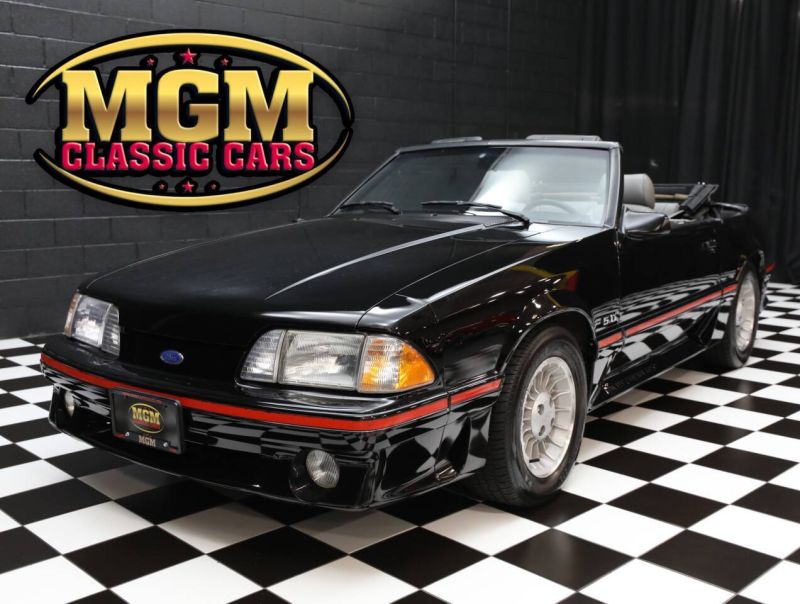
Ford announced the 1987 car in August 1986. The whole line got an aero nose with flush headlamps, lifted from the SVO, plus a new dash and console. GTs got skirts, louvered taillamps and turbine wheels. With E7TE heads the 5.0 went to 225 hp at 4,200 rpm and 300 lb-ft at 3,200 rpm. That is the number people mean when they say "5.0," and it stayed on the books through 1992. The headlamps split the hobby into four-eye cars (1979 to 1986) and aero cars (1987 to 1993), and that is still the first question at any Fox meet.
Here is the part people forget. That facelift was supposed to be a bridge. Ford had a front-drive, Mazda-based coupe coded ST-16 lined up as the 1989 Mustang. AutoWeek ran it on the cover in April 1987. Mustang Monthly editor Donald Farr told readers to write to Ford chairman Donald Petersen, and plenty did. Also in 1987, Alex Trotman ruled that ST-16 was not a Mustang, and it went on sale as the Ford Probe. So a nose meant for two model years ended up on seven.
The real draw was the cheap way to get the engine. In 1987 a coupe started at $8,271 and the LX 5.0 package listed at $1,885. GT engine, plain body, no skirts. The notchback was the lightest Fox body, 2,722 lb in the 1988 tables against 2,791 for the hatchback. It looked like a rental car. It wasn't.
After that, Ford worked on details. Mass-air-flow injection replaced speed-density for 1989, which is a bigger deal than it sounds: a mass-air car tolerates a new cam or intake, and that is why the late 5.0 became the aftermarket's favorite. A driver airbag became standard for 1990, and the tilt wheel went away. The 1990 "7-Up" cars, 4,103 Emerald Green LX 5.0 convertibles with white tops and white leather, came out of a soft-drink promotion that got canceled. The 1991 V8 cars got 16-inch five-spoke wheels.
The final year had two headlines. Ford rerated the 5.0 to 205 hp and 275 lb-ft. The usual explanation is a revised measurement method, plus a slightly changed cam profile and the hypereutectic pistons every 302 got that year. And Ford's new Special Vehicle Team delivered the 1993 SVT Cobra: GT-40 heads, 235 hp, rear disc brakes and the first 17-inch wheels on a factory Mustang. SVT built 4,993 Cobras and 107 Cobra R race cars.
"The 1993 car didn't lose 20 horsepower. The window sticker did. Same block, same heads, same car you could buy the year before. What the Fox really had going for it was never on the sticker anyway: it was light, it was cheap, and every part on it bolted off and something better bolted on."
Mike Sullivan
Fox body Mustang V8 and production, year by year
Here is the whole run in one place. Ratings are SAE net. Production counts after 1986 disagree by thousands of cars depending on the source, so I left those years as a range or flagged them rather than pick a winner.
| Model year | Front end | Top V8 rating | Production | What changed |
|---|---|---|---|---|
| 1979 | Four-eye | 302, about 140 hp | 369,936 | Fox launch; Indy pace car; 2.3 turbo |
| 1980 to 1981 | Four-eye | 4.2 V8, 118 to 120 hp | 271,322 / 182,552 | V8 automatic only; T-top for 1981 |
| 1982 | Four-eye | 5.0 HO, 157 hp | 130,418 | GT returns; SSP police car |
| 1983 | Four-eye | 175 hp | 120,873 | Convertible returns; T-5 five-speed |
| 1984 | Four-eye | 175 hp | 141,480 | LX trim; SVO arrives |
| 1985 | Four-eye | 210 hp | 156,514 | Roller cam; last carbureted V8 |
| 1986 | Four-eye | 200 hp | 224,410 | Sequential injection; 8.8-inch axle |
| 1987 to 1992 | Aero | 225 hp | Disputed by source | Aero nose; mass-air 1989; airbag 1990 |
| 1993 | Aero | 205 hp (Cobra 235 hp) | 114,228 to 115,359 | 5.0 rerated; first SVT Cobra |
Read the two columns together and the odd thing jumps out. The Fox sold best in its first year, before the 5.0 HO existed, and some of its best engineering landed in years Ford was building the fewest cars. Total production lands somewhere between about 2.52 million and more than 2.6 million, depending on whether you count by model year or calendar year and whether exports are in. Nobody has a Ford document that settles it, so be suspicious of anyone quoting one exact total.
What the Fox left behind
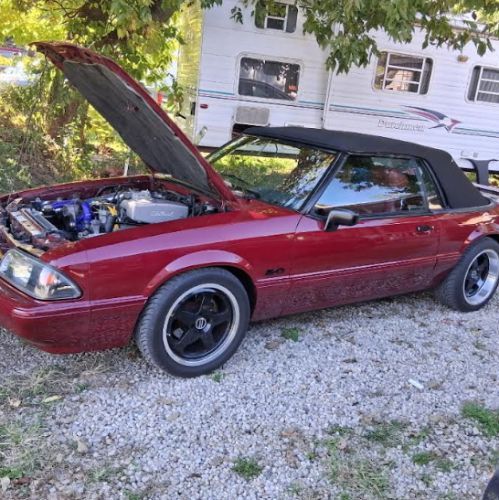
Cheap speed made the Fox, and cheap speed used most of them up. The 5.0 cars went to drag strips, to Fun Ford Weekend events that started in 1990, and to the street on Friday nights. Owners swapped heads, intakes, gears and exhausts, then swapped them again. The Fox became a platform for parts the way the small-block Chevy had been a generation earlier. Today a lot of the rough ones end up as restomods with modern V8s, and that is fine for a car nobody was going to save.
The flip side is that clean, unmodified cars with paperwork are now the scarce ones. The 1993 Cobra and Cobra R, the SVO, the 1984 GT350 20th Anniversary cars, the 7-Up convertibles and the 1979 pace cars draw the most attention, because they were limited when new. An everyday LX or GT is still priced as a driver unless it can prove otherwise.
Check before you pay. From 1981 the 17-character VIN carries the model year in the tenth position, and on 1987 to 1993 cars an E in the eighth position means the factory 5.0 HO (1986 cars use M). A 5.0 badge on a car with a four-cylinder code is a conversion. Plenty of conversions are good cars. They just aren't factory 5.0s, and they shouldn't cost like one.
The platform didn't end in 1993 either. Ford built the SN95 that followed in 1994 on an updated version Ford called Fox-4, which kept the floor pan and the front crossmember. What it dropped was the notchback, the first Mustang since 1964 without one, and with it the light, plain-looking sleeper that defined the late Fox years. If you're shopping, browse Fox Body Mustangs for sale with the VIN codes in hand, and ask what's original before you ask what it runs.
Sources and notes
Related Reading
Article
The Classic Ford Mustang Story
Article
The Mustang II Story (1974–1978): The Small Pony That Kept the Name Alive
Article
The SN95 Mustang Story (1994–2000): Ford Rethinks the Pony Car
Article
What Is a Fox Body Mustang? Where the Name Comes From
Article
The Fox Body Years: How the Mustang Changed, 1979 to 1993
Article
Jack Telnack and the Fox Body's Aero Shape
External
/ford/mustang/fox-body
#mustang history
#Ford Mustang
#fox body mustang
#mustang gt
#5.0 HO
#1980s Mustang
#SVT Cobra
#LX 5.0

About the author
Mike Sullivan
Detroit-area muscle car enthusiast and restoration specialist with three decades of hands-on experience working on American iron.
Related Listings - Ford Mustang




Comments
Be the first to comment on this article.