
A child lies on a kitchen floor in 1968, cheek pressed to the linoleum, watching a tiny car shoot down a strip of orange track and skid under the refrigerator. The car is a Mustang, small enough to close a fist around, heavy enough to feel real. For millions of people the first Mustang they ever owned looked something like that, and the story of the Mustang Hot Wheels car, the pedal cars before it and the video games after it is really a story about how a full-size car found its way into small hands.
Car Features
6 min read
Hot Wheels, Pedal Cars and Video Games: The Mustang in Miniature
From the 1968 Custom Mustang Hot Wheels car to pedal cars, model kits and a 2005 video game: how the Mustang found its way into small hands.
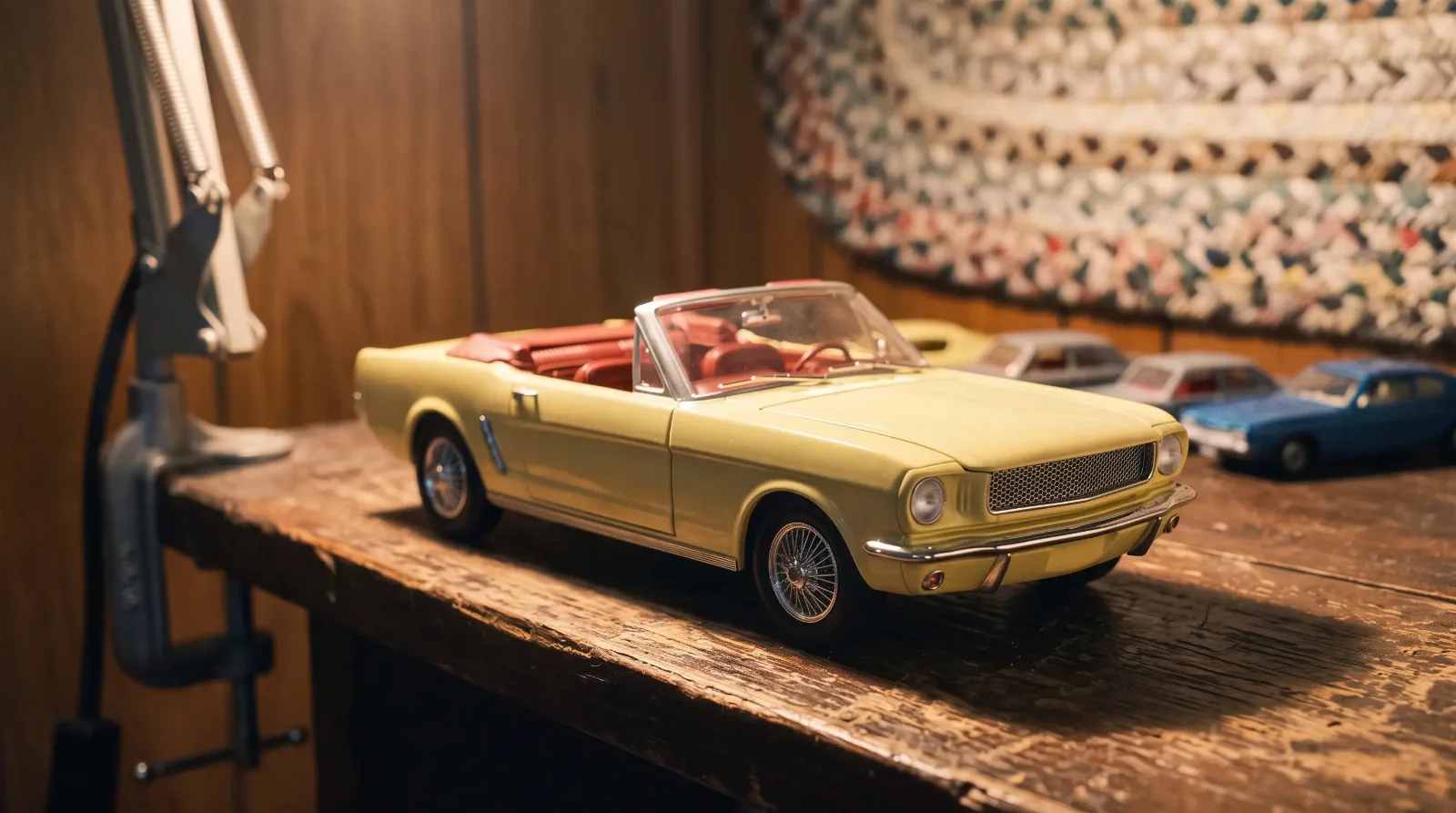
This piece is one thread of Mustang pop-culture history. The films and famous owners have their own pages; here the subject is the miniature.
Why the Mustang shrank so well
Some cars ask to be toys. The Mustang arrived on April 17, 1964, at the New York World's Fair and in showrooms the same day, and about 22,000 were bought or ordered in the first days. More than 400,000 sold in the first year. A car that popular was everywhere children looked: in driveways, in parking lots, in the background of family photographs. When a child wanted a car of their own, it was natural to want that one.
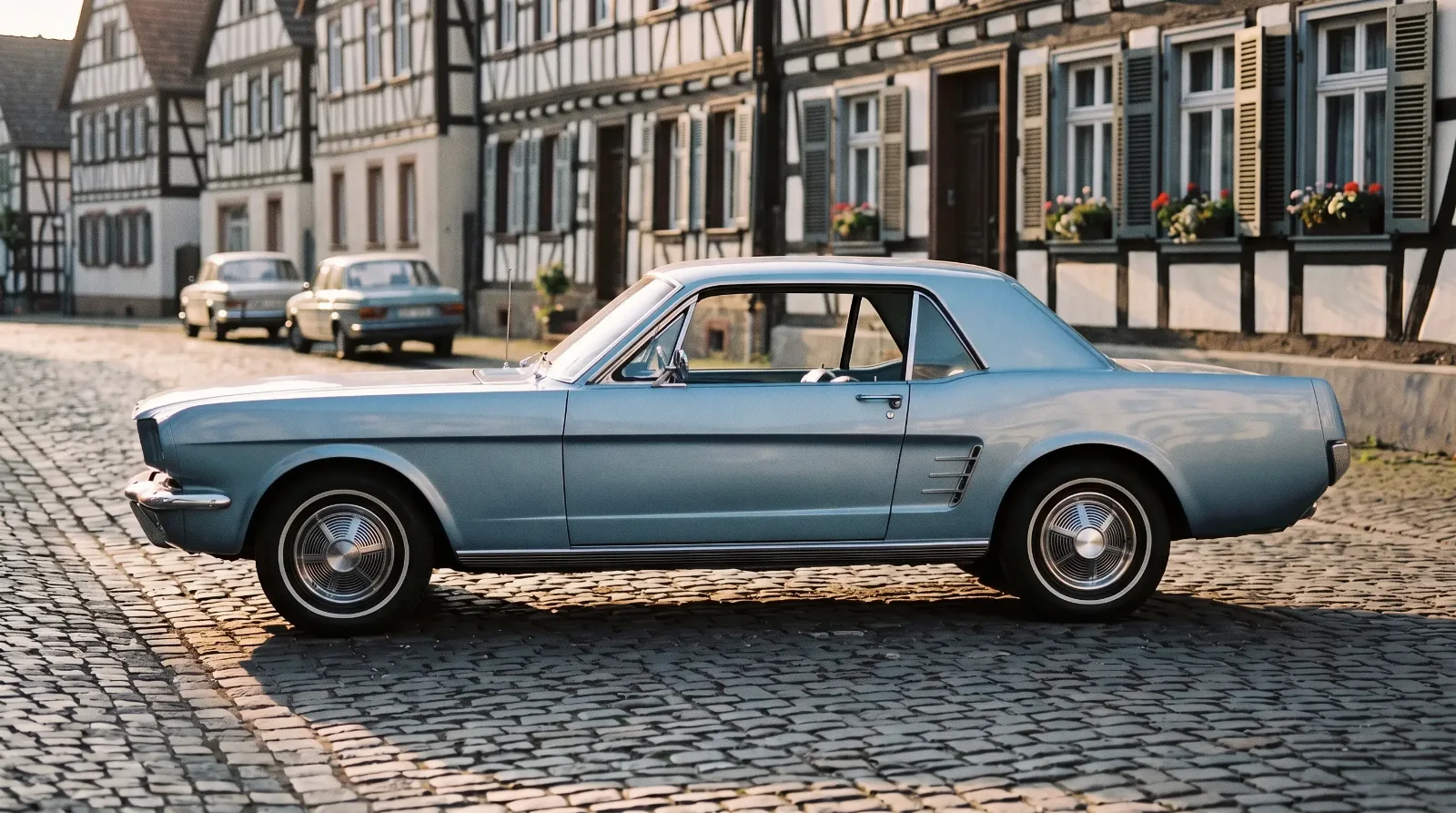
The shape helped too. A long hood and a short deck read clearly at any scale, the way a silhouette of a horse reads even when it is no bigger than a thumbnail. You do not need chrome trim or a dashboard to recognize a Mustang. You need the proportions, and the proportions survive being shrunk.
The Custom Mustang: the first Mustang Hot Wheels car
Mattel introduced Hot Wheels on May 18, 1968. The idea came from Elliot Handler, and the first 16 cars were shown at the 1968 New York Toy Fair. Collectors call that opening group the "Sweet 16," and one of them was the Custom Mustang. Harry Bentley Bradley designed 11 of those first 16 cars.
Imagine opening that blister pack. The Custom Mustang was not a faithful copy of a showroom car; the name says as much. It was a Mustang seen through the eyes of a hot rodder, the kind of car a child had glimpsed at a drive-in and never stopped thinking about. That spirit, the real thing made a little wilder, is what Hot Wheels sold from the start, and the Mustang was there on day one.
Hot Wheels kept coming back to the car. A 1965 Mustang GT joined the Hot Wheels Classics Series 2 line in late 2005, decades after the first one rolled off the orange track, which says something about how long that first impression lasts.
Pedal cars, promos and plastic kits
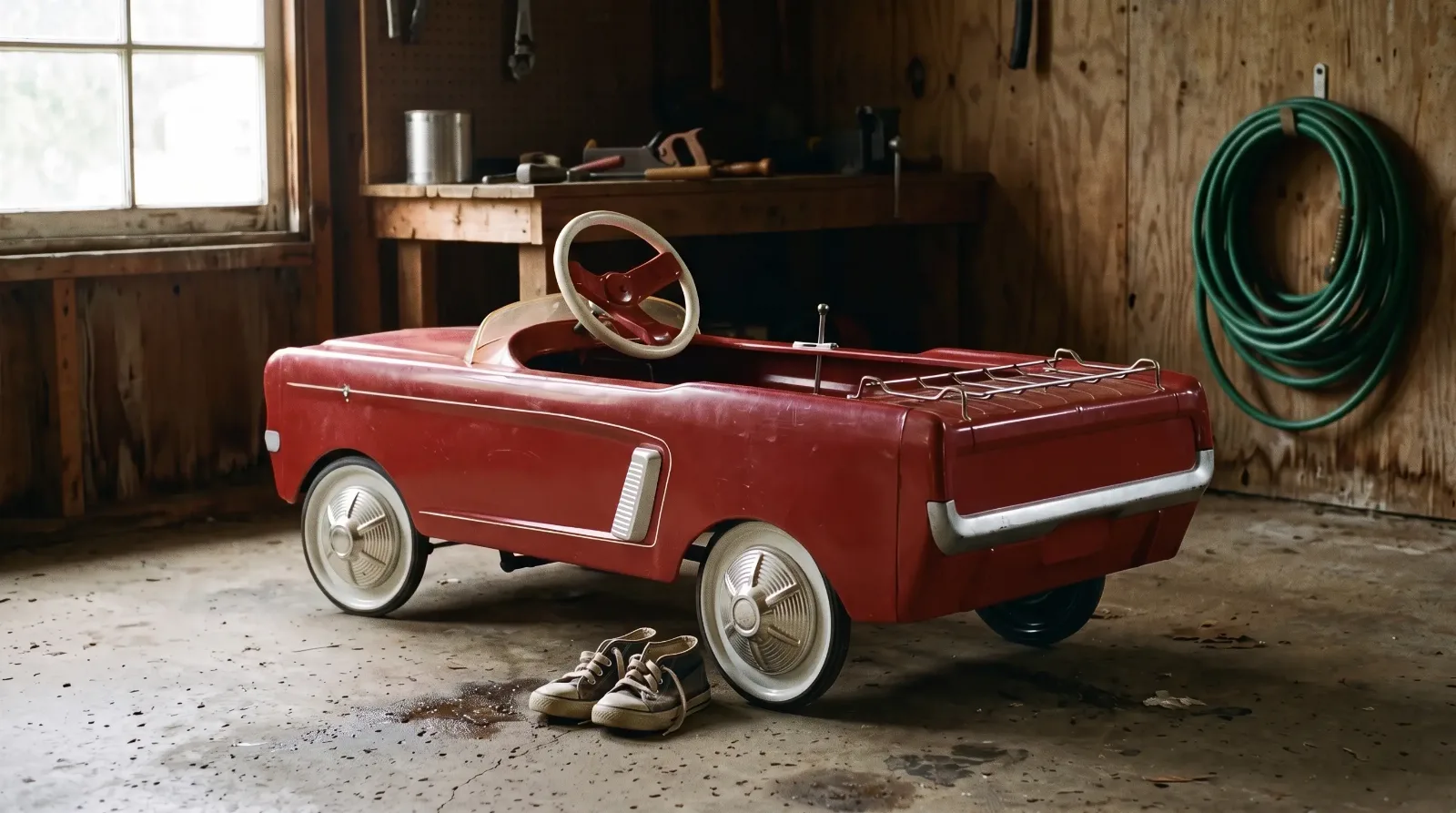
Before Hot Wheels, there were Mustangs a child could sit in. Ford showed a Mustang pedal car in 1964, American Machine and Foundry (AMF) built it in quantity, and Ford dealers sold it for $12.95. It had a child-size Mustang body, a steering wheel that actually turned, and pedals that squeaked on the driveway. Picture a boy in a striped shirt pedaling furiously down a sidewalk while his father's real Mustang sits in the carport behind him, two versions of the same dream at two sizes.
For older children there were models. AMT built pre-assembled 1965 Mustang promotional models that Ford dealers sold or gave to customers, and the same company sold plastic kits, among them a 1/32 scale 1965 Mustang 2+2 first issued in 1965. A kit meant an evening at the kitchen table with a tube of glue and a sheet of decals, fingertips sticky, the smell of cement in the air, and a finished car that sat on a bedroom shelf for years. Die-cast makers had the car before Hot Wheels existed, too: Corgi's 1/46 scale Ford Mustang Fastback 2+2, number 320, came out in 1965 with opening doors and tilting seats.
"Ask someone about their first Mustang and watch their face. Half the time the car they describe was three inches long, and they remember the color better than any real car they ever bought."
Nora Beckett
From the toy box to the screen
The next generation met the Mustang on a television. Racing games put classic Mustangs into the hands of players who had never seen one on the road, and the car has turned up across the big driving franchises: a 1993 Mustang police car chased players in the first Need for Speed in 1994, Gran Turismo 2 carried four Mustangs in 1999, and a Mustang was one of the first hero cars of Forza Motorsport in 2005. The clearest example of the car getting a game of its own is Ford Mustang: The Legend Lives.
Developed by Eutechnyx and published in North America by 2K, it was released on April 19, 2005, for the PlayStation 2 and the Xbox. It gathered 40 Mustangs, from 1964 onward, and set them loose on 22 tracks. For a teenager in 2005, that meant a 1960s Mustang and a much later one could share a starting grid, something that almost never happened in a real parking lot. The game treated the car's history as a garage to explore rather than a timeline to memorize.
What the game and the toys share is scale and access. Neither asks for a title, an insurance card or a garage. Both let a person hold the car, in the palm or through a controller, long before they could ever own one.
Keeping the small ones
Many of those children grew up and bought the real thing, and many of them kept the toy too. A tiny Custom Mustang on a desk next to the keys to a full-size one is not an unusual sight, and it tells you which car came first. Those collections often find their way into club displays, where the miniatures sit beside the cars that inspired them; the wider world of the clubs and museums is where many of them end up.
Not every famous Mustang became a familiar toy. Jim Morrison's 1967 Shelby GT500 earned the nickname "The Blue Lady" from his friend Babe Hill, after a character in a screenplay Morrison was writing, and it is remembered less as a miniature than as a car people have spent years trying to trace. That is the longer story. The small Mustangs carry a quieter history: the kitchen floor, the orange track, the first car anyone ever called their own.
Sources and notes
- Hot Wheels (Wikipedia): the 1968 launch, the Custom Mustang and the 2005 Classics Series 2
- Audrain Automobile Museum: 1964 Ford Mustang pedal car by American Machine and Foundry
- Analog Shift: 1965 Mustang coupe Ford dealer promo model from AMT
- Corgi Model Club: the 320 Ford Mustang Fastback 2+2, first issued in 1965
- MustangSpecs: the Mustang in video games, 1980s to today
- Ford Mustang: The Legend Lives (Wikipedia)
Related Reading
Have a
Ford Mustang
for Sale?
Reach thousands of serious classic car collectors across the US.
Sell It Here →
Selling a classic? Here's how: compare the places to sell classic cars
Are You a Classic Car Dealer?
List your full inventory and connect with targeted classic car buyers.
Join as a Dealer →
#pop culture
#Ford Mustang
#Hot Wheels
#model kits
#Custom Mustang
#Mustang toys
#Pedal cars
#Mustang video games

About the author
Nora Beckett
Automotive features writer and photographer who tells the human stories behind the cars, from show fields to cross-country road trips.
Related Listings - Ford Mustang

Comments
Be the first to comment on this article.