
On September 17, 1964, London's West End turned out for the premiere of Goldfinger, and among the cars at the event was a Wimbledon White Mustang convertible. Ford's new car had been on sale in America for exactly five months. It already had a supporting role in the year's biggest spy film and a place on a British red carpet. If you want to measure Mustang global cultural impact, that evening is the right place to start, because it shows the pattern early: the car traveled as an image long before it traveled in any real numbers.
Car Features
8 min read
How the Mustang Became a Worldwide Icon
Magazine covers, Bond films, a German badge that said T-5: how the classic Mustang became famous abroad before it was sold there in volume.
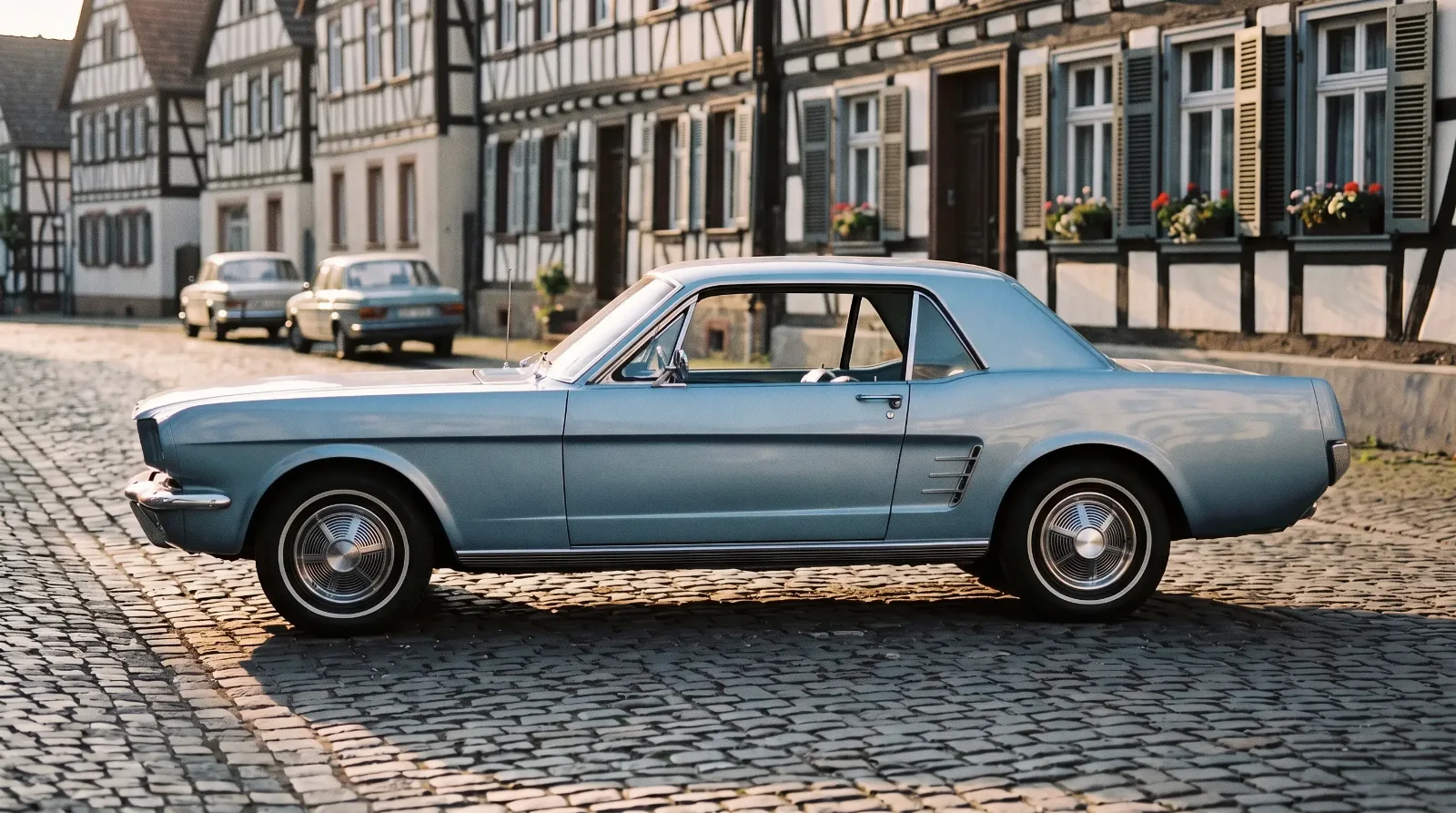
This piece follows that image out of Dearborn. It looks at the launch machinery that made the Mustang famous at home in a single week, the films that carried it abroad, the one country where it could not use its own name, and the reasons the reputation lasted. The wider origin story, from the committee rooms to the rivals, is covered here.
A launch built to be seen
Ford did not leave fame to luck. The night before the April 17, 1964 introduction, it bought prime-time television on all three American networks, a buy of about $500,000 that reached almost 30 million homes. Ads ran in 2,600 newspapers. That same week Lee Iacocca and the Mustang were on the covers of Time (dated April 17) and Newsweek (dated April 20), and Life and BusinessWeek gave the car generous space too. Ford's own history says it was reportedly the first time a retail product had appeared on either magazine's cover. Iacocca later credited that exposure with about 100,000 extra sales.
The public answered. Ford says more than 4 million people visited showrooms that first weekend and placed over 22,000 orders. Those were orders, and they came over a weekend, whatever the "first day" legend says. In the twelve months from launch, buyers took 418,812 Mustangs, a 12-month record.
The fairground side of that week has its own story in the World's Fair debut, so I won't walk the pavilion again. What matters here is the multiplier. A car on two newsmagazine covers in the same week had stopped being a product. It had become news, and news crosses borders much faster than freighters do.
Mustang global cultural impact on screen
Here is the part most American fans get backward: the Mustang's first film role was not in an American picture. Before Bond, it appeared in The Troops of St. Tropez (1964), in which Geneviève Grad drives a Poppy Red 1964½ convertible.
Then came Goldfinger. High in Switzerland's Furka Pass, Tania Mallet's Tilly Masterson drives a white Mustang convertible with a red interior, and Bond uses the wheel-mounted cutters on his Aston Martin DB5 to slash its tires and force a meeting. The film car wore British plates and was prepared by Alan Mann Racing. Ford had supplied several cars for the film, from a Thunderbird for Felix Leiter to the Falcon Ranchero that hauls away a crushed Lincoln. The Mustang was the one people remembered.
Scale explains why. Goldfinger cost about $3 million to make and took about $124.9 million worldwide. Every one of those tickets put a Mustang in front of somebody, wherever the film played.
Ford kept the arrangement going. In Thunderball, Luciana Paluzzi's Fiona Volpe drives a turquoise Mustang convertible with a white top in Nassau, and a Tropical Turquoise coupe was on hand for the film's Tokyo premiere on December 9, 1965. A car that was not yet two years old was now working premieres on the far side of the Pacific.
Hollywood made it permanent in 1968. The Bullitt car was a Highland Green Mustang GT 390 fastback with the S-code 390 four-barrel and a four-speed, and two cars were used in the film. Robert Kiernan bought the original for $6,000 in 1974. When it crossed the block at Mecum in Kissimmee, Florida, on January 10, 2020, it made $3.4 million hammer, $3.74 million with fees, the most ever paid for a Mustang at public auction at that point. Bullitt is the best known of many screen roles, and the details of the rest are in our film and pop culture roundup.
The country where it could not be called a Mustang
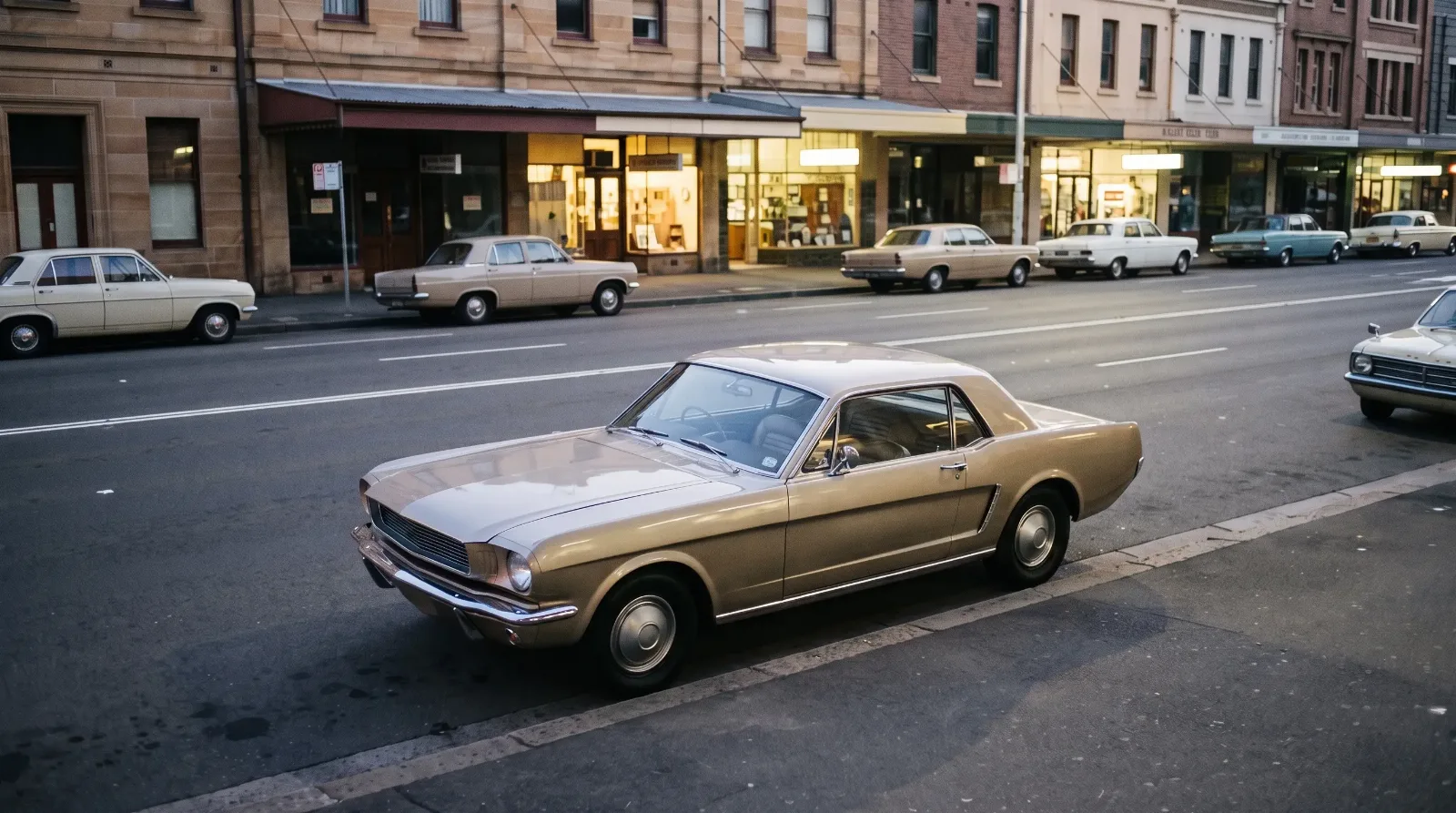
That country was West Germany. Krupp held the German trademark on "Mustang" for its trucks, and German sources say the moped maker Kreidler held rights as well. Krupp asked Ford for about $10,000. Ford refused. So for most of the classic era, a Mustang sold in Germany wore the badge T-5, which was the car's internal project code back in Dearborn.
The change went deeper than one emblem. German cars got T-5 fender badges, and the Mustang name came off the horn ring, the gas cap and other parts. Early cars got plain black-center hubcaps. They also had European lighting and a stiffer suspension with a shock-tower brace. The running pony stayed on the grille. In 1966 a T-5 hardtop with the 3.3-litre six listed at DM 16,100. How many T-5s Ford sold is a figure I have never seen documented, and Ford's 1960s export totals are just as hard to pin down. The trademark finally lapsed at the end of the 1970s, and the car went on sale in Germany as the Mustang from 1979.
Think about what that episode says. Ford was willing to ship a car into a market where it could not use the name its whole American campaign rested on. The shape and the pony were expected to sell it on their own.
Australia, which drives on the left, got the car another way. In July 1965 Ford Australia imported 48 hardtop coupes and had them converted to right-hand drive at its Sydney plant, each with the 289 V8, an automatic and front disc brakes. More cars followed in 1966, and the most cited total for these official conversions is 161. Ford used them to promote the new XR Falcon of 1966, which it sold on its Mustang connection.
Influence flowed the other way as well. Jack Telnack, who would later lead the Fox body's design, was chief designer at Ford of Australia in 1966 and ran design at Ford of Europe from 1974. The 1970 Milano concept, which previewed the 1971 fastback's long nose and flat rear deck, also shaped Australia's 1974 Falcon XB coupe.
| Date | Where | What happened |
|---|---|---|
| 1964 | France | Poppy Red 1964½ convertible in The Troops of St. Tropez, the Mustang's first film |
| Sept 17, 1964 | London | Goldfinger premieres; a Wimbledon White convertible at the event |
| 1964 to 1979 | West Germany | Sold as the T-5 because Krupp held the name |
| 1965 to 1966 | Australia | Ford Australia converts 161 Mustangs to right-hand drive in Sydney |
| Dec 9, 1965 | Tokyo | Tropical Turquoise coupe at the Thunderball premiere |
| 1966 | Australia | Jack Telnack becomes chief designer at Ford of Australia |
| 1974 | Australia | Falcon XB coupe shows the influence of the 1970 Milano concept |
Why the reputation stuck
Plenty of cars get a famous launch. Very few are still recognized by strangers sixty years later. The Mustang managed it partly through sheer numbers. Ford built the millionth one on March 2, 1966, less than two years after the introduction, a milestone told in this piece. Ford also says the Mustang was America's best-selling sports car every year from 1966 through 2020. That is the company's own reading of registration data, so treat it as a claim, but the general point is hard to argue with. A car that common ends up in everybody's family album, on the street outside the cinema as well as on the screen.
The other part was the owners. The Mustang Club of America was founded in 1976, around the time the first cars were turning into old cars, and clubs like it are what keep a model's meaning alive once the factory has moved on. The films supplied the image. The clubs and the people who kept driving these cars supplied the memory.
"An icon is a car people can draw from memory without ever having sat in one. The Mustang got there abroad through cinema screens and magazine covers before it got there in showrooms, and I think that order of events is most of the secret."
Patrick Walsh
The modern epilogue is the one the 1960s hinted at: in 2015 Ford finally sold the Mustang in more than 100 markets, with right-hand-drive cars built at Flat Rock for more than 25 of them. The reputation those buyers were paying for had been built decades earlier, on a Swiss mountain road and under a German badge that never said Mustang at all.
Sources and notes
- The Henry Ford: Mustang, the birth of an American icon
- Ford: Lee Iacocca and the Mustang on the covers of Time and Newsweek
- Wikipedia: Goldfinger (film)
- Jalopnik: when the Mustang was the T-5 in Germany
- Carsales: the Mustang in Australia
- Goodwood Road & Racing: original Bullitt Mustang sells for $3.4 million
Related Reading
Have a
Ford Mustang
for Sale?
Reach thousands of serious classic car collectors across the US.
Sell It Here →
Selling a classic? Here's how: compare the places to sell classic cars
Are You a Classic Car Dealer?
List your full inventory and connect with targeted classic car buyers.
Join as a Dealer →
#mustang history
#Ford Mustang
#Bullitt Mustang
#mustang in film
#Goldfinger Mustang
#Ford T-5
#Mustang culture

About the author
Patrick Walsh
Automotive journalist covering classic car shows, events, and the enthusiast community across North America.
Related Listings - Ford Mustang

Comments
Be the first to comment on this article.