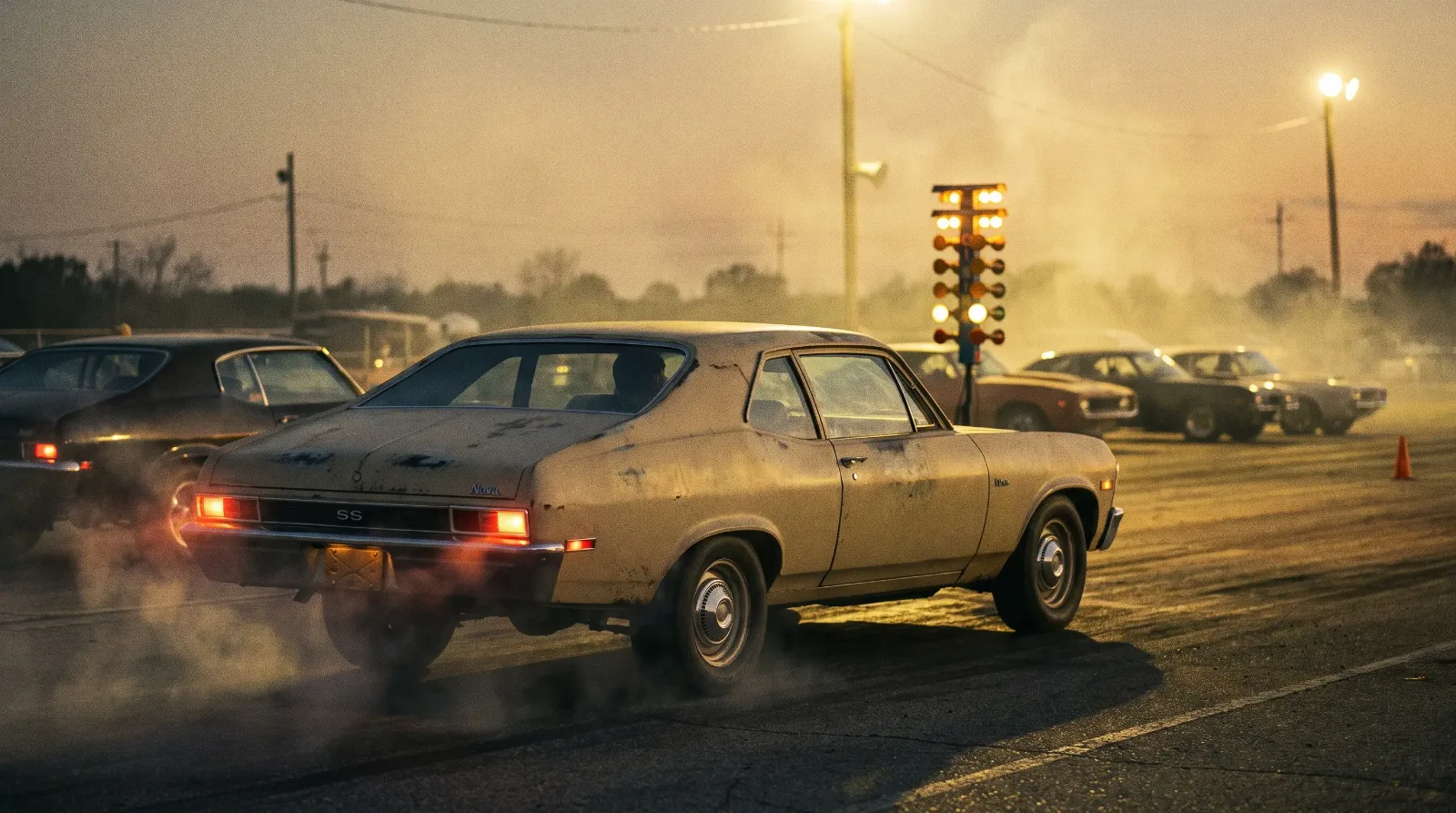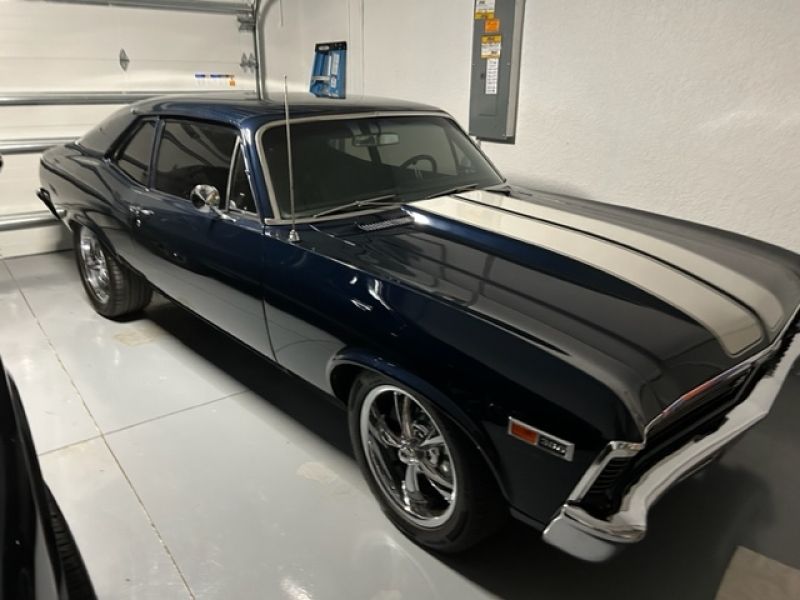
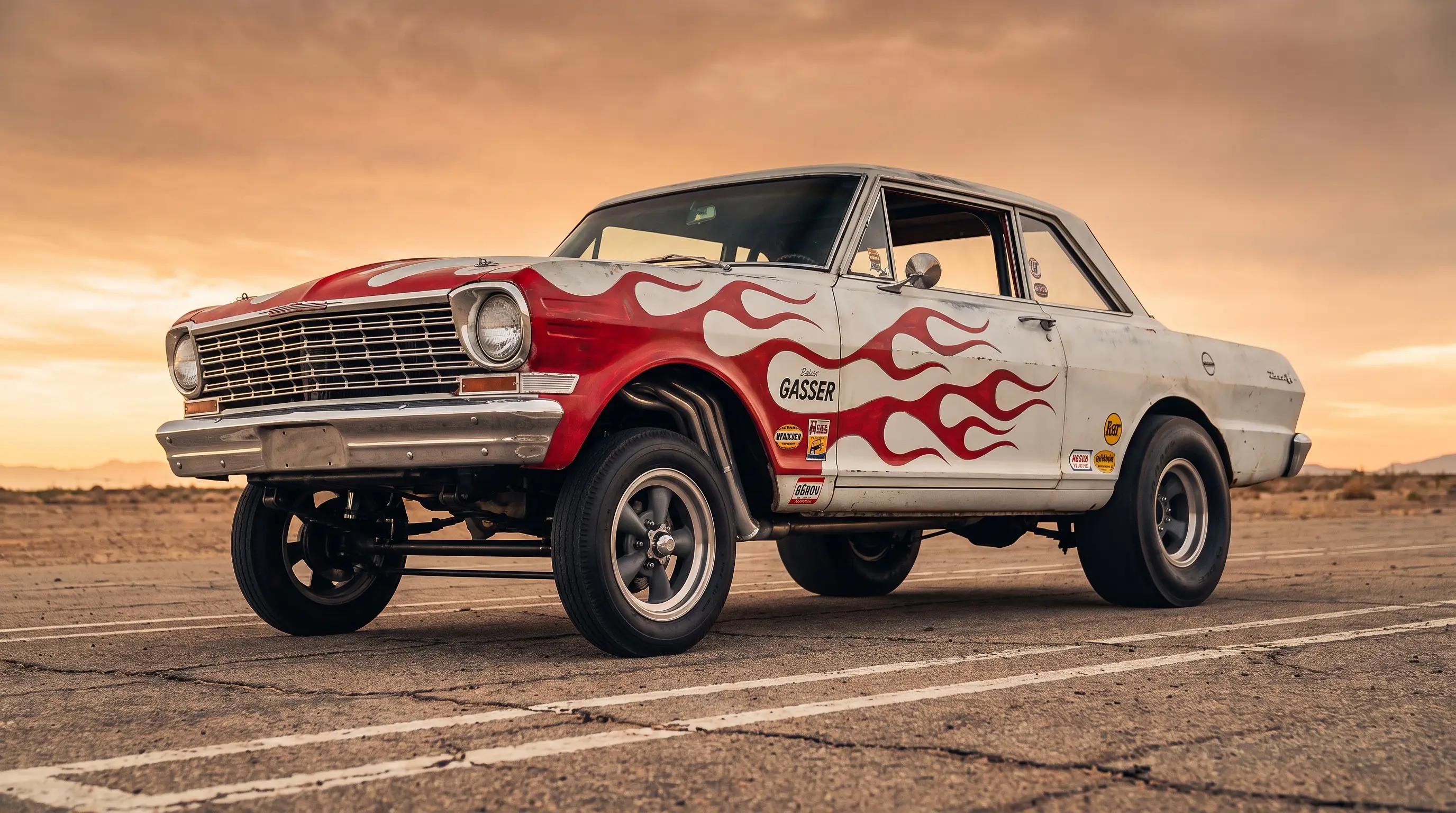
Under the lights at a Saturday night bracket race, a straight-axle Chevy Nova sits nose-high on skinny front tires, headers barking, front end raised so far the driver can barely see the tree over the hood. It looks almost comically aggressive, like someone jacked up a family car and forgot to level it back out. That's the gasser look, and the Nova wears it better than almost anything else Chevrolet ever built. Light, cheap, and simple enough for a home garage to gut in a weekend, the Nova became one of the go-to platforms for drag racers chasing a straight line rather than a trophy for concours polish.
Where the gasser look actually came from
Gasser racing dates back to the 1950s and 60s NHRA classes, where cars ran on gasoline rather than exotic fuel blends and were divided by weight-to-power ratios into classes like A/Gas and B/Gas. To get weight off the front wheels for better traction off the line, racers raised the front suspension, sometimes with straight axles borrowed from trucks, and moved the battery to the trunk. The result, a high, aggressive stance with the back end squatting low, became iconic on its own, independent of whatever brand of car it happened to be bolted to.
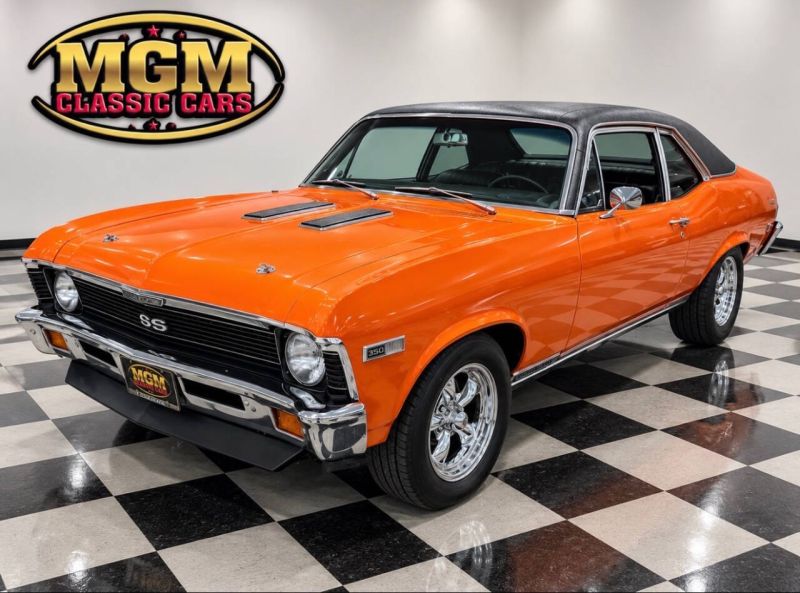
By the time compacts like the Nova arrived in 1962, drag racers had a lighter, cheaper option than the full-size cars that dominated earlier gasser fields. A stripped Nova with a small-block or big-block swap could run competitively against much larger cars simply because there was less mass to move. Chevy's own factory-built performance variants, the Nova SS with 350 and later 396 options, gave builders a head start with a car that already leaned toward performance.
Class rules also dictated exact wheelbase-to-weight ratios, which is why so many period gasser photos show cars with wildly mismatched wheel and tire combinations. A small, narrow front tire kept unsprung weight down, while a wide slick or drag radial out back put as much rubber on the pavement as the rules allowed. None of it was about looking good for a magazine spread. Every inch of stance on a real period gasser traces back to a rulebook somewhere, which is part of why the look still reads as authentic instead of costume-like decades later.
Pro Street takes the formula further
Where gasser culture is rooted in period-correct 1960s NHRA rules, Pro Street emerged later, in the late 1970s and through the 1980s, as a street-legal answer to full-tube chassis drag cars. Pro Street Novas kept the visual drama, huge rear tires tucked under massively flared fenders, but pushed the engineering further with tubbed rear wheel wells, full roll cages, and engines built for four-digit horsepower numbers rather than mild street tunes. A well-built Pro Street Nova could carry a blown big-block making well over 800 horsepower, and documented feature builds on modern EFI and boost have pushed past 1,000 horsepower, enough to make the car nearly undriveable in daily traffic and entirely the point.
The Nova's unibody construction, shared loosely with the Chevy II platform underneath, actually made this kind of build more involved than it looks. Builders had to fabricate subframe connectors and reinforce the rear frame rails to handle the torque of a big-block without the car twisting itself apart under hard launches.
Engines that defined the build
Small-block 327s and 350s were the bread and butter of budget gasser Novas, cheap, plentiful, and easy to hop up with a period four-barrel carburetor and headers. Serious builders reached for big-blocks, the 396 and 454, when they wanted to run in heavier classes or simply wanted more theater under the hood. Later Pro Street builds leaned on aftermarket aluminum blocks and forced induction, since the goal shifted from period-correct racing to raw, showable power.
| Build style | Typical era | Common engine | Defining trait |
|---|---|---|---|
| Gasser | 1962-1969 | 327/350 small-block, 396 big-block | Raised front end, straight axle, NHRA class rules |
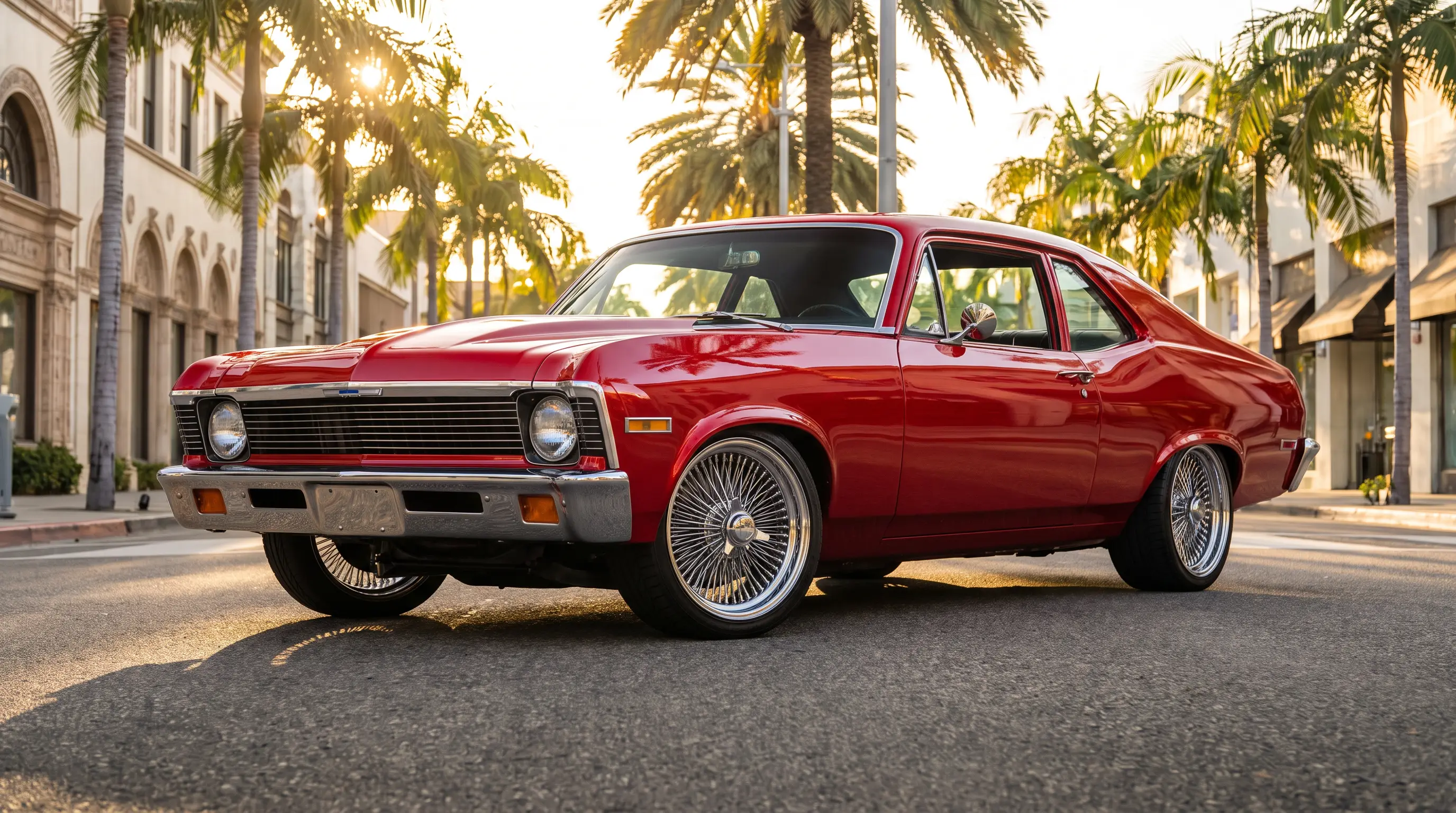
| Street/Strip | 1970s | 350-454 big-block | Lowered stance, mag wheels, everyday drivability |
| Pro Street | 1980s onward | Big-block or aftermarket stroker | Tubbed rear, flared fenders, cage, huge power |
"A gasser Nova tells you exactly what it is the second you see the stance. There's no mystery, no subtlety. Somebody built that car to leave the line hard, and it still looks like it means it forty years later."
— Patrick Walsh
Why the style still draws builders today
Gasser and Pro Street Novas have become a genuine collector niche of their own, separate from stock restorations. Builders and buyers who want period-correct drag history look for cars with documented racing pedigree, while others build tribute cars purely for the look and the sound. Either way, the appeal comes down to honesty. There's nothing subtle about a raised front end and open headers, and that bluntness has aged remarkably well against decades of changing automotive fashion.
Parts availability helps keep the scene alive too. Small-block Chevy engines, period-correct wheels, and reproduction fiberglass hoods and fenders are all still in production, which means a gasser or Pro Street Nova build doesn't require the same scavenger hunt that plagues rarer platforms. That accessibility is exactly why new builds keep appearing at bracket races and car shows instead of the style fading into a museum piece.
To understand why the Nova endures across so many different scenes, from strip to boulevard, it helps to step back and look at the model's culture story as a whole. And for a completely different flavor of Nova obsession, one built around auction paddles instead of eighth-mile times, there's another angle worth reading.