
Picture a burger stand parking lot on a summer night in 1995. A red Mustang GT with the new rounded body sits two spaces down from a black Z28, both hoods up, both owners pointing at the other car's engine as if it had insulted their family. The Camaro guy has the numbers. The Mustang guy has the crowd. That argument, SN95 vs 4th gen Camaro, ran in parking lots, at drag strips and in magazine letters pages for the rest of the decade, and it was the last time the two old rivals fought it out with V8s, rear drive and the century about to turn.
Car Features
6 min read
Mustang vs Fourth-Gen Camaro: The Last Pony War of the Century
The Camaro had the horsepower, the Mustang had the crowd. How the SN95 and the fourth-gen Camaro fought the 1990s, on paper, on track and in showrooms.
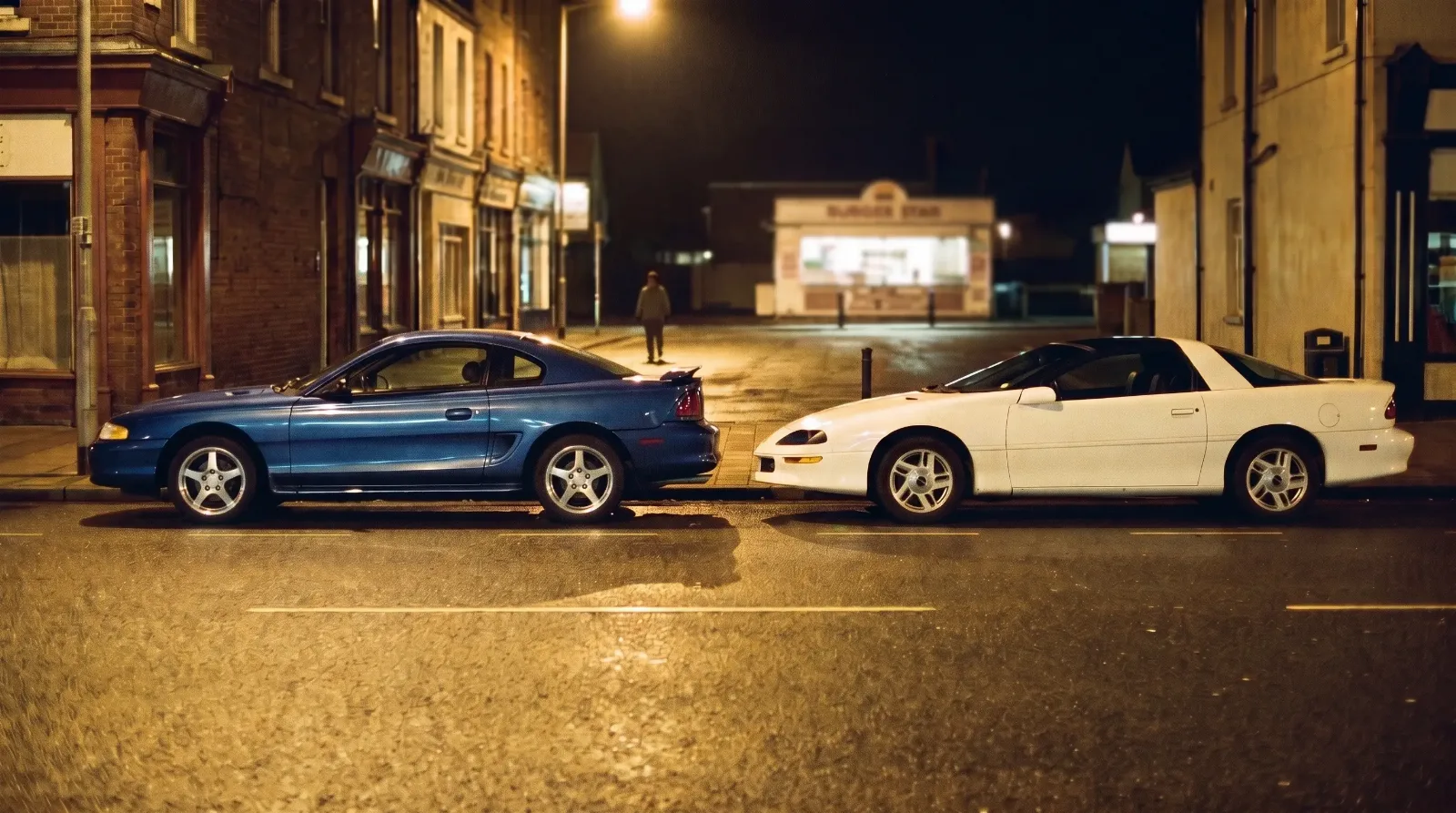
Chevrolet had been chasing the first pony car for more than a quarter century by then. In the 1990s the chase got personal again, because both companies redesigned their cars within a year of each other and sent them out into the same showrooms, the same insurance offices and the same Saturday nights.
Two new cars, one year apart
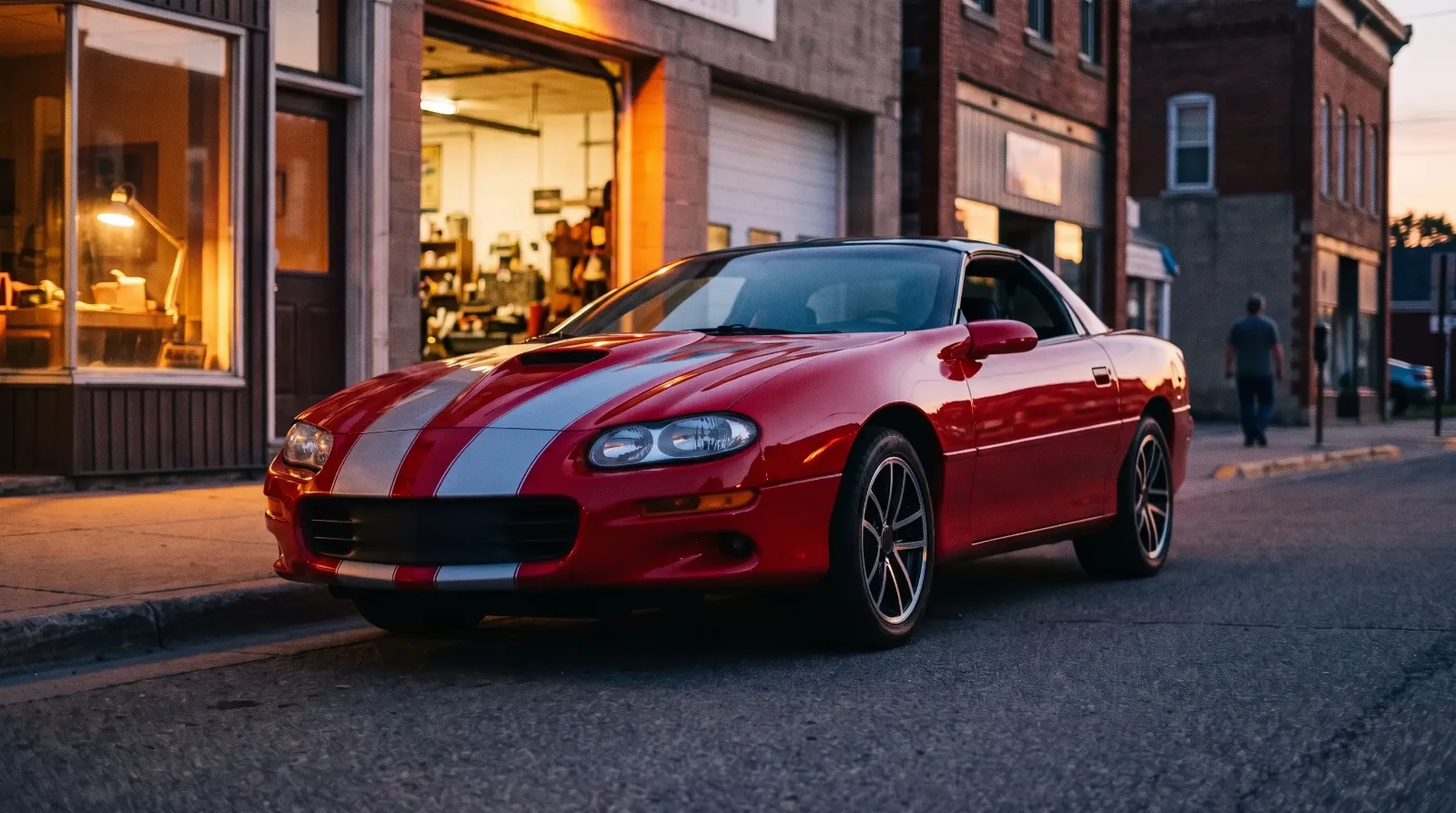
Chevrolet moved first. The fourth-generation Camaro arrived in January 1993 as a 1993 model, built at Sainte-Thérèse, Quebec. It was sleek, low and wide, and its Z28 carried a 5.7-liter V8 that made the old Fox-body Mustang look tired.
Ford answered in December. Job One for the new Mustang came in October 1993, two months ahead of schedule, and the car went on sale on December 9, 1993, at Dearborn Assembly inside the Rouge complex. Ford had already shown it to the public at 100 sites around the country on one Sunday in October. The SN95 Mustangs were a new body on a reworked chassis, and the press liked them: the 1994 Mustang was Motor Trend's Car of the Year.
Ford also priced it with care. The base Mustang came in a few dollars under the base Camaro and Firebird. A V6 coupe started at $13,365 and a GT coupe at $17,280. In a rivalry often decided by what a young buyer could finance, a few dollars mattered less than the message: the cheapest Mustang would never cost more than the cheapest Camaro.
SN95 vs 4th gen Camaro on paper
Here the Mustang faithful had to swallow hard. The 1993 to 1995 Z28's LT1 V8 made 275 hp and 325 lb-ft. The 1994 and 1995 Mustang GT's 5.0 made 215 hp and 285 lb-ft. That is a 60 hp gap, and no amount of parking-lot talk closed it.
The stopwatch agreed. MotorWeek took a 1994 Mustang GT and a 1994 Z28 to Charlotte Motor Speedway on the same warm, muggy day. The Mustang ran 0 to 60 mph in 6.8 seconds and the quarter mile in 15.6 seconds at 90 mph. The Z28 did it in 6.4 seconds and 14.9 seconds at 95 mph. The Mustang felt stable on the banking, but the Camaro was quicker everywhere the clock could see.
The switch to the 4.6 Modular V8 in 1996 did not change the GT's rating, still 215 hp. It rose to 225 hp in 1998 and to 260 hp with the 1999 New Edge car. The Camaro, meanwhile, gained power for 1996 and took the LS1 V8 for 1998, a motor rated at 305 hp in the Z28 from 1998 through 2000 and 310 hp from 2001, with the SS at 320 hp and then 325 hp.
The six-cylinder cars told the same story. From 1995 Chevrolet offered the 3800 Series II V6 at 200 hp, and from 1996 every base Camaro had it. The Mustang's 3.8 V6 made 145 hp through 1995, 150 hp from 1996 and 190 hp for 1999 and 2000.
| Matchup | Mustang | Camaro |
|---|---|---|
| V8, 1994 to 1995 | GT 5.0: 215 hp, 285 lb-ft | Z28 LT1 5.7: 275 hp, 325 lb-ft |
| V8, 1998 | GT 4.6: 225 hp, 290 lb-ft | Z28 LS1: 305 hp |
| V8, 1999 to 2000 | GT 4.6: 260 hp, 302 lb-ft | Z28 LS1: 305 hp |
| V6, 1995 | 3.8: 145 hp | 3800 Series II: 200 hp |
| V6, 1999 to 2000 | 3.8: 190 hp | 3800 Series II: 200 hp |
Ford's closest answer on paper came from its Special Vehicle Team. The 1996 to 1998 SVT Cobra's hand-built 4.6 DOHC V8 made 305 hp, and the 1999 Cobra was advertised at 320 hp with independent rear suspension. Owners soon found the 1999 car slower than the 1998, and dyno results suggested about 285 hp. Ford issued a stop-sale on August 6, 1999, and fixed the cars. Chevrolet had its own limited hero that era: 979 Camaro 30th Anniversary cars in 1997, of which 108 went to SLP for an LT4 V8 rated 330 hp.
"The Camaro won the spec sheet for most of the decade, and its owners never let anyone forget it. The Mustang won something harder to measure. People wanted to be seen in it, and they kept buying it when the numbers said they shouldn't."
Patrick Walsh
Why the Mustang won the showroom anyway
Horsepower makes the arguments. Sales pay the bills. In 1998, the year the Camaro got the LS1, Chevrolet sold 48,495 Camaros. Ford built 175,522 Mustangs for the 1998 model year. Those are different measures, sales against production, but the gap is too wide for the accounting to explain away.
Most of those Mustangs were not GTs. The V6 coupe carried the line: 99,801 of them in 1998 and 121,026 in 2000, when Mustang production hit 215,239, its best SN95 year. For a lot of buyers the Mustang was a good-looking, affordable coupe that happened to have a famous name and a V8 version if they ever wanted one. The Camaro sold itself on performance first, and fewer buyers were shopping on that alone.
By the end the numbers were hard to read any other way. Camaro sales fell to 29,009 in 2001, the lowest of the generation, and recovered only to 42,098 in 2002. Ford built 1,078,176 SN95 Mustangs from 1994 to 2000. The rivalry was close on the street and lopsided at the dealership.
Racing, and who won the war
Ford got its loudest win on the track. In the 1997 Trans-Am Series, Tommy Kendall won the first 11 of 13 rounds in a Mustang, a record run of straight wins, and Ford swept the series. It was Kendall's third straight title. Whatever the Z28 did on a stoplight drag, the Mustang name owned the road-racing headlines that year.
Then the Camaro was gone. The Quebec line built its last fourth-generation car on August 27, 2002, and the Mustang kept going without a direct Chevrolet rival for years. The full arc of that car, from launch to the last one off the line, is in the fourth-generation Camaro story. The parking-lot argument from 1995 had no tidy winner. The Camaro owner was right about the horsepower. The Mustang owner was right about everything that kept a car alive.
The rivalry itself was older than either car, and you can read how the rivalry started in 1967, when the first Camaro took aim at a Mustang that had the market to itself. For where the SN95 sits among every generation before and after it, there is the full Mustang story.
Sources and notes
- Chevrolet Camaro (fourth generation), Wikipedia
- LS-based GM small-block engine (LS1 ratings by car), Wikipedia
- MotorWeek Retro: 1994 Camaro vs Mustang comparison, GM-EFI
- Roanoke Times, October 1993: the new Mustang's launch and prices
- 1998 Ford Mustang specifications and production, MustangSpecs
- 1997 Trans-Am Series, Wikipedia
Related Reading
Have a
Ford Mustang
for Sale?
Reach thousands of serious classic car collectors across the US.
Sell It Here →
Selling a classic? Here's how: the best sites to sell a classic car
Are You a Classic Car Dealer?
List your full inventory and connect with targeted classic car buyers.
Join as a Dealer →
#chevrolet camaro
#pony car rivalry
#Ford Mustang
#mustang vs camaro
#mustang gt
#SN95 Mustang
#1990s pony cars

About the author
Patrick Walsh
Automotive journalist covering classic car shows, events, and the enthusiast community across North America.
Related Listings - Ford Mustang

Comments
Be the first to comment on this article.