
I watched two guys argue for twenty minutes at a swap meet over whether a center console belonged in a 1966 Nova SS. One of them was certain every SS came with one. The other had the original invoice folded in his wallet like a poker hand he'd been waiting to play, and when he finally laid it down, it showed a three-speed column shift and no console at all, just the standard bucket seats sitting on either side of an open floor. That is the Nova gen2 interior in a nutshell: plenty of assumptions floating around, and the actual paperwork usually telling a different, more interesting story than the assumptions do.
Car Features
6 min read
Gen2 Interior and Trim
From bench seats to optional SS buckets, the Nova gen2 interior is full of assumptions that a club member's invoice can settle in seconds flat.
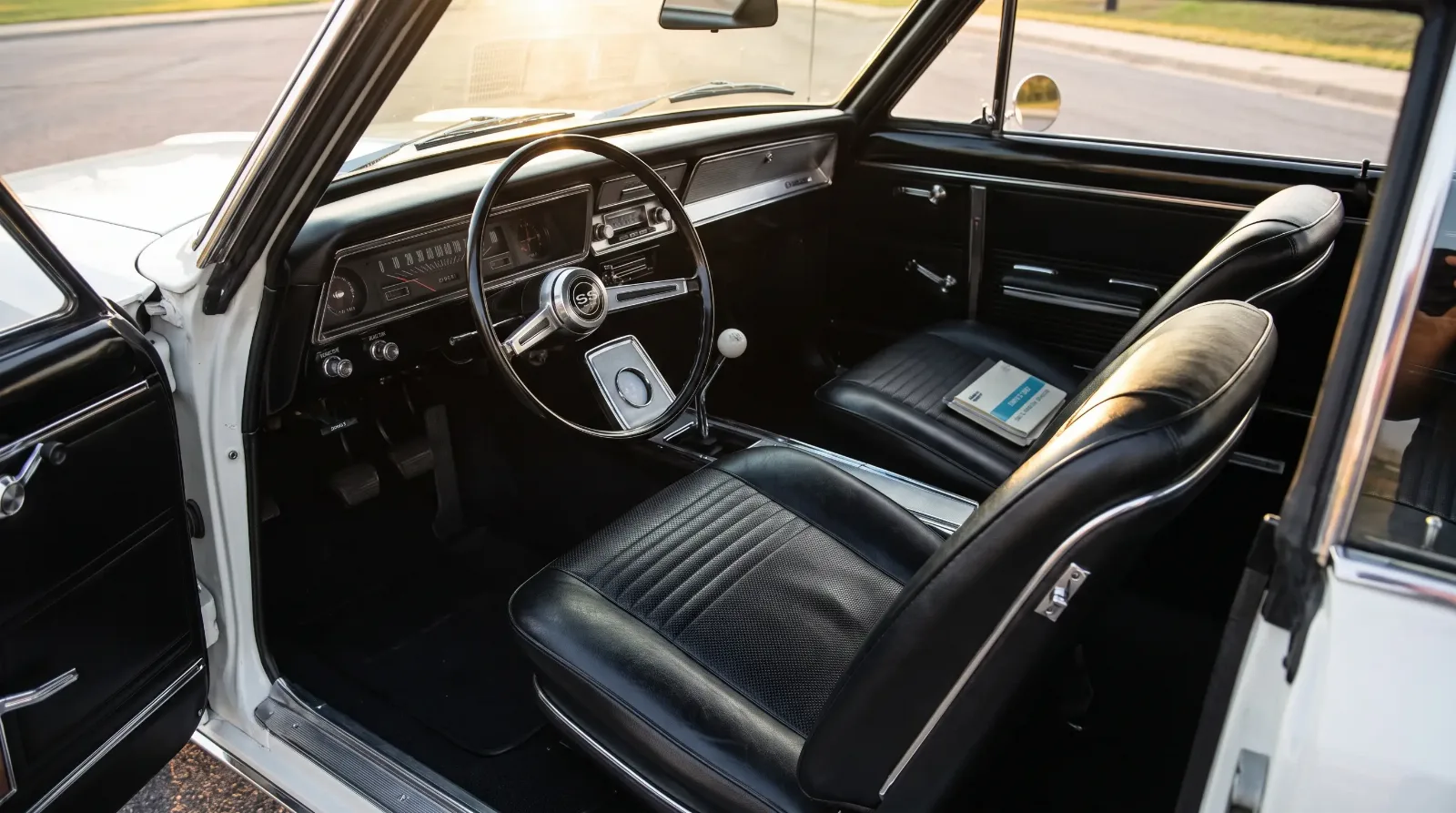
What Chevrolet actually put inside
The 1966-67 Nova cabin split pretty cleanly along trim lines. Base and Nova 400 models rode on a bench seat with vinyl or cloth-and-vinyl combinations depending on the year, a simple dash with round gauges, and rubber floor mats in the cheapest configurations. Step up to the SS package and bucket seats were standard equipment, not an extra-cost option, which surprises people who assume every trim upgrade on a mid-1960s Chevrolet had to be ordered separately. The center console is the piece that actually depended on what else was on the order sheet: cars built with the standard three-speed column-shift manual got the SS buckets with open floor between them, while a Powerglide automatic or the optional four-speed brought the floor shifter and console along with it. Plenty of SS cars left the factory with buckets and no console because that is what the original buyer's transmission choice dictated.
The dash itself carried a simple horizontal sweep with a speedometer and a cluster of secondary gauges, more function than flash compared to what Pontiac or Oldsmobile were doing in the same era. Chevrolet was not trying to out-luxury anybody with this car. It was trying to make a compact feel a notch more substantial than a stripped Chevy II without pretending to be a Caprice.
Color and material choices across the two years
Interior color combinations for 1966-67 leaned on the same palette Chevrolet was using across its broader lineup that generation, with vinyl and cloth-vinyl combinations in black, red, blue, fawn, gold, and turquoise depending on exterior color pairing rules, with all-vinyl trim on SS models. Cloth inserts showed up on some mid-trim bench seats, giving buyers a step between bare vinyl and the SS buckets without paying SS money.
Door panels and kick panels followed the same restrained approach as the dash, using simple stamped textures rather than elaborate wood-look inserts or extensive brightwork. That plainness is part of why so many surviving interiors get dismissed as boring by people who have only seen photos of flashier contemporaries. Sit in one in person and the proportions read differently. It is a tidy, purposeful cabin built for a car that was never trying to be anything other than what it was.
Carpet was standard on Nova 400 and SS models, with rubber floor covering still showing up on the plainest base cars, another detail that trips people up when they assume every 1966-67 Nova got the nicer treatment. Steering wheels ranged from a basic two-spoke unit on base cars to a sport wheel that came with the SS package.
The instrument cluster nobody argues about
One area where the folklore mostly agrees with the record is the gauge package. SS models got a slightly more complete cluster than base cars, though Chevrolet still held some of its more elaborate factory tachometer and gauge packages back for the mid-size and full-size lines. A Nova SS driver watched speed and fuel closely and trusted an idiot light for the rest, which was standard practice across most of the American compact segment at the time, not a Nova-specific shortcut.
None of that stopped period buyers from adding aftermarket gauges, and plenty of surviving cars carry them today. Distinguishing a factory-correct cluster from a later addition is, again, exactly the kind of thing a build sheet resolves in seconds where a swap meet argument can run in circles for twenty minutes.
| Trim Level | Standard Seating | Optional Upgrade |
|---|---|---|
| Chevy II 100 / base | Vinyl bench | Cloth-vinyl combination |
| Nova 400 | Cloth-vinyl bench | Two-tone trim package |
| SS | Vinyl bucket seats (standard) | Center console (with Powerglide or four-speed) |
Documentation over folklore
I have been to enough Nova club meets to know the folklore runs thick on this car. Somebody's uncle's Nova "definitely" had buckets from the factory, or a particular color "never" came with a certain interior. Half of that is misremembering, and half of it is people repeating what they heard from somebody else who was also misremembering. What actually settles the argument, every time, is the build sheet or the original invoice, not the strength of anybody's conviction at the folding table.
That habit of trusting the paper over the pitch is the same lesson that comes up in a companion piece on how buyers sort out which transmission actually belongs behind a given engine in these cars. Interior and drivetrain arguments both get settled the same way, with a document instead of a hunch.
"Every club has that one guy who shows up with the actual invoice folded up like it's a winning lottery ticket. Half the time it is."
Wayne Coburn
Sources and notes
- Chevrolet Chevy II / Nova - Wikipedia
- '66 SS with or without console - Chevy Nova Forum
- NovaResource - 1966 Cowl Tag Decoder
- 1966 Chevrolet Nova SS - Hagerty Valuation Tools
- Vintage Motor Trend Review: 1966 Chevy II Nova SS 327 - Curbside Classic
- 1967 Chevy II By The Numbers - Chevy Hardcore
Why the plain cabin still has fans
Part of what draws people to the second-gen Nova's interior specifically is that restraint. It is not trying to impress anybody, and that honesty ages well next to some of the more overwrought cabins from the same period. Owners who spend real time in these cars tend to describe the layout as easy to live with, the visibility as good, and the whole package as one that rewards a driver rather than a showroom photographer.
None of that means the interior is simple to restore correctly. Matching the right material to the right trim level and year takes exactly the kind of documentation the swap meet argument turned on, and that is precisely why club records and factory literature matter as much as they do to people trying to get a 1966-67 Nova interior right rather than just plausible.
Related Reading
Have a
Chevrolet Nova
for Sale?
Reach thousands of serious classic car collectors across the US.
Sell It Here →
Are You a Classic Car Dealer?
List your full inventory and connect with targeted classic car buyers.
Join as a Dealer →

About the author
Wayne Coburn
Longtime Corvette owner, judge and club figure who knows the cars, the records and the people behind them.
Related Listings - Chevrolet Nova




Comments
Be the first to comment on this article.