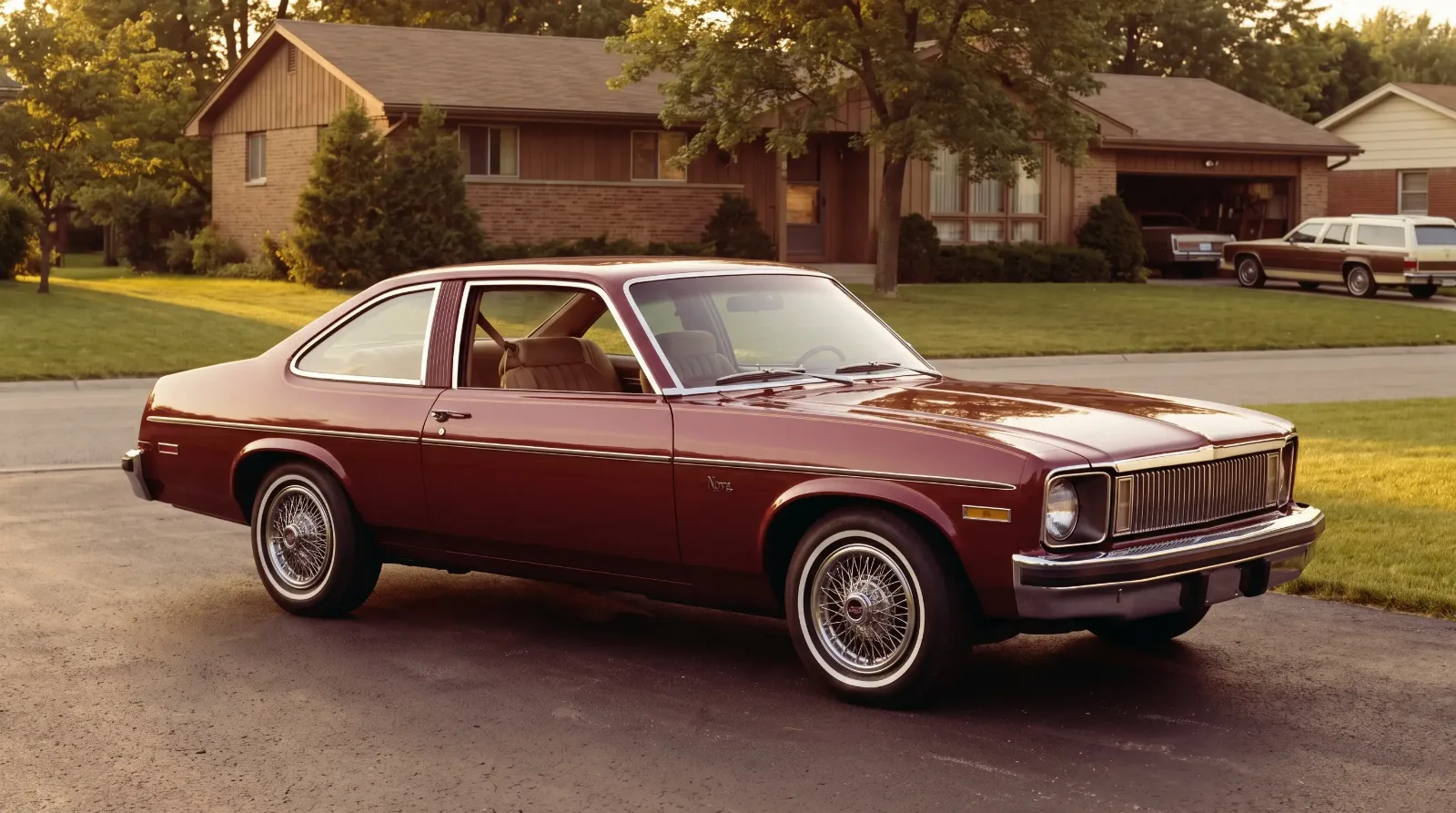
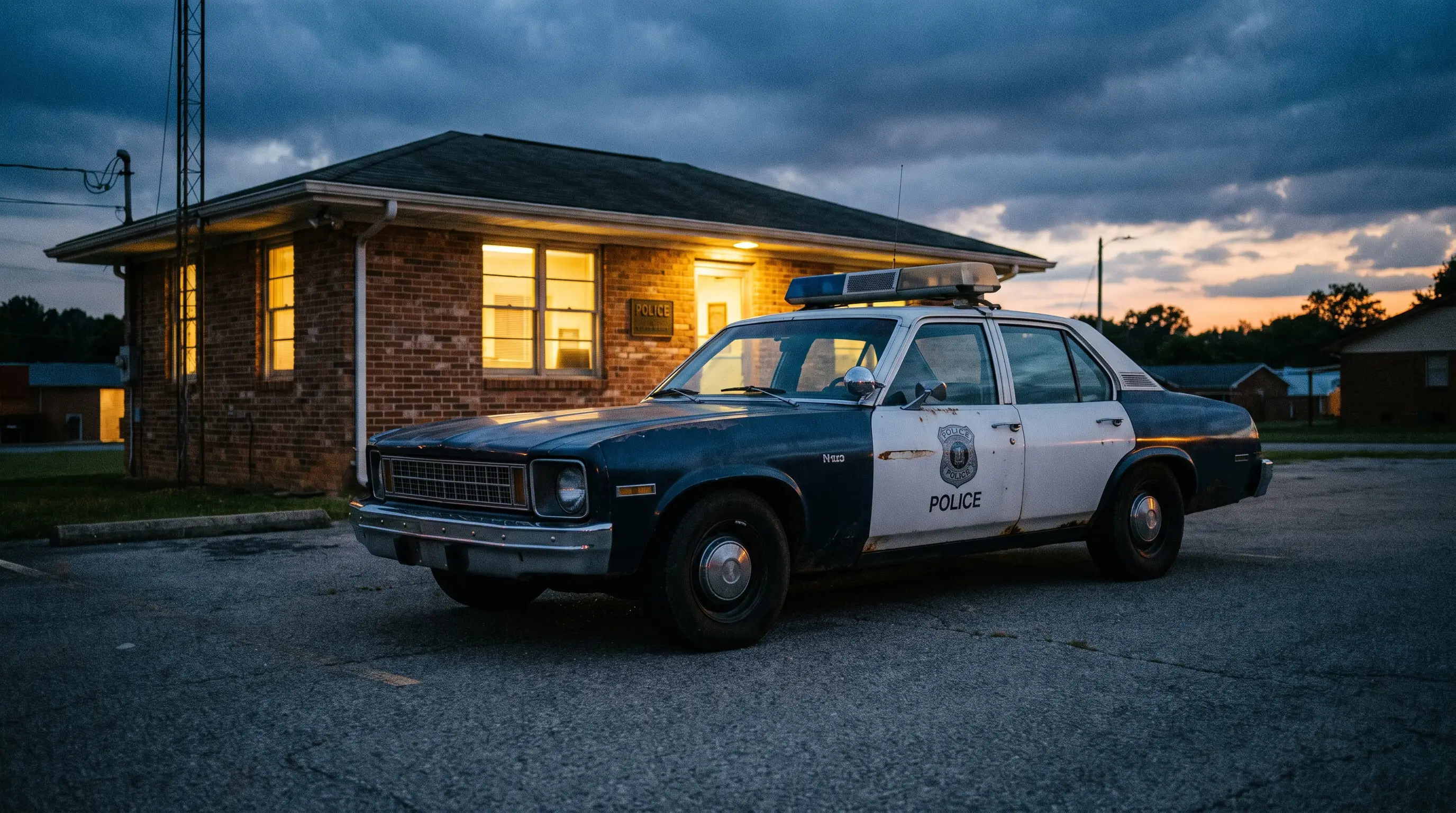
Every Nova club has a guy like this. He shows up to the meet with a plain-Jane 1977 four-door, no stripes, no badges to speak of, and lets people walk right past it toward the SS clones parked up front. Then somebody notices the certified speedometer, the heavy-duty seat frame, and the extra holes drilled in the firewall where a spotlight bracket used to live, and the questions start. That car was a working police cruiser, and the police-package Nova is one of the odder corners of the whole Nova story: a car built to be ignored, now sought out for exactly that reason.
The Nova 9C1 designation covers the police-package option that Chevrolet ran on the compact platform through the back half of the 1970s, alongside the better-known 9C1 Impalas and Caprices that dominated highway patrol fleets. Departments running smaller budgets, tighter city streets, or unmarked detective work wanted something more nimble than a full-size pursuit car, and the Nova filled that gap. It never got the glamour treatment. It got the engineering.
What the police package actually changed
A 9C1 order sheet reworked the car from the frame up, not just the trim. Suspension came heavier: stiffer springs, larger-diameter front and rear sway bars, and shocks valved for sustained hard use rather than a Tuesday commute. Brakes were upgraded across the line, and cars ordered with the available front discs got semi-metallic pads suited to repeated hard stops, the kind a patrol car sees in a single shift that a civilian Nova might see in a year.
Cooling got the same treatment. A heavy-duty radiator, a larger fan, and in many cases an auxiliary transmission cooler kept the drivetrain alive through hours of idling with the engine running and the lights on, a scenario that cooks a stock cooling system. The electrical system was upgraded too, with a higher-output alternator to run radios, light bars, and spotlights without draining the battery on a night shift. None of it photographs well. All of it is why these cars survived hard service that would have killed a civilian equivalent.
| System | Standard Nova | 9C1 police package |
|---|---|---|
| Front suspension | Standard springs and bushings | Heavy-duty springs, larger sway bar |
| Brakes | Standard duty lining | Semi-metallic pads, upgraded cooling |
| Cooling | Standard radiator | Heavy-duty radiator and fan, optional trans cooler |
| Electrical | Standard alternator | High-output alternator for radio and light-bar load |
| Engine options | Six-cylinder or small V8 | 350 cubic-inch V8 required (L48 in the mid-1970s, LM1 from 1975 on), no six-cylinder or economy-V8 builds |
I have talked to more than one retired officer at swap meets who drove one of these, and the story is always the same. It was not fast in a straight line by later standards, but it turned and stopped like nothing else in the fleet that size, and that mattered more on a patrol beat than a quarter-mile time ever would.
Who actually bought them, and why records are thin
This is where the paper trail runs short, and honestly, that is the whole appeal for a certain kind of collector. Municipal police departments do not keep archives the way factory teams do. A city buys a fleet of cruisers, runs them until the mileage or the body rust makes the decision for them, then auctions the lot to whatever used-car dealer shows up with a check. Nobody wrote a magazine feature about the Cedar Rapids PD's Nova order in 1977. The build sheet, if it survives at all, is usually a photocopy in a shoebox that the second or third owner inherited by accident.
What we do know comes from a patchwork: fleet order guides that survive in dealer archives, VIN-decoded production data from Nova-specific registries, and the honest recollections of the people who drove these cars for a living. Smaller municipal departments and sheriff's offices favored the Nova specifically because it cost less to run than a full-size pursuit car, fit better on narrow city streets, and still handled the heavy-duty demands of daily patrol work. Some cars went to college and university police forces. Others were used, unmarked, for detective and traffic-enforcement duty where a plain sedan drew less attention than a marked cruiser.
Spotting a real one versus a clone
Because the 9C1 police package never carried a badge, exterior badges tell you nothing. What tells you something is underneath. Look for the heavier front spring rate, which sits the nose slightly different than a civilian six-cylinder car of the same year. Look at the wiring behind the dash for extra grommets and unused connectors where a radio or light-bar harness used to route. Check the firewall and trunk floor for drilled holes that never got filled, evidence of mounting hardware long since removed.
The build sheet or broadcast sheet, when one survives inside the seat springs or under the carpet, is the closest thing to a birth certificate this car will ever have. A genuine RPO code tied to the police package on that sheet settles the argument in a way that no amount of bench-racing at a car show ever will. Absent that, a VIN decode through a Nova registry can at least confirm the trim level and options the car left the factory with, even if it cannot always confirm fleet duty on its own.
"Everybody at the club had a theory about that plain-Jane 1977 until somebody found the broadcast sheet still folded up under the back seat, and just like that, the bench-racing was over."
— Wayne Coburn
Where the police Nova sits in the bigger story
On its own, the 9C1 Nova is a footnote. In the context of the 1970s Nova, it is a reminder that the fourth-generation cars were built for a much wider range of duty than the buyer's guides usually credit them for. The same platform that carried a police radio and a shotgun rack also carried grocery-getters, first cars for teenagers, and the odd rally-inspired trim package, all off the same basic architecture. If you want how the Nova legend began, the police package is a useful reminder that the Nova's real reputation was built on being tough and cheap to run, not on being flashy.
For collectors, the appeal is specific. These are not investment-grade cars in the way a documented SS is, and nobody should buy one expecting Bloomington Gold attention. What you get instead is a genuinely different piece of the Nova story, a car engineered for a job most people never think about, at a price that has not caught up to the novelty yet. If the fleet-car angle interests you more than the muscle-car angle, this is one of the few corners of the Nova market where that curiosity still pays off. Anyone chasing a project along these lines should keep reading the series, and anyone shopping should start with the classic Chevy Novas for sale currently listed, since fleet-history cars turn up in ordinary used-car listings more often than dedicated muscle-car auctions.