
Somewhere in a private garage, a car built before the First World War still turns over on its original crankshaft. The owner does not drive it often. When they do, the neighbors come out to watch, the same way people once gathered at a crossroads a century ago to see the first automobile pass through town. Nothing about that moment has really changed.
Car Features
7 min read
The Oldest Cars Still Running Today
A handful of brass-era cars have never truly stopped running. Their survival says as much about the people who kept them as the engineering itself.
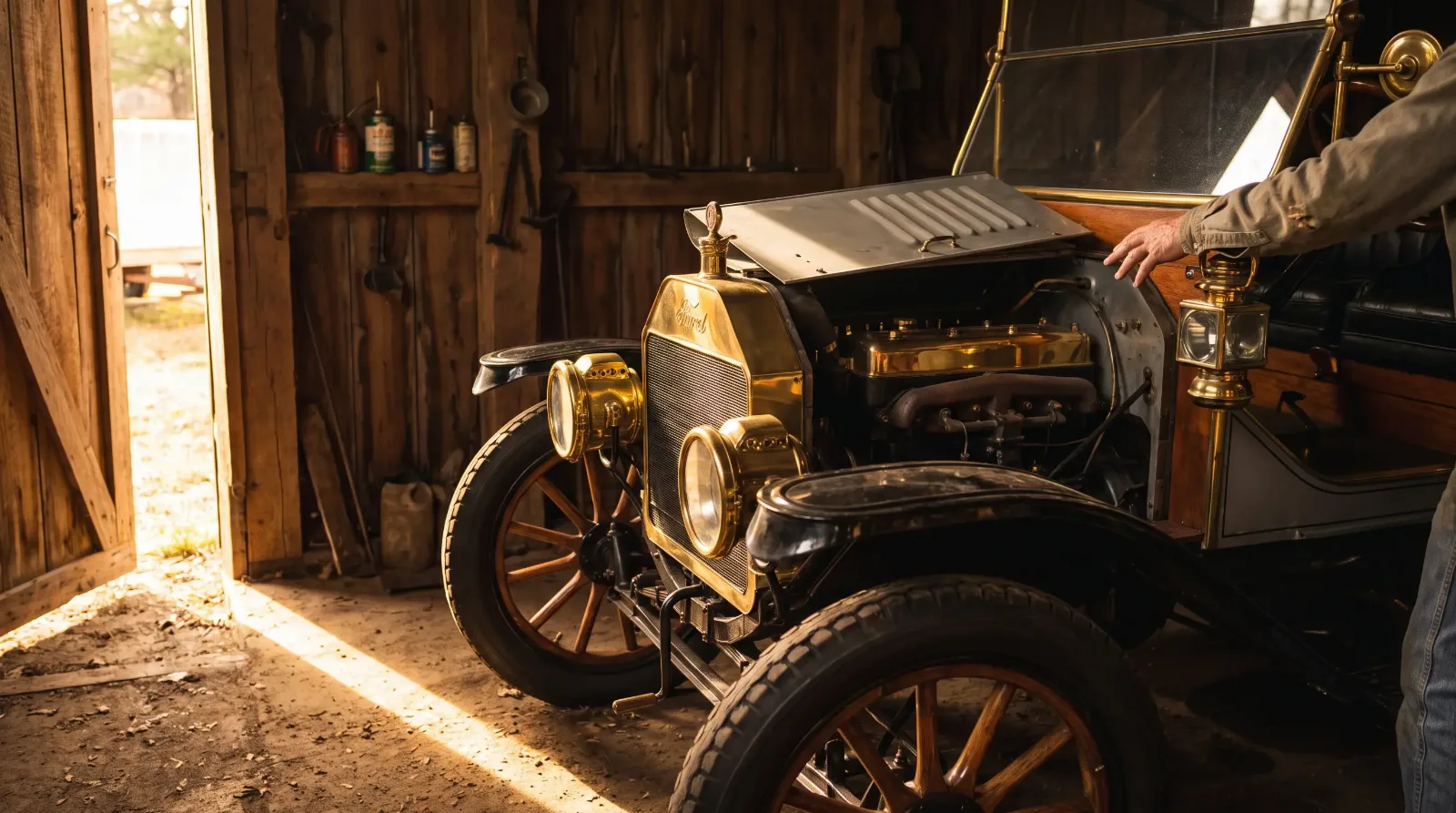
What has changed is everything around the car. The roads are paved now. The horses are gone. And yet somewhere under the hood, a set of parts machined before radio broadcasting existed keeps doing the one thing it was built to do, turn fuel into motion, decade after decade, largely unbothered by the century collapsing around it.
What "still running" actually requires
A car that runs today after more than a hundred years is not simply a car that was never junked. It is the survivor of a long chain of small decisions, each one made by someone who chose to fix rather than scrap, to store rather than sell for parts, to care about a machine that had long since stopped being useful in any practical sense. Every one of those decisions could have gone the other way.
Mechanically, longevity of this kind usually comes down to simplicity. Brass-era engines were low-compression, low-stress designs by modern standards, built with generous tolerances and few of the failure-prone electronics or plastics that doom later cars to the scrapyard. A well-maintained example from this period can, in principle, run indefinitely, because there is comparatively little inside it to wear past the point of repair. That is not the whole story, though. Plenty of mechanically similar cars from the same years are gone entirely, lost to fire, to neglect, to simple indifference. The ones that survive are not necessarily the best built. They are the ones somebody decided were worth keeping.
The cars that never stopped
A handful of brass-era automobiles are documented as having run, in some capacity, continuously or near-continuously since new, without the long dormant periods that most survivors endure. These are treated almost as living witnesses by the collector community, cars that were present for the actual moment their era describes rather than reconstructed from parts decades later.
La Marquise, built in the 1880s and often cited as among the oldest running automobiles in the world, predates the brass era proper but sets the standard for what continuous operation across a century actually looks like. Within the brass era itself, early Cadillacs, Locomobiles, and a scattering of other marques survive in running order, some maintained by museums, others by private collectors who treat the car's mechanical health as a kind of ongoing responsibility rather than a restoration project with an end date.
What separates these cars from static museum pieces is use. A car that is started, driven, and maintained regularly ages differently than one that sits under a cover. Seals stay supple. Bearings stay lubricated in the way they were designed to be. Paradoxically, the cars most likely to still run in another fifty years are often the ones being driven hardest today, not the ones locked away to preserve them.
The people behind the survival
Every car on this short list has a human story attached, usually a family or a caretaker who treated the machine as something closer to an inheritance than a possession. These are not always wealthy collectors. Some of the best-preserved brass-era survivors passed through generations of owners who simply could not bring themselves to let the car go, storing it in a barn through decades when nobody was paying attention to automotive history, long before the current market ever existed to reward that patience.
There is something quietly moving about a machine that has outlived everyone who built it. The engineers who designed these engines are gone. The factories that assembled them are, in most cases, gone too. What remains is metal and motion, still doing the job it was given more than a hundred years ago, indifferent to how much the world around it has changed.
"I once watched an owner start a car built in 1911, and the whole small crowd went quiet at the first cough of the engine. It was not nostalgia exactly. It was closer to witnessing something that should not still be possible, and somehow was."
Nora Beckett
The maintenance that nobody sees
Keeping a hundred-year-old engine turning over is not a passive achievement. It is a running list of small, unglamorous decisions repeated across decades: which gasket to source when the original supplier has been gone for eighty years, whether to machine a new part or hunt down a period-correct original, when to rebuild a bearing rather than let it fail and take the crankshaft with it. None of this work photographs well. It rarely gets mentioned in the auction catalog description that eventually sells the car. But it is the actual mechanism by which a brass-era engine keeps functioning long after everyone involved in building it has died.
Fuel is its own quiet problem. Modern gasoline formulations, particularly those blended with ethanol, behave differently in a fuel system designed around early-1900s materials and tolerances, and owners of running brass-era cars often modify their fuel storage and delivery components specifically to cope with a fuel supply the original engineers could never have anticipated. It is a small, telling example of how keeping an old machine alive sometimes means quietly adapting it to a modern world it was never built for, without changing anything a purist would notice.
What this means for the wider story of the brass era
These surviving cars matter beyond their own individual histories because they anchor everything else written about the period. When historians describe how a brass-era engine sounded, how a clutch engaged, how a car actually felt to drive, the honest answer often comes from studying one of these still-functioning examples rather than a static restoration. A car that has never fully stopped running carries information a rebuilt one cannot fully replicate, however careful the restoration.
The fuller context for why this era produced machines capable of this kind of longevity, and what made some of them worth saving in the first place, is covered in the oldest running cars story, which traces the engineering and cultural threads that connect these survivors back to the moment they were built.
Not every name from this period made it this far, of course. For every car still turning over in a garage today, there were dozens of manufacturers whose entire output has vanished, along with most memory of them ever existing. That quieter, more common story deserves its own telling, and you can read on to meet some of the brands the survivors left behind.
Sources and notes
Related Reading
Have a
Classic Car
for Sale?
Reach thousands of serious classic car collectors across the US.
Sell It Here →
Are You a Classic Car Dealer?
List your full inventory and connect with targeted classic car buyers.
Join as a Dealer →

About the author
Nora Beckett
Automotive features writer and photographer who tells the human stories behind the cars, from show fields to cross-country road trips.
Comments
Be the first to comment on this article.