
Frankfurt, September 1963. Under the show lights on the Porsche stand at the IAA, a low, compact coupe sits with a badge on the engine lid reading "901." It is the car meant to carry the company past the aging 356, and the crowd circling it has no idea that within about a year its name will already be gone. That is the real start of the porsche 901 to 911 story, and it begins not in a wind tunnel or a design studio but in a French trademark filing. For anyone working through the 911 saga from the beginning, this is the part most people skip past, and it deserves a proper look.
Car Features
6 min read
Porsche 901 to 911: The Name Fight With Peugeot
Porsche's new flat-six coupe was badged 901 at its 1963 debut, until a French trademark dispute with Peugeot forced a last-minute rename that stuck for good.
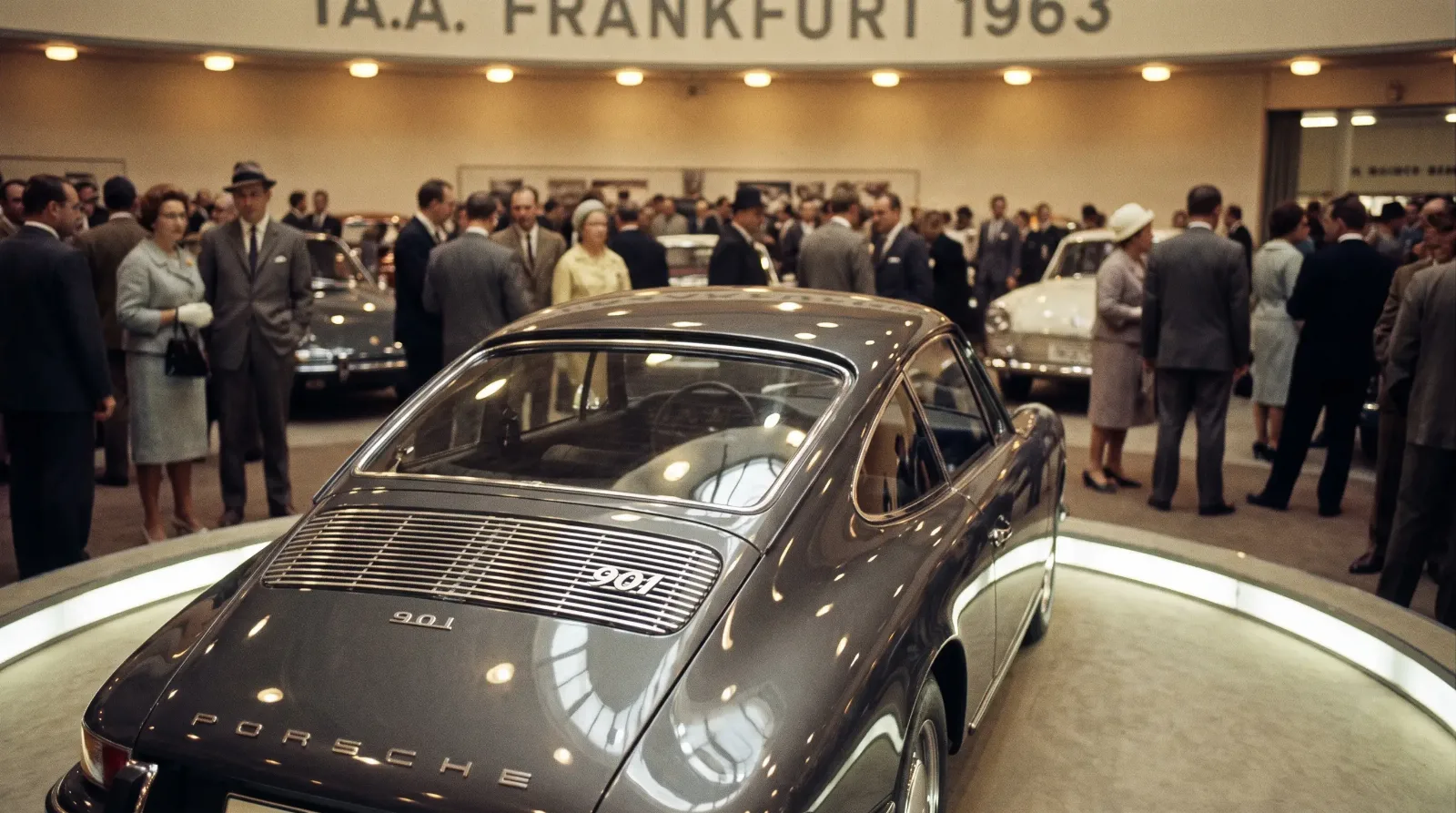
A three-digit name, unveiled in Frankfurt
The number 901 wasn't a marketing invention. It was the next slot in Porsche's internal type-numbering ledger, the same sequential system that had already produced the 356's various generations of engineering codes behind the scenes. Ferdinand "Butzi" Porsche's styling team and Erwin Komenda's body engineers had been refining the shape since the early 1960s, working toward a longer, more usable successor to the 356 with a proper rear seat and a flat-six in place of the old flat-four. When the finished car debuted at Frankfurt, "901" went straight onto the decklid because that was simply what the project had always been called internally. Nobody in Stuttgart was thinking about France.
Reaction at the show was strong. Journalists praised the proportions, the visibility, the sense that Porsche had grown up without losing the plot. Production versions started reaching customers in September 1964, close to a year after the unveiling, which is a normal enough gap for a car going from show stand to assembly line. What wasn't normal was the phone call that arrived not long after those first cars left the factory.
Peugeot's claim on the middle zero
Peugeot had been building its naming convention around three-digit model numbers with a zero in the middle since 1929, and by the 1960s that pattern covered a long run of cars: the 201, the 301, the 401, the 403, the 404. The French company had gone to the trouble of registering the format itself in France, not just individual names, which meant any manufacturer selling a car under a similar badge inside French borders was stepping into a fight it hadn't picked. Porsche wasn't the first company to bump into this. Peugeot had a documented history of policing the format, having used the three-digit, middle-zero scheme since the 201 in 1929 and asserting naming rights over it in its key markets, though enforcement was uneven: it let British marque Bristol use the format for its 400-series cars for decades and never challenged Ferrari's Dino 206 or 308 series.
It's worth saying plainly that this had nothing to do with the 901 being derivative of anything Peugeot built. Nobody at Porsche was trying to trade on the Lion badge. It was a pure numbering collision, the kind of coincidence that trademark law doesn't care about once the paperwork exists.
The letter, and Stuttgart's quick pivot
Peugeot's objection reached Porsche in early October 1964, not long after the 901 name had already gone into print, onto badges, and into sales literature intended for the French market, where the car had just been shown at the Paris Auto Salon. Rather than fight a trademark battle over a single digit, Porsche did the practical thing. Ferry Porsche signed off on the change on November 22, 1964, swapping the middle zero for a one, and the 901 became the 911, a change small enough to look almost cosmetic and consequential enough to define how three generations of enthusiasts would refer to the car for the next sixty years.
What's easy to miss is how little else changed. The engine, the chassis, the running gear, none of it moved. This was a rename executed at speed, likely inside weeks rather than months, because cars were already rolling off the line and dealers needed consistent badging before wider distribution ramped up.
"Every enthusiast argument about the 911's name eventually runs into the same fact: the car we all know by that number almost wasn't called that at all, and the reason has nothing to do with engineering."
Patrick Walsh
What the 901 badge left behind
Exactly 82 cars were built under the 901 designation between September and November 1964, but Porsche never sold any of them to private customers, they were used for testing and exhibition, and every surviving example was retitled as a 911 before reaching an owner. Those cars are now among the most closely tracked early-production 911s in the hobby, not because they drive any differently, but because the badge itself is a documented historical anomaly rather than a rare option.
The number didn't disappear from Porsche's own paperwork, either. Internally, the type designation 901 kept showing up for years afterward on components like the original five-speed transmission, commonly referred to among mechanics and parts catalogs as the "901 transmission," along with various chassis and engine case codes. So while the badge changed overnight, the engineering vocabulary inside the factory held onto the old number well into the following decade.
Why a filing cabinet dispute still matters
It would be easy to file this away as trivia, a footnote for the kind of person who corrects strangers at car shows. But the Peugeot dispute is a genuinely useful lens on how the 911 came into the world: not as a mythic, fully formed icon, but as a project that got bumped, adjusted, and renamed under real commercial pressure in its first year on sale. The car survived a French lawyer's letter the same way it would go on to survive engine displacement increases, emissions rules, and a dozen predictions of its own retirement. If you want to see where that resilience actually got built into the car itself, from a longer nose to a stiffer shell, keep reading the series.
Sources and notes
Related Reading
Have a
Porsche
for Sale?
Reach thousands of serious classic car collectors across the US.
Sell It Here →
Are You a Classic Car Dealer?
List your full inventory and connect with targeted classic car buyers.
Join as a Dealer →

About the author
Patrick Walsh
Automotive journalist covering classic car shows, events, and the enthusiast community across North America.
Related Listings - Porsche
Comments
Be the first to comment on this article.