
I've watched more than one 911 owner get quiet at a track day after riding shotgun in a well-sorted 928 through a fast sweeper. It's not the power that surprises them, it's how settled the car feels doing something a heavy front-engine grand tourer isn't supposed to do well. That balance isn't an accident and it isn't magic. It's the transaxle layout Porsche built into the 928 from the very first cars in 1977, and it's the single biggest reason porsche 928 transaxle conversations still come up whenever someone tries to explain why the car handles the way it does.
Car Features
6 min read
The Transaxle Layout: Why the 928 Handles
The porsche 928 transaxle layout and Weissach axle rear suspension are the mechanical reasons a heavy front-engine V8 grand tourer handles like it shouldn't.
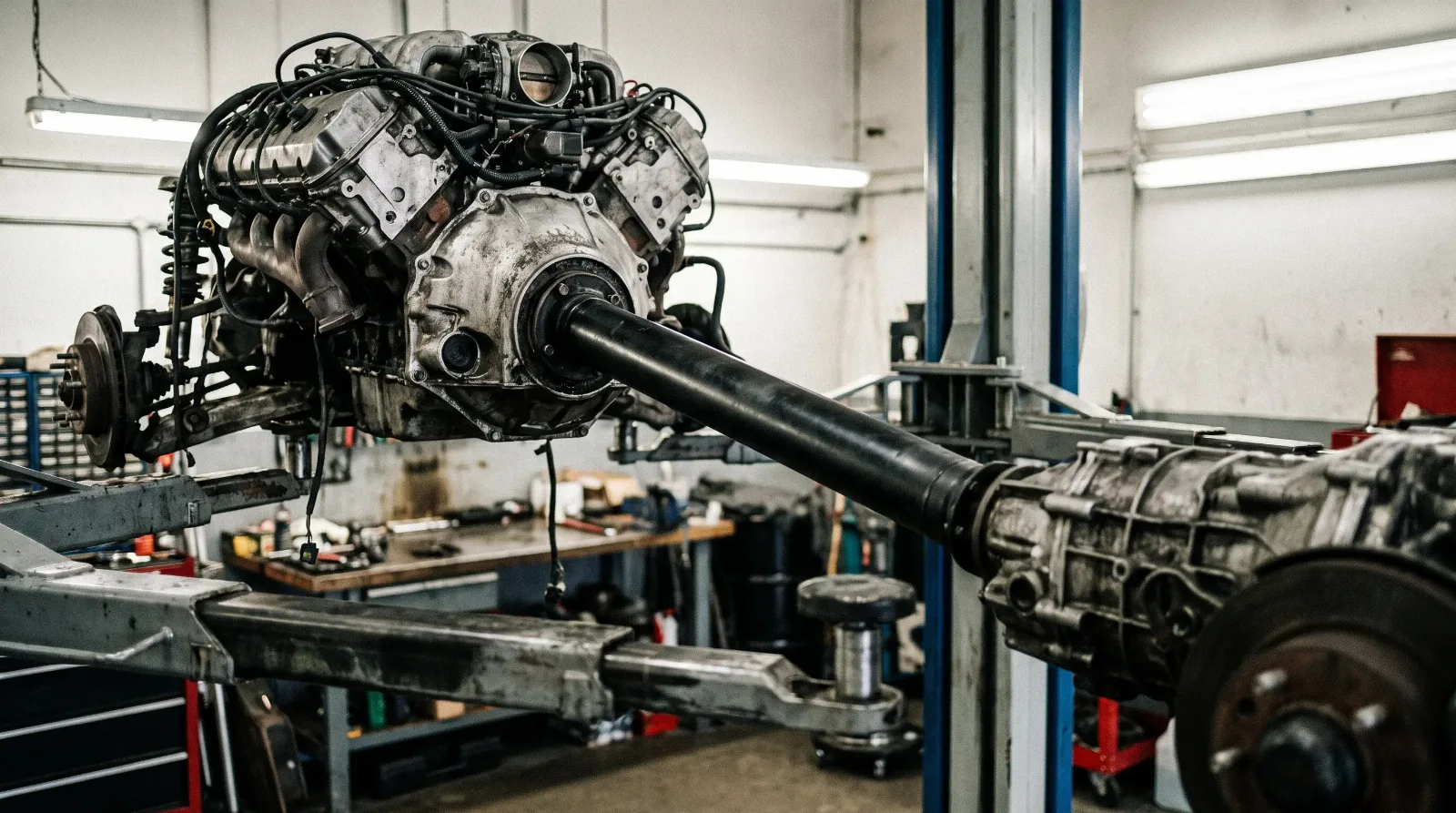
This piece follows on from the front-engine 928 overview, focusing specifically on the mechanical layout underneath the body.
What "transaxle" actually means on this car
Most front-engine cars bolt the transmission directly to the back of the engine, up front, then run a driveshaft back to a separate rear differential. The 928 does something different. The engine sits up front as expected, but the transmission itself, the actual gearbox, is mounted at the rear axle, connected to the engine by a spinning torque tube running the length of the car. That's the transaxle: transmission plus axle, combined into one rear-mounted unit.
The point of doing it this way is weight distribution. With the gearbox moved to the back, Porsche's engineers could get the 928 close to a 50/50 front-to-rear weight split despite starting with a heavy V8 sitting ahead of the front axle. A car with that kind of engine placed conventionally would be nose-heavy and prone to understeer. The 928, thanks to the transaxle, doesn't behave that way.
It's worth remembering how unusual this was for a production grand tourer in 1977. Plenty of manufacturers were building front-engine, rear-drive cars with the gearbox up front, because it's simpler to build and cheaper to service. Porsche chose the harder, more expensive route because the company wanted a specific handling result, not because the layout was easy to engineer or easy to explain to a service technician five years later.
The Weissach axle: solving oversteer with geometry, not electronics
Weight distribution alone doesn't explain everything the 928 does well. Porsche also engineered a rear suspension setup known as the Weissach axle, named for the company's development center, that changes toe angle at the rear wheels under specific conditions. Lift off the throttle mid-corner in a lot of rear or mid-engine cars and the rear end wants to step out, a classic lift-off oversteer moment that catches drivers off guard. The Weissach axle uses suspension geometry, rubber bushings and pivot points designed to react to the forces of trailing-throttle cornering, to pull the rear wheels toward a slight toe-in under those same conditions instead of letting them toe out.
None of this needed a computer or a sensor. It's a mechanical answer to a mechanical problem, worked out in the mid-1970s and built into every 928 that followed. That's worth sitting with for a second, because it means the car's forgiving nature under trailing-throttle load isn't a modern retrofit or an electronic nanny system. It's baked into the suspension pickup points themselves.
Drivers coming from a modern car with stability control often assume some hidden electronic system is doing this work, and they're surprised to learn the 928's behavior under trailing throttle predates any of that by decades. It says something about how far Porsche's suspension engineers were willing to push a pure mechanical solution before electronics became the default answer to every handling question, and it's a big part of why the layout is still discussed decades after the last 928 rolled off the line.
| Component | Function |
|---|---|
| Rear-mounted transaxle | Shifts weight toward the rear axle for balance |
| Torque tube | Transfers engine power to the rear-mounted gearbox |
| Weissach axle | Rear geometry that reduces lift-off oversteer |
Why this layout made the 928 expensive to build, and expensive to fix
None of this engineering came cheap, then or now. A transaxle layout means more precision machining, a torque tube that has to be built and balanced correctly, and a rear suspension geometry that's more complex than a standard trailing arm setup. Porsche was building a genuinely sophisticated grand tourer, not cutting corners to hit a price point, and the 928's original sticker price reflected that.
The tradeoff shows up decades later in ownership costs. A torque tube coupling or center bearing failure isn't a weekend driveway job the way a clutch swap might be on a simpler car, and Weissach axle bushings wear out like any rubber suspension component, just with a bigger consequence if they're ignored, since they're part of what keeps the rear end predictable under trailing throttle.
"Guys show up expecting a nose-heavy barge and leave the passenger seat asking why it doesn't drive like one. That's the transaxle and the Weissach axle doing their job, quietly, the way good engineering usually does."
Wayne Coburn
The layout's legacy inside Porsche's own lineup
Porsche didn't stop at the 928 with this idea. The layout, or close variations of it, showed up later in the 924, 944 and 968 as well, proving the original 928 engineering wasn't a one-off experiment but a genuine platform strategy. For anyone weighing whether the 928's added mechanical complexity is worth it against a simpler classic, a related deep-dive looks at the value case directly, and browsing a classic Porsche 928 for sale is a reasonable next step if the handling argument alone has you convinced.
Sources and notes
Related Reading
Have a
Porsche
for Sale?
Reach thousands of serious classic car collectors across the US.
Sell It Here →
Are You a Classic Car Dealer?
List your full inventory and connect with targeted classic car buyers.
Join as a Dealer →

About the author
Wayne Coburn
Longtime Corvette owner, judge and club figure who knows the cars, the records and the people behind them.
Related Listings - Porsche
Comments
Be the first to comment on this article.