
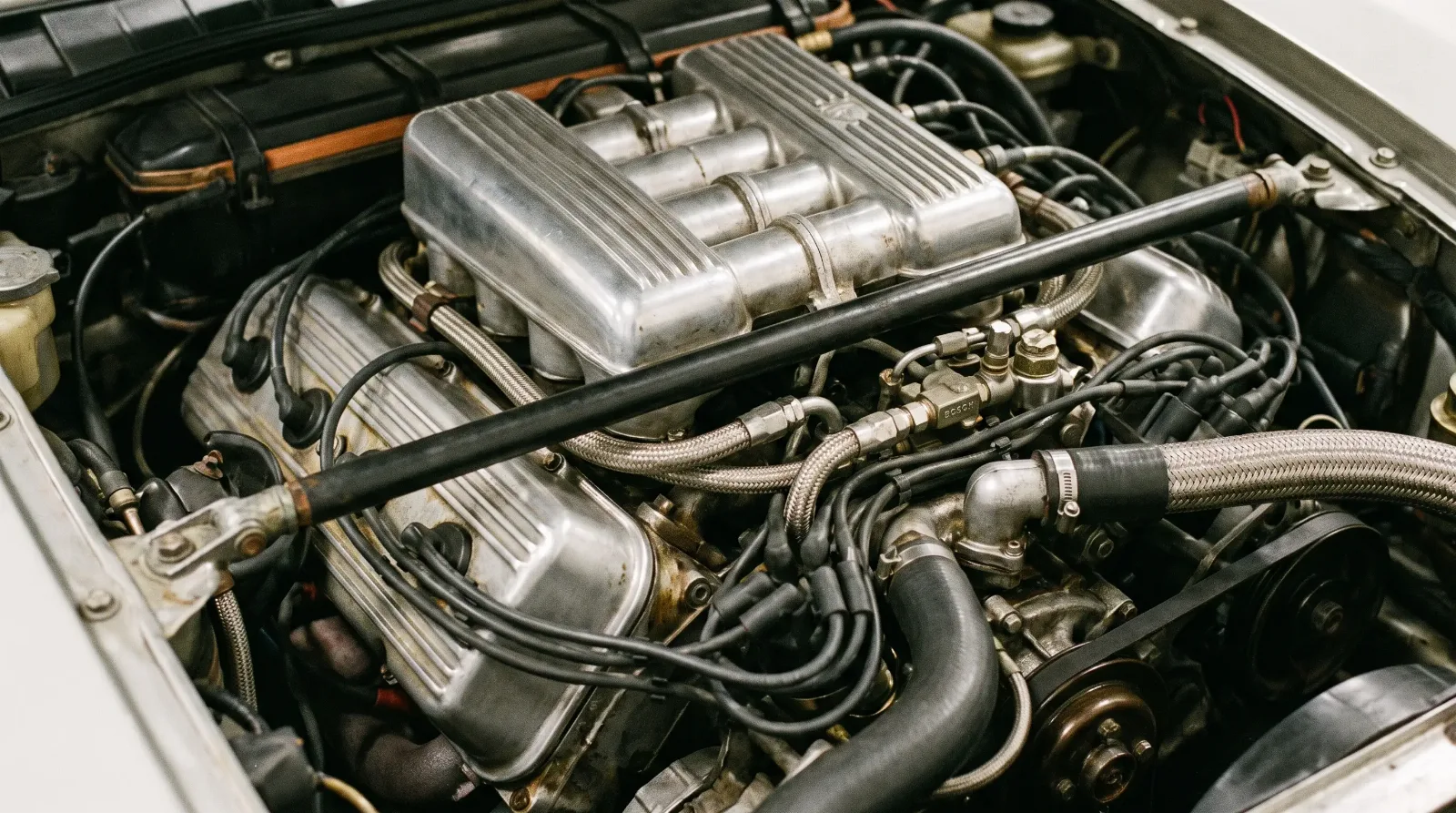
A guy showed up to a Porsche 928 meet a few years back towing a trailer with nothing but an engine block strapped down in it, no car attached, and set it up in the parking lot like a trophy. People walked over just to look at it. That block, a water-cooled V8 with no fan shroud in sight, was the reason half the room's grandfathers had sworn off Porsche for a decade. It was also the reason the other half showed up at all. Nothing splits a Porsche crowd faster than the Porsche 928 v8 engine, and the split has never fully healed.
Car Features
6 min read
The 928's V8: Water-Cooled Heresy
Porsche's first water-cooled production engine split owners for a generation. Here is what the 928's V8 actually was, and why it earned its keep.
The engine that broke a decades-old rule
For most of Porsche's life up to the mid-1970s, the company's identity ran on one mechanical idea: air-cooled, horizontally opposed engines, hung out behind the rear axle, no radiator, no water pump, no compromise. It was a design philosophy people bought a ticket for. So when Porsche revealed the 928 with a water-cooled, front-mounted V8, it did not read to longtime owners as an upgrade. It read as a rejection of the thing they had signed up for in the first place.
Wayne heard the phrase "water-cooled heresy" from an old club president more than once, always delivered with a grin, because by the time he was saying it the joke had already lost most of its sting. The engine had earned its place. But the word heresy was not chosen for laughs originally. Some owners meant it.
What Porsche actually built, and why
The 928's V8, internally the M28, launched in 1977 at 4.5 liters, an aluminum-block unit with single overhead cams per bank, a departure from Porsche's flat-six tradition in almost every respect except the badge on the valve covers. Porsche's engineers chose water cooling and a front-mounted V8 layout deliberately, aiming for a smoother, quieter grand tourer that could meet tightening emissions and noise rules without the packaging headaches a rear-mounted air-cooled unit would have created in a heavier, more comfort-oriented car.
The displacement did not stay put. The original 4.5-liter made 240 PS (237 bhp) in Europe, though US smog equipment cut that to 219 hp. Porsche grew the V8 across the 928's production life to 4.7 liters in the 928 S, eventually reaching 310 PS (306 hp) in Europe by 1985. The 5.0-liter, 32-valve, dual-overhead-cam unit arrived in the 1987 928 S4 at 320 PS (316 hp), and the 1989 GT version of that same 5.0-liter engine was tuned to around 326 hp. The run ended with the 5.4-liter engine in the 1992-1995 GTS, rated at 350 PS (345 hp), a progression that tracked the car's shift from grand tourer to something closer to a genuine high-performance flagship.
Porsche also made a point of building the block and heads in aluminum rather than iron, keeping weight over the front axle in check even as displacement climbed. That decision mattered more than a spec sheet line item suggests. A heavier iron block sitting ahead of the front axle would have worked against the very balance Porsche was chasing with the car's transaxle layout, so the aluminum construction was not a luxury touch, it was part of how the whole package was meant to handle.
The debate that never quite settled
Ask a room of longtime Porsche people whether the 928's V8 was the right call and you will get two confident, opposite answers, often from the same person at different points in the conversation. One side points to refinement: the V8 was quieter, torquier at low speed, and better suited to long highway stretches than a high-revving flat-six ever was. The other side points to identity: Porsche's whole reputation was built on doing engines nobody else did, and a V8 with water jackets was, on paper, the kind of engine you could find under the hood of a dozen other manufacturers' cars.
The refinement camp usually wins the argument once the conversation turns to actual road manners. A 928 loaded with luggage on a long interstate run does not need to be worked the way an air-cooled six does to stay comfortable at speed, and that difference is exactly what Porsche's engineers were chasing when they drew up the car's original brief. The identity camp rarely disputes that outcome. What they dispute is whether comfort was ever the right goal for a Porsche to chase in the first place, and that argument, unlike the engineering one, has no clean technical answer.
"Nobody at the counter argued the engine was bad. They argued it wasn't Porsche. Those turned out to be two very different complaints."
Wayne Coburn
What the ownership record actually says
Set the identity argument aside and look at what 928 owners and mechanics have reported over decades of real use, and the V8 has held up as a genuinely durable, well-engineered unit when maintained on schedule, timing belt service in particular being the item that separates careful owners from expensive lessons. That durability record is part of why the V8 grand tourer built a loyal following of its own instead of just fading as a footnote to the 911's history.
Longtime club mechanics tend to describe the V8 the same way across different regional chapters, which is itself worth noting. Cars that have had their timing belts and water pumps replaced on the manufacturer's schedule rack up high mileage without drama. Cars bought cheap and neglected on that one service item tend to become cautionary stories told at the next meet. The engine rewards attention and punishes deferred maintenance in fairly predictable ways, which is a different failure pattern than the reputation the water-cooled layout earned at launch would suggest.
| Generation | Displacement | Configuration | Power |
|---|---|---|---|
| Original 928 (1977-1979) | 4.5 liters | SOHC per bank, aluminum block | 219-240 hp |
| 928 S (1980-1986) | 4.7 liters | SOHC per bank, revised internals | 234-306 hp |
| 928 S4 / GT | 5.0 liters | DOHC, 32-valve heads | 316-326 hp |
| 928 GTS | 5.4 liters | DOHC, 32-valve heads | 345-350 hp |
Why the argument was worth having
The trailer with the bare block never got a satisfying verdict that day, and it probably never will at any meet. That is fine. The Porsche 928's V8 does not need the room to agree on whether it was heresy or genius, because the engine's own service record has done most of the arguing already: a water-cooled, front-mounted unit that Porsche kept refining for nearly two decades, growing displacement and valve count rather than walking away from the layout.
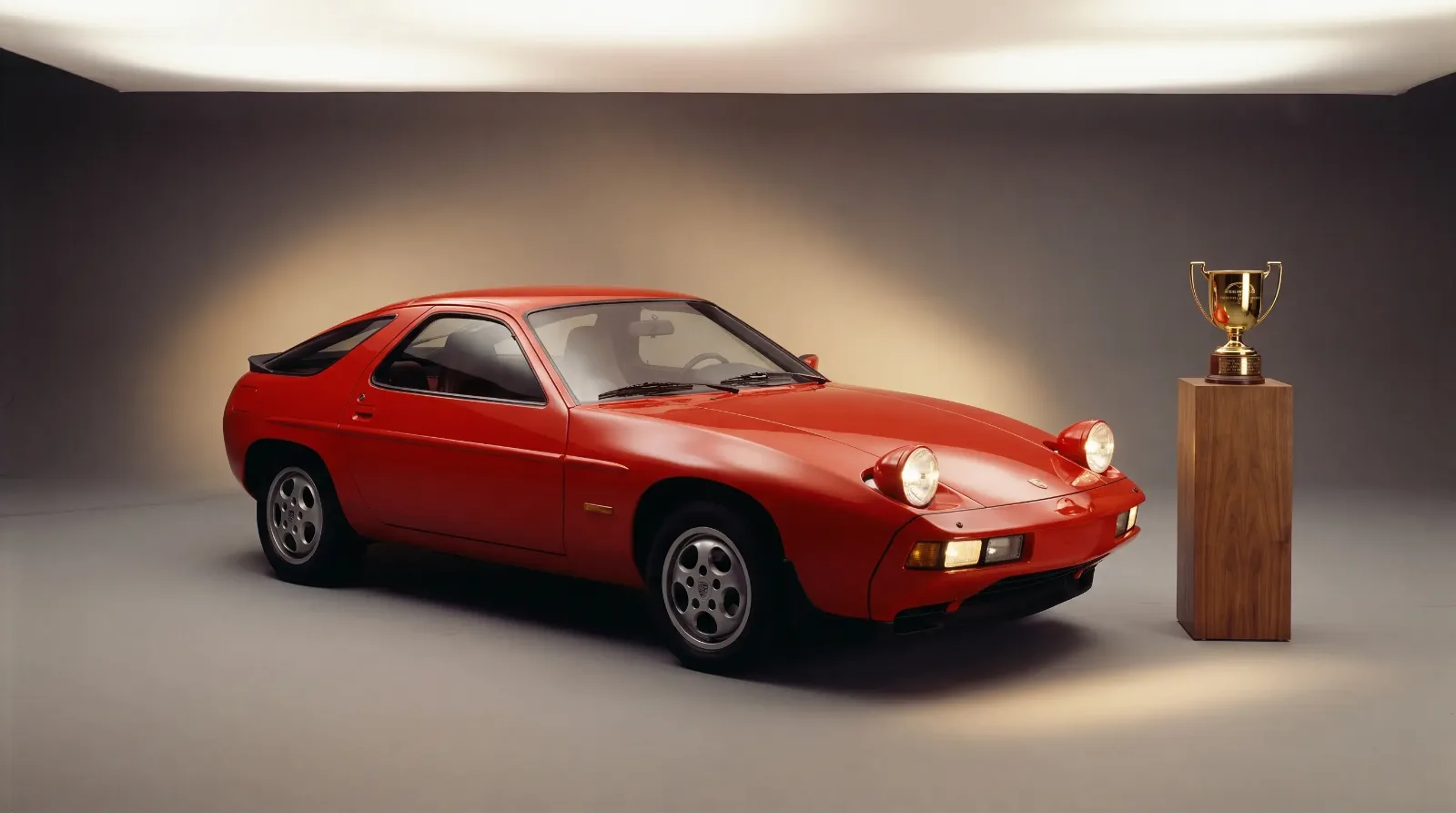
For the fuller story of how that engine's development tracked the car's rise to genuine flagship status, including the year it took home an award nobody expected a front-engine Porsche to win, a companion piece picks up exactly where this one leaves off.
Sources and notes
Related Reading
Have a
Porsche
for Sale?
Reach thousands of serious classic car collectors across the US.
Sell It Here →
Are You a Classic Car Dealer?
List your full inventory and connect with targeted classic car buyers.
Join as a Dealer →
#classic porsche
#porsche 928
#Porsche history
#Porsche V8 engine
#water-cooled Porsche
#grand tourer engines

About the author
Wayne Coburn
Longtime Corvette owner, judge and club figure who knows the cars, the records and the people behind them.
Related Listings - Porsche




Comments
Be the first to comment on this article.