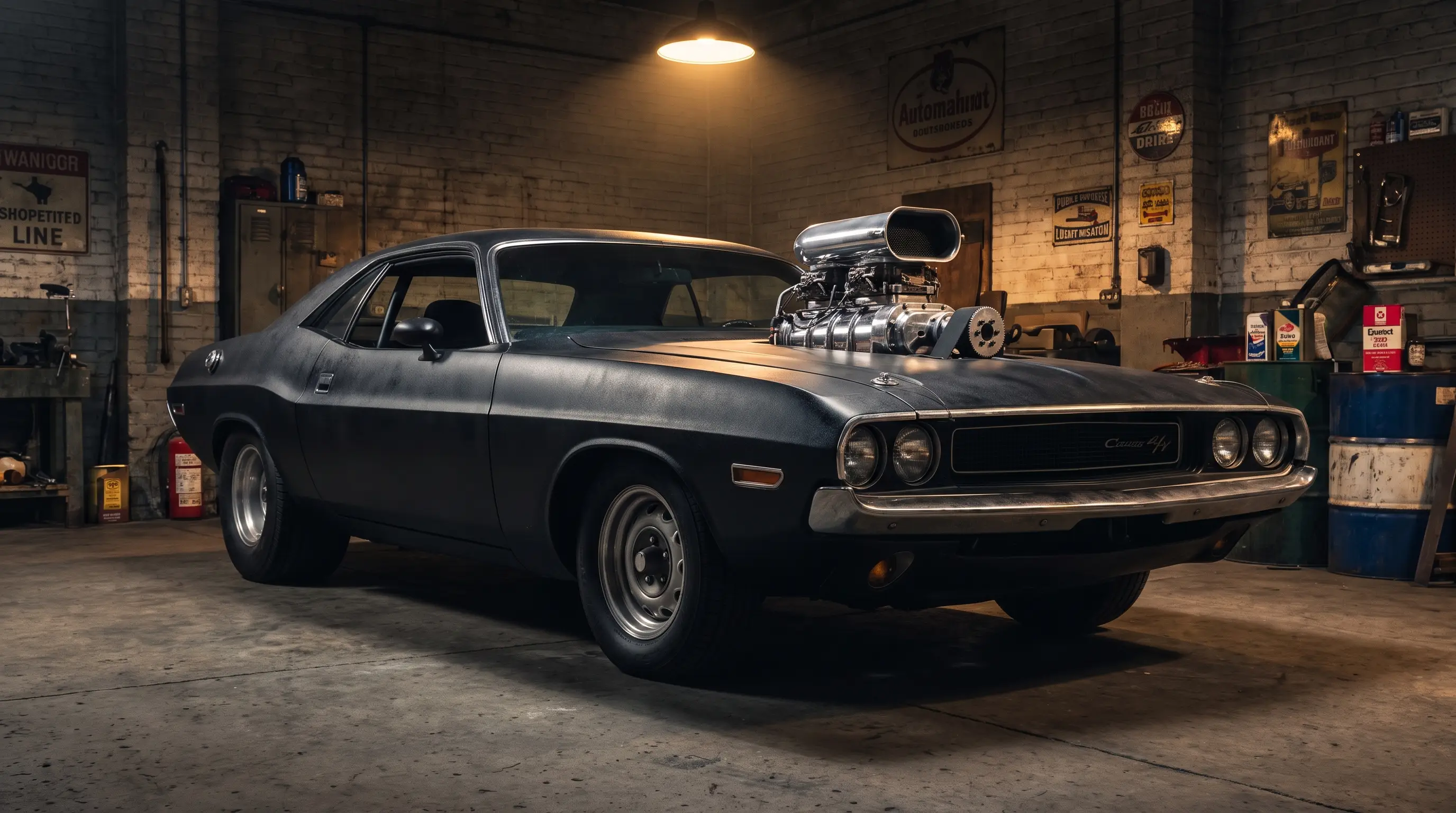

The bugcatcher scoop earned its name the honest way, by catching bugs. Any air cleaner assembly tall enough to sit exposed above a Pro Street car's cut hood was going to collect its share of insects at speed, and the racers who coined the nickname were not being poetic about it. The name stuck because it was funny and because it was true, and it became one of the most recognizable pieces of hardware to come out of the entire movement.
What a bugcatcher actually is
Strictly speaking, a bugcatcher is a tall, often triangular or trapezoidal air filter housing mounted on top of a blower's carburetors, positioned to sit up above the hood line in the open air rather than sealed underneath it. It replaced the low-profile air cleaner you would find on a naturally aspirated engine with something considerably taller, since the whole point was feeding as much clean, unrestricted air as possible into a blown setup that needed it. Function came first. The scoop shape and the exposed filter element were there because a blown big-block genuinely breathes better with unrestricted airflow, not because someone thought it would look good on a magazine cover, though it certainly did that too.
Where the shape came from
The design traces back to drag strip Funny Cars and Top Fuel dragsters of the 1960s and early 1970s, where teams needed the tallest, least restrictive air filter housing they could fit within the rules. Pro Street builders, borrowing heavily from that world the way the whole movement did, adapted the same basic shape for street use. A few companies started producing bugcatcher housings specifically for street applications, with mesh or paper filter elements that could handle rain and road grime better than a pure race piece designed for a controlled strip environment. That practical adaptation, race hardware toughened up for the street, is really the story of Pro Street in miniature.
The visual role it played
A bugcatcher sitting on top of a blower, itself sticking up through a cut hood, became the visual crown of a Pro Street engine bay. Chrome-plated or polished bugcatchers caught light and drew the eye immediately, which mattered at car shows where a well-detailed engine bay could win points on presentation alone. Builders who wanted their car noticed in a parking lot full of other blown Pro Street cars often invested real money in a show-quality bugcatcher, sometimes with custom lettering or logos etched or painted onto the sides, turning a functional air filter housing into a personal signature piece.
"I remember a guy at a swap meet holding up a bugcatcher like it was a trophy, telling anyone who'd listen how many bees it had personally taken out over one summer. That's the whole culture right there, equal parts engineering and storytelling."
- Wayne Coburn
The nickname and how it spread
The term "bugcatcher" was never an official industry name printed on any parts catalog. It emerged the way most good nicknames do, informally, among racers and builders who found it funnier and more accurate than whatever the manufacturer called the part on the box. Once it stuck within drag racing circles, it carried over naturally into Pro Street culture, spread through magazine articles, swap meet conversations, and word of mouth at cruise nights until it became the accepted term for this style of tall, exposed air filter housing regardless of which company actually manufactured it. That kind of grassroots naming is common throughout hot rod and drag racing culture generally, where a functional description often outlives whatever formal product name a manufacturer originally assigned.
By the time Pro Street reached its peak popularity in the mid-1980s, "bugcatcher" had become such standard vocabulary within the scene that builders used it without a second thought, the same way they would say "blower" instead of "supercharger" in casual conversation. That shared language was part of what made the Pro Street community feel like a distinct culture rather than just a loose collection of individual builders working in isolation from each other.
Common variations builders ran
Not every bugcatcher looked the same, and the differences reflected both function and personal taste. Some ran a fully triangular shape tapering to a point at the top, a design borrowed almost directly from Top Fuel dragster practice. Others favored a more trapezoidal or box shape, offering a larger filter surface area at the cost of a bit more visual bulk. Filter material varied as well, with some builders preferring a paper element for maximum filtration on a car that saw regular street use, while others, more focused on strip performance than daily driving, ran a lighter mesh screen that flowed more air but offered less protection against dust and debris. The choice usually came down to how the car was actually going to be used, strip-only builds favoring flow over filtration, street-driven cars favoring the reverse.
Finish quality separated a budget build from a show-quality one just as much as shape did. A raw aluminum bugcatcher, functional but unfinished, was common on cars built primarily for performance rather than presentation. Chrome plating, polishing, or custom paint matched to the car's body color signaled a builder who cared as much about how the engine bay photographed as how quickly the car ran, and those detail choices are often what separates a car remembered fondly decades later from one that has simply been forgotten.
Why it mattered beyond the visual statement
There was real engineering logic underneath the showmanship. A blown engine consumes a large volume of air very quickly, and any restriction in that path costs boost and power. Sitting the filter assembly up in open air, away from the heat radiating off the engine and away from the more restricted space under a stock hood, gave the carburetors access to cooler, denser air, which is always a good thing for an engine trying to make maximum power. The height also served a second, more practical purpose on cars running dual four-barrel carburetors side by side, since a low-profile filter setup simply could not accommodate that footprint the way a taller bugcatcher housing could. Where this started covers the blower itself in more depth, since the bugcatcher only exists because of the airflow demands that blower created in the first place.
Bugcatchers remain one of the most identifiable signatures of an authentic period build today, and collectors looking at original Pro Street cars often check whether the bugcatcher, blower, and hood modification all match in period style and finish quality, since a mismatched combination usually signals a later repair or a modern re-creation rather than an original build. Anyone chasing one of those original combinations can look at a classic Pro Street car for sale, where the details under the hood tell you more about the car's real history than the paint ever will.
Sources and notes
- Why Do Some Muscle Cars Have Blowers On The Hood - SlashGear
- Hot Rod Lingo! Getting a Grip on the Rodding Lifestyle - Rod Authority
- The Straight Scoop: Exploring the Science Behind Hood Scoop Design - OnAllCylinders
- Pro Street: A Look Back At The Bow-Tie Style That Never Gets Old - Chevy Hardcore
- A Quick History of the GMC 6-71 Blower - Mac's Motor City Garage