
Matt and Debbie Hay had already spent fourteen years building award winning pro street machines together, working through project after project as a team long before most builders in the scene had settled into a signature style, by the time their 1988 Thunderbird rolled out in a shade of pink nobody at a regional show was going to overlook. That kind of experience shows in a build. This was not a couple's first attempt at the style, and the Thunderbird carried the confidence of two people who already knew exactly what they were doing and were not interested in playing it safe on color.
Car Features
7 min read
Matt and Debbie Hays' Pink Thunderbird
A bright pink 1988 Thunderbird built by a husband-wife team with fourteen years of experience became a coast-to-coast award winner, then a car they bought back.
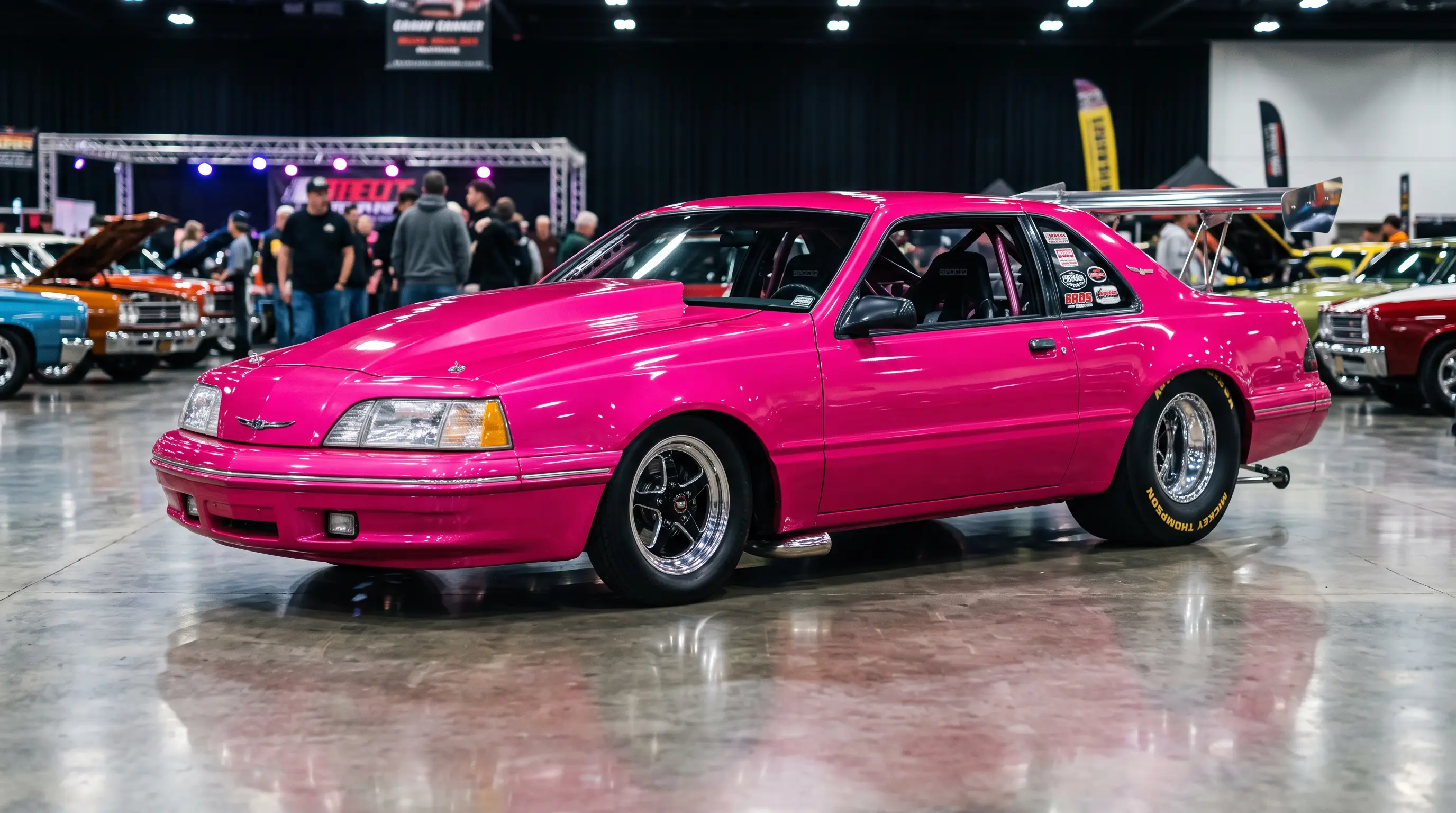
A husband and wife team with real staying power
Pro street was overwhelmingly a solo builder's game through most of the 1980s, dominated by individual names attached to individual garages, which makes Matt and Debbie's partnership stand out on its own merits before you even get to the car itself. Fourteen years of building award winning machines together by 1988 meant they had already worked through the trial and error most builders go through alone, and they brought that shared experience directly into the Thunderbird project. The result reads like a team effort rather than one person's vision with a second name added for credit.
Bright pink and impossible to miss
The Thunderbird's bright pink finish was a deliberate statement in a scene where builders more often reached for candy reds, deep blacks, or aggressive graphics packages to make their car stand out. Pink did the same job with a fraction of the visual noise, and it worked. Within months of its debut in 1988, the car was winning awards from coast to coast and appearing on national magazine covers, a level of exposure that most builds never come close to reaching even over an entire career. That kind of rapid, widespread recognition usually only happens when a car photographs as well as it looks in person, and the Thunderbird clearly managed both, since editors kept choosing it for cover placement rather than a single feature and moving on.
Fourteen years of shared experience shows in the small choices
A couple building their first pro street car together tends to make certain predictable mistakes, spending too much on the parts that photograph well while underfunding the fabrication details that actually determine whether a car holds up under real use. Matt and Debbie had already worked through that learning curve on earlier projects by the time the Thunderbird came together, and it shows in how balanced the finished build reads. Nothing about the car feels like a builder chasing one flashy element at the expense of everything else. The paint gets attention, the drivetrain gets attention, the chassis fabrication gets attention, and none of those elements feels like it was shortchanged to fund another. That kind of balance is hard to fake, and it usually only comes from having already built enough cars to know exactly where the corners not to cut actually are.
Detail work built for the long haul
Beyond the paint and the supercharged Windsor V8, the Thunderbird carried genuinely serious componentry throughout, including aluminum radiators, Alston aluminum wheel hubs, and aluminum floorboards and transmission tunnel work that reduced weight while adding a level of fabrication polish that judges at the time clearly noticed. Deist drogue chutes rounded out a build that took its performance credentials as seriously as its show presentation, a combination that mirrors the same show-meets-strip balance found in the best pro street builds of the period. The livery work came from Squeeg's Customs, whose graphics and paint execution helped the car photograph as well in a magazine spread as it looked sitting under show lights.
"Pink should not have worked as well as it did on that car, and that is exactly why it did. Nobody forgets the Thunderbird once they have seen it, and that was the whole point."
- Wayne Coburn
Sold, missed, and brought back home
Matt and Debbie sold the Thunderbird in 1991, three years after its debut, closing out its original run with the couple who built it. That might have been the end of the story for most cars from this era, many of which disappeared into private hands and were never heard from again. Instead, the Hays repurchased the car in 2013, more than two decades after letting it go, and found it in an obscure corner of Western Pennsylvania before towing it over two thousand miles back home for restoration. Few builders ever get the chance to reclaim a car that meant that much to their own history, and fewer still take it. That decision says something about how much the Thunderbird represented to the two people who built it in the first place.
What the twenty two year gap says about ownership
Cars change hands constantly in this hobby, and most owners who sell a build move on without looking back, especially once a couple of decades and several other projects separate them from the car they used to own. Matt and Debbie's decision to actively pursue and repurchase the Thunderbird more than twenty years after selling it runs against that usual pattern, and it says something specific about what the car represented to them beyond its trophy case. A build that wins awards is one thing. A build that a couple goes out of their way to track down and haul home across two thousand miles, long after any practical reason to do so, is something else entirely, closer to reclaiming a piece of their own history than simply adding another car to a collection.
A build that still represents the era at its best
The Thunderbird has gone on to become recognizable enough to appear in die-cast model collections years later, a small but telling sign of how deeply the car embedded itself in pro street culture beyond its original show run. For anyone trying to understand what separated a genuinely great pro street build from a merely competent one during the genre's peak years, the Thunderbird is a strong case study in how far a confident color choice, careful fabrication, and years of shared building experience could carry a single car. Readers who want the fuller context on how this build fits among the movement's most significant machines can find where this started and trace the line from earlier pioneering builds through to cars like this one.
Collectors drawn to that same combination of bold presentation and real engineering substance should take the time to look at what is currently available, since a classic Pro Street car for sale with documented history and fabrication work of this caliber does not come along often.
Sources and notes
Related Reading

About the author
Wayne Coburn
Longtime Corvette owner, judge and club figure who knows the cars, the records and the people behind them.
Comments
Be the first to comment on this article.