
Ask ten pro street enthusiasts to name the car that first put Scott Sullivan's name on the map, and you will get a mix of answers, since reputations built decades ago rarely survive intact once a builder produces one truly famous car that overshadows everything that came before it, because Sullivan had more than one build worth remembering long before Cheez Whiz made him a household name in wider circles. His early Nova, built and refined years before that famous 55 Chevy, is where a lot of his signature ideas about finish and proportion first showed up in public. The car ran a deep blue finish and swept the field at the 1980 Car Craft Street Machine Nationals in Indianapolis, then appeared in the October 1981 issues of Hot Rod, Car Craft, and Popular Hot Rodding within the same season, the kind of triple magazine placement that put a builder's name on the map fast.
Scott Sullivan's Nova Hugger
Years before Cheez Whiz made him famous, Scott Sullivan's bold orange Nova worked out the proportions and bodywork discipline that defined his later career.
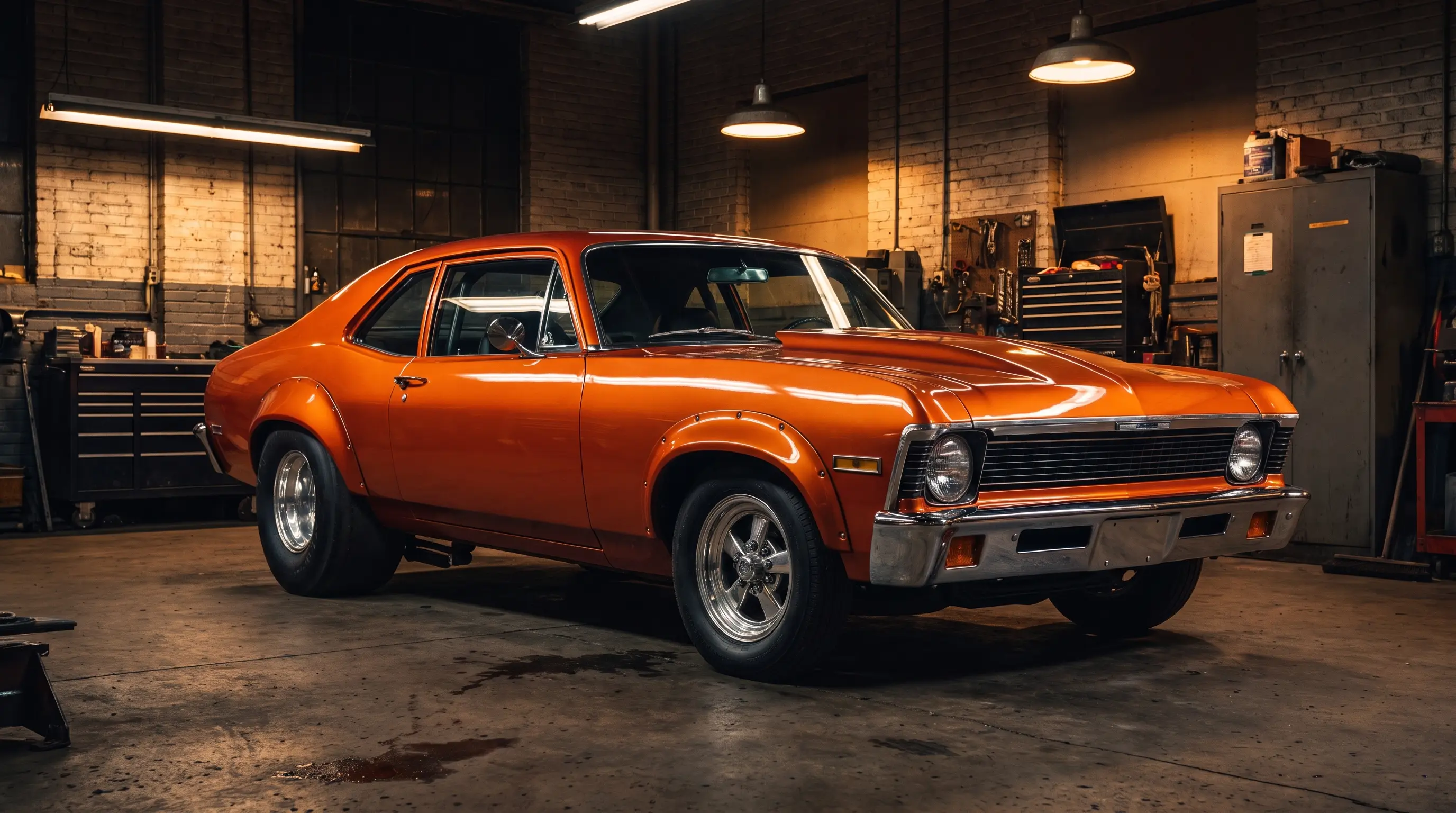
A Nova that arrived early and stuck around
Sullivan's 1967 Nova was one of the earliest builds to popularize the pro street look at a time when the style had not yet become the magazine phenomenon it would grow into by the mid-1980s. That timing matters. Being early to a movement carries real risk, since there is no established template to work from, no established audience already primed to appreciate the style, and no guarantee the approach will catch on with anyone outside your own garage. Sullivan built the Nova anyway, working out proportions, stance, and bodywork ideas that had not yet been standardized by a decade of other builders copying each other, essentially writing the early rulebook that later pro street builders would take for granted as common knowledge.
The deep blue finish was not a subtle choice for the era, and it did not need to be. A car built to prove a new idea about what a street driven muscle car could look like benefits from being impossible to ignore, and this Nova was exactly that on any lot it rolled into.
Color and finish choices like that carried real risk for an early build trying to establish a builder's reputation. A bold paint job on a car with mediocre bodywork underneath only draws more attention to the flaws, since deep color and heavy clear show every wave and every panel gap that a duller finish might hide. Getting that Nova to Nationals-winning condition meant Sullivan had to be confident the metalwork underneath could stand up to that kind of scrutiny, and by the results it did, which is part of why the car built his name rather than damaging it.
Working out proportion before the internet existed to help
Getting the stance right on a tubbed car, the exact relationship between how far the rear tires push out the quarter panels and how low the front end sits over those small tires, is one of those things that looks simple until you actually try to do it. Get the ratio wrong and a car looks either timid or cartoonish, with no middle ground that reads as intentional. Today a builder can pull up hundreds of reference photos in seconds and compare proportions side by side before cutting a single piece of sheet metal. In the era Sullivan was working, there was no such shortcut. A builder either had a good eye for it or he did not, and figuring out what worked meant building it, stepping back, and deciding whether the result actually looked right or needed to be redone. That trial and error process, repeated across an early car like this Nova, is exactly the kind of unglamorous groundwork that later made Sullivan's more famous builds look effortless.
The techniques that carried forward
What makes this Nova worth studying today is not just its own presence at shows during its active years, but how directly it set up everything Sullivan built afterward. The seamless bodywork and disciplined color choices that later defined Cheez Whiz and his other well-known machines did not appear out of nowhere. They were worked out here first, on a car that had to prove the concept before Sullivan had the reputation to simply be trusted on his name alone. Builders who study his career in order, rather than jumping straight to his most famous work, tend to come away with a much better sense of how much trial and refinement sat behind the polish everyone remembers.
"You do not get to Cheez Whiz without a Nova like this one first. Every builder has an early car that teaches them what they actually believe about proportion and finish, and this was Sullivan's."
- Patrick Walsh
Part of a bigger story about where pro street began
This Nova sits at an interesting point in pro street history, early enough to be a genuine pioneer but built by someone who would go on to define the movement's later, more refined direction as well. Readers who want where this started for the movement as a whole will find useful context for understanding why an early car like this one carried so much weight among builders who came after it. It is also worth reading more on the famous pro street cars that shaped the golden era, since Sullivan's later work sits comfortably alongside the other machines that defined that period.
Why an early, less famous build still matters
It is tempting for collectors and enthusiasts to focus attention only on a builder's most celebrated work, treating everything that came before it as a footnote on the way to the real story. That instinct sells cars like this Nova short. Understanding a builder's full body of work, including the earlier, less polished pieces that were still working out fundamental ideas, gives a far more complete picture of why the later, more famous cars turned out the way they did. Nothing about Sullivan's reputation for seamless bodywork and disciplined proportion appeared fully formed. It was built one car at a time, starting with builds like this one, long before wider audiences were paying close attention.
A reference point for serious collectors
Early pioneering builds like this one rarely survive in their original form, since owners over the decades tend to update, repaint, or otherwise modify cars that were not yet recognized as historically significant at the time. That makes any surviving example, or any faithful recreation built with real attention to the original proportions and finish, genuinely valuable to collectors who care about where the movement's defining ideas actually came from. Anyone chasing that kind of period-correct history should spend time browsing classic Pro Street cars on the market and asking sellers directly about provenance, since a car with a documented connection to this early era of the movement carries a different kind of significance than a more generic tribute build.
Sources and notes
Related Reading

Automotive journalist covering classic car shows, events, and the enthusiast community across North America.
Comments
Be the first to comment on this article.