
Two engines in one chassis sounds like a joke until you see the number it produces. Twin-engine Pro Street show cars were never common, and they were never subtle, but the small handful that got built proved a point most builders wouldn't touch: if one big-block makes a car quick, two makes a car a headline.
Car Features
7 min read
The Twin-Engine Pro Street Show Cars
A rare handful of Pro Street builders doubled up on engines entirely, trading practicality for a number and a spectacle no single-motor car could match.
Why builders even tried it
By the mid-1980s, single-engine Pro Street combinations had gotten seriously potent. Big-block Chevrolet and Chrysler builds were putting down four-figure horsepower numbers on the dyno, and the class was running out of easy gains within a conventional single-motor layout. A twin-engine build sidestepped that ceiling entirely. Instead of chasing incremental power from one combination, a handful of builders simply doubled the hardware. Two engines, two sets of accessories, twice the fabrication headache, and a number that no single-engine car in the country could touch on paper.
Well-documented, full street-legal twin-engine Pro Street builds, cars with a complete interior and license plate rather than a stripped exhibition dragster, are genuinely rare in the historical record. Most of the twin-engine cars that survive in magazine archives and show circuit memory are one-off, regionally known builds rather than nationally famous names, which is part of why the format never grew beyond a handful of standout examples. The engineering problem wasn't really making two engines run. It was making two engines run together, in a chassis that had to carry double the weight of a conventional drivetrain while still looking like a street car sitting at a cruise night.
| Engineering challenge | Why it mattered |
|---|---|
| Drivetrain synchronization | Two engines had to deliver power to the rear wheels without one overpowering or fighting the other |
| Weight distribution | Doubling the powertrain mass shifted the car's balance and demanded reworked chassis geometry |
| Cooling | Two engines meant two cooling systems packaged into a body never designed to hold one and a half |
| Fabrication | Custom mounts, linkages, and exhaust routing had no factory reference point to start from |
The number that made the point
A single big-block Pro Street combination in the mid-1980s could reasonably be pushed past 800 horsepower with the right parts and enough development time. A well-sorted twin-engine setup didn't need to double that figure to make its point. It just needed to be bigger than anything a single-motor car could realistically field, and a properly built twin-engine car cleared that bar without much argument. The number was never really the point on its own. The point was that nobody else at the show had one.
That's an important distinction for understanding why these cars existed at all. Pro Street was partly a competitive class and partly a rolling exhibition, and a twin-engine car played almost entirely to the second half of that equation. Owners of these builds weren't necessarily chasing the fastest bracket time of the weekend. They were chasing the loudest gasp when the hood came up.
The maintenance burden owners rarely discussed publicly
A single-engine Pro Street car already demanded a serious maintenance schedule to keep a high-strung combination running reliably from one event to the next. A twin-engine car doubled nearly every category of that upkeep at once, from valve adjustments to ignition service to the routine inspection every serious racer performs before trusting a car with a full-throttle pass. Owners who took these builds seriously as more than static show pieces had to accept a maintenance commitment that most single-engine competitors would have found unreasonable, and that commitment is a big part of why so few twin-engine cars actually made it to the strip on a regular basis compared to how often they appeared at static shows.
The economics were equally demanding. Sourcing, building, and maintaining two complete engine combinations instead of one roughly doubled the ongoing cost of campaigning the car, on top of the initial fabrication expense that already dwarfed a conventional single-engine build. Very few owners could sustain that level of investment for more than a season or two, which is part of why these cars tend to appear in the historical record as a handful of standout examples rather than an ongoing, evolving branch of the class the way single-engine builds became.
The tradeoffs nobody could engineer around
Every gain a twin-engine layout offered on paper came with a cost the chassis had to absorb somewhere else. Twice the engine weight meant twice the demand on the front suspension and the frame rails supporting it, which meant more reinforcement, more custom fabrication, and more time in the shop before the car ever turned a wheel. Fuel delivery had to feed two engines without starving either one under load. Ignition and throttle linkage had to fire and respond in sync, because an engine that lagged behind its twin by even a fraction of a second could send the whole combination into a wheel-hopping, sideways mess at the worst possible moment on the strip.
None of that stopped builders from trying, and the ones who got it right built cars that are still talked about specifically because so few other people ever attempted the same thing. Rarity in this case wasn't a marketing angle. It was the honest result of how hard the engineering actually was.
Where these cars actually appeared
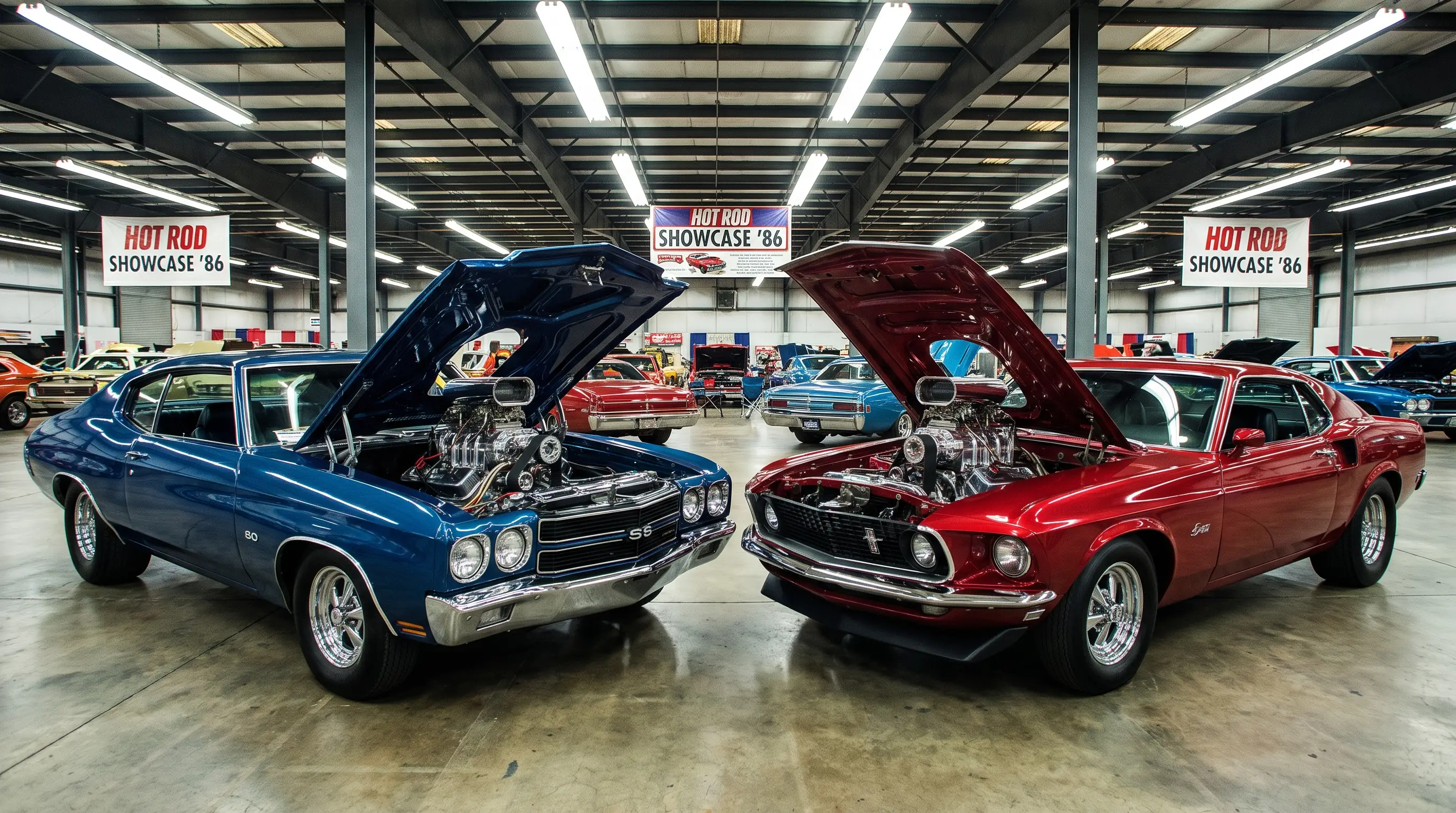
Twin-engine builds were far more common at show circuits than at competitive drag strips, and that distinction tells you something important about their real purpose. A tech inspector at a serious drag event had to sign off on the safety of a car carrying double the fuel system, double the ignition hardware, and double the potential failure points of a conventional build, and plenty of tracks were understandably cautious about letting an unproven twin-engine combination make a full-power pass down their strip. Show promoters, by contrast, welcomed these cars enthusiastically, because a twin-engine Pro Street car parked under the lights with both hoods propped open was exactly the kind of attraction that pulled a crowd through the gate.
That reality shaped how these builds were engineered from the start. A car built primarily to run competitively needed a drivetrain that could survive dozens of full-power passes across a season. A car built primarily for static display and the occasional exhibition run had more room to prioritize spectacle over long-term reliability, and more than a few twin-engine builds leaned into that tradeoff deliberately, accepting a shorter service life between full rebuilds in exchange for a number and a look nothing else in the parking lot could match.
What the cars proved about the class
Twin-engine builds never became a mainstream branch of Pro Street, and they were never meant to. What they proved was that the class had room for genuine engineering extremism alongside its more common single-engine builds, and that the ceiling on what counted as a Pro Street car was set by imagination as much as by any rulebook. The whole picture of what Pro Street produced across its run includes builds like these next to the more conventional single-engine cars that made up the bulk of the movement.
The bottom line on twin-engine Pro Street cars is simple. They cost more to build, more to maintain, and more to keep sorted than a single-engine car could ever justify on a number-for-number basis. Builders did it anyway, because Pro Street was never purely a numbers game. If period-correct single or twin-engine builds from this era interest you, you can shop classic Pro Street car listings to see what's currently available.
"Two engines doesn't mean twice the car. It means twice the fabrication, twice the failure points, and about ten times the attention when the hood comes up at a show. The number on the dyno sheet was never the hard part."
- Dan Reeves
Sources and notes
Related Reading
Have a
Classic Car
for Sale?
Reach thousands of serious classic car collectors across the US.
Sell It Here →
Are You a Classic Car Dealer?
List your full inventory and connect with targeted classic car buyers.
Join as a Dealer →

About the author
Dan Reeves
Performance engine builder from North Carolina's motorsports corridor, focused on swaps, forced induction and making real, repeatable power.




Comments
Be the first to comment on this article.