
Two carburetors, two completely different philosophies, one job: feed a big block enough fuel and air to make the power it was built for without wasting gas at part throttle. The Rochester Quadrajet and the Holley four-barrel both did that job on big-block Chevelles, but they did it in ways that changed how the car actually felt to drive, not just what it made on paper.
Car Features
6 min read
Quadrajet vs Holley: big-block Chevelle carburetor character
The LS5 ran a Quadrajet, the LS6 ran a Holley. Here's why those two carburetors gave the same displacement two completely different personalities.
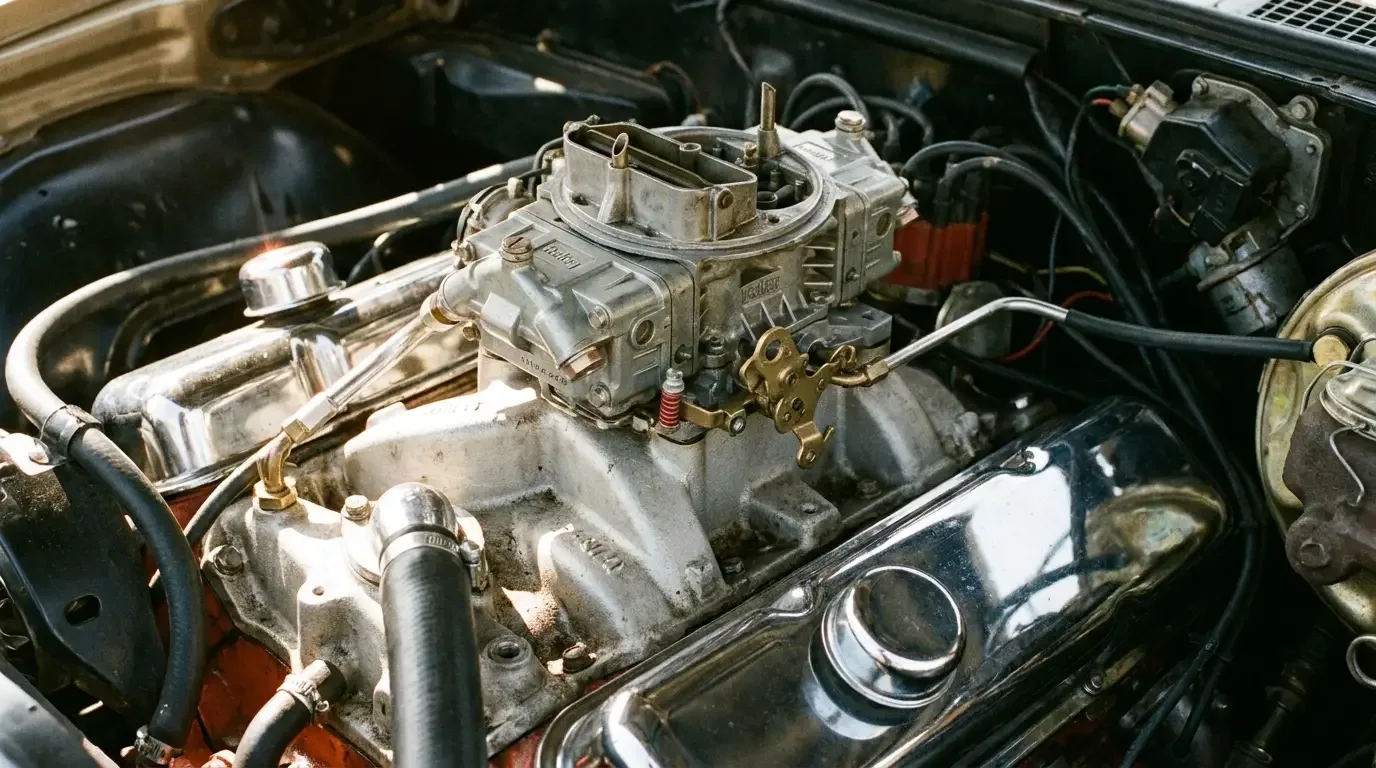
I've tuned both types on the dyno enough times to know the difference isn't marketing. It's mechanical, and it shows up the second you get into the throttle.
The Quadrajet: small primaries, big secondaries, driveability first
The Quadrajet ran small primary bores paired with large secondary bores, a "spread-bore" design that gave it excellent throttle response and fuel economy at part throttle, since the small primaries kept air velocity high at low airflow demand. Chevrolet used the Quadrajet across a huge range of engines, including the LS5 454, specifically because it delivered good street manners without sacrificing top-end capability once the secondaries opened.
The tradeoff was tuning complexity. The Quadrajet's air valve controlling the secondary opening rate, along with its float bowl and metering rod calibration, made it a carburetor that rewarded a patient tuner and punished a careless one. A poorly calibrated Quadrajet could stumble on secondary opening or run rich at cruise, and that reputation for finickiness followed it for decades, fair or not. The LS5 454's factory Quadrajet was rated around 750 CFM, sized for a strong but street-manageable big block rather than an all-out race engine.
The Holley: big, simple, and built for the LS6
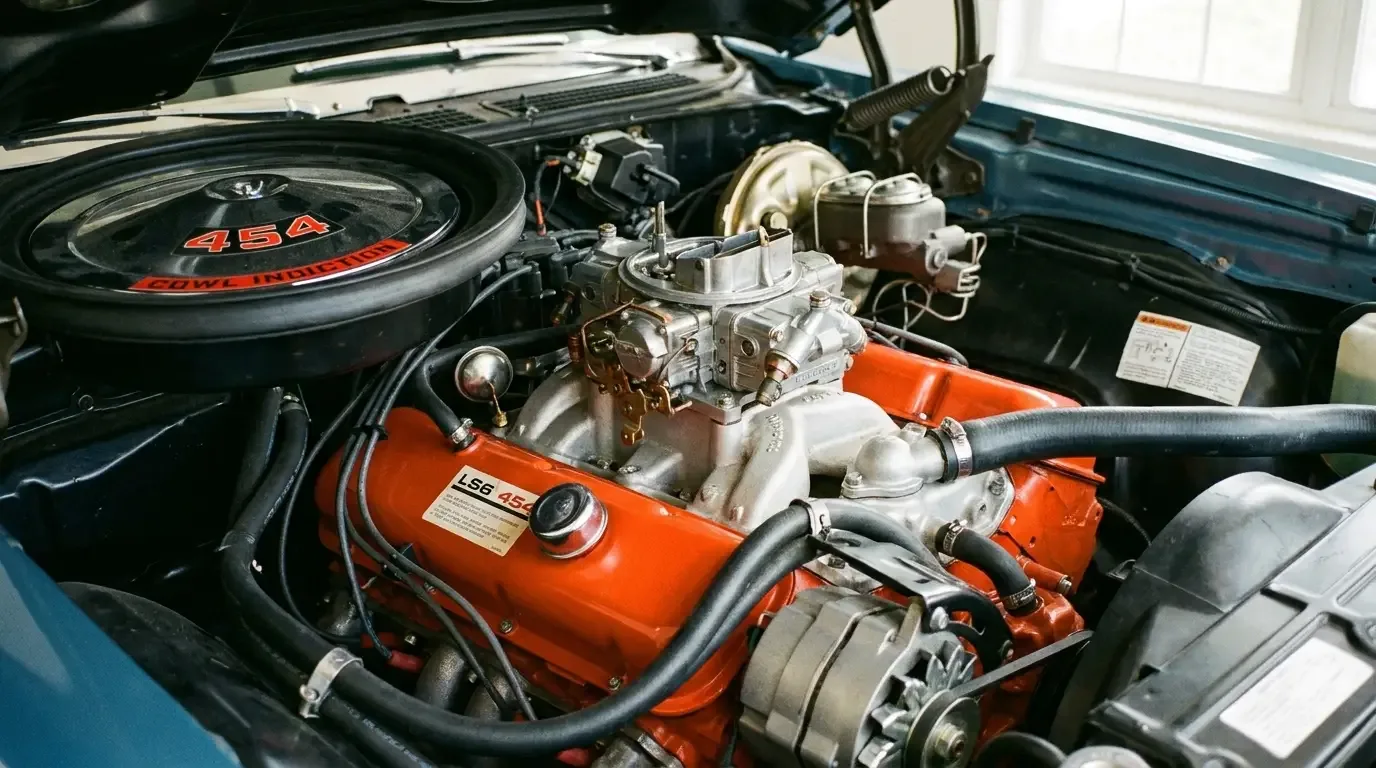
The LS6 454 got the Holley four-barrel, a square-bore design rated at 780 CFM, factory list numbers 4492 and 4556 behind the automatic, 4557 and 4491 behind the M22 four-speed. Both the Quadrajet and the factory LS6 Holley actually used vacuum-operated secondaries, so the popular idea that the Holley snapped both barrel pairs open the instant the throttle hit the floor isn't quite right. The real difference is in how each carburetor stages that opening. The Quadrajet's secondaries are metered by a spring-loaded air valve working in tandem with tapered metering rods, a multi-stage system tuned for a gradual, almost cushioned transition. The Holley's vacuum secondary works off a single diaphragm and spring responding directly to airflow signal, a simpler mechanism with less in the way between "more throttle" and "more fuel."
That difference is exactly why an LS6 has a different character off idle and under hard acceleration than an LS5 running the same basic architecture underneath it. The Holley doesn't hedge its opening the way the Quadrajet's layered air-valve-and-metering-rod system does. Get into it hard and the secondaries come in quickly and directly, without the extra stage the Quadrajet uses to smooth the transition. It's a simpler mechanical concept, fewer moving parts controlling the transition, and it's part of why the LS6 earned its reputation as the more aggressive, more track-oriented engine of the two 454 variants.
| Carburetor | Design | Secondary type | Typical use |
|---|---|---|---|
| Rochester Quadrajet (~750 CFM) | Spread-bore | Vacuum-operated air valve + tapered metering rods | LS5 454, daily-driven big blocks |
| Holley 4-barrel (780 CFM) | Square-bore | Vacuum-operated, single diaphragm | LS6 454 |
What each one feels like from the driver's seat
A Quadrajet-equipped 454 tends to feel smoother and more civilized at part throttle, easier to live with in traffic, better on fuel during the parts of a drive that aren't wide open. Snap the throttle open hard and there's a beat before the secondaries fully commit, a small but real delay compared to the Holley's immediate response. That's not a flaw. It's a design choice that favored street manners over outright aggression, and it made sense on an engine that was meant to be a strong, drivable big block rather than a dedicated performance flagship.
The Holley, by contrast, feels sharper and more direct the instant you get into it, with less of that gradual buildup and more of a decisive character under hard acceleration. It's less forgiving of sloppy tuning too, since there's no metering-rod-and-air-valve stage smoothing things out if the jetting is off. Get it right, though, and it's the carburetor most associated with why the LS6 pulled the numbers it did, because there was less standing between the throttle position and full airflow once the driver committed.
Buying and rebuilding either carburetor today
Both carburetors have healthy aftermarket rebuild support today, so parts availability isn't the deciding factor it once was. What matters more for a buyer is matching the carburetor to the engine's actual factory application and confirming a swap hasn't happened somewhere in the car's history, since a Holley bolted onto an LS5 short block, or a Quadrajet sitting on what's supposed to be an LS6, changes both the driving character and the correctness of the car relative to its build sheet.
If originality matters to you, get the carburetor's date code and casting number checked against the engine's build date before you assume factory correctness. If you just want the car to drive well, either carburetor properly tuned will get the job done, they simply do it with a different personality behind the pedal.
The maintenance reality behind each carburetor
A Quadrajet that's been sitting for years tends to gum up in the small primary bores first, since those passages are narrower and more prone to varnish buildup from stale fuel than the Holley's larger, simpler bores. That means a Quadrajet coming out of long-term storage often needs a more thorough rebuild before it runs correctly again, not just a float bowl cleaning. The Holley's simpler mechanical design, with fewer small internal passages and no vacuum-operated secondary mechanism to gum up, tends to be a more forgiving carburetor to bring back to life after sitting.
On the other side of that coin, the Quadrajet's plastic float and certain internal components are known wear points that a rebuild should specifically address, since a saturated float or a worn metering rod can throw off the fuel curve in ways that aren't obvious until you're actually driving the car and wondering why it hesitates on a cold start. Either carburetor rewards a rebuild from someone who's actually worked on that specific design before, rather than a generalist shop treating both the same way. The tuning philosophy is different enough that shortcuts on one don't necessarily translate to the other.
"The Holley doesn't hedge. It's got one simple diaphragm deciding when the secondaries open, and it decides fast. The Quadrajet runs a whole staged system, an air valve and metering rods working together to answer that same question more gradually. Neither one is wrong. They're built for different jobs, and the LS6 got the one built for the job it actually had."
Dan Reeves
With the fuel system sorted, the next logical question is what all this hardware actually produced when independent testers got a car on a track with a stopwatch. Next: next: The LS6 in Period Road Tests.
Sources and notes
- Team Chevelle forum: correct factory carburetor for 1970 454
- Team Chevelle forum: Quadrajet CFM differences by application
- Holley: Understanding Holley Vacuum Secondary Carburetors
- Chevy Hardcore: Choose Your Quadrajet, Number Identification Guide
- California Speed Shop: 1970 Chevelle SS 454 LS6 Identification & Specifications
Related Reading
Have a
Chevrolet Chevelle
for Sale?
Reach thousands of serious classic car collectors across the US.
Sell It Here →
Are You a Classic Car Dealer?
List your full inventory and connect with targeted classic car buyers.
Join as a Dealer →

About the author
Dan Reeves
Performance engine builder from North Carolina's motorsports corridor, focused on swaps, forced induction and making real, repeatable power.
Related Listings - Chevrolet Chevelle


Comments
Be the first to comment on this article.