
335 horsepower. That's the number that made the 1968 road runner 383 the right engine for the job, and it's the number most magazine writers skip past on their way to talking about the Hemi option instead. Wrong focus. The 383 is the engine that actually sold this car.
Car Features
6 min read
The 383 Road Runner: The Standard Engine
The 1968 road runner 383 was the standard engine, not a placeholder, and it did more to build the car's reputation than the rare Hemi option ever did.
The number that mattered
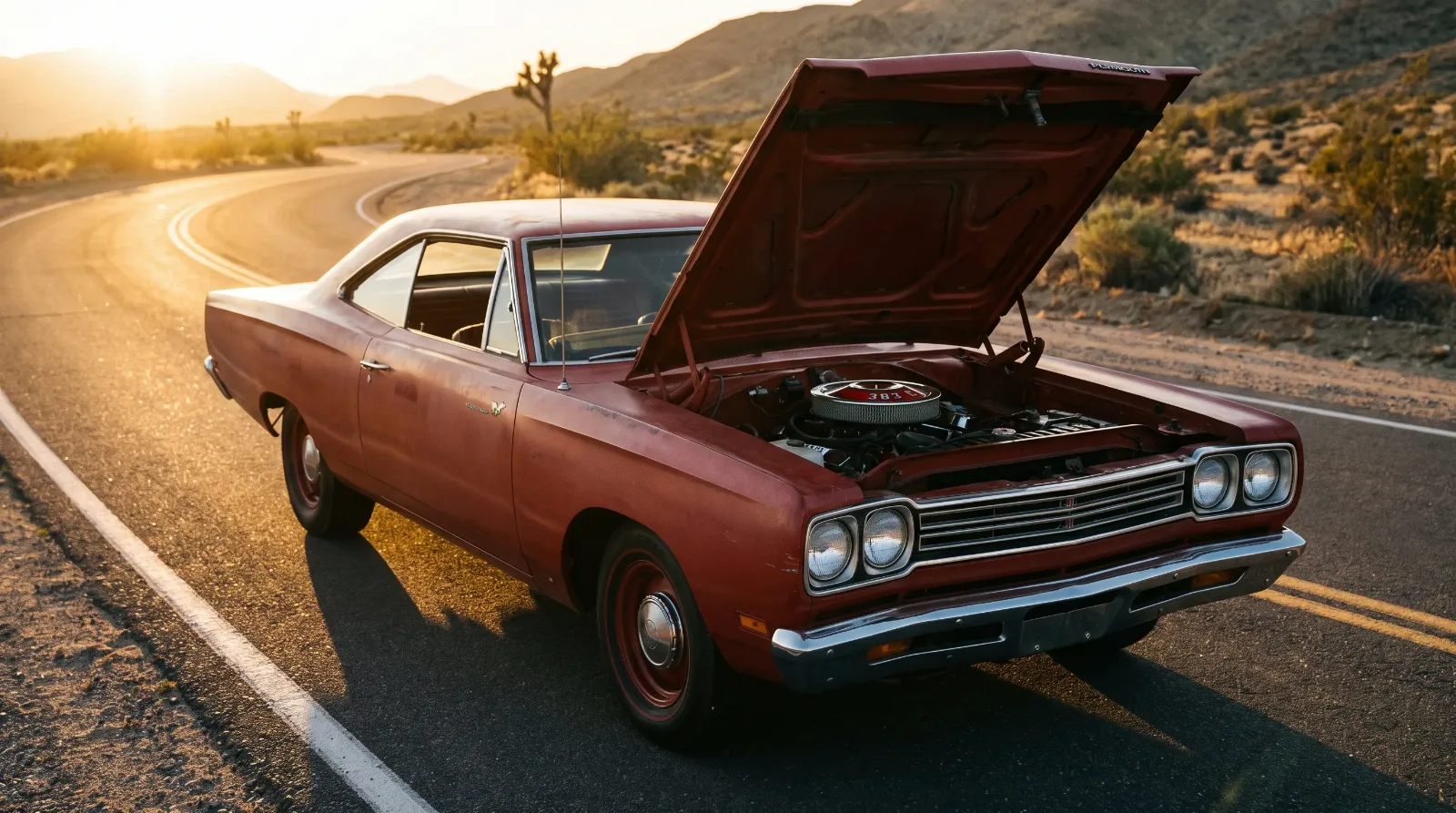
Plymouth rated the standard 383 cubic inch V8 at 335 horsepower for the 1968 Road Runner, using a specific high-performance camshaft and cylinder head combination borrowed from the company's other big-block applications, not a detuned version pulled from a family sedan. That distinction gets lost in casual conversation. This was not a "big engine, low output" arrangement meant to satisfy a spec sheet requirement. It was a genuinely strong engine, built to move a light car fast, sitting under the hood of the cheapest model in the lineup.
Compare that to the base 383 offered in other Plymouth models the same year, which ran lower compression and a milder cam for smoother street manners. The Road Runner's version got the aggressive cam, larger exhaust manifolds, and a dual-plane intake tuned for output over refinement. Buyers paying under $2,900 got an engine with real teeth, not a watered-down placeholder waiting for someone to check the Hemi option box.
Why Plymouth made the 383 standard instead of optional
The math is simple. A 426 Hemi added significant cost and required a stiffer suspension, better brakes, and a heavier-duty drivetrain to handle the power, all of which pushed the price up fast. Plymouth needed a standard engine that delivered real performance without dragging the base price toward GTO territory. The 383 did that job. It gave the car legitimate quarter-mile numbers straight off the showroom floor, no options required, which meant the marketing claim of a genuinely fast car under $2,900 was not an asterisk. It was true on the base model.
Independent magazine testing in period generally put the 383 Road Runner in the low-to-mid 15 second quarter mile range, with Car Life recording times between 14.90 and 15.55 seconds, which was competitive with cars costing hundreds more. That gap between price and performance is the entire reason this car sold as well as it did.
| Spec | 1968 Road Runner 383 |
|---|---|
| Displacement | 383 cubic inches |
| Horsepower rating | 335 hp |
| Torque rating | 425 lb-ft |
| Standard transmission | Four-speed manual |
| Optional transmission | TorqueFlite automatic |
The Hemi gets the headlines, the 383 gets the credit
People assume the Hemi Road Runner was the version that made the car famous. Backward. The Hemi option was expensive, rare, and bought by a small slice of customers chasing maximum bragging rights. The 383 was the car most people actually drove home, and it's the 383 that proved Plymouth's whole thesis, that a stripped-down car with a strong standard engine could outsell a loaded competitor. Numbers don't lie. The 383 cars vastly outnumber Hemi cars in original production, and that ratio tells you which engine actually did the heavy lifting for the nameplate's reputation.
"People love talking about the Hemi option because it's rare and it's fast. Fine. But the 383 sold this car by the tens of thousands. If you want to understand why the Road Runner worked, look at the engine most buyers actually chose, not the one that gets the magazine covers."
- Dan Reeves
How the 383 compared against the competition's standard engines
Line up the Road Runner's standard 383 against what Pontiac, Chevrolet, and Ford were putting under the hood of their own base-model performance cars in 1968, and the comparison favors Plymouth more often than not. A base GTO ran a 400 cubic inch engine rated at 350 horsepower, which sounds like an edge on paper until you factor in the Road Runner's lighter overall weight thanks to its stripped trim. Power to weight, not raw horsepower alone, is what actually determines how a car performs in a straight line, and the Road Runner's combination of a strong 383 and a lighter body closed that gap more than the raw numbers suggest.
This is the detail that gets lost when people compare muscle cars purely by cubic inches or horsepower rating on a spec sheet. Plymouth's engineers understood that a lighter car with a genuinely strong engine could outrun a heavier car with a slightly bigger one, and the 383 Road Runner's real-world performance backed that thinking up on the street and at the track.
What it means for buyers today
A numbers-matching 383 car is not the six-figure auction star a documented Hemi car can be, but it is the more honest representation of what this model actually was in 1968. Values on well-documented 383 Road Runners have climbed steadily as the broader muscle car market has matured, and buyers who want a genuinely usable, genuinely quick classic without chasing Hemi-level money tend to land on the 383 as the smart choice. Where this started covers the full context of how the model launched and where the 383 fit into that plan.
If you're shopping, classic Runner for sale listings will show you the price gap between 383 and Hemi cars clearly, and for most buyers the 383 remains the more sensible entry point into Road Runner ownership.
Documentation matters as much as displacement
A numbers-matching 383 in a Road Runner is only worth what a buyer can prove, and that is where a lot of deals fall apart at inspection time. Broadcast sheets, fender tags, and casting numbers on the block itself all factor into confirming whether the engine currently under the hood is the one that left the factory with that specific car, and sellers who can produce clean documentation on a 383 car tend to get meaningfully stronger offers than sellers relying on word of mouth about a car's history. Given how many engine swaps happened over the decades, sometimes for performance reasons and sometimes because an original engine simply wore out and got replaced with whatever was on hand, a documented numbers-matching 383 has become its own distinct category within the market, separate from an undocumented but period-correct replacement.
That distinction did not matter much to the original 1968 buyer, who just wanted a fast car for cheap money. It matters enormously to today's collector, and it is one of the clearer examples of how a car's original value proposition and its current collector value proposition can diverge over fifty years without the car itself changing at all.
The bottom line on the standard engine
The 383 was never the underdog engine. It was the engine that made the entire concept work. Strip the trim, keep the power, price it right. That formula depended on the 383 delivering real performance without pushing the sticker price up, and it did exactly that. The 1968 road runner 383 deserves credit as the engine that actually built this car's legend, not just the engine that came before the Hemi upgrade on the order form.
Sources and notes
Related Reading
Have a
Plymouth Road Runner
for Sale?
Reach thousands of serious classic car collectors across the US.
Sell It Here →
Are You a Classic Car Dealer?
List your full inventory and connect with targeted classic car buyers.
Join as a Dealer →
#muscle car engines
#Plymouth Road Runner
#Mopar big block
#383 V8
#1968 Road Runner
#1968 road runner 383

About the author
Dan Reeves
Performance engine builder from North Carolina's motorsports corridor, focused on swaps, forced induction and making real, repeatable power.
Related Listings - Plymouth Road Runner

Comments
Be the first to comment on this article.