
Picture a stoplight somewhere in suburban Detroit in the summer of 1969. Two cars pull up side by side, one wearing Plymouth's cartoon bird badge, the other carrying Dodge's stinger and bumblebee stripe. Same corporation, same basic B-body underneath, same 383 or 440 wedge under the hood in a lot of cases, and yet the two drivers waiting for the light to change would have told you, without a second of hesitation, that they were driving completely different cars. That argument, road runner vs super bee, played out at a thousand stoplights that summer and still gets argued today at car shows where owners of each park a little too close to each other on purpose.
Car Features
7 min read
1969 Road Runner vs Super Bee
The road runner vs super bee rivalry pitted two nearly identical Chrysler B-bodies against each other, separated more by badge and attitude than performance.
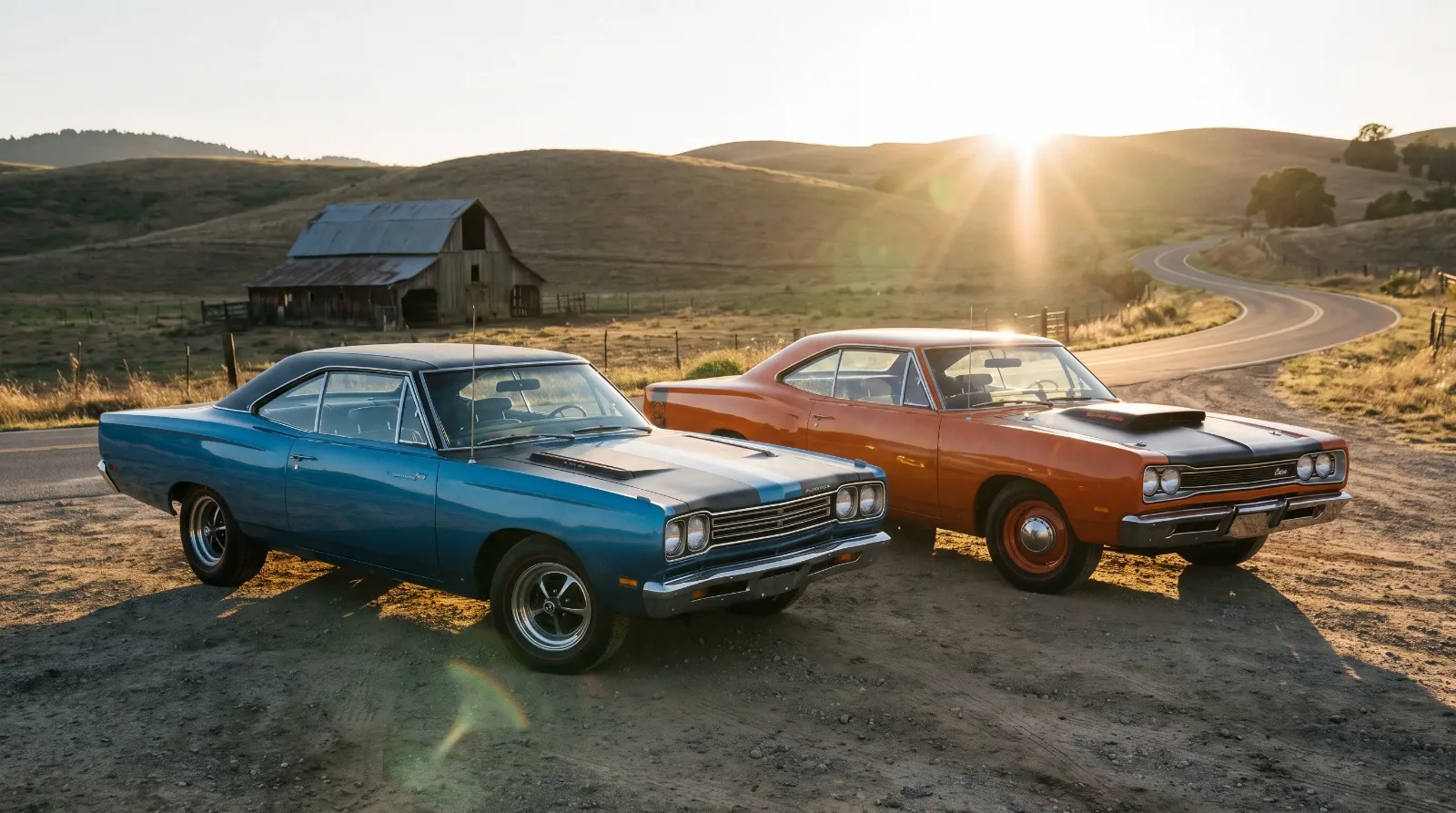
Two badges, one corporate playbook
Plymouth and Dodge built the Road Runner and Super Bee for the same basic reason: undercut the flashier, more expensive GTX and Charger R/T with a stripped down, honestly priced muscle car aimed at a younger buyer who wanted maximum performance for minimum money. Both cars shared Chrysler's B-body platform, both offered the 383 as a standard engine with the 440 and eventually the Hemi as options, and both leaned on cartoon inspired branding, the Road Runner licensed straight from the Warner Bros character, the Super Bee built around Dodge's own bumblebee stripe graphic and winged badge.
The corporate logic behind building two nearly identical cars under different brands was straightforward. Chrysler wanted Plymouth and Dodge dealers each fighting for the same budget muscle car buyer without those buyers simply cross shopping a single showroom. It worked well enough that both cars sold strongly, but it also guaranteed the two nameplates would spend the next several decades being compared directly against each other by anyone weighing a purchase.
| Category | Road Runner | Super Bee |
|---|---|---|
| Brand | Plymouth | Dodge |
| Platform | Chrysler B-body | Chrysler B-body |
| Standard engine | 383 cid V8 | 383 cid V8 |
| Big block option | 440, mid year 440 Six Barrel (A12) | 440, 440 Six Pack option |
| Branding hook | Warner Bros cartoon license, horn beep sound | Bumblebee stripe, winged badge |
Where the two cars actually diverged
Despite the shared bones, the two cars did not feel identical to period buyers, and the differences went beyond badges. The Road Runner leaned hard into its cartoon licensing, right down to a horn that mimicked the character's beep beep sound effect, a novelty that became one of the car's most talked about features and something Dodge never tried to replicate on the Super Bee. That choice made the Road Runner feel a little more playful, a little more willing to lean into its own absurdity, while the Super Bee carried itself with a slightly more straightforward muscle car attitude built around the stripe graphic and the winged bee badge rather than any licensed character gimmick.
Body style timing also separated the two nameplates in 1969 specifically. Plymouth expanded the Road Runner lineup that year to include a new pillarless hardtop and a new convertible alongside the original coupe, while Dodge's Super Bee lineup followed its own separate development path on the Coronet platform. Buyers cross shopping the two in showrooms in 1969 were not always comparing identical body style choices side by side, which matters when weighing survivor examples and restoration projects against each other today.
The stoplight argument, then and now
Straight line performance between comparably equipped Road Runners and Super Bees ran close enough that period magazine tests rarely crowned one nameplate a decisive winner over the other with matching engines and gearing. What separated buyers in 1969, and still separates owners at shows today, came down to badge loyalty, styling preference, and which cartoon or graphic language spoke to a given buyer more directly. Enthusiasts who grew up on the Road Runner cartoon gravitated toward Plymouth's version. Buyers who wanted their stripe package to look a little more aggressive and a little less cartoonish tended to land on the Super Bee.
That preference split has aged into something closer to friendly rivalry within the wider Mopar community than any genuine performance gap, since both cars pull from the same parts bin and the same fundamental engineering. Show up to any major Mopar gathering today and you will find both nameplates parked in the same rows, their owners trading good natured jabs about horn sounds and stripe graphics while agreeing completely on everything that actually matters, namely that both cars represent the same era's best expression of a stripped down, honestly built muscle car.
"Nobody who actually owns one of these cars really believes the other one is worse. It is more like a sibling rivalry, the kind where you will defend your own car to the death in an argument but secretly respect the other guy's choice completely."
- Patrick Walsh
What the parts bins tell you about the rivalry
Spend time under either car on a lift and the shared parentage becomes obvious fast. Suspension components, much of the drivetrain, and plenty of interior hardware interchange directly between a 1969 Road Runner and a Super Bee of the same model year, a reality that restoration shops working on both nameplates rely on constantly when original badge specific parts run short. That parts commonality is not a knock against either car. It is simply what happens when one corporation builds two versions of essentially the same engineering answer for two different retail networks, and it means owners of either nameplate benefit from a combined parts ecosystem larger than either badge could support entirely on its own. The real separation between the two, badge design, interior trim details, and marketing language, sits almost entirely above the frame rails rather than below them.
Why the comparison still matters to buyers today
For anyone shopping the used market now, the Road Runner versus Super Bee decision often comes down to personal taste and regional availability more than any hard performance distinction, since both cars share enough mechanical DNA that a well sorted example of either delivers a similar driving experience. What differs more meaningfully is the depth of documentation and parts support each nameplate's dedicated enthusiast community has built up over the decades, along with the simple emotional pull of one badge over the other for a given buyer.
Readers wanting the deeper context on how the Road Runner side of this rivalry reached its high point should look at the 1969 plymouth road runner story, which covers the specific changes that made that model year the nameplate's commercial peak. For the origin of the whole concept, including how Plymouth landed on the idea in the first place, the full story traces the nameplate back to its earliest planning stages. And for buyers ready to move past the debate and actually shop, you can browse classic Runners on the market to see how today's asking prices reflect this decades old rivalry between two cars built by the same corporation to fight over the exact same customer.
Sources and notes
Related Reading
Have a
Plymouth Road Runner
for Sale?
Reach thousands of serious classic car collectors across the US.
Sell It Here →
Are You a Classic Car Dealer?
List your full inventory and connect with targeted classic car buyers.
Join as a Dealer →
#Plymouth Road Runner
#1969 muscle cars
#Dodge Super Bee
#B-body
#muscle car comparison
#Mopar rivalry

About the author
Patrick Walsh
Automotive journalist covering classic car shows, events, and the enthusiast community across North America.
Related Listings - Plymouth Road Runner




Comments
Be the first to comment on this article.