
Plymouth built the Road Runner to be cheap and mean, and nowhere does that mission show up more plainly than inside the 1969 road runner interior. Beep-beep horn aside, this was a car stripped of pretense from the factory floor. Plymouth's product planners had one directive for the cabin: keep the price under three thousand dollars while giving buyers a 383 or bigger under the hood. Everything you sat in, gripped, or looked at was a consequence of that math.
Car Features
7 min read
The 1969 Road Runner Interior
The 1969 Road Runner interior was built for durability, not luxury, and that stripped down honesty is exactly what collectors chase today.
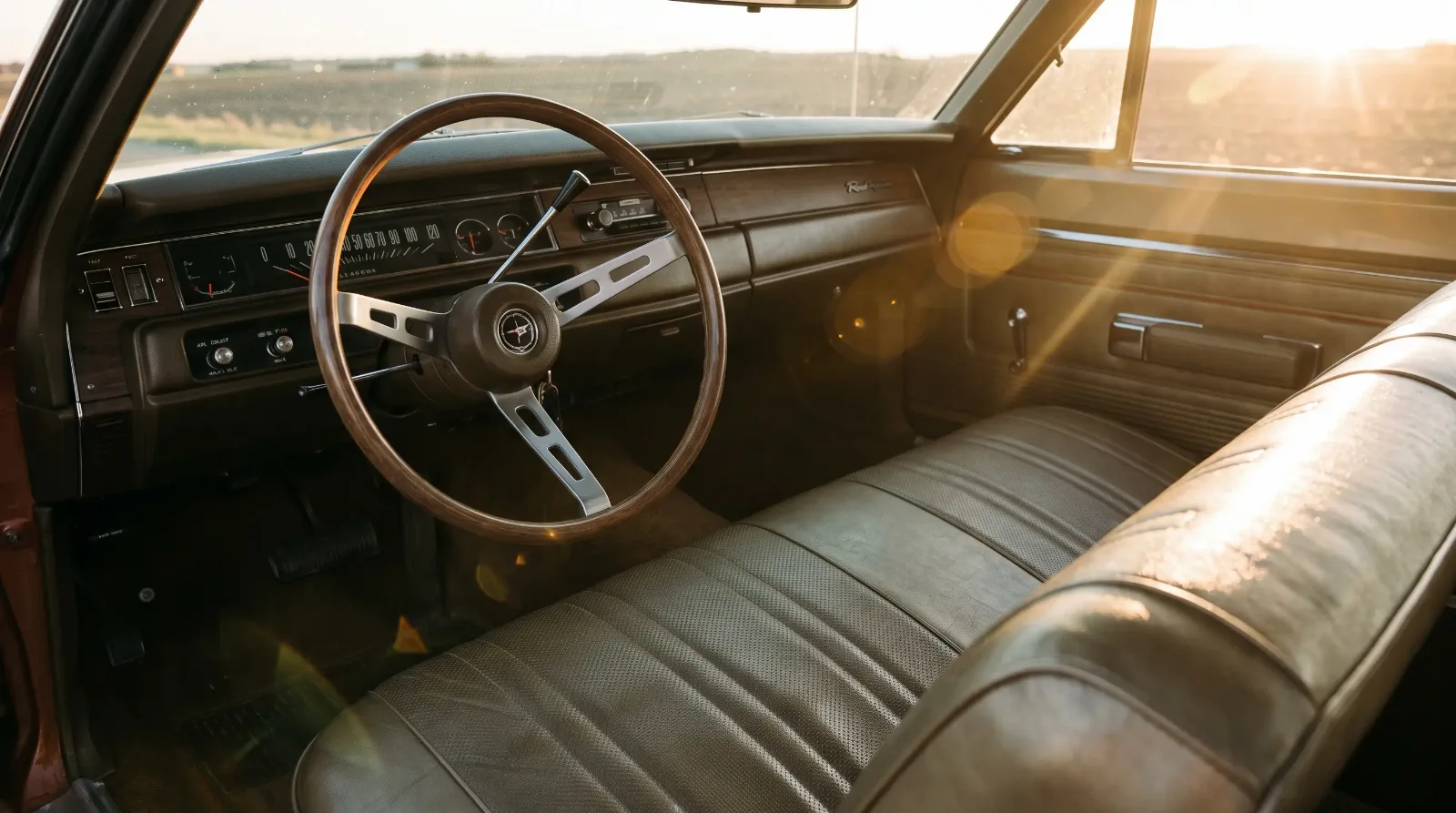
A cabin built by a spreadsheet, not a stylist
Chrysler's B-body interior for 1969 started life as a shared architecture across the Belvedere, Satellite, and GTX. The Road Runner got the same basic dash, the same door panels, and the same bench or bucket seating options as its corporate siblings. What set it apart was what Plymouth left out. Sound deadening was minimal. Carpet was standard but thin. Sun visors, a day/night mirror, and dual horns were about as fancy as the base trim got before a buyer started checking option boxes.
The standard front bench, done in a durable vinyl, was the default seating and most cars left the factory that way. Bucket seats were available as an option, part of a console package that also brought a floor shifter for the four speed or TorqueFlite automatic. Plymouth's own marketing leaned into the contradiction: a car built to look and feel basic, wearing a 383 or 440 that made the rest of the industry nervous.
The dash and the gauges Plymouth left on the shelf
Instrumentation followed the same logic as the seats. The standard dash carried a speedometer and not much else, a design choice that annoyed enthusiasts even in period. Plymouth offered a rally gauge cluster as an option, adding oil pressure, water temperature, and an ammeter to a car that, with a 440 under the hood, arguably needed them more than most. Buyers who skipped that box got a warning light setup instead, which is part of why so many surviving base cars show later owner-installed gauges tucked under the dash.
Steering wheels ranged from a plain two spoke unit to an optional rim blow wheel, where the driver honked the horn by squeezing the wheel's rim rather than hitting a center pad. It was a novelty Chrysler pushed across several 1969 models, and it shows up often enough on Road Runners to be considered period correct rather than rare.
Trim colors and the vinyl that actually held up
Interior color choices for 1969 ran through the usual late sixties Chrysler palette, black, blue, red, and a few greens and gold tones depending on production timing. Vinyl was the default material almost everywhere in the car, chosen as much for durability under hard use as for cost. These were cars bought by young men who intended to drive them hard, and Plymouth's engineers built the cabin to survive that intention. Door panels used a molded vinyl with minimal brightwork, another line item trimmed to keep the base price down.
Carpet color was tied to interior trim rather than exterior paint, which occasionally produces combinations that look jarring to modern eyes but were entirely factory correct. Restorers chasing period accuracy still reference build sheets and broadcast sheets closely here, since reproduction interior kits vary in how faithfully they match original dye lots.
"People assume a muscle car interior means gauges everywhere and a wheel wrapped in leather. The 1969 Road Runner proves the opposite. Plymouth spent its money on the engine bay and made the cabin do the least amount possible, and that restraint is exactly what collectors now go looking for when they want an honest, unmolested example."
- Tom Ramirez
Options that quietly moved a lot of cars
Air conditioning was technically available but rarely ordered, since it competed for space and cooling capacity with the big block engines buyers actually wanted. Power steering and power brakes were common additions, given the weight sitting over the front wheels with a 440 installed. An AM radio was standard on many build combinations, with an AM/FM or an AM with a rear speaker as step up choices. None of it was luxury. All of it was function, dressed in as little chrome as Plymouth could get away with.
For buyers who want the specifics on how the 1969 model year fits into the car's broader story, including engine choices and production numbers, the full story covers the year in depth.
Why the plain cabin matters to collectors now
Decades later, that stripped down cabin has become part of the car's appeal rather than a mark against it. Unrestored, numbers matching interiors with their original vinyl and dash pads command real premiums at auction because so many were replaced or upgraded over the decades. A basic bench seat interior in good original condition is, ironically, rarer today than one with the console and bucket seat option, simply because base cars were driven harder and discarded sooner.
Buyers chasing an honest example should look closely at seat foam, dash pad cracking, and whether the door panels match the factory build sheet before assuming a car is original. Reproduction parts have improved, but subtle details like stitch pattern and vinyl grain still separate a correct restoration from a close approximation. Anyone shopping the market seriously can find a classic Runner for sale and compare interior condition firsthand against what the build sheet claims.
What a build sheet actually tells you
Original broadcast sheets and fender tags carry codes for seat type, trim color, and console presence, and these documents have become as important to serious buyers as the title itself. A code that reads out to a black vinyl bench with no console should match the car sitting in front of you, right down to the absence of a floor mounted shifter boot. Sellers who cannot produce this paperwork are not automatically hiding something, since plenty of cars lost their sheets decades ago, but a documented match removes a lot of guesswork from a purchase decision.
Restoration shops that specialize in B-body Mopars keep reference libraries of factory colors and material codes precisely because the differences between correct and close are small but visible once you know what to look for. Stitch count on seat covers, the depth of the door panel's molded pattern, and even the specific gray used on factory carpet padding all vary by supplier and year. None of it is dramatic. All of it separates a car worth a premium from one that merely looks the part.
The bottom line on a purposeful cabin
The 1969 Road Runner interior was never meant to impress anyone standing still. It was meant to survive a driver who planned to use every one of the engine's horsepower, week after week, without complaint. That single minded focus on durability over decoration is precisely why the cabin still reads as honest today, and why collectors who understand the car's original mission treat a correct, unmolested interior as one of the strongest indicators of authenticity on the whole car.
Sources and notes
Related Reading
Have a
Plymouth Road Runner
for Sale?
Reach thousands of serious classic car collectors across the US.
Sell It Here →
Are You a Classic Car Dealer?
List your full inventory and connect with targeted classic car buyers.
Join as a Dealer →
#factory documentation
#classic car collecting
#Plymouth Road Runner
#muscle car interiors
#mopar b-body
#1969 Road Runner

About the author
Tom Ramirez
Corvette researcher and historian based in Bowling Green, Kentucky. Two decades documenting Corvette production history from original factory records.
Related Listings - Plymouth Road Runner
Comments
Be the first to comment on this article.