
There is a particular kind of quiet that falls over a swap meet table when someone sets down an original, unfaded Road Runner decal still in its factory backing paper. Collectors lean in. Somebody always asks the price first and regrets it second, because the seller usually already knows what they have. The road runner decals badge on a Plymouth is small, cartoonish, and worth more attention than its size suggests, because it is the one piece of the car that came from a movie studio instead of a stamping plant.
Car Features
7 min read
The Cartoon Bird Decals and Badging
Plymouth licensed a Looney Tunes character for its cheapest muscle car. The road runner decals badge became one of the most recognizable pieces of automotive branding of its era.
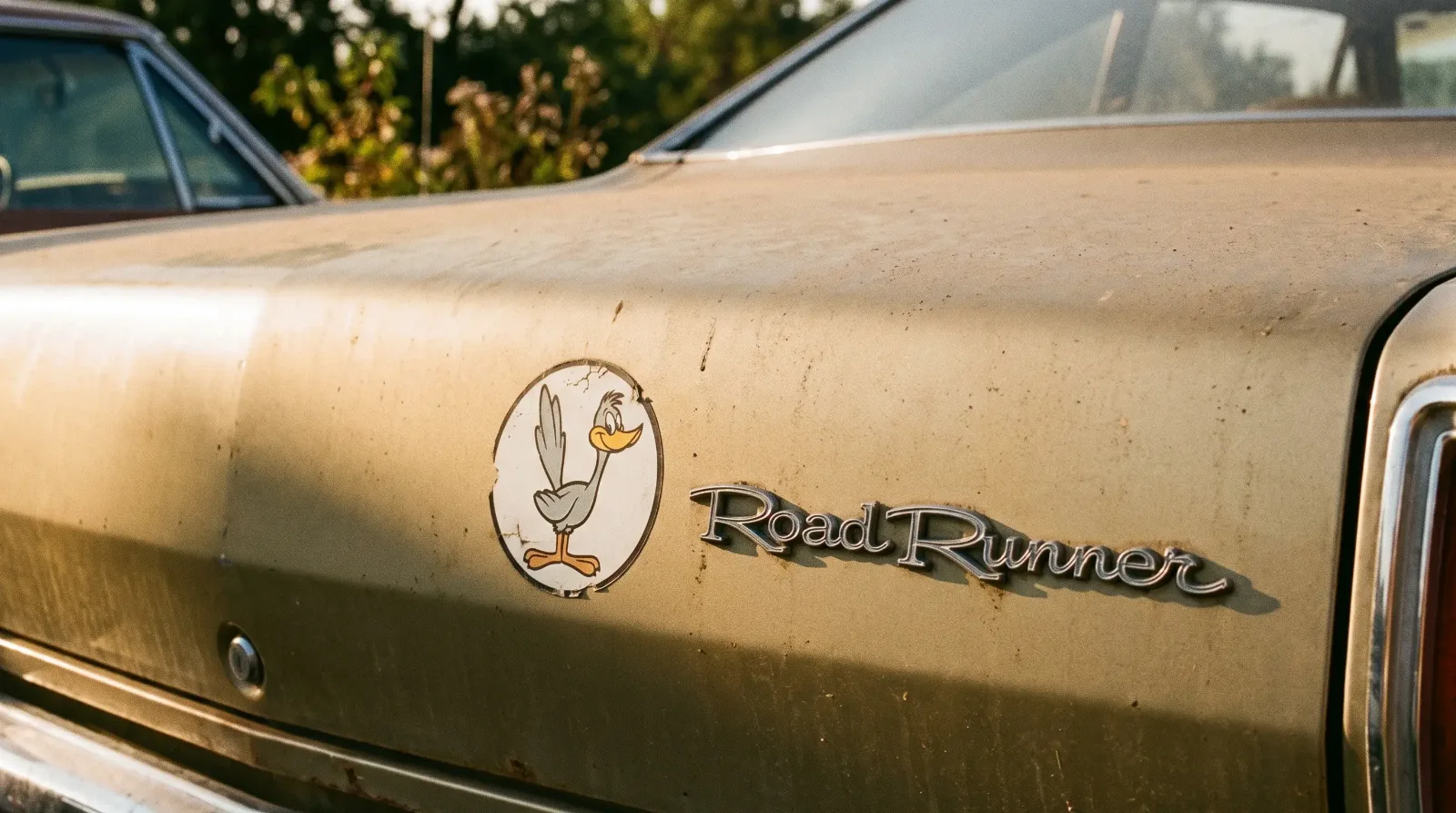
Plymouth licensed the Road Runner character from Warner Bros in 1967, paying a fee reported at $50,000 for the rights to use the bird's name and likeness, plus a separate $10,000 to engineer the "beep beep" horn. That single decision turned a cheap muscle car program into something closer to a piece of pop culture merchandise, years before automakers thought seriously about licensing cartoons for anything.
A bird nobody expected on a Chrysler product
Warner Bros animator Chuck Jones had built the Road Runner cartoon character around a joke that never got old: the bird always escapes, the coyote always fails. Plymouth's product planners wanted a name and an identity that promised speed without pretension, and the cartoon fit almost too well. The decal itself, a simplified running silhouette of the bird against a plain background, appeared on the trunk lid, the doors, sometimes the dash, depending on the model year and the options ordered.
The badge also carried a job the character never had in the cartoons: it had to survive years of sun, wax, and parking lot dings while still reading clearly from thirty feet away. Chrysler's design studio simplified the Looney Tunes artwork into a version clean enough to stamp, mold, and reproduce at scale, which is part of why the decal looks slightly different from the character as most people remember it from Saturday mornings.
Where the badges actually lived on the car
Badge placement shifted across the Road Runner's run, and that variation is exactly what makes decal research so tangled for restorers and judges today. Early 1968 cars carried the bird primarily on the trunk lid and the front fenders. Later years added steering wheel horn button graphics, dash emblems, and even seat upholstery patterns that referenced the character in stitched outline. Every generation of the car found a new place to put the bird, which meant every generation also created a new set of reproduction parts for the aftermarket to eventually get wrong.
- Trunk lid decal, present across nearly every model year in some form
- Front fender badges, chrome-bordered on most trims
- Horn button graphic tied to the beep option
- Dash and glovebox emblems on higher trim variants
- Optional seat fabric patterns referencing the running bird motif
Why originality matters more than most people assume
A reproduction Road Runner decal, bought new today, looks close enough to fool a casual glance. It rarely fools a judge at a serious show, and it almost never fools a buyer who has handled the real thing. Original decals from the correct model year carry specific print registration, ink density, and backing material that reproduction houses have chased for decades without perfectly nailing every variant.
That gap matters financially. A numbers-matching car with its original, correctly dated decals intact commands a premium over an identical car wearing modern reproductions, even when the reproduction is visually convincing. Buyers researching the 1968 plymouth road runner story quickly learn that the badge is treated almost like a matching-numbers component in its own right among serious collectors, not just a cosmetic detail.
"People think they're buying a car and forget they're also buying a piece of licensed cartoon art from 1967. The decal is small. The story behind it is not."
- Nora Beckett
The badge as a cultural artifact, not just a car part
What makes the road runner decals badge worth a story of its own is how far outside the automotive world its influence traveled. Kids who never sat in a Road Runner recognized the bird from television before they ever saw the car. Parents who bought the car sometimes did so because their children begged for "the beep beep car," a marketing effect Chrysler could not have manufactured through a traditional ad campaign no matter the budget. The badge did work that no chrome trim package or performance number could do on its own: it made the car recognizable to people who had never opened a spec sheet.
Sources and notes
- Plymouth Road Runner - Wikipedia
- The $50,000 Secret Hidden In Every Road Runner's Horn - HotCars
- How The Plymouth Road Runner Pack's Beep Beep Horn Works - HotCars
- How The Legendary Plymouth Road Runner Got Its Name - SlashGear
- 10 Facts About The Plymouth Road Runner - HotCars
That crossover appeal is also why the badge survives so strongly in the collector market's imagination decades later. A stripped, cheap coupe with a cartoon bird on the trunk became one of the most instantly identifiable American cars of its era, and the badge did most of that identity's heavy lifting. Anyone tracing the full story of the nameplate eventually has to talk about the Looney Tunes deal, because the car's entire personality was built around a joke about a bird nobody could catch.
How the aftermarket learned to reproduce the bird
By the time restoration culture matured in the 1980s and 1990s, demand for correct reproduction decals had grown enough to support several dedicated suppliers, each chasing the exact print registration and material feel of the originals. Early reproductions from that first wave often missed subtle details, a slightly wrong ink saturation, a backing material that peeled differently than factory stock, or proportions stretched just enough to bother a trained eye at a show.
Later suppliers improved considerably, working directly from surviving factory samples and period documentation rather than guessing from faded photographs. Even so, a gap remains between the best modern reproductions and genuine survivor decals, and that gap is part of why originals still draw premium prices whenever a documented, unused set surfaces at a swap meet or an estate sale.
Finding one to own today
Collectors chasing an original badged car should expect the decal condition to factor into price discussions the same way paint and interior condition do. A tired repaint with correct decals can be more desirable to a purist than a fresh repaint wearing the wrong reproduction pattern. If you are shopping rather than researching, you can browse classic Runners on the market and start comparing badge condition alongside the usual mechanical checklist.
When I write about these cars, I keep coming back to how much personality a two-inch decal can carry. A muscle car badge usually just states a name and a displacement number. This one told a joke, and the joke landed with an entire generation of buyers who grew up watching the same cartoon on Saturday mornings before they ever sat behind a wheel.
The bird on the trunk lid was never just decoration. It was Plymouth borrowing a cartoon's entire personality, betting that buyers would rather laugh at their car's name than be impressed by it, and winning that bet decisively enough that the badge outlived the production run by more than half a century.
Related Reading
Have a
Plymouth Road Runner
for Sale?
Reach thousands of serious classic car collectors across the US.
Sell It Here →
Are You a Classic Car Dealer?
List your full inventory and connect with targeted classic car buyers.
Join as a Dealer →
#car collecting
#Plymouth Road Runner
#muscle car decals
#Chrysler history
#Warner Bros license
#Road Runner badge

About the author
Nora Beckett
Automotive features writer and photographer who tells the human stories behind the cars, from show fields to cross-country road trips.
Related Listings - Plymouth Road Runner
Comments
Be the first to comment on this article.