
In early 1958, Motor Trend magazine handed its Car of the Year award to a Thunderbird that barely resembled the car Ford had been building for the previous three seasons. The 1958 Thunderbird Motor Trend recognition was not a nod to a facelift. It was an acknowledgment that Ford had reinvented the car from the ground up, at real financial risk, and gotten it right on the first attempt. The production records back up how deliberate that reinvention was, and they are worth walking through in detail because so much of the popular telling gets the sequence wrong.
Car Features
6 min read
The 1958 Thunderbird: Motor Trend Car of the Year
How a completely reengineered unibody Thunderbird won Motor Trend Car of the Year and proved Ford's four-seat gamble right.
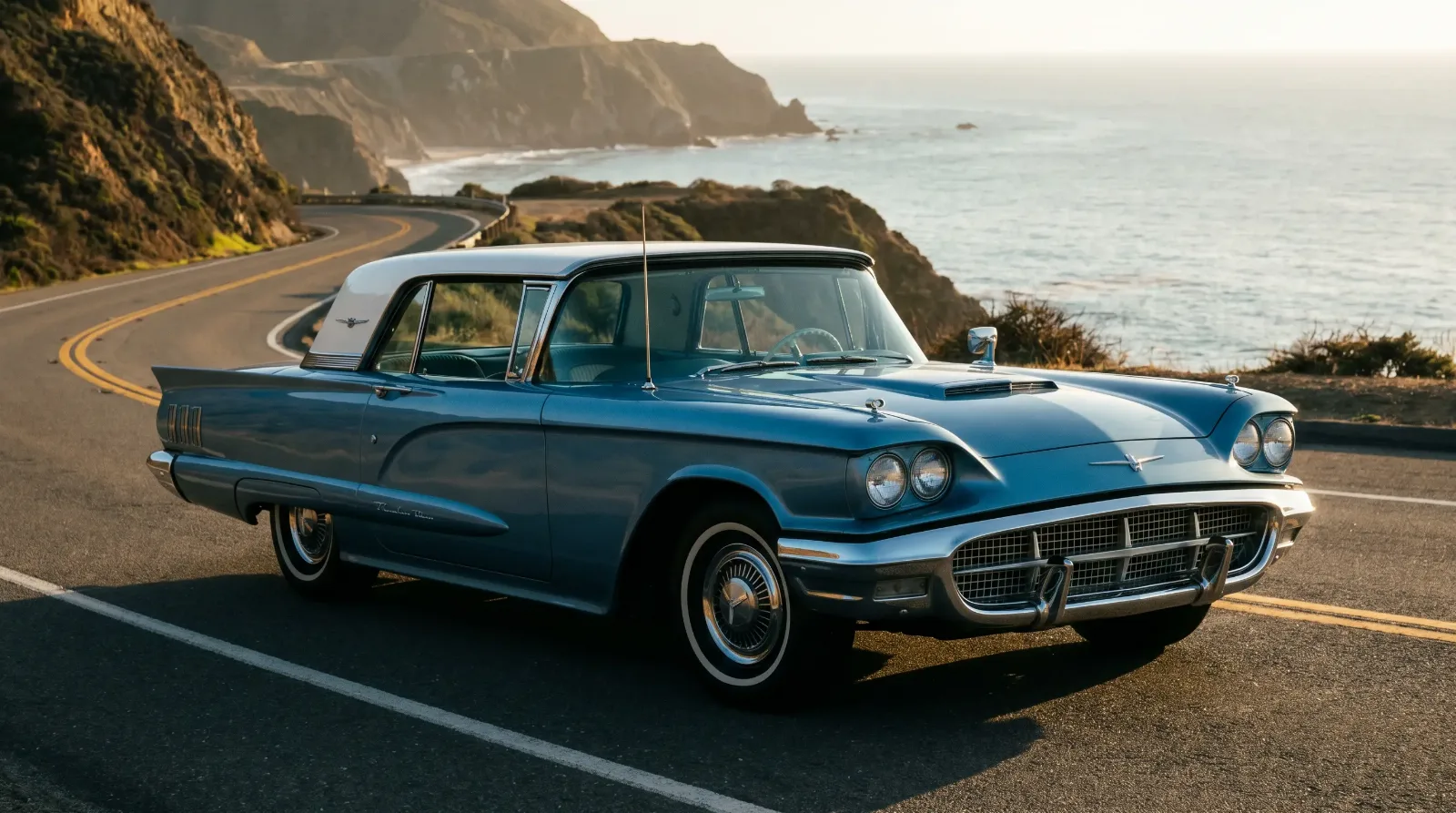
A car built from a completely different set of drawings
The 1958 Thunderbird shared almost nothing with the 1957 model beyond the name and the general idea of a Ford personal car. Engineers under Bill Boyer's styling direction stretched the wheelbase from 102 inches to 113 inches, widened the track, and switched the body to unibody construction, a first for the model. The car grew from a tight two-seat package into a genuine four-seat coupe or convertible, with the back seat treated as a real design priority rather than an afterthought bolted onto an existing platform.
Production records show Ford committed serious tooling money to this change well before 1957 sales figures were finalized, which tells you the decision to expand the Thunderbird into a four-seat car was made on projected demand, not panic. That gamble is documented in more detail in a related story about how Ford doubled the Thunderbird's seating and why the company was willing to bet on it.
What Motor Trend actually judged
Motor Trend's Car of the Year award in this era was not a performance trophy. The magazine's staff weighed engineering ambition, manufacturing execution, and how well a new design served the market it targeted. The 1958 Thunderbird checked every box. It was a genuinely new unibody structure built at high volume without the reliability disasters that sometimes accompanied a manufacturer's first unibody attempt. It offered features that felt genuinely upscale for a Ford-badged product, including available power windows, a swing-away steering wheel option that arrived a few years later, and an interior that read closer to a Lincoln than a Fairlane.
The judges also noted that Ford had managed to make a bigger, heavier car without losing the visual identity that made the Thunderbird recognizable. The 1958 car kept the low, wide stance and the character-line details that tied it back to the two-seater, even while the underlying engineering was completely different.
| Spec | 1957 Thunderbird | 1958 Thunderbird |
|---|---|---|
| Wheelbase | 102 in | 113 in |
| Seating | 2 | 4 |
| Construction | Body-on-frame | Unibody |
| Base engine | 292 V8 | 352 V8 |
| Model-year production | 21,380 | 37,892 |
Ford also had to solve a manufacturing problem most competitors never attempted at this scale. Unibody construction meant the entire structural strength of the car came from the stamped body panels themselves rather than a separate ladder frame, which demanded much tighter tolerances on the stamping line and a welding process that had to hold up under years of road vibration without cracking. General Motors and Chrysler were both still building body-on-frame personal cars in this size class, and Ford's willingness to commit an entire high-volume model to unibody construction, on the first attempt, is part of what impressed Motor Trend's staff. A failure here would have meant recalls, warranty claims, and a public relations disaster during a recession year when Ford could least afford one.
The engine behind the award
The standard engine for 1958 was Ford's 352 cubic inch V8, rated at 300 horsepower, a meaningful step up in displacement from the outgoing 292 and 312 options. Buyers who wanted more could order the FE-series engine with a factory tune aimed at stronger low-end torque, better suited to a heavier car carrying four passengers than the previous two-seater's engines had been. The extra weight of the unibody structure and the longer wheelbase meant Ford genuinely needed the additional displacement just to keep performance from sliding backward, and the engineering team hit that target without sacrificing the smooth, quiet ride that personal luxury buyers expected.
Sales proved the judges right
Awards are opinions until the sales floor confirms them. The 1958 Thunderbird moved 37,892 units for the model year, nearly double what the best two-seat year had managed, and it did this during a recession that hurt most of the American auto industry that same season. Ford had bet that a four-seat personal luxury car would find a bigger audience than a two-seat sports coupe, and the Motor Trend award landed in the same window that proved the bet correct at the cash register, not just in a magazine's judging room.
Interior fit and finish also factored into the judging. Ford trimmed the 1958 Thunderbird with a padded dash, a wraparound instrument cluster angled toward the driver, and available options like a tilt-away steering wheel mechanism that arrived in updated form a couple of years later. Reviewers at the time compared the cabin favorably against cars costing considerably more, which mattered to Motor Trend's staff because the award was explicitly framed around value delivered for the price, not just raw engineering ambition on its own. A car that impressed on the test track but disappointed the moment a buyer sat inside it would not have taken home the trophy.
A recognition that shaped the category
The Motor Trend award mattered beyond bragging rights. It validated the entire personal luxury car category that the 1958 Thunderbird had effectively created, a segment that would eventually include cars like the Buick Riviera and the Oldsmobile Toronado. Ford's competitors took notice of a car that combined size, comfort, and style without pretending to be a sports car, and the industry spent the next decade chasing the formula the Square Bird had proven out.
For readers who want the full arc of the 1958 model, from the styling decisions through its place in Thunderbird history, our 1958 ford thunderbird history covers the complete story in one place.
"You do not accidentally win Car of the Year with a car that changes this much in one model cycle. Every dimension, every panel, the whole structure changed, and Ford still shipped it on schedule with no major reliability black eye. That is the part people forget to admire."
- Tom Ramirez
Six decades on, the factory paperwork still tells the clearest version of this story. Ford took a real risk on the 1958 Thunderbird, built it with more engineering discipline than the timeline should have allowed, and the Motor Trend Car of the Year award simply confirmed what the sales figures went on to prove for the rest of the model year. Anyone shopping the market today can find Thunderbirds for sale now that trace directly back to that pivotal redesign.
Sources and notes
- Automobile Catalog - 1958 Ford Thunderbird 352 Special V-8 Specs
- Squarebirds.org - 1958 Ford Thunderbird Specifications
- Ford Thunderbird (second generation) - Wikipedia
- Old Cars Weekly - Car of the Week: 1958-1960 Ford Thunderbirds
- Auto History Preservation Society - Ford 352 CID V-8: 1958-1966
- Over-Drive Magazine - 1958 Ford Thunderbird Fact Sheet
Related Reading
Have a
Ford Thunderbird
for Sale?
Reach thousands of serious classic car collectors across the US.
Sell It Here →
Are You a Classic Car Dealer?
List your full inventory and connect with targeted classic car buyers.
Join as a Dealer →
#motor trend car of the year
#personal luxury car
#thunderbird history
#square bird
#1958 thunderbird
#Ford unibody

About the author
Tom Ramirez
Corvette researcher and historian based in Bowling Green, Kentucky. Two decades documenting Corvette production history from original factory records.
Related Listings - Ford Thunderbird




Comments
Be the first to comment on this article.