
Ford's design and engineering records from 1963 document a deliberate break from the rounded, missile-nosed body that had defined the Thunderbird since 1961. The 1964 Thunderbird redesign replaced compound curves with sharp, rectilinear surfacing, a body change substantial enough that Ford treated it as a new generation rather than a facelift, even though the platform underneath carried forward more engineering continuity than the sheet metal suggests. This is a car built on a genuinely different design brief than its predecessor, and the production paperwork bears that out clearly.
Car Features
6 min read
The 1964 Thunderbird: The Crisp Redesign
Ford's 1964 Thunderbird redesign replaced the rounded Bullet Bird body with sharper, more formal styling, opening the Flair Bird generation with a strong production increase.
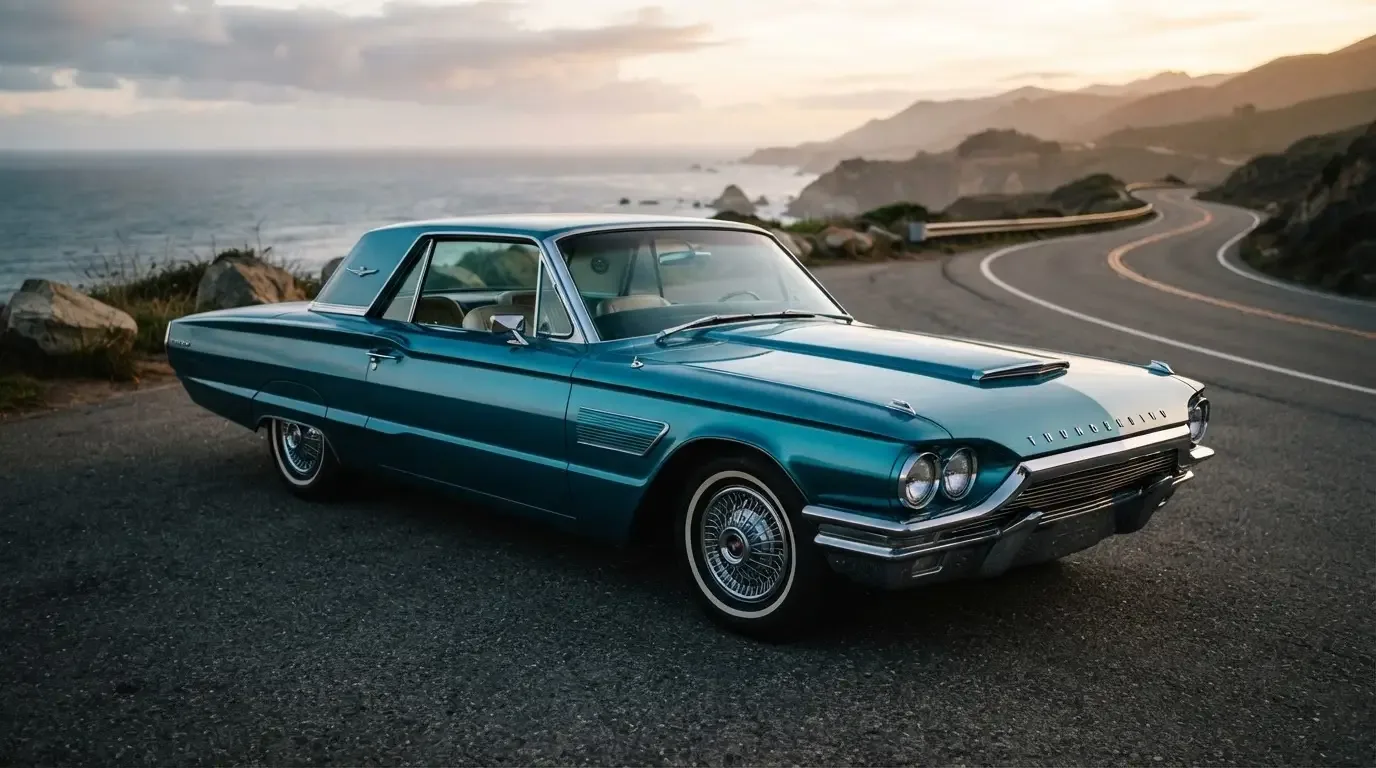
What actually changed for 1964
The most immediately visible shift is the beltline and roofline treatment. Where the Bullet Bird generation emphasized rounded surfacing and a tapered, pointed profile front and rear, the 1964 body introduced crisper creases along the fenders and a more formal, upright greenhouse. Ford's designers were responding to shifting tastes across the American market, where squared-off, more architectural styling was gaining ground against the rounded jet-age forms that had dominated the previous several years. The new car's rear end carried a distinctive concave panel housing the taillights, a detail that became one of this generation's signature identifiers and one that Ford would refine further in subsequent model years.
Underneath the new sheet metal, the 1964 Thunderbird retained a unibody structure similar in engineering philosophy to its predecessor, though Ford's build documentation shows meaningful revisions to the chassis to accommodate the new body's dimensions and to address specific durability concerns identified during the previous generation's production run. Wheelbase held at 113 inches, consistent with the prior two generations, which meant the redesign was primarily a surfacing and structural exercise rather than a fundamental change to the car's underlying proportions.
Engine and drivetrain carryover, with real updates
The 390 cubic inch V8 continued as the Thunderbird's standard engine for 1964, rated at 300 hp in its standard four-barrel configuration, a figure consistent with the prior generation's output. What did not carry forward was the Tri-Power M-code option that had defined the top of the Bullet Bird's engine lineup. Ford discontinued the triple-carburetor 390 for the Thunderbird with this redesign, a decision documented in period parts and options guides, leaving the standard four-barrel as the only 390 configuration available to Thunderbird buyers going forward.
Ford's engineering notes from the period indicate this decision reflected both cost considerations and a broader shift in how the Thunderbird was being positioned. The Tri-Power option had never sold in large numbers, and Ford's product planners appear to have concluded that a simpler, single-carburetor engine lineup better matched what the vast majority of Thunderbird buyers actually wanted: reliable, comfortable performance rather than a specialty high-output option most customers never checked on the order form anyway.
Interior changes documented in period materials
Ford's sales literature for 1964 emphasizes a redesigned dashboard that moved away from the wraparound cluster of the previous generation toward a more conventional, driver-focused instrument layout. The swing-away steering wheel option carried forward from the prior generation, remaining one of the Thunderbird's signature convenience features and continuing to draw attention in dealer demonstrations even though the novelty had worn off somewhat after three model years on the market.
Seating and trim options expanded modestly for 1964, with Ford's order guides listing additional upholstery combinations not offered on the outgoing generation. None of these changes represented a dramatic departure from what Thunderbird buyers had come to expect from the nameplate. Ford was refining the formula that had made the car successful rather than reinventing the ownership experience, even as the exterior styling underwent its most significant change since the original 1955 model's debut.
"The paperwork from Ford's own engineering department is pretty clear about what changed and what stayed the same for 1964. The body is new. A lot of what makes a Thunderbird a Thunderbird underneath it is not."
- Tom Ramirez
| Spec | 1964 Thunderbird |
|---|---|
| Wheelbase | 113 inches |
| Standard engine | 390 cid V8, four-barrel |
| Standard output | 300 hp |
| Tri-Power option | Discontinued for this generation |
| Body styles | Hardtop, Landau, convertible |
Production volume and what it tells us
Total Thunderbird production for the 1964 model year came in at 92,465 units across all body styles, a meaningful increase over the final year of the previous generation. That jump suggests the new styling connected with buyers immediately rather than requiring a model year or two to find its footing in the market, which was not guaranteed given how different the new body was from what Thunderbird buyers had grown used to since 1961. Ford's own sales reporting from the period treats the increase as validation of the redesign, and dealer order patterns from late 1963 show strong early interest in the new body style well before the first cars reached showroom floors.
The Landau hardtop, distinguished by its vinyl-covered roof and simulated S-bar trim, represented a significant share of that production total, reflecting where Ford's product planners believed the bulk of Thunderbird demand actually sat. Convertible production remained the smallest share of the three body styles, consistent with the pattern established in the prior generation, where the added cost and mechanical complexity of the automatic top limited convertible volume relative to the hardtop and Landau.
How this generation fits the broader Thunderbird story
The 1964 redesign opened what enthusiasts commonly call the Flair Bird generation, a name that describes the sharper, more angular design language introduced this year and carried forward with running changes through 1966. For the complete 1964 ford thunderbird history, including how the design evolved across the following two model years, that piece traces the full arc this article only introduces. Readers interested specifically in the safety and braking updates Ford introduced shortly after this redesign should also look at a related story covering the front disc brake option that arrived the following year.
Buyers researching this generation today should treat the 1964 model as a distinct entry point into the Flair Bird years, one defined by its clean introduction of the new body before the running changes of 1965 and 1966 arrived. Anyone browsing Thunderbirds for sale now from this generation should confirm which specific model year they are looking at, since the differences between 1964, 1965, and 1966 cars, while less dramatic than the change from the previous generation, are still meaningful enough to affect both originality assessments and value.
Sources and notes
- Squarebirds.org: 1964 Ford Thunderbird Specifications
- Automobile Catalog: 1964 Ford Thunderbird Landau 390 Special V-8 Specs
- Conceptcarz: 1964 Ford Thunderbird
- Ate Up With Motor: Gaudy but Glamorous, 1958-1966 Ford Thunderbird
- Mac's Motor City Garage: Bullet Birds, The 1961-63 Ford Thunderbirds
- Wikipedia: Ford Thunderbird (fourth generation)
Related Reading
#ford thunderbird
#flair bird
#1964 thunderbird
#classic Ford history
#Thunderbird redesign
#Thunderbird production

About the author
Tom Ramirez
Corvette researcher and historian based in Bowling Green, Kentucky. Two decades documenting Corvette production history from original factory records.
Related Listings - Ford Thunderbird

Comments
Be the first to comment on this article.