
Documentation from Ford's engineering department around the 1965 model year points to a change that mattered enormously to how the car actually performed, even though it never appeared in a single advertisement's headline. The 1965 Ford Thunderbird made front disc brakes standard equipment across the entire lineup, a genuinely significant engineering shift for a personal luxury coupe of this weight and performance class, arriving at a moment when disc brakes remained far from universal even among American cars positioned above the Thunderbird in price.
Car Features
6 min read
The 1965 Thunderbird and Standard Front Disc Brakes
The 1965 Ford Thunderbird made front disc brakes standard across the lineup, a quietly significant engineering upgrade that period road testers praised more than the modest styling revisions.
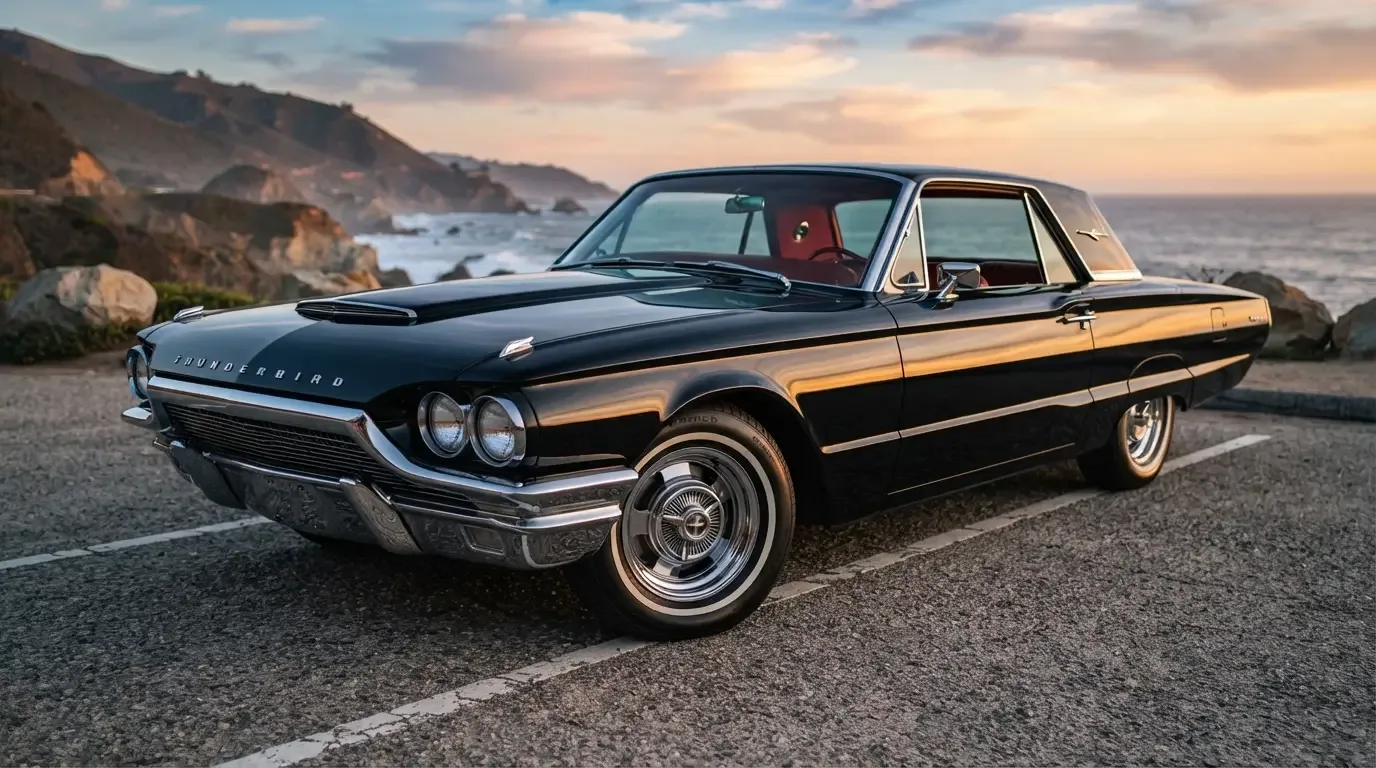
Why disc brakes mattered on a car this heavy
A Thunderbird from this era is not a light car. Fully equipped with a 390 cubic inch V8, power accessories, and the structural mass of a unibody built for comfort and isolation rather than minimum weight, the car presented a genuine braking challenge for the four-wheel drum system that had served the nameplate since 1955. Drum brakes fade under repeated hard use because the heat generated during braking has nowhere efficient to escape, and a car with the performance to reach highway speeds quickly needs a braking system that can shed that heat just as reliably.
Front disc brakes address this directly. The rotor design exposes far more surface area to passing air than an enclosed drum does, and the caliper design clamps rather than expands against an internal surface, both factors that reduce fade under sustained or repeated hard braking. Ford's decision to make this standard rather than optional on the 1965 Thunderbird reflects an engineering priority that period road tests consistently praised, with several contemporary publications noting the improved stopping confidence as one of the year's most meaningful updates, even as the exterior styling carried over from 1964 with only modest revisions.
How Ford implemented the system
The 1965 Thunderbird retained drum brakes at the rear, a configuration standard across the American industry at the time and one that remained common on production cars for years afterward. Ford's front disc setup used a caliper design supplied through its established brake component relationships, engineered specifically to work within the existing suspension geometry carried over from the 1964 chassis without requiring a wholesale redesign of the front end. This mattered practically, since it let Ford introduce a genuine safety and performance improvement without the cost and complexity of an entirely new front suspension architecture.
Service documentation from the period notes that the new system required different maintenance procedures than the drum brakes it replaced, a detail dealers had to communicate clearly to service departments accustomed to decades of drum brake service work. Disc brake pads wear differently and require different inspection intervals than drum shoes, and Ford's own training materials for dealer service departments from this period spend real space explaining the distinction, evidence of how significant a change this represented within Ford's own organization, not just to outside observers evaluating the car.
What carried over and what stayed the same
Exterior styling for 1965 held closely to the 1964 body introduced the previous year, with modest trim revisions rather than a substantial redesign. This continuity means the brake system upgrade stands as the single most significant change most contemporary observers pointed to when discussing what separated the 1965 model from its immediate predecessor. The 390 cubic inch V8 continued as the standard engine, and the overall mechanical package otherwise remained consistent with the prior year's Flair Bird generation Thunderbird.
This pattern, a strong new body introduced one year followed by a significant mechanical refinement the next, reflects how Ford tended to manage the Thunderbird's development cycle during this era, spreading major changes across model years rather than concentrating everything into a single redesign. Buyers researching this specific model year should understand the 1965 Thunderbird primarily through this lens: a mechanically improved version of the 1964 body rather than a styling milestone in its own right.
"The 1965 Thunderbird doesn't announce its most important change with a single line of chrome. You have to know to look at what's behind the front wheel, and once you know, it changes how you think about the whole model year."
- Sarah Whitfield
| Spec | 1965 Ford Thunderbird |
|---|---|
| Front brakes | Disc, standard across the lineup |
| Rear brakes | Drum |
| Standard engine | 390 cid V8 |
| Wheelbase | 113 inches |
| Body styles | Hardtop, Landau, convertible |
How period road testers reacted
Contemporary automotive press coverage of the 1965 Thunderbird treated the disc brake upgrade as newsworthy in its own right, distinct from the usual model year update coverage that focused on trim and color changes. Several period testers specifically praised the reduction in pedal fade during repeated hard stops, a detail that mattered to a car regularly used for sustained highway travel, which was exactly the kind of driving that most exposed the previous drum-only system's limitations. This reception matters historically because it shows the improvement was not simply an internal engineering achievement Ford quietly folded into the car. It was recognized at the time as a genuine advance, one that arguably did more for the car's real-world usability than that year's modest styling revisions.
That reception also helps explain why Ford continued expanding disc brake availability across its broader lineup in the years that followed, using the Thunderbird's early adoption as a proving ground within the company for a technology that would eventually become standard across most of the American auto industry by the following decade. Viewed from that angle, the 1965 model's brake system upgrade carries a significance well beyond this single car and this single model year.
Documenting an original braking system today
For collectors and appraisers evaluating a surviving 1965 Thunderbird, confirming the front disc brake components are period-correct and functioning as designed is a meaningful part of assessing the car's overall originality and mechanical integrity. Replacement components exist, and a car that has had its front brakes converted away from the original caliper and rotor specification, whether toward a later Ford design or an aftermarket system, represents a departure from factory configuration that matters to anyone documenting the car for concours presentation or historical accuracy.
For our complete history of the Flair Bird generation this car belongs to, including the 1964 redesign that established the body this braking system was engineered around, that piece provides the fuller context for understanding where the 1965 model sits within Ford's broader development plan for these years. Buyers looking to find a classic Thunderbird from this generation should ask specifically about brake system originality alongside the usual questions about engine numbers and body condition, since this particular mechanical detail carries more historical significance than its modest presence in period advertising ever suggested. A well-documented, correctly equipped example rewards that kind of scrutiny, and it is a small thing to verify against a large thing to get wrong when the car's overall authenticity is being judged.
Sources and notes
- Curbside Classic: Vintage Car Life Road Test, Disc-Braked 1965 Ford Thunderbird
- Squarebirds.org: 1965 Ford Thunderbird Standard Equipment
- Squarebirds.org: 1965 Ford Thunderbird Specifications
- Ate Up With Motor: Gaudy but Glamorous, 1958-1966 Ford Thunderbird
- Wikipedia: Ford Thunderbird (fourth generation)
- Wikipedia: Ford Thunderbird
Related Reading
#ford thunderbird
#disc brakes
#thunderbird history
#flair bird
#1965 Thunderbird
#classic Ford engineering

About the author
Sarah Whitfield
Third-generation classic car collector specializing in pre-war American and European coachbuilt automobiles. Researcher and concours enthusiast.
Related Listings - Ford Thunderbird

Comments
Be the first to comment on this article.