
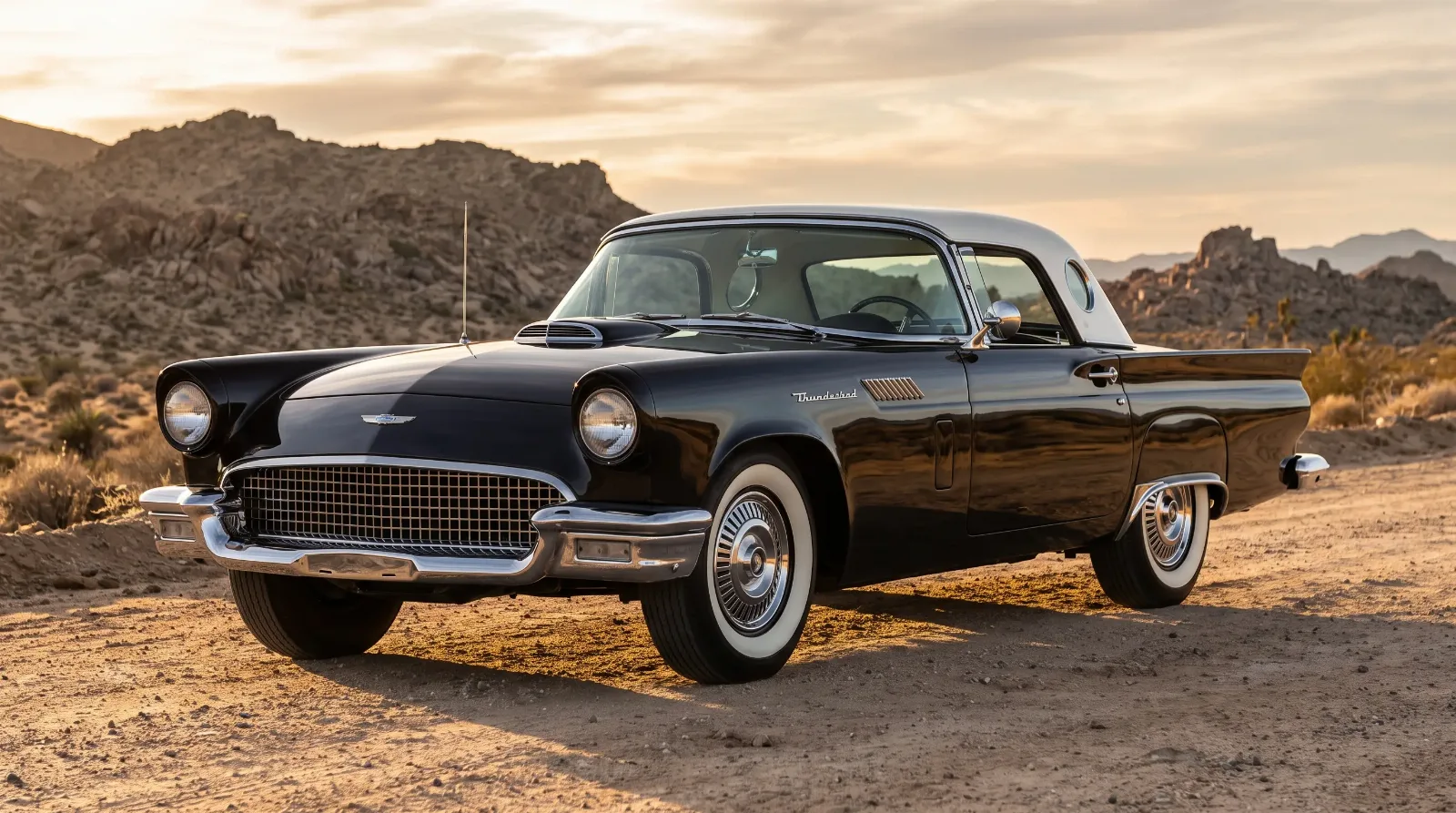
Ford built 211 supercharged Thunderbirds in 1957. That number is small enough to fit in a high school gymnasium with room to spare, and it is the reason the 1957 supercharged Thunderbird, nicknamed the F-Bird after its F-code engine designation, still moves the needle at auction decades later. This was not a dealer add-on or a magazine dream car. It was a factory-built, homologated response to Chevrolet's fuel-injected Corvette, and Ford built exactly as many as it needed to qualify for NASCAR and no more.
Car Features
6 min read
The F-Bird: The Supercharged 1957 Thunderbird
Ford built only 211 supercharged Thunderbirds in 1957 to answer the fuel injected Corvette, and the F-code car remains one of the rarest performance variants in Thunderbird history.
Why Ford went to a blower in 1957
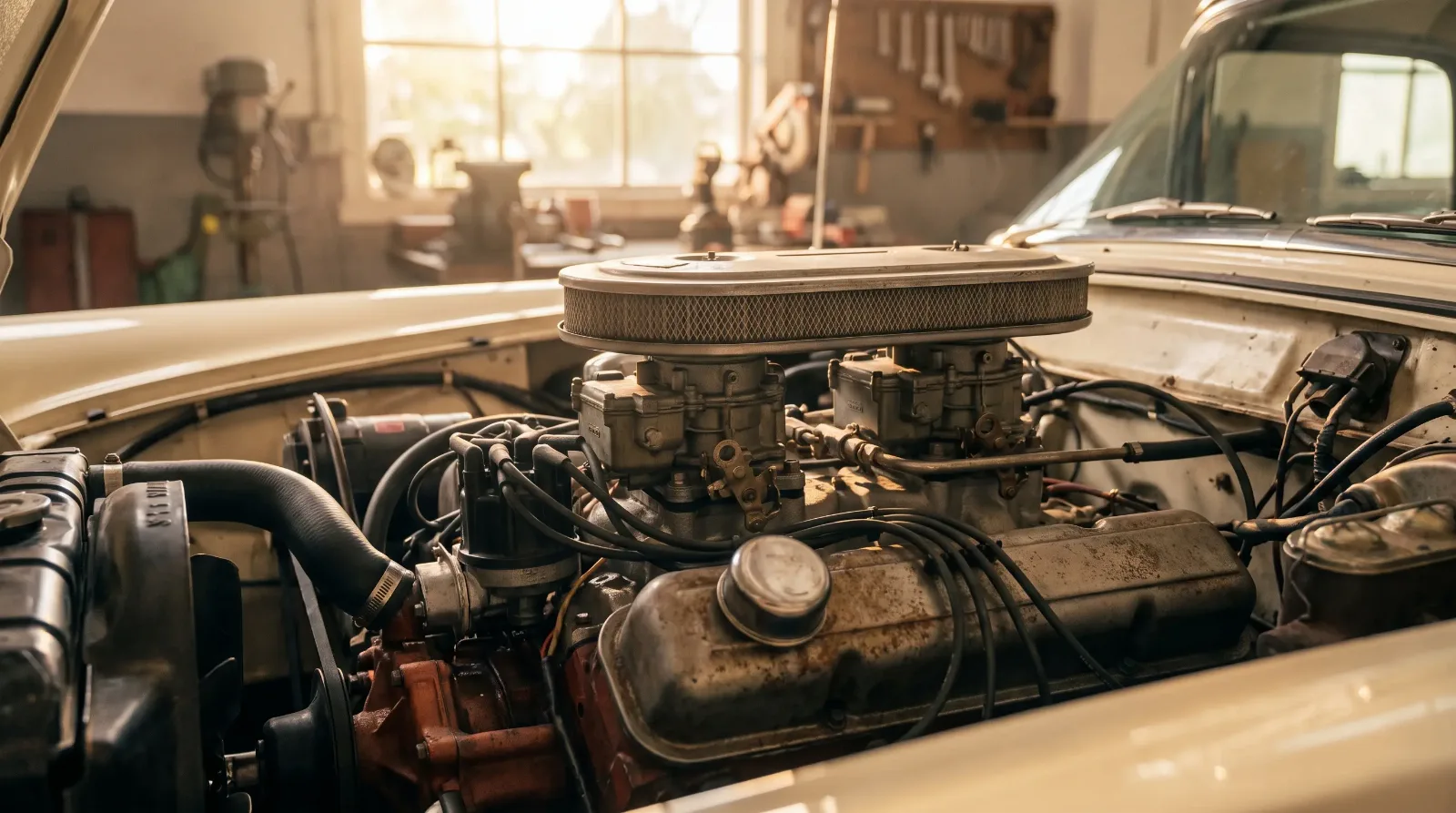
The 1957 model year was the last for the two-seat Thunderbird before Ford moved the nameplate to a four-seat car, and it arrived in the middle of Detroit's horsepower race. Chevrolet had fuel injection on the Corvette. Ford did not have a production fuel injection system ready, so Dearborn's engineers reached for a supercharger instead. The result was the F-code 312 cubic inch V8, fitted with a McCulloch VS57 centrifugal supercharger and paired with a Holley four barrel carburetor mounted upstream of the blower.
Ford rated the F-code at 300 hp in standard tune, with a small run of racing versions pushed closer to 340 hp using a higher compression ratio and a different pulley. Those racing-spec cars are rarer still, and their exact production count is one of the most argued numbers in Thunderbird history.
What the F-code actually cost a buyer
The supercharger option was not cheap and it was not simple. Buyers who checked the box got a car that ran hotter, drank more fuel, and demanded more from its drivetrain than the standard 245 or 270 horsepower 312. Ford knew the F-Bird was a low volume, high stress piece of engineering built to win races and sell showroom traffic, not to be a daily driver for the average buyer in Ohio. That tension between race car and consumer product is part of why so few were built and why so many did not survive intact.
Dealers who wanted the halo effect of a supercharged Thunderbird on the showroom floor sometimes found themselves explaining warranty limits and service quirks to customers who just wanted the fastest car in town. The factory backed the F-code, but it was clear this was a competition part wearing a passenger car body.
The F-Bird on the sand and the track
Supercharged Thunderbirds ran at Daytona Beach during Speed Weeks in 1957, and factory backed teams also entered stock car events with F-code power. The car was fast in a straight line, which suited the flying mile runs on the sand, but the added weight and heat of the supercharger system created its own set of problems in longer competition. Reliability was never guaranteed, and more than one F-Bird retired early with a cooked engine bay or a slipping belt.
Still, the speed numbers got attention. A blown Thunderbird could out accelerate a fuel injected Corvette in a straight sprint, and that bragging right mattered more to Ford's marketing department than any single race result. For readers who want the whole picture on how the two-seat Thunderbird got to this point, the story of the F-code is really the final chapter of a three year sprint that started in 1955.
Inside the McCulloch supercharger itself
The McCulloch VS57 unit that Ford bolted to the F-code 312 was not a Ford design. McCulloch built superchargers for a handful of manufacturers in the mid 1950s, and the centrifugal blower it supplied Ford spun on a variable speed drive that used a transmission fluid coupling to modulate boost. That coupling was the weak link. It ran hot, it needed the right fluid level to survive, and a neglected unit could slip, overheat, or fail outright within a season of hard driving. Owners who bought an F-Bird new and actually raced it learned that lesson quickly, and the parts bin for a failed VS57 was not exactly deep at the local Ford dealer.
The physical layout also complicated life under the hood. The blower sat low and to the side of the engine, the Holley four barrel fed air into it rather than straight into the intake, and the whole assembly ran on a wide serrated belt that needed correct tension to avoid slipping under boost. None of this was insurmountable for Ford's engineers, but it made the F-code a car that rewarded an attentive owner and punished a careless one. That reality shaped how the car was driven, sold, and eventually remembered.
Survival, fakes, and what collectors look for
Because genuine F-Birds are rare and because the supercharger conversion is not impossible to fake, buyers have to do real homework before paying F-code money for a car. The Ford data plate carries the engine code, and matching numbers documentation, period service records, and a verified McCulloch supercharger housing all matter more on this car than on almost any other 1957 Thunderbird variant.
A correctly documented F-Bird commands a serious premium over a standard 1957 Thunderbird, sometimes multiples of the price. That gap has only grown as buyers with real money have started chasing genuine low production Ford performance cars from the 1950s rather than the more common muscle car era pieces that flooded the market for years.
Restoration shops that specialize in early Thunderbirds say the giveaway on a fake is rarely the supercharger housing itself, since period correct McCulloch units do turn up at swap meets and can be bolted onto any 312. The giveaway is everything around it: the wiring harness routing, the correct pulley ratio, the specific carburetor jetting, and a data plate that actually matches the car's frame and body tags. A buyer who only checks for the blower and skips the paperwork is buying a story, not necessarily a genuine F-code car.
"Two hundred and eleven cars is not a production run, it is a science experiment that Ford happened to sell to the public. That is exactly why people pay what they pay for a real one."
- Dan Reeves
What the F-Bird means for the Thunderbird story
The supercharged 1957 Thunderbird is a footnote in total sales and a headline in enthusiast circles. It shows Ford was willing to build a genuinely difficult, low margin car just to answer a competitor and just to say it could. That is not nothing. Two hundred eleven cars, one supercharger supplier, one model year, and a legacy that outlasted every sales chart Ford ever printed on it. Rarity did that. Rarity, and the fact that Ford actually built the thing instead of just talking about it. If you want to see what a real F-code sells for or what is currently on the market wearing that pedigree, shop classic Thunderbird listings and compare documentation before you compare price.
Sources and notes
- RM Sotheby's - 1957 Ford Thunderbird F-Code
- Supercars.net - 1957 Ford Thunderbird D/F-Code Phase I
- Old Cars Weekly - Vintage Muscle: the '57 Thunderbird F-Code
- Silodrome - A Rare Factory-Supercharged Ford Thunderbird F-Code
- autoevolution - 1-of-15 McCullough Supercharged 1957 Ford Thunderbird
- Wikipedia - Ford Thunderbird (first generation)
Related Reading
Have a
Ford Thunderbird
for Sale?
Reach thousands of serious classic car collectors across the US.
Sell It Here →
Are You a Classic Car Dealer?
List your full inventory and connect with targeted classic car buyers.
Join as a Dealer →
#ford thunderbird
#two-seat thunderbird
#1957 thunderbird
#classic Ford V8
#F-code
#supercharged Ford

About the author
Dan Reeves
Performance engine builder from North Carolina's motorsports corridor, focused on swaps, forced induction and making real, repeatable power.
Related Listings - Ford Thunderbird
Comments (1)
V
Vince Calabrese
2 months ago
Condition grade IV cars are where most real buyers actually operate. Nice to read something that takes that seriously.