
Every Thunderbird club newsletter I have ever flipped through eventually runs a photo feature on portholes, close-up shots of that little round window in the removable hardtop, usually captioned with something like "the detail that made the car." I used to think that was clubs romanticizing a minor trim option. Then I sat through enough conversations with people who actually restore these cars to understand the porthole earned that reputation the hard way, by solving a real problem nobody designed for on purpose.
Car Features
6 min read
The Porthole Hardtop: The Thunderbird's Signature Window
The Thunderbird's porthole hardtop started as a fix for a visibility complaint, not a styling idea, and club history backs up exactly how it happened.

A complaint that became a signature
The Thunderbird's original removable hardtop, offered starting with the 1955 model, was a solid piece with no window at all in the C-pillar area, which sounds fine until you actually try to back out of a parking space in one. Owners complained about restricted rear-quarter visibility almost as soon as cars reached the road, and Ford's response, arriving for the 1956 model year, was to cut a round window into the hardtop's rear pillar. That is the entire origin story. Not a styling flourish dreamed up in a design studio, a fix for a complaint, executed fast enough to reach customers within a single model year of the one where it was identified.
I like that origin because it is so unglamorous, and because it explains why the detail feels so right on the car instead of tacked on. Problems solved under real pressure, by people who had to answer to actual customers, tend to age better than problems solved by a committee chasing a look. The porthole worked because it needed to, and it happened to look sharp doing it.
From running change to standard equipment
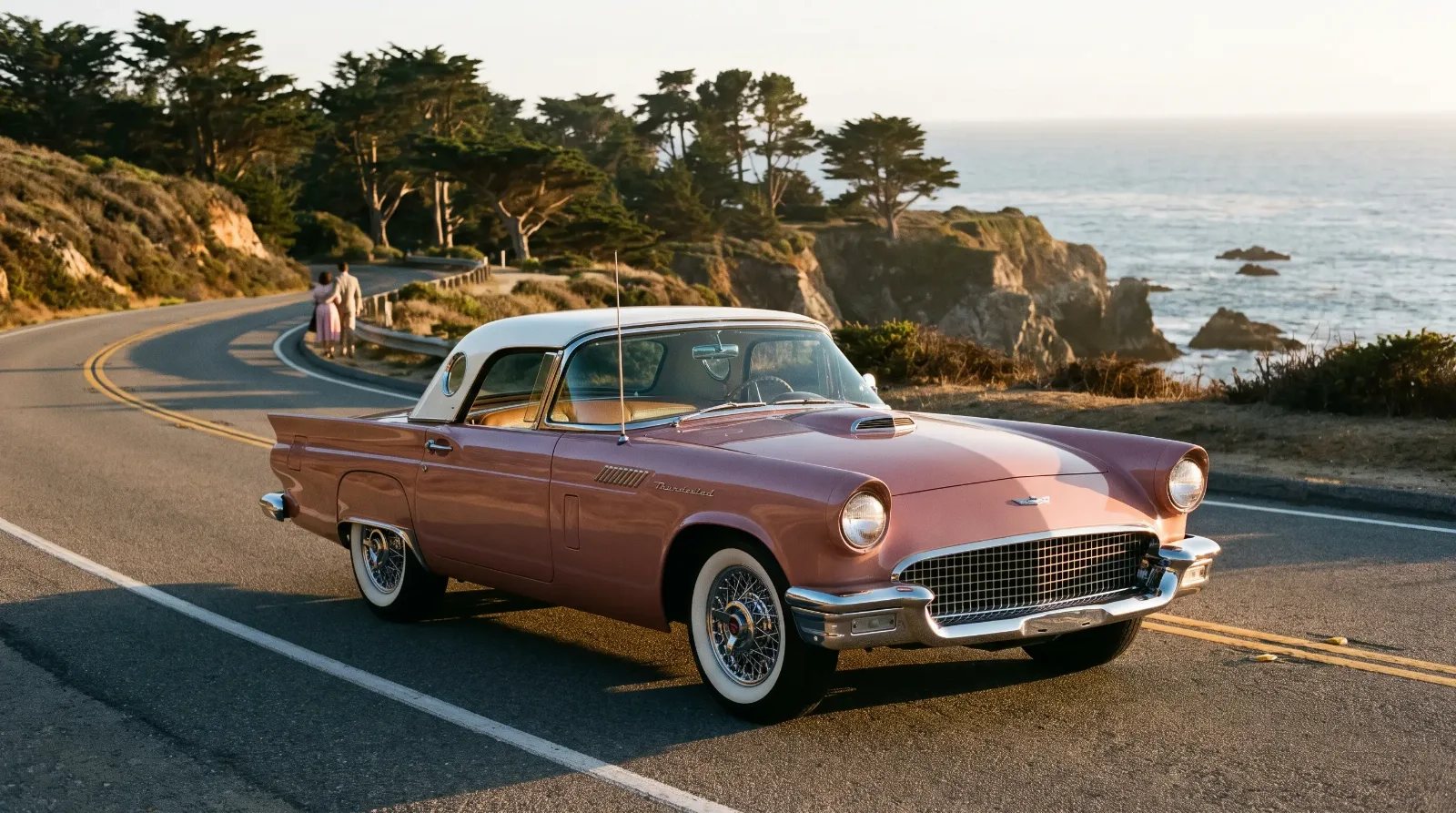
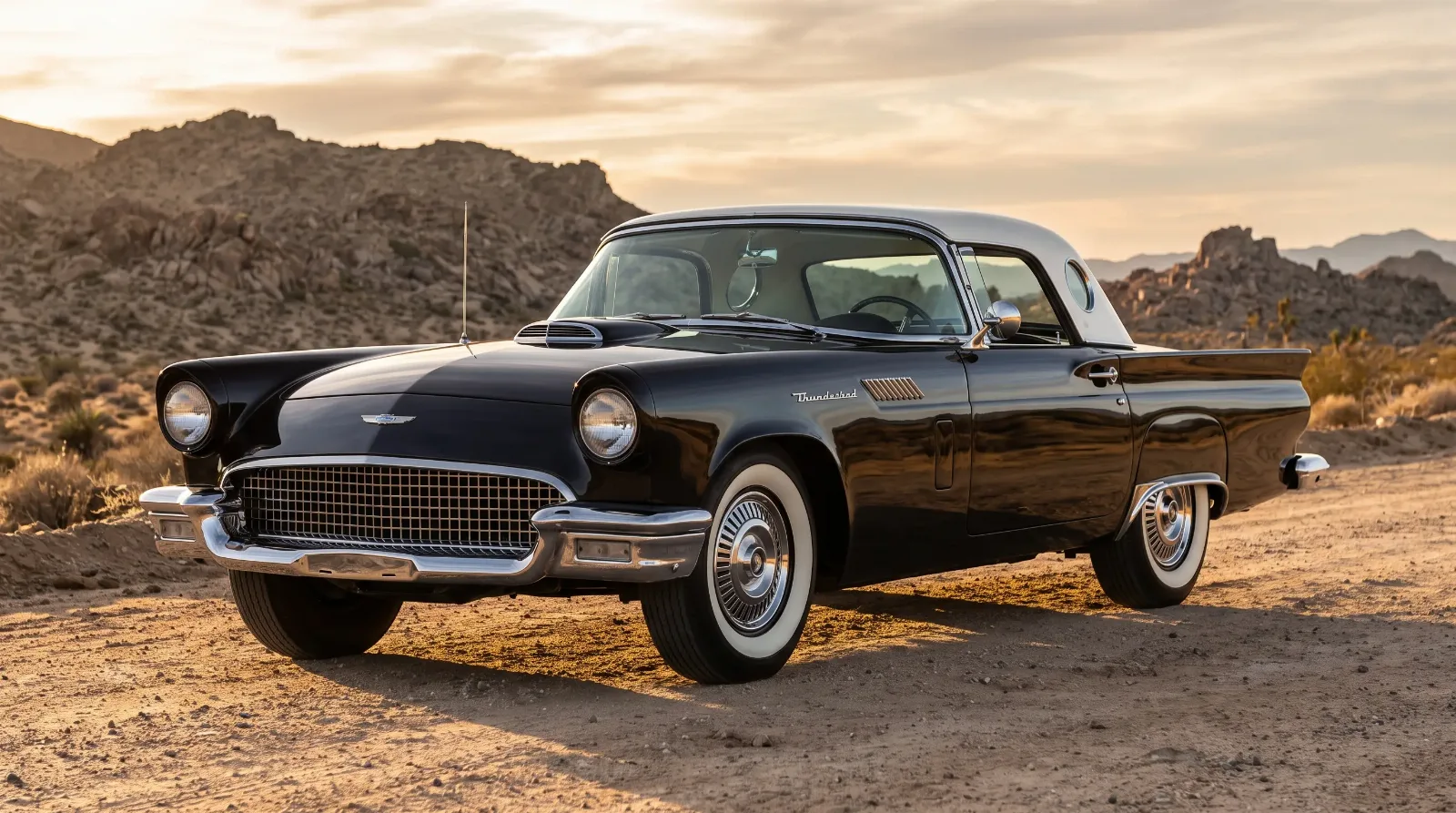
Ford introduced the porthole hardtop for 1956, and this is where documentation earns its keep against the way the story sometimes gets told at swap meets. A few retellings push the porthole's debut back into 1955, but the record does not support that: no 1955 Thunderbird left the factory with a porthole hardtop. The window arrived as a new option at the start of the 1956 model year, offered at no extra cost alongside a plain, portholeless hardtop for buyers who preferred the cleaner roofline, with Ford's own factory documentation from the period listing both as available configurations on hardtop-equipped cars.
Most people, given the choice, chose the porthole. That preference shows up clearly in how many portholeless 1956 and 1957 hardtops survive today compared to the porthole version: they are the rarer variant now, a genuine reversal of what "standard" meant on the factory floor versus what collectors chase today. Read the background on how the two-seat Thunderbird evolved across all three model years for the fuller context around when each design change landed.
Why the detail stuck around after the two-seater ended
Ford carried the porthole design language forward well past the two-seat Thunderbird's discontinuation in 1957, working variations of it into later Thunderbird generations across multiple decades, evidence that Ford's own design team recognized what they had stumbled into. That is a rare thing in car design: a fix for a customer complaint becoming a brand signature strong enough to outlive the specific car it was invented for by twenty, thirty, forty years.
Club members take the porthole seriously enough that authenticating one on a specific car is its own small discipline. Casting details on the hardtop's window trim, the exact chrome surround profile, and even the glass tinting varied across production, enough that a careful eye can often place a hardtop within its correct model year just from the porthole assembly alone, independent of any other body panel or trim detail on the car.
"Ask ten different owners why they love the porthole and you'll get ten different answers about how it looks. Ask them why it exists and, if they've done their homework, you'll get the same answer every time. It fixed a blind spot. Everything else it became was a bonus nobody at Ford actually planned for."
- Wayne Coburn
The rivalry the porthole quietly won
None of the Thunderbird's contemporaries bothered copying the porthole directly, which says something about how specific it was to Ford's particular design language rather than a generic solution every manufacturer would have landed on independently. The Corvette solved its own visibility complaints differently, through different hardtop designs over the following decades, but never adopted anything resembling the round window that became so associated with Ford's car. That divergence is one more small piece of evidence for something club members already believe without needing convincing: the porthole was not an obvious idea that any competent stylist would have reached for. It was a specific answer to a specific complaint, arrived at under a specific deadline, and it happened to be good enough that Ford kept using variations of it for decades after the original problem had been forgotten by everyone except the people who actually collect these cars.
What to know if you are chasing one
If you are hunting for a correct porthole hardtop for a restoration, or trying to verify one already on a car, expect the search to take longer than most other trim pieces on a Thunderbird. Original hardtops in good condition, with correct trim and undamaged porthole glass, command real money on their own, separate from whatever the rest of the car is worth, and reproduction pieces vary considerably in how closely they match factory tolerances. A mismatched hardtop, one from a different model year fitted to the wrong car, is common enough in the hobby that experienced club members treat it as the default assumption until proven otherwise, not the exception.
Whether you are restoring one or simply shopping for a well-documented example, the porthole remains the single detail most buyers ask about first. You can find a classic Thunderbird currently listed and see how closely its hardtop, porthole or plain, matches what the factory actually shipped for its specific model year, and if the seller cannot answer a direct question about the top's originality, take that as useful information in itself.
Sources and notes
Related Reading
Have a
Ford Thunderbird
for Sale?
Reach thousands of serious classic car collectors across the US.
Sell It Here →
Are You a Classic Car Dealer?
List your full inventory and connect with targeted classic car buyers.
Join as a Dealer →
#classic ford
#ford thunderbird
#1956 Thunderbird
#porthole hardtop
#Thunderbird restoration
#Ford design history

About the author
Wayne Coburn
Longtime Corvette owner, judge and club figure who knows the cars, the records and the people behind them.
Related Listings - Ford Thunderbird




Comments (1)
E
Eddie Carlisle
2 months ago
The insurance section is worth a separate article. A lot of people reach claim time before realizing agreed value coverage is completely different from what they bought.