
Engine specification sheets rarely tell the whole story, and the 1964 Thunderbird 390 is a good example of why. On paper it looks like a straightforward carryover engine bolted into a newly restyled body. In practice, the way that engine actually performed in the redesigned 1964 chassis says more about Ford's priorities that year than the horsepower figure alone ever could.
Car Features
6 min read
The 390 in the Flair Bird
The 1964 Thunderbird 390 was a conservative, proven engine choice bolted into a dramatically restyled body, and that conservative engineering is exactly why so many are still running today.
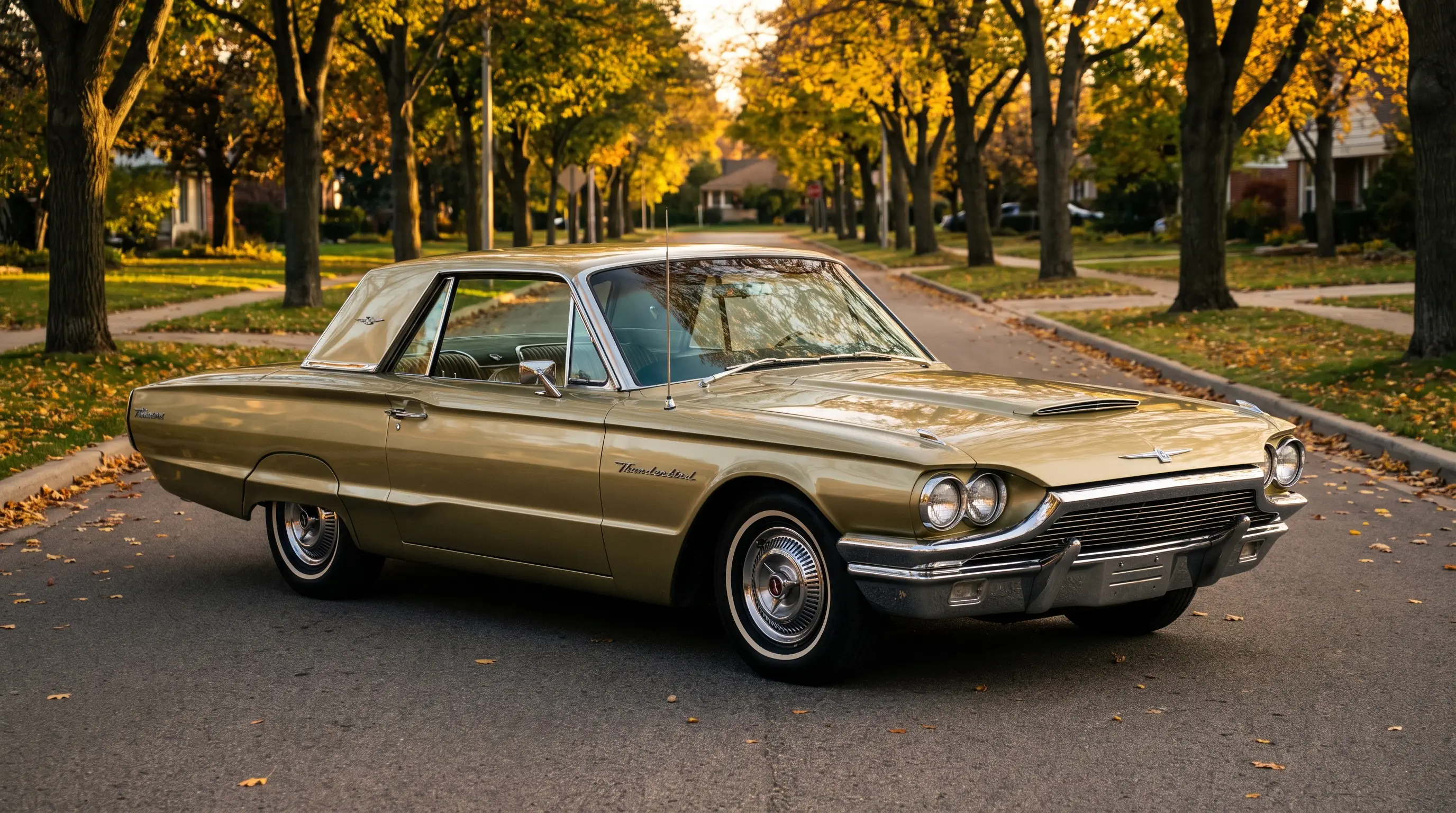
The engine behind the redesign
Ford introduced a substantially reworked Thunderbird for 1964, the car often called the Flair Bird for its sculpted, formal styling. Read the background on that redesign for the full picture of what changed on the outside. Under the hood, the standard engine carried forward was the 390 cubic inch FE series V8, an engine Ford had already proven across multiple full size and mid size platforms by the early 1960s. Choosing a known quantity for the powertrain while investing heavily in new sheet metal was a deliberate risk management decision, not an oversight. Ford's engineers had enough uncertainty to manage with a new unibody structure and new suspension geometry without also debugging a brand new engine at the same time.
What the numbers actually show
The 390 in the 1964 Thunderbird was rated at 300 horsepower (SAE gross), a figure that placed it comfortably in the middle of the personal luxury segment rather than at the top. That is worth sitting with for a moment, because it runs counter to the assumption a lot of newcomers make, that a car this visually dramatic must have had performance numbers to match. It did not, and it was not trying to. The 390's torque curve was tuned for smooth, confident acceleration from a stop and relaxed highway cruising, not quarter mile times, which matched exactly what a Thunderbird buyer in 1964 was shopping for.
| Spec | 1964 Thunderbird 390 |
|---|---|
| Engine family | Ford FE series V8 |
| Displacement | 390 cubic inches |
| Horsepower | 300 hp (SAE gross) |
| Transmission | Automatic, standard across the range |
| Role in lineup | Standard engine, 1964 Thunderbird |
Reliability, in plain terms
The FE series had a track record by 1964 that made it a low risk choice, and that track record generally holds up when you look at how these engines have survived in the decades since. The failure modes that do show up on surviving cars are predictable and mostly tied to age rather than any inherent design flaw, cooling system deterioration, worn valve guides after high mileage, and electrical components that have simply outlived their expected service life. None of that is a knock on the engineering. It is what happens to any mechanical assembly after sixty years, and it is worth knowing going in rather than being surprised by it during a pre purchase inspection.
What I find more interesting than the failure modes is how rarely the core architecture itself is the problem. Blocks and heads on these engines tend to survive remarkably well when maintained even modestly, which says something about the margin Ford built into the design in the first place. A conservative engine, built with headroom rather than pushed to its limits, ages more gracefully than one running closer to the edge of its design tolerances, and the 390 is a reasonably good case study in that principle.
"People want the exciting answer when they ask about the 390, some hidden performance secret. The honest answer is that it was a conservatively engineered engine doing exactly what it was designed to do, and that is precisely why so many of them are still running today."
- Emily Chen
What this means for a buyer today
If you are evaluating a 1964 Thunderbird with the 390 today, the engine itself should rank fairly low on your list of worries compared to the body, the electrical system, and the convertible top mechanism on cars so equipped. The FE architecture is well understood, parts availability is solid because the same family powered so many other Ford products, and a competent independent mechanic will have no trouble sourcing what they need for routine service. The bigger variable is always how the specific car in front of you was maintained, not which generation of engine family it carries under the hood.
That said, a compression test and a careful listen for valve train noise on cold start remain worthwhile diagnostic steps before any purchase, the same as they would be on any engine of this age. Data beats assumptions every time, and a five minute check tells you more than any amount of confident sounding sales talk from a private seller. If you are ready to start comparing cars, you can find a classic Thunderbird and bring an inspection checklist with you, 390 powered or otherwise.
Comparing the 390 to what came after it
Ford eventually added the larger 428 to the Thunderbird lineup for 1966, and it is worth being precise about what that change actually represented rather than assuming bigger automatically meant better. The 428 offered more torque and a stronger reserve for passing and highway merging, useful traits as the car's equipment list and curb weight grew over the run of this generation. But the 390 was never underpowered for its intended role, and plenty of period owners never felt the need to step up. Choosing between the two today comes down to priorities rather than a clear technical verdict in either direction. A 390 car tends to be lighter on the nose, slightly easier to keep fed with parts given how widely the displacement was used across Ford's lineup, and in most cases a bit less expensive to acquire than a comparable 428 example, since the larger engine carries a documented rarity premium among buyers who specifically seek it out.
Neither engine choice should be treated as a red flag or a green light on its own. Condition and documentation matter more than displacement, and a well maintained 390 will outperform, in every practical sense, a neglected 428 sitting two rows over at the same show.
Reading a build sheet correctly
One habit I recommend to anyone shopping this generation is learning to read the original build documentation before trusting a badge, a seller's description, or even a casing number glanced at quickly in a driveway. Engine swaps happened over the decades, sometimes done well and disclosed honestly, sometimes not. A build sheet, a Marti style production report, or a matching set of casting and stamping numbers gives you something closer to ground truth than any verbal assurance can. This is not paranoia, it is basic due diligence applied to a machine old enough that its history has had sixty years to get complicated.
The reward for doing that homework is real. A documented, numbers correct 1964 Thunderbird with its original 390 carries a clarity of story that an undocumented car simply cannot match, regardless of how good it looks in photographs. Evidence beats assumption, in engine bays just as much as anywhere else.
Sources and notes
Related Reading

About the author
Emily Chen
Bay Area engineer with a deep focus on vintage Japanese and European performance cars. Approaches classic car research and restoration with an analytical eye.
Related Listings - Ford Thunderbird

Comments
Be the first to comment on this article.