
I have watched a lot of arguments start at Thunderbird club meets over exactly one sentence: "It's not a sports car." Somebody new to the hobby says it about their own 1955, half apologizing, and somebody who has owned three of them for thirty years jumps in before the sentence finishes. "Good. It was never supposed to be one." That is not a defensive line people invented after the fact. Ford said it themselves, in print, from the very first brochure.
Car Features
7 min read
Personal Car, Not Sports Car: How Ford Positioned the Thunderbird
Ford called the Thunderbird a personal car on purpose, and both the sales literature and club memory back up exactly why that word choice stuck.
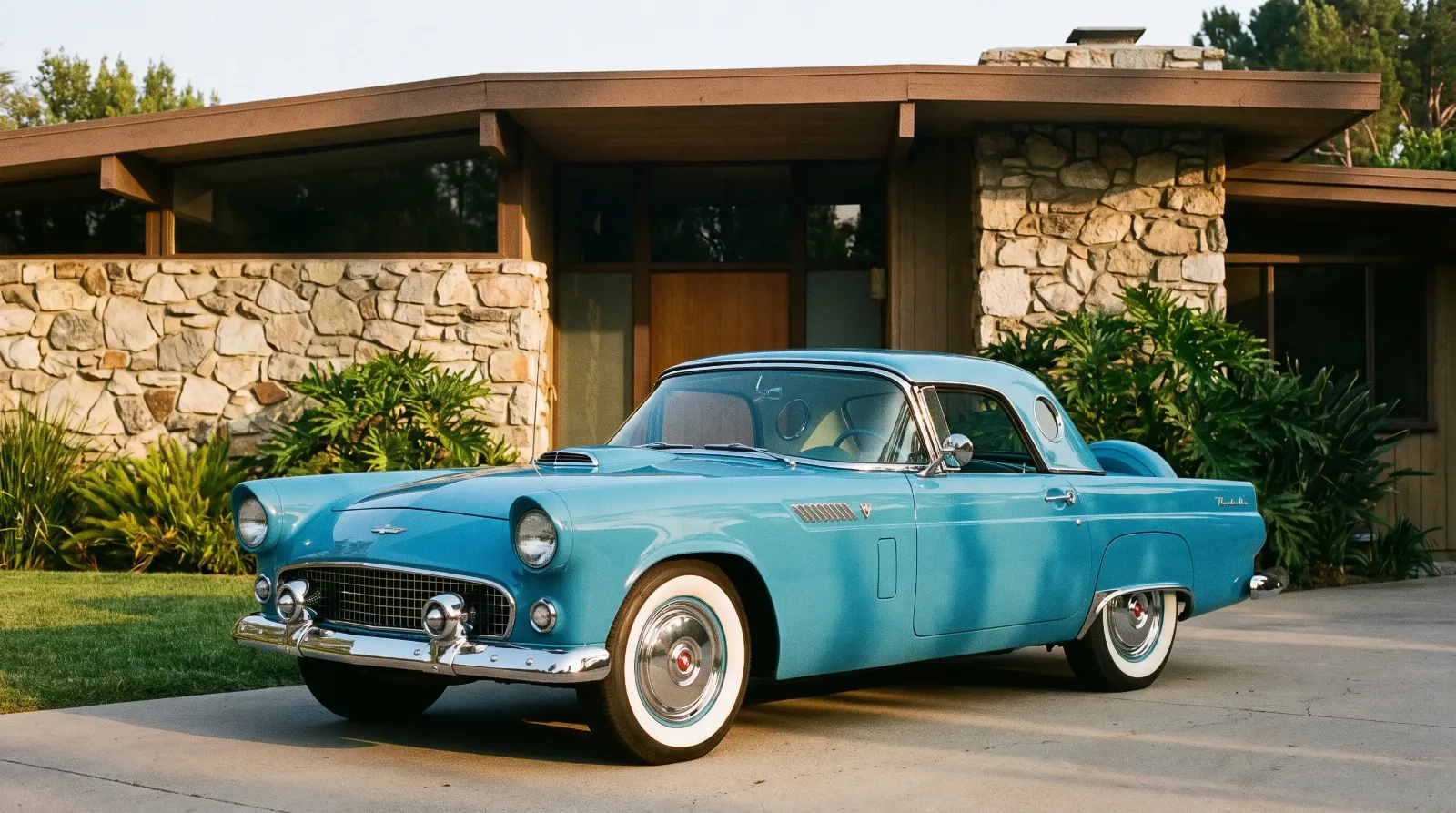
The phrase Ford chose on purpose
Ford called the Thunderbird a "personal car" in its own 1955 sales literature, and that word choice was deliberate, not a hedge. The company's market research under Lewis Crusoe and Robert McNamara had identified a customer who wanted something distinctive to drive, something that looked sporting parked in a driveway, without giving up comfort features a Ford buyer already expected. A sports car, in the era's understanding, meant side curtains instead of roll-up windows, a stripped interior, and a ride that punished you on anything but smooth pavement. The Thunderbird offered none of those compromises, and Ford wanted buyers to know it up front rather than discover it by comparison shopping against a Corvette.
I have heard old-timers at regional meets describe how their fathers or uncles bought a Thunderbird specifically because a salesman walked them through this exact distinction: this car rides like your sedan, steers easy with the power option, and still turns every head in the lot. That sales pitch, repeated across thousands of Ford dealerships in 1955, is why the personal car label stuck in the culture around the car for seventy years, long after most buyers stopped needing it explained to them.
What "personal car" meant on the order sheet
Talk is one thing. What actually separates a personal car from a sports car in 1955 shows up on the factory option list, and this is where the documentation does the punchline for you. A 1955 Thunderbird could be ordered with power steering, power brakes, a power seat, and a factory Motorola radio, none of which existed as options on the contemporary Corvette. Buyers who wanted a fully equipped car could have one, and plenty did. Club members who research original build sheets consistently find Thunderbirds ordered with nearly every comfort option available, evidence that Ford's read on its customer was accurate from the start.
That same customer wanted a car for actual use, not a weekend toy locked in a garage. Club histories and old dealer records describe Thunderbirds bought as second cars for professionals, doctors, business owners, people who wanted something with presence for the commute or the country club lot but still needed the car to start reliably on a cold morning and ride comfortably on a real trip. That is a different customer than the one Chevrolet was chasing with the Corvette in its early, rougher years, and Ford's positioning matched the difference exactly.
Community memory versus the official record
Every long-running Thunderbird club I have spent time with carries some version of the same oral history: a founding member's father who bought new in 1955 or 1956, a car passed down, a story about how the family used it. Those stories are not always precise on the details, and that is fine, because the documentation exists to check them against. What the stories get right, almost without exception, is the emotional core of why people bought the car: it was supposed to feel special without asking you to give anything up. That is the personal car pitch in a sentence, and it survives in club culture because it was true enough to be worth repeating for seventy years.
Where community memory and factory documentation line up is instructive. Members who have dug through period Ford dealer training materials find the same language used internally that showed up in customer-facing ads: comfort first, sportiness as the visual language, never the mechanical reality. That consistency between what Ford told its own salespeople and what it told the public is worth more than any single anecdote, because it shows the personal car positioning was not just marketing spin layered over a sports car underneath. It was the actual design brief. For the fuller account of how that brief turned into the finished 1955 through 1957 cars, where this started lays out the whole two-seat era in one place.
"Every club has a member who insists their grandfather's Thunderbird could have beaten a Corvette off the line. Maybe it could have on a given day. That was never the point Ford was selling, and the sales literature backs that up every time somebody actually goes and reads it."
- Wayne Coburn
The persona rivals it never quite created
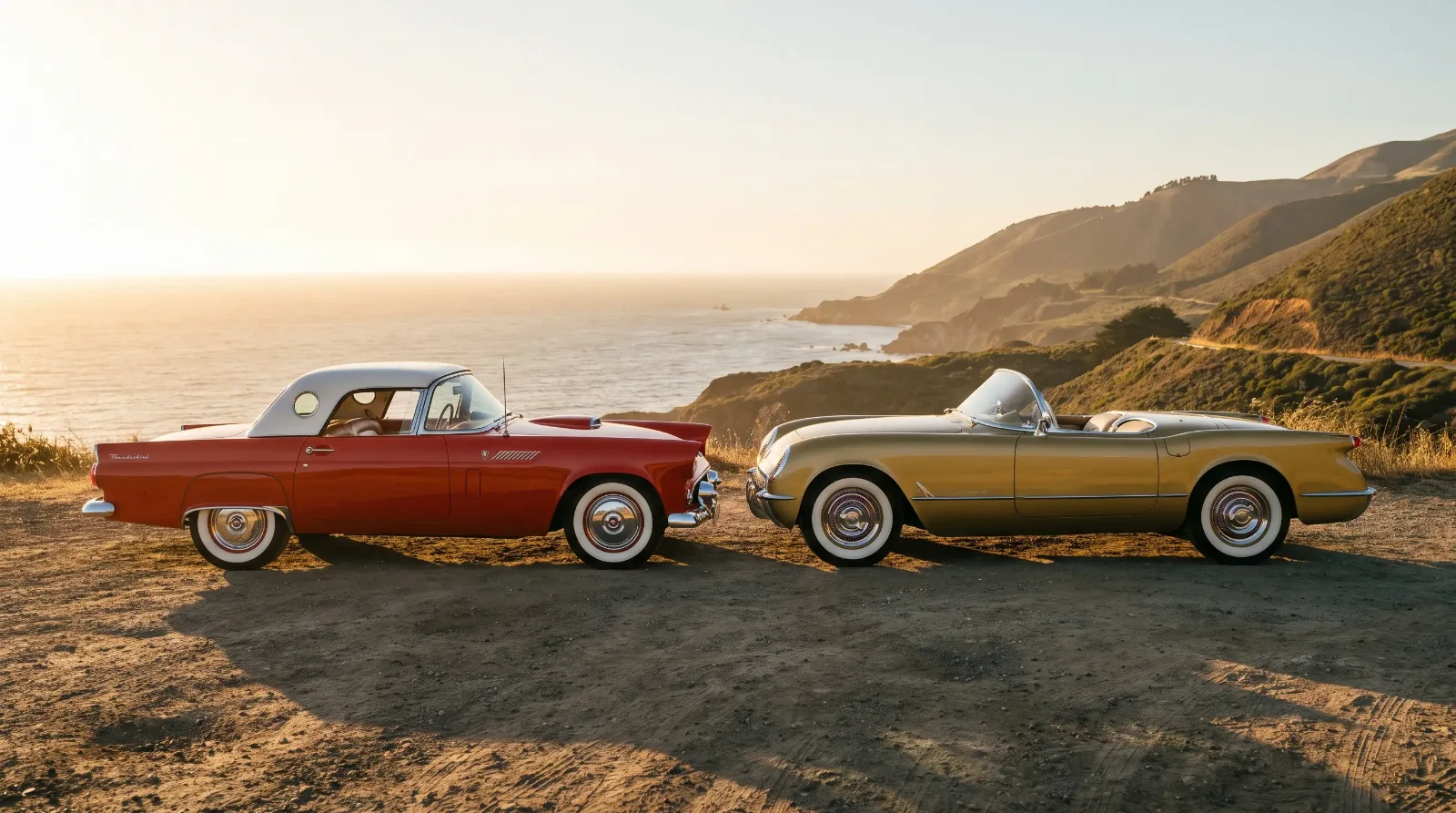
What strikes me most, having sat through enough club dinners to lose count, is how little genuine resentment survives between Thunderbird people and Corvette people once you get past the first round of ribbing. Part of that is time. Part of it is that the personal car positioning never actually asked anyone to choose a side in a performance contest. Ford built a comfortable, image-forward second car for people who already owned something practical. Chevrolet built an unapologetic sports car for people chasing lap times and bragging rights. Once both camps stop pretending those were ever the same competition, the friendliness that shows up at joint car shows makes a lot more sense.
That said, do not tell a room full of Thunderbird owners their car was "the comfortable option" like it is a consolation prize. Comfortable was the entire assignment, chosen on purpose, delivered on purpose, and sold on purpose. Treating it as a lesser achievement than outright speed misses what Ford was actually trying to do, and every original order sheet in every club archive backs that reading up.
Why the distinction still matters to owners today
Understanding the personal car positioning changes how you evaluate an original Thunderbird today. A heavily optioned example with power everything and a factory radio is not a lesser, softer version of what the car was supposed to be. It is closer to what most original buyers actually ordered, and closer to what Ford intended the car to be from the first sketch. Stripped-down examples exist and have their own appeal, but they represent buyers who deviated from the car's central premise, not the other way around.
That distinction shapes club judging standards, too. Concours events that evaluate Thunderbirds against period-correct criteria weigh comfort options and factory equipment as authentically part of the car's identity, not deductions for straying from some imagined sports car ideal. If you spend any real time around the club scene, you will hear this explained patiently, more than once, usually by someone holding a photocopy of a 1955 order sheet as evidence. The documentation always wins the argument, eventually.
If that comfortable, personal-car approach to a classic still appeals to you, current examples come up for sale regularly enough to be worth watching. You can look at a classic Thunderbird for sale today and see how closely a given car's original options match the personal car formula Ford built its entire pitch around back in 1955.
Sources and notes
Related Reading
Have a
Ford Thunderbird
for Sale?
Reach thousands of serious classic car collectors across the US.
Sell It Here →
Are You a Classic Car Dealer?
List your full inventory and connect with targeted classic car buyers.
Join as a Dealer →
#classic ford
#ford thunderbird
#1955 Thunderbird
#personal car
#Thunderbird club history
#Ford marketing

About the author
Wayne Coburn
Longtime Corvette owner, judge and club figure who knows the cars, the records and the people behind them.
Related Listings - Ford Thunderbird
Comments
Be the first to comment on this article.