
I was at a regional meet a few years back, standing next to a 1966 Thunderbird Town Landau while its owner argued good naturedly with another club member about whether the car in the next row, a plain Town Hardtop, was really the same car underneath a different roof treatment. Neither one of them was wrong, and that argument is basically the whole story of these two models in a nutshell.
Car Features
7 min read
The 1966 Town Landau and Town Hardtop
The 1966 Thunderbird Town Landau added a vinyl roof and landau bars to the Town Hardtop's formal profile, and club members have been arguing about which one matters more ever since.
Two roofs, one idea
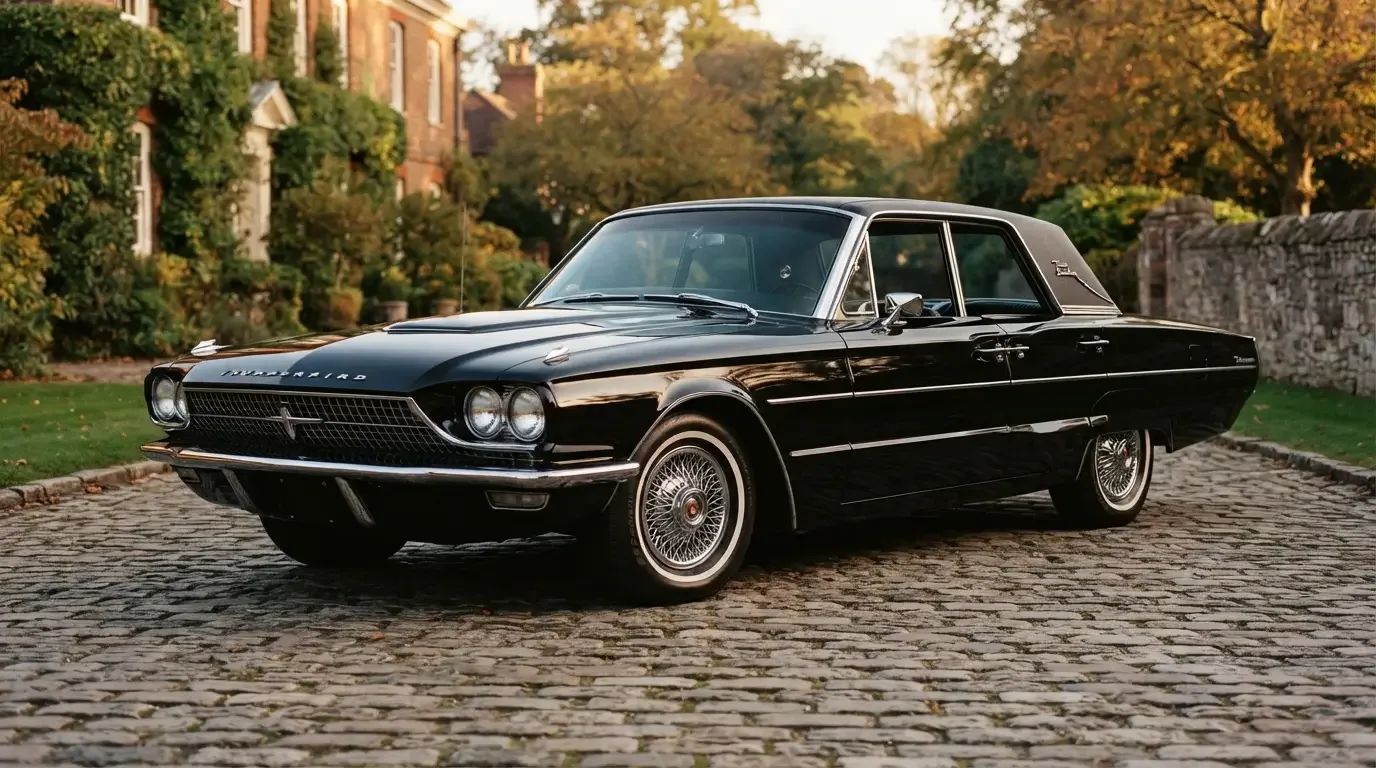
By 1966, Ford was offering the Thunderbird hardtop in two distinct roof treatments, and the naming took some getting used to even for people who followed the brand closely. The Town Hardtop carried a blacked out C pillar with a formal, close coupled look, while the Thunderbird Town Landau added a vinyl covered roof section to that same formal profile, pushing the car further toward the personal luxury image Ford wanted for the whole lineup that year. Underneath the trim, both were built on the same 1966 Thunderbird hardtop platform, sharing mechanicals, interior architecture, and most of the sheet metal.
What separated them was presentation, and in the mid 1960s presentation sold cars. A vinyl roof signaled something to a buyer's neighbors that a painted roof did not, even when the difference cost the factory relatively little to produce. Ford understood that psychology well, and the Thunderbird Town Landau became the version people pictured when they thought of the top trim hardtop in this generation.
Where the name came from
The word Landau has a long history in coachbuilding, originally describing a carriage with a folding top split into front and rear sections. American automakers borrowed the term for decades to describe cars with vinyl covered rear roof sections that echoed that old folding top look, even though the roof itself did not actually fold on a production Thunderbird. It was styling language, not engineering, but it was styling language buyers understood instantly, and it carried real weight in showroom conversations.
Club members who have spent time researching this generation will point you toward the broader context of how the Thunderbird arrived at this formal, landau bar equipped look in the first place. Where this started traces that back to the 1964 redesign, when the roofline and the general vocabulary of formality first took hold on the nameplate, setting up everything the Town Landau would later build on.
What actually separated the trims
Beyond the roof covering, the differences between a Town Hardtop and a Town Landau came down mostly to standard equipment packages and trim details rather than anything structural. Landau bars, the decorative S shaped hardware mounted where a folding landau top would have hinged on an older carriage, appeared on the sail panels of the Landau version as a visual signature, even though they served no mechanical function on the production car. It was ornamentation with a history behind it, which is part of why club discussions about these details tend to run long. Everybody has an opinion about how much a set of landau bars should matter to a car's overall value.
Sales numbers back up how much that formal roof mattered to buyers. Ford built 69,176 Thunderbirds across all body styles for 1966, and the Town Landau alone accounted for 35,105 of them, roughly half the year's total production and the best selling single body style Ford offered that year.
The community keeps the record straight
What I find every time this subject comes up at a show is that the people who actually know the differences between these two roof treatments learned it from each other, not from a factory brochure sitting in a filing cabinet somewhere. Club newsletters, regional meets, and long running online forums have done more to keep the Town Landau's specific history straight than any single reference book. Somebody's grandfather ordered one new, somebody else restored one from a barn find, and between those two stories you end up with a fuller picture than either person had alone.
That is really the value of a car club beyond the trophies and the show fields. It is a running, informal archive, updated every time two owners stand next to their cars and compare notes. The argument I mentioned at the start, over whether a Town Landau is really just a Town Hardtop in a vinyl coat, gets settled a little differently every time, and that is fine. The details survive because people keep telling the story.
"Ask ten club members what makes a Town Landau worth more than a Town Hardtop and you will get ten answers, and every single one of them will be partly right. That is how you know the history is still alive instead of just written down somewhere."
- Wayne Coburn
Finding one today
Surviving examples of both roof treatments show up at shows and in private sales, though the Town Landau's vinyl roof adds a maintenance consideration that a painted Town Hardtop does not carry. Vinyl roofs trap moisture against the metal beneath them if they are not maintained properly, so a careful buyer looks closely at the roof edges and drip rails on any Town Landau before getting too attached to the landau bars and the formal profile. If you are ready to start comparing real examples, you can look at classic Thunderbird for sale listings and see how many of each trim level are actually out there right now.
Whichever version speaks to you, the Town Hardtop's clean lines or the Town Landau's formal vinyl roof and landau bars, both represent the same idea Ford was chasing in 1966, a Thunderbird that looked like it belonged somewhere important even parked in an ordinary driveway.
A trim level that outlived its own model year
The Town Landau name did not disappear when the 1966 model year ended. Ford carried the idea forward into later Thunderbird generations, reusing the vinyl roof and formal branding on subsequent redesigns because the combination kept selling. That continuity is part of why club members treat the 1966 version as an origin point worth documenting carefully rather than just another trim option lost among many. It is the car that established the pairing of vinyl roof and Thunderbird prestige that Ford would return to again and again over the following decade.
Talk to enough long time owners and you will hear the same observation phrased different ways. A Town Landau in good original condition, landau bars intact, vinyl roof properly sealed, tends to draw a crowd at a show faster than an equally clean Town Hardtop parked right next to it. Part of that is rarity, since fewer originals survive with the vinyl roof in sound shape. Part of it is simply that the formal roof treatment reads as more distinctive at a glance, even to people who could not tell you why. Either way, the two trims continue to sit side by side at meets the way they once sat side by side on dealer lots, and the conversation about which one earns the bigger reaction never really settles for good.
Sources and notes
Related Reading

About the author
Wayne Coburn
Longtime Corvette owner, judge and club figure who knows the cars, the records and the people behind them.
Related Listings - Ford Thunderbird
Comments
Be the first to comment on this article.